
A few days ago, I was checking a currency exchange app and noticed the numbers changing every second, which struck me as odd. If this is truly real-time, where do these numbers actually come from? I wondered if there was an ’exchange’ for the KRW/USD rate—like a stock exchange—where you could watch an order book and see trades execute. As it turns out, there isn’t one. There is no single exchange for the KRW/USD rate like there is for the KOSPI.
Instead, there is an invisible market where banks buy and sell from each other via phone and electronic networks. This is called the ‘interbank market.’ Prices are set here on a second-by-second basis, and these prices eventually trickle down to the numbers we see on our apps. Interestingly, while each bank posts slightly different rates, the very first rate of the day is identical across all banks. That’s where things get interesting.
Where is the KRW/USD rate settled and who sets it?
In a narrow sense, the foreign exchange market refers to the place where supply and demand for foreign currency meet. In a broader sense, it encompasses the entire mechanism of foreign exchange formation, circulation, and settlement. In other words, the place where the ’exchange rate is set’ is not a physical building, but the network of transactions between banks itself.
At the heart of this network is the interbank market. The spot market is where the interbank rate—the foundation for the customer-facing rates—is determined. This is where foreign exchange banks offset positions from customer trades or trade for profit. To put it simply: if a bank sells $1 million to a customer, it momentarily enters a ‘short position’ (lacking dollars). To avoid losses if the exchange rate rises, the bank immediately buys dollars from another bank to balance its position. These ‘balancing’ trades accumulate in real-time, causing the exchange rate to fluctuate.
So, among all those individual trades, who determines the ‘representative rate of the day’? That role falls to two brokerage firms: Seoul Money Brokerage Services (SMBS) and Korea Money Brokerage Corporation. SMBS calculates the daily Market Average Rate (MAR) based on the midpoint of quotes between the US dollar and other currencies formed in real-time in major international forex markets. Banks don’t act as exchanges themselves; rather, the brokerage firms collect trades between banks and distill them into a single representative value.
How is the Market Average Rate (MAR) exactly calculated?
I was confused at first, thinking ‘real-time rate’ and ‘Market Average Rate’ were the same thing, but they are completely different concepts. The Market Average Rate is the market-average exchange rate calculated by taking the volume-weighted average of US dollar spot transactions executed through brokerage firms on the most recent business day. Each foreign exchange bank then adds or subtracts a certain margin from this rate to determine the customer-facing exchange rate.
In short, the MAR (Market Average Rate) is not ’the exchange rate at this very moment,’ but rather ’the average of values actually traded in the wholesale market on the previous business day.’ It takes the trades conducted between banks yesterday, averages them using transaction volume as a weight, and publishes that once every morning. The SMBS Market Average Rate is published exactly once per business day: at 8:00 AM for the US dollar and Chinese yuan, and before 8:30 AM for the arbitrage rates of 55 other currencies like the yen, euro, and pound.
There is another interesting point here. Once SMBS publishes the MAR, the first quoted rate of the day becomes identical for all banks. However, from the second quote onward, each bank adjusts its reference value based on real-time market fluctuations and adds a small commission. This explains why the first screen in the morning shows the same rate, but the rates gradually diverge as the day progresses. Rates shown in real-time by securities firms are a different concept; they record the closing price of the SMBS rate at 3:30 PM as that day’s record, which is separate from the MAR.
There is also a clear legal basis for this. According to Article 4-3 of the Regulations on Foreign Exchange Transactions, brokerage firms authorized by the Minister of Economy and Finance must calculate the MAR and the arbitrated MAR and report them to the Minister of Economy and Finance, the Governor of the Bank of Korea, and each foreign exchange institution by a set time every day. Since it is calculated by private brokerage firms but authorized and reported to government agencies, it is by no means a number decided arbitrarily by a private entity.
Why does the KRW/USD exchange rate fluctuate?
If the MAR answers ‘who and how,’ the ‘why’ is a different story. The most fundamental factor determining the exchange rate is the change in the price levels of the respective countries. Since currency value is a measure of purchasing power for goods, services, and capital, the exchange rate is ultimately determined by relative purchasing power as gauged by relative price levels. In the long term, productivity gaps also play a role. If one country’s productivity improves faster than another’s, its currency appreciates because production cost savings from productivity gains lead to lower prices and higher currency value.
In the medium term, the balance of payments and monetary policy are at work. If the balance of payments is in surplus due to external trade, the supply of foreign currency increases, causing the exchange rate to fall; if deficits persist, excess demand for foreign currency causes the rate to rise. Tightening monetary policy tends to reduce the money supply, leading to a relative decrease in the supply of won and a fall in the exchange rate (won appreciation). In the short term, much more impulsive factors—such as market participants’ expectations, fluctuations in neighboring countries’ currencies, and daily news—have a greater impact. Honestly, this is likely the hardest area to predict; while inflation or productivity can be tracked with data, ‘how anxious dealers are today’ cannot be boiled down to a single number.
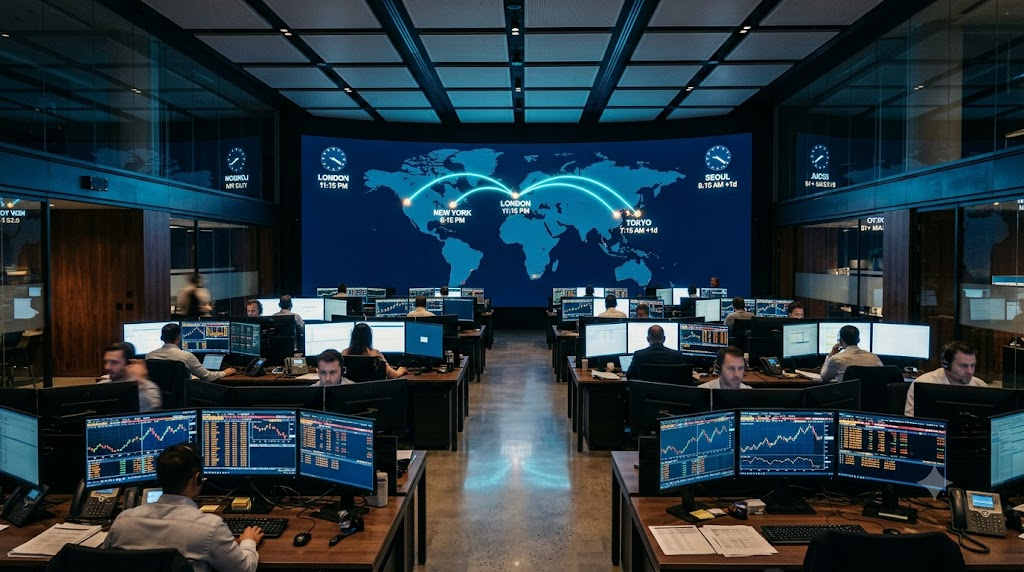
Why does this market never sleep—the flow from London to New York to Tokyo
This is where the scale expands. While the KRW/USD market seems like a domestic issue, the entire foreign exchange market is a structure that circles the globe. When Sydney opens, Tokyo overlaps; as Tokyo winds down, London opens, and New York joins during London’s trading hours. Trading volume concentrates in these overlapping periods, and during the gaps between markets, even a small order can cause the exchange rate to fluctuate.
There is a figure that shows just how large this market is. According to the Bank for International Settlements (BIS) survey released by the Bank of Korea, the global average daily turnover in the foreign exchange market reached $9.6 trillion as of April 2025, a 28.5% increase from the previous survey. The BOK attributed this to increased exchange rate volatility following the announcement of US tariff policies. By category, spot transactions increased by 41.8%, forward transactions by 59.5%, and FX swaps—which account for the largest share (41.5%) of the FX market—also grew by 4.9%. By currency, the US dollar remains dominant, with a transaction share of 89.2%, up 0.8 percentage points from 2022. The Chinese yuan's share has nearly doubled in six years, from 4.3% in 2019 to 8.5%. The Korean won't presence is modest; while the average daily trading value of the won increased by 22.5% over three years to about $142 billion, its currency share remains at 0.9%, ranking 12th in the world.
By the numbers, Korea is just a tiny piece of this massive flow. Yet, that tiny piece has recently undergone a major change.
24-hour foreign exchange market opening in 2026: What changed?
The fact that the KRW/USD market has become a 24-hour market was the most surprising part of my research. The 24-hour opening of the foreign exchange market is a system that expanded the KRW/USD trading hours—previously from 9:00 AM on weekdays to 2:00 AM the next day—to 24 hours a day, implemented from July 6, 2026 (excluding weekends and January 1st). The exact real-time trading hours vary slightly depending on daylight saving time.
Comparison of Foreign Exchange Market Hours, Before and After 24-Hour Opening
| Category | Before 24-Hour Opening | After 24-Hour Opening (from 2026.07.06) |
| — | — | — |
| Real-time Trading Hours | Weekdays 9:00 AM ~ 2:00 AM next day | Monday 6~7 AM ~ Saturday 6~7 AM (varies by DST) |
| Weekday Holiday Trading | Not available | Available (excluding weekends/Jan 1st) |
| Open/High/Low Calculation Basis | Trading day basis | 6:00 AM ~ 6:00 AM next day basis |
| MAR Calculation | Weighted average of 9:00 AM ~ 3:30 PM trades | Maintained for now; discussion on TWAP transition in long term |
The background of this reform is also interesting; it wasn’t just about ‘increasing convenience.’ For foreign investors to invest in Korean stocks or bonds, they need to convert dollars into won, but the restricted trading hours made it difficult to invest at desired times. For example, a New York-based investor could not trade KRW/USD at all between 1:00 PM and 8:00 PM (DST). There is also a bigger picture: Korea is still classified as an ’emerging market’ by MSCI. While its market size and liquidity are rated at a developed level, institutional factors like FX market accessibility have been a bottleneck. The government included this opening task in the ‘Comprehensive Roadmap for Foreign Exchange and Capital Markets’ announced in January 2026. In essence, one of the real goals of this policy is to get Korea included in the MSCI Developed Markets index.
24-hour opening also introduced a new concept. As exchange rates move day and night, a Time-Weighted Average Rate (TWAP) is now provided every hour to help track rate trends. However, the existing system hasn’t changed overnight. The 3:30 PM exchange rate used as a benchmark for some transactions and the bank exchange reference rate will maintain their current methods for the time being, and while the MAR will also keep its current calculation method, discussions are underway to transition to a TWAP method in the long term.
Will the exchange rate be more stable if the market is open 24 hours?
One might expect the market to be more stable if it’s always open, but that doesn’t seem to be the case. Some point out that in a structure where investment from abroad into the domestic market is relatively insufficient, 24-hour opening alone is unlikely to significantly lower or stabilize the exchange rate. There are also concerns that during hours when trading volume drops—between the end of the New York session and the opening of the Asian session—even small trades could cause the exchange rate to move significantly. In fact, on the first day of the 24-hour opening, the intraday fluctuation of the KRW/USD rate was 18.2 won, the largest in five months since the previous December.
This is perhaps the ironic part. We opened up the market by extending trading hours, but in doing so, we created liquidity gap periods, which in turn increased the moments of high volatility. Of course, since it’s still in the early stages, it remains to be seen whether this is a temporary adjustment period or a structural characteristic that will persist.
For companies, there is a tangible change. For example, if an exporting company received payment from a US buyer on a weekday dawn and the exchange rate suddenly rose, they previously had to wait until the morning. With expanded night-time exchange services, they could convert it into won the moment the rate rises to secure more won. However, this is only if the bank provides night-time exchange services, and actual availability and service hours vary by financial institution.
Ultimately, that number on the app
Returning to the question I first had, the number changing every second on the app is closer to the ‘post-second-quote’ rate that banks post by reflecting real-time quotes from the interbank market. If you trace its roots, you find the Market Average Rate, which is the volume-weighted average of the previous day’s trades. Go back further, and you find the interbank trades that banks around the world exchange by the second, all set against a backdrop of inflation, balance of payments, and the collective anxiety of the day.
It is fascinating that a market with no exchange and no opening bell can function so precisely, yet it is also striking that this precision has only been operating in a 24-hour, non-stop structure for just about two months now. Honestly, it is hard to say at this point whether this change will stabilize the exchange rate in the long run or make the volatility of liquidity gap periods a constant.
References
- Bank of Korea, Foreign Exchange Market and Exchange Rates (bok.or.kr)
- Bank of Korea, Factors of Exchange Rate Fluctuation (bok.or.kr)
- Bank of Korea, FAQ on Market Average Rate (bok.or.kr)
- Seoul Money Brokerage Services, Basis for Exchange Rate Calculation (smbs.biz)
- Seoul Money Brokerage Services, Guide to Market Average Rate (smbs.biz)
- Korea Money Brokerage Corporation, Guide to Spot Market (kmbco.com)
- News Tomato, Foreign Investment Increased but Exchange Criteria Vary
- Kyunghyang Shinmun, Global FX Trading Volume Increased by 28.5% Over 3 Years (2026.10.01)
- BIS, 2025 Triennial Central Bank Survey of Foreign Exchange and OTC Derivatives Markets
- KB Think, 24-Hour FX Market Opening Implemented in July (2026.06.22)
- Daum News, 24-Hour FX Market Offers Convenience but Volatility Remains a Challenge
- Regulations on Foreign Exchange Transactions, Article 4-3