
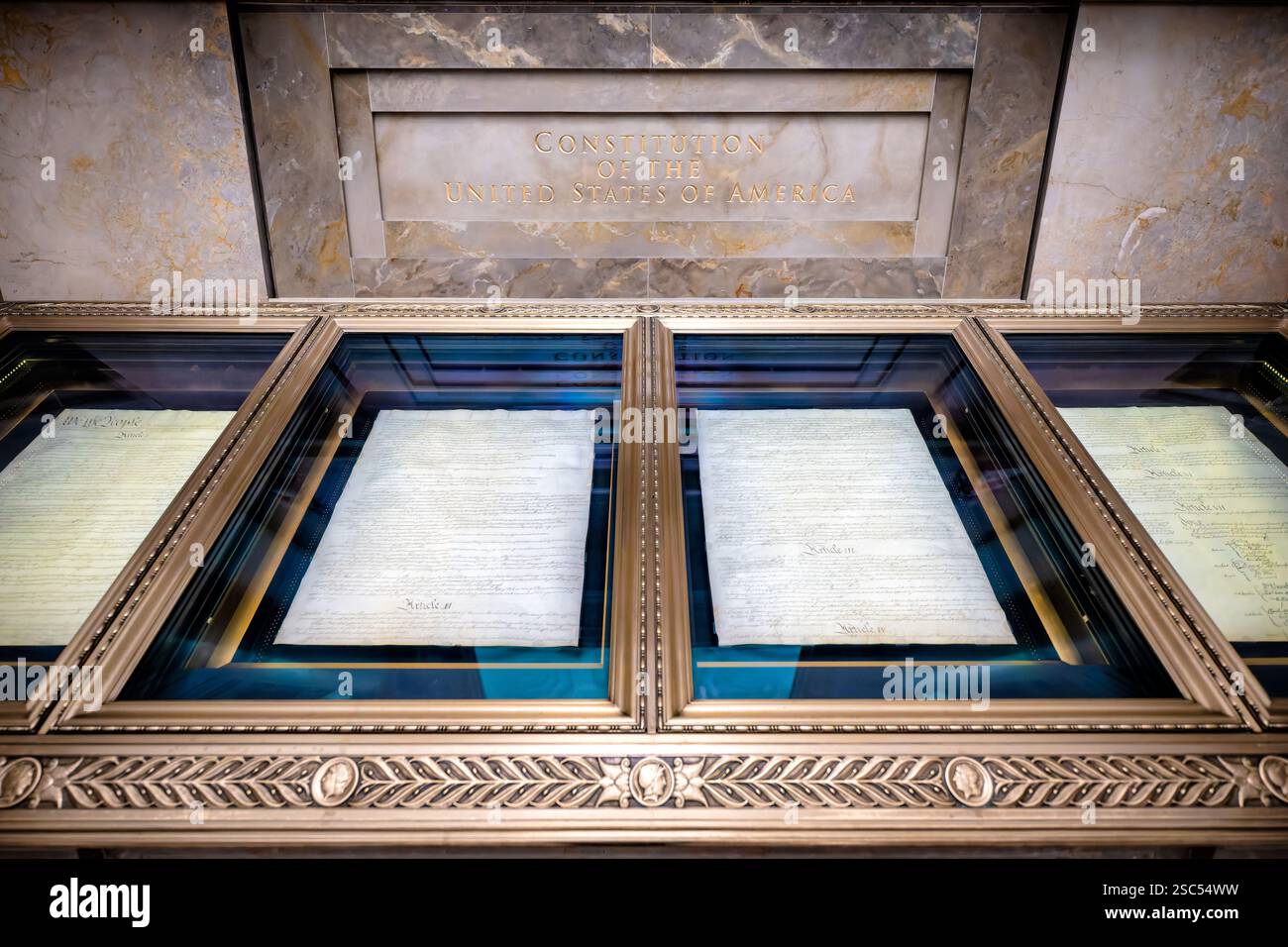
Read the Constitution from beginning to end, and you will not find the word “bank” even once. The powers to coin money, collect taxes, and raise an army are spelled out clearly, yet the power to establish a bank is nowhere to be found. And yet, on February 25, 1791, George Washington signed the bill creating the national bank into law. An institution founded on a nonexistent power thus became the largest financial institution and the largest corporation in the United States.
May a government do what is not written in law? This question did not end 236 years ago. Even today, whenever a new crisis erupts, we watch governments roll out responses not explicitly stated in any statute book. Whether it is pandemic relief funds or emergency regulations, the question “Where is this power written?” and the counterargument “There is no reason we cannot do it just because it isn’t written” repeat every single time. The archetype of that battle lies in Philadelphia in 1791. And this archetype carries a backstory that is often omitted: less than a year after the bank opened its doors, the United States faced its very first financial panic.
An Extension Not on the Blueprint
When designing a building, an architectural blueprint does not draw every single wall. It specifies only the load-bearing walls—the core structures supporting the building’s weight—leaving the rest to be filled in reasonably within that framework. Years later, when a structural engineer evaluates an extension, the question asked is not “Is this wall drawn on the blueprint?” but rather “Does this extension conflict with the load-bearing logic of the original design?” Not being on the blueprint does not automatically make it an illegal extension.
James Madison and Thomas Jefferson read the Constitution in the first way. Theirs was a strict textualism: only what was drawn on the blueprint was real power, and what was not drawn did not exist. Since a bank was not on the blueprint, it could not be built. Jefferson went one step further. If Congress could exercise unstated powers merely on the grounds of being “necessary and proper,” there would be virtually nothing it could not do under that logic. It was a bank today, but a warning that it could be anything tomorrow.
Alexander Hamilton’s rebuttal followed the second way. The Constitution explicitly gave the federal government the power to collect taxes, manage currency, and regulate commerce. A bank was merely a means to carry out those powers efficiently; therefore, if it was a “necessary and proper” means to achieve an end specified in the Constitution, the government could employ it even if it was not explicitly enumerated. He articulated this through what would later be known as the doctrine of “implied powers.” If the end is constitutional, the means reasonably connected to that end also fall under the protection of the Constitution.
Looking at the exact same document, the two men read two entirely different countries. For one side, the nation was only what was written in the text; for the other side, the nation encompassed the direction in which the text pointed.
Two Opinions on Washington’s Desk
In February 1791, even after the bill passed Congress, Washington did not sign it immediately. He requested written opinions from his cabinet members. Jefferson submitted an opinion arguing it was unconstitutional, while Hamilton submitted one asserting its constitutionality. For several days, two sheets of paper reaching diametrically opposite conclusions lay side by side on Washington’s desk. Even as the signing deadline drew near, he delayed his decision.
Ultimately, Washington sided with Hamilton. Hamilton’s vision—that the nation had to organize credit and capital as a commercial state to survive—prevailed over Jefferson’s vision of preserving an agrarian, self-sufficient republic. With this single choice, the United States decided for the first time the answer to a question that would recur for the next 200 years: even if an action is not in the Constitution, the government may do it as long as it aligns with constitutional ends.
Once the bill passed, the market’s reaction was intensely passionate, in stark contrast to the debate. On July 4 of that year, the public offering for bank shares opened in Philadelphia. Twenty thousand shares priced at $400 each—a total of $8 million—sold out entirely within just two hours of opening the subscription window. Due to the flood of applications, an additional 4,000 shares worth of orders could not even be allocated. Given that the federal government’s annual revenue at the time was around $4.4 million, this single bank's $10 million in capital meant that more than twice the government’s annual budget was mobilized in a single day of frenzy. Regarding this sell-out, Washington wrote in a letter that it was unexpected for confidence in the government to be established so rapidly.
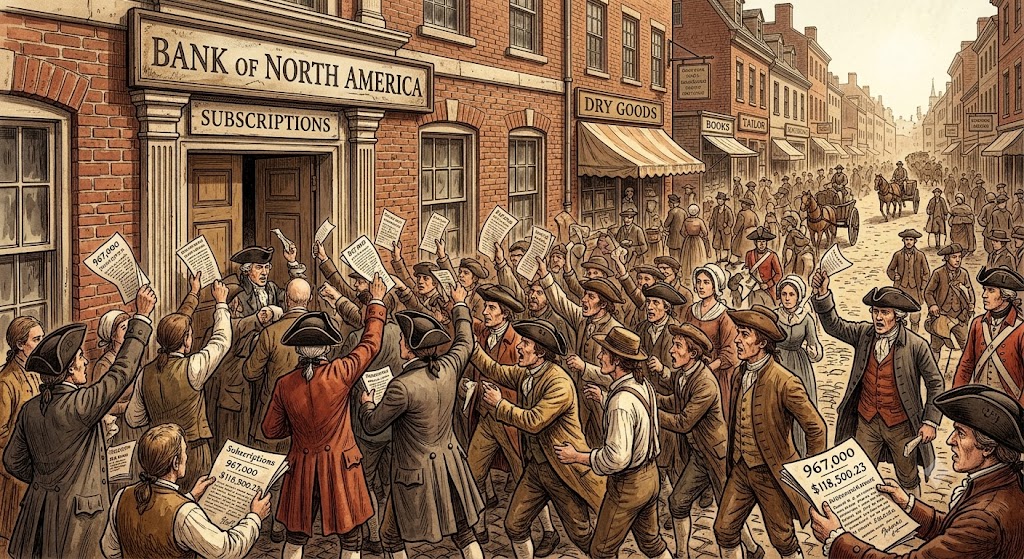
This gap between the legal debate over constitutional clauses and the market’s reaction represents the true face of the event. While politicians argued over constitutional interpretation for months, capital poured in twice the government’s revenue in two hours, just five months after the bill’s passage. The market delivered its verdict faster, and far more definitively, than legal theory.
Trust Crumbles in Two Weeks
Yet this euphoria had a dark side. As soon as the shares sold out, bank subscription rights—known as “scrip”—began trading at a premium. The price of scrip, which was $25 in early July, jumped to $45 in about ten days and skyrocketed to $135 by early August. Hamilton's own correspondence even records trades at up to $280. As soon as the intangible asset of credit was created, speculation backed by that very credit grew alongside it.
At the center of this speculation was a man named William Duer. A former Assistant Secretary of the Treasury, he was personally close to Hamilton. After leaving office, Duer borrowed immense sums of money in an attempt to corner the market by buying up massive amounts of government bonds and bank stock. On March 5, 1792, the price of the 6% government bonds he had hoarded peaked at 129. However, once his funding sources were exposed and banks began tightening credit, his scheme unraveled in an instant. Within three days, bond prices plunged to 116, and on March 9, Duer defaulted on debts of approximately $500,000. He was thrown into debtor’s prison, and angry mobs gathered outside the jail. Commerce in New York came to a virtual standstill for a time, and land values across Pennsylvania plummeted by a third.
Hamilton stepped in once again. Instead of using the First Bank of the United States, which did not yet have a branch in New York, he directed the Bank of New York to purchase up to $1 million in government securities. His approach was to continue supplying funds where good collateral existed, while having the government directly purchase collapsing bonds to put a floor under the market. Economists later evaluated this response as an early execution of the “lender of last resort” principle—which Britain’s Walter Bagehot would codify in writing 80 years later—the rule that in a crisis, liquidity must be provided abundantly against sound collateral, albeit at a penalty rate. The panic subsided within weeks, and broader contagion across the entire American economy was averted.
A Battle That Defined the Size of the Nation, Not Just a Bank
Placing these two scenes side by side—selling out in two hours and collapsing in two weeks—reveals the true gravity of the debate. Whether a single bank could be established was merely the surface question. The real question was how large the federal government could become in the future, and whether a government endowed with such power could also take responsibility for the market side effects it created.
For Hamilton, America’s future lay in manufacturing, commerce, and the flow of international capital; for that, a powerful central institution to organize credit and manage currency was essential. For Jefferson, America’s future was a land where independent yeoman farmers tilled their own soil, a country where a central bank should have very little to do in the first place. The constitutional debate was a proxy war to decide which of these two visions would become the real America. And Duer’s bankruptcy provided tangible political momentum to Jefferson’s faction. In the 1792 House elections, voters turned away over the speculation scandal tied to Duer, and that resentment benefited Hamilton’s political rivals. Hamilton had created the credit, but he also had to bear the political cost of the first disaster that credit produced.
This bank had only received a 20-year temporary charter, not a permanent place in the Constitution. When the charter expired in 1811, Congress voted down its renewal, and the bank closed its doors. Yet the core question of whether the government should centrally manage money and credit never disappeared. The Second Bank of the United States was established, and after it too collapsed, the nation progressed through the Civil War and the Great Depression, eventually arriving at today’s Federal Reserve System. Each time, the same question returned in a different guise, and each time, the answer was accompanied by a second question: May the government intervene in the market during a crisis?
Whenever the Federal Reserve raises or cuts interest rates today, or directly injects liquidity into failing markets as it did in 2008 and 2020, we are essentially rereading those two opinions on Washington’s desk in 1791 and the instructions Hamilton issued to the Bank of New York in March 1792. Is the nation only what is written in the document, or does it encompass the direction in which the document points? And must that nation step in once again when the credit it created runs amok? To these questions, there is still no single definitive answer.
References
- Wikipedia, First Bank of the United States https://ko.wikipedia.org/wiki/%EB%AF%B8%ED%95%A9%EC%A4%91%EA%B5%AD_%EC%A0%9C1_%EC%9D%80%ED%96%89
- Federal Reserve History, The First Bank of the United States https://www.federalreservehistory.org/essays/first-bank-of-the-us
- Federal Reserve Bank of Minneapolis, The Bank that Hamilton Built https://www.minneapolisfed.org/article/2007/the-bank-that-hamilton-built
- US House of Representatives, The First Bank of the United States https://history.house.gov/Historical-Highlights/1700s/1791_First_Bank/
- Wikipedia, Panic of 1792 https://en.wikipedia.org/wiki/Panic_of_1792
- Investor Amnesia, Panic Series (Pt. I) - 1792 https://investoramnesia.com/2021/09/05/the-panic-series-pt-i-1792/
- The Tontine Coffee-House, Hamilton and the Panic of 1792 https://tontinecoffeehouse.com/2021/02/01/hamilton-and-the-panic-of-1792/