
“Is it true that a single pack of ramen costs 2,000 won?”
Last year, President Lee Jae-myung asked this question during an emergency economic inspection task force meeting.
MBC News reported that some cup ramen prices had indeed exceeded 2,000 won. When even the president is questioning price tags, grocery inflation has moved beyond individual complaints and become a political issue.
However, this question only provides half the answer.
Recently, vegetable prices have actually been falling, and the consumer price index has dropped to the 2% range, marking a five-month low. Yet, the prices of rice and meat continue to climb. Attributing this to weather or distribution margins doesn’t quite add up.
The real cause is hidden behind the monthly price index, buried within the government’s annual self-sufficiency statistics.
The Numbers Behind OECD Rank #2 Grocery Prices
As of 2024, the price of food and non-alcoholic beverages in South Korea is 46% higher than the OECD average.
Ranking 2nd among 38 OECD countries after Switzerland (147), Korea’s index stands at 146. Japan (121), the U.S. (107), France (100), Germany (95.2), and the U.K. (91.4) all have lower indices than Korea.
| Country | Food Price Index (OECD Average=100, 2024) |
|---|---|
| Switzerland | 147 |
| South Korea | 146 |
| Japan | 121 |
| U.S. | 107 |
| France | 100 |
| Germany | 95.2 |
| U.K. | 91.4 |
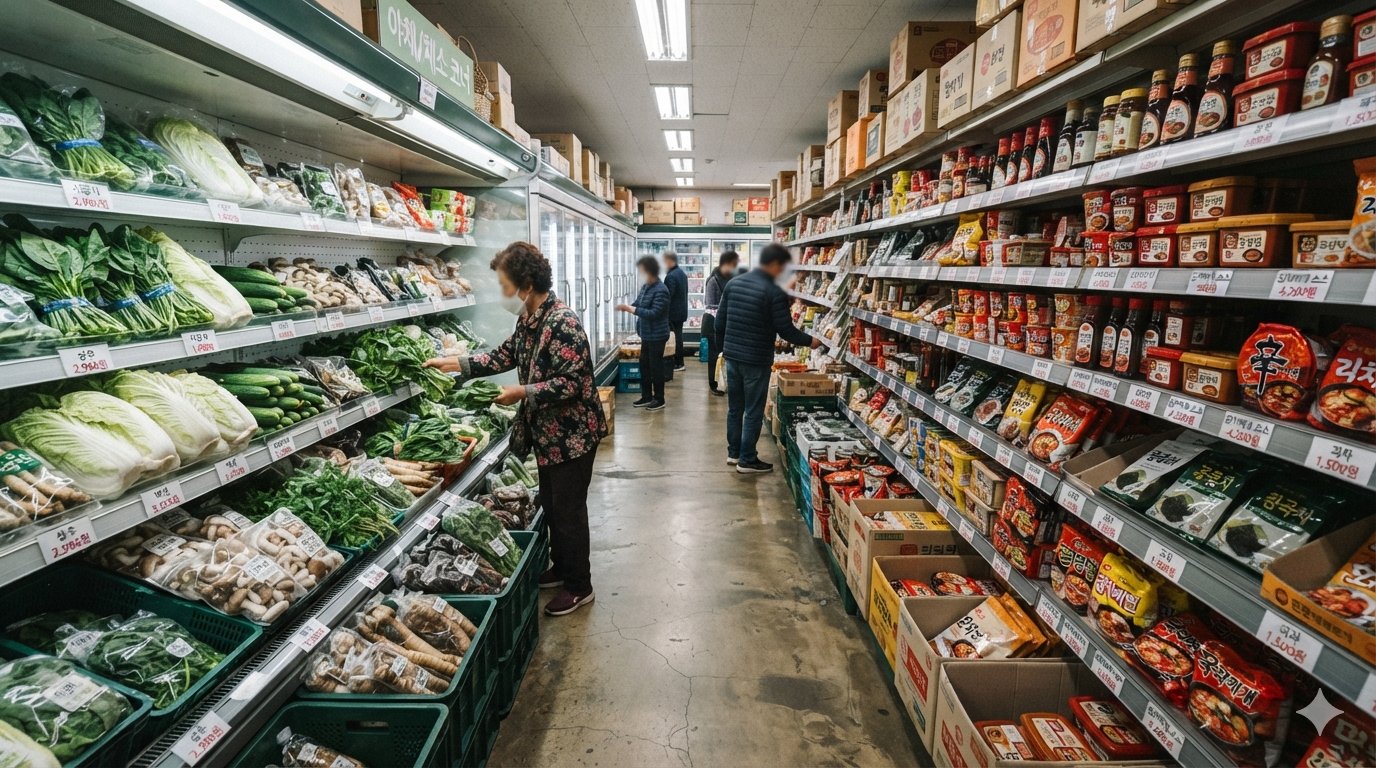
*This isn’t a one-year anomaly. In 2022, Korea ranked 2nd after Israel, and in 2023, it surpassed Switzerland to take 1st place.
It hasn’t left the top two spots in three years. This signifies a structurally entrenched position rather than a temporary shock.
However, looking at the recently released consumer price indicators, it appears as if things have stabilized.
In January 2026, consumer prices rose by only 2.0% compared to the same month last year, and the fresh food index even fell by 0.2% due to lower vegetable and fruit prices. The government announced plans to stabilize perceived inflation through supply management of holiday goods and disease prevention for livestock. While these measures work for items grown domestically like vegetables and fruits, they cannot change the fundamental structure of grain and feed prices, which rely on imports from the start.
Why the 47.9% Food Self-Sufficiency Rate is an Illusion
The government’s announced “food self-sufficiency rate” of 47.9% excludes feed grains. The real “grain self-sufficiency rate,” including feed, is only 21.6%. This means nearly 80% of the grains we consume are brought in from overseas. Excluding rice, the situation is even more dire, with edible wheat self-sufficiency dropping to 1.5% and corn to 4.3%.
There are even more hidden factors. The coffee we drink in the morning, the flour in our ramen, and the cocoa in our chocolate aren’t even captured in these statistics.
The 47.9% self-sufficiency figure is a number that has already been edited to look optimistic.
The outlook is even worse. The ‘Agricultural Outlook 2026-2035’ jointly published by the OECD and FAO predicts that Korea’s grain self-sufficiency rate will fall from an average of 19.2% in 2023-2025 to 16.8% by 2035. While rice cultivation areas are disappearing at a rate equivalent to 130,000 soccer fields, the import volume of wheat and corn continues to rise.
The ABCD Grain Giants: The Weakness of a Nation with Low Self-Sufficiency
When you cannot be self-sufficient, you must buy from the international market, which is effectively controlled by four companies.
Archer Daniels Midland (ADM),
Bunge,
Cargill,
Louis Dreyfus Company (LDC)—the “ABCD” companies.
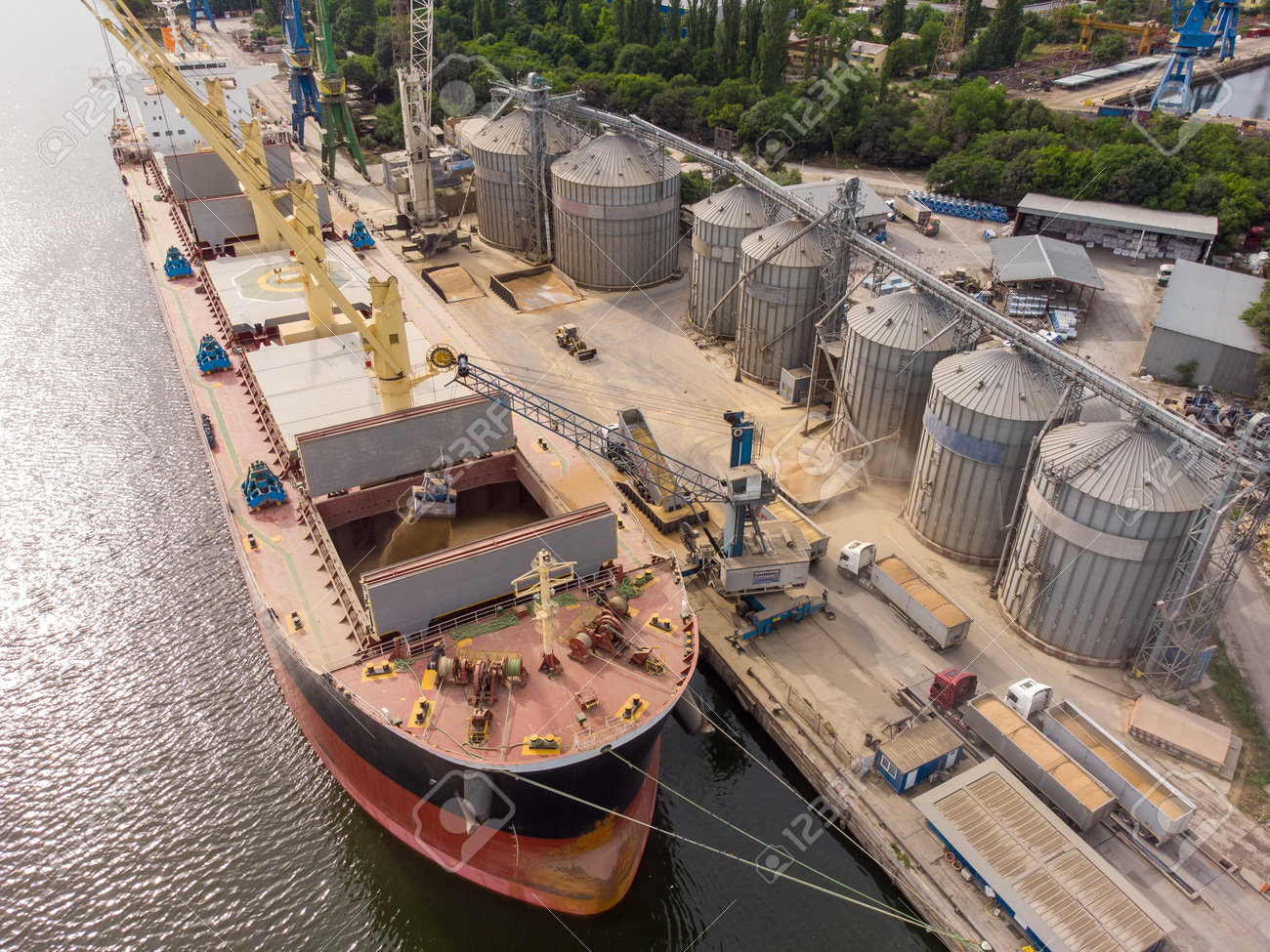
They maintain their dominance not just through grain, but through infrastructure.
Grain is a commodity that requires port storage and transport facilities to move. Once a few companies secure these facilities, they effectively create a structure that blocks new entrants.
For Korea to buy wheat and corn, it must go through one of these four, and the party setting the price at the negotiation table is always them. There are reports that in years of severe food inflation, the performance of the ABCD companies actually improved.
The 21.6% grain self-sufficiency rate is essentially another way of saying we are in a position where we cannot set our own prices.
The Disappearance of Tariff Barriers Leads Back to Grocery Prices
On top of this, as tariff barriers are lowered, dependency on specific supplier countries is increasing.
Under the Korea-US FTA, tariffs on U.S. beef were lowered incrementally over 15 years, reaching 0% completely starting January 2026. Out of 461,000 tons of imported beef in 2024, 222,000 tons were from the U.S.—nearly half.
When tariffs disappear, it helps consumer prices immediately. However, it also means dependency on one specific country grows accordingly.
While the import dependency of wheat and corn is evident from the grain self-sufficiency statistics, even items that seem to have decent self-sufficiency rates on paper, like meat, can quietly lean toward specific countries in this way. This means the domestic grocery price is increasingly vulnerable to that country’s exchange rates, export policies, or even a single logistics strike.
When you have low self-sufficiency and the defensive barrier of tariffs is also removed, all that remains is a “structure where you cannot determine the price.”
Food Self-Sufficiency: The Choice of a Nation That Cannot Set Prices
This is why discussions on enacting a Food Security Act are continuing in and out of the National Assembly.
After a poor rice harvest in 2020 dropped the self-sufficiency rate to 44.1%, sparking fears of the 40% threshold collapsing, there have been constant calls to manage this number through law.
Nam Jae-jak, head of the Korea Precision Agriculture Institute, says, “Given our farmland and agricultural conditions, there is a limit to how drastically we can boost the self-sufficiency rate.” He points out that the focus of the discussion should shift from “how much to increase the self-sufficiency rate” to “how to secure a stable global supply chain.”
Considering farmland and demographic structures, there are not many ways to drastically increase self-sufficiency.
Instead, what we can try is to diversify import sources so they aren’t concentrated in one or two countries or companies,
and to gradually broaden the domestic supply base by shortening distribution stages to connect producers and consumers directly, like the local food movement in Wanju.
The reality that we cannot grow all our own grain will not change.
However, it is possible from now on to diversify which countries we import from, through which routes, and in what quantities. This is why, before feeling reassured by a single food self-sufficiency number, we must first confirm what was excluded when that number was calculated.
References
- MBC News, "OECD 2nd in 'Food Prices'... 'Eating at home is now a burden'", 2025.6.16
- News1, "Korea's food prices are 2nd in the OECD based on purchasing power... more expensive only after Switzerland", 2026.7.9
- Yonhap News Monthly Midas, "[Graphic News] Korea's Food and Beverage Prices are 2nd in OECD, etc.", 2026.8.5
- Food and Climate Change, "The Trap of Food Self-Sufficiency — Import Dependency Beyond 47.9%", 2026.4.16
- The Nongmin, "Has the government given up on 'strengthening food security'?", 2026.1.12
- Financial News, "Korea's grain self-sufficiency rate to fall to 16% by 2035... food security becomes vulnerable", 2026.7.2
- Chosun Biz (economychosun), "Korea is in a state of 'food encroachment' by global conglomerates like 'ABCD'", "url":"https://economychosun.com/site/data/html_dir/2020/08/24/2020082400004.html"
- Korea Economic Daily, "Grain companies smiling at food inflation... Big 4 earned $4.5 billion last year alone", 2021.7.29
- KDI Economic Information Center, "January consumer prices rose by 2.0%", 2026