
Response to False Information in a Confucian State and Its Limitations
- We understand the specific forms of ‘fake news’ that existed during the Joseon Dynasty through concrete terminology.
- We learn about the legal mechanisms (Daemyungryul, Banjwa-ryul) and the role of investigative agencies (Uigeumbu) aimed at controlling false information.
- We confirm through historical examples how false information was transformed into a weapon for political purges.
The Various Faces of Fake News in the Joseon Dynasty
The phenomenon commonly referred to as ‘fake news’ today also existed in the Joseon Dynasty. However, it was not a singular concept at that time. Fake news in the Joseon Dynasty was referred to by various names depending on its form and danger, and understanding this is the first step to reading Joseon society.
- Rumors (流言蜚語): Groundless rumors that spread and create public anxiety. Particularly, rumors undermining the king’s legitimacy were considered acts threatening the social foundation.
- Wall Writings (掛書) or Wall Notices (壁書): Anonymously posted writings in public places, serving as a means of strong political criticism or personal slander. These often became the catalyst for large-scale political purges.
- Evil Words (妖言) and Evil Writings (妖書): Words and writings that mislead public sentiment with ominous and strange content. Denying the dynasty’s mandate from heaven (天命), or legitimacy, was treated as a serious crime equivalent to treason.
- Slander (讒訴) and False Accusation (誣告): Acts of defaming others or falsely accusing them. In the midst of intense factional struggles, this was the most critical political weapon for eliminating rivals.
The fundamental reason the Joseon Dynasty reacted so sensitively to false information lies in the Confucian ideology of ‘Rectification of Names (正名論)’. It was believed that names and realities must align for social order to be maintained; thus, false information was perceived as an act that disrupts the hierarchy of society. Therefore, state control of the press had a moral justification for protecting the Confucian hierarchical society.
This article examines how, despite the Joseon Dynasty establishing sophisticated legal and institutional mechanisms to respond to false information, these mechanisms were transformed into tools for purges amid intense factional strife. It aims to show that the greatest vulnerability of the state was not the false information itself, but the political context that interpreted that information and determined its consequences.
Chapter 1: The State’s Sword, The Legal Structure of Controlling False Information
The State’s Law: ‘Daemyungryul’ and ‘Gyeongguk Daejeon’
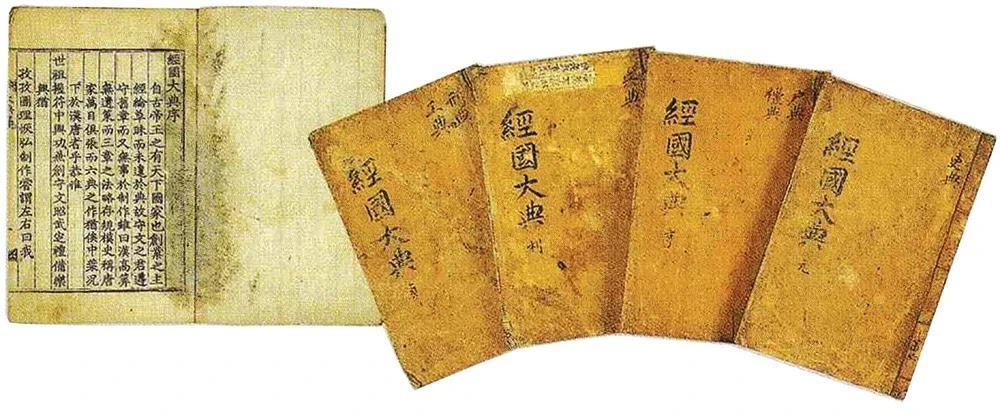
Crimes related to information during the Joseon Dynasty were primarily punished based on the Ming Dynasty’s criminal law, ‘Daemyungryul’. Particularly, acts of misleading public sentiment with evil words (妖言) and evil writings (妖書) were considered serious crimes threatening national security. The main offenders faced execution or severe punishment, and the punishment extended to their families. The basic legal code of Joseon, ‘Gyeongguk Daejeon’, clearly defined the application of these laws.
Principle of Reciprocity: Banjwa-ryul (反坐律)
To prevent the abuse of false accusations, a unique system called ‘Banjwa-ryul’ was established. Banjwa-ryul stipulated that if someone falsely accused another of a specific crime and it was proven untrue, the accuser would receive the same punishment as the accused. For example, if someone falsely accused another of treason, the accuser could be punished for treason themselves. This was a powerful institutional mechanism to suppress political slander.
The King’s Investigative Agency: The Role and Methods of Uigeumbu
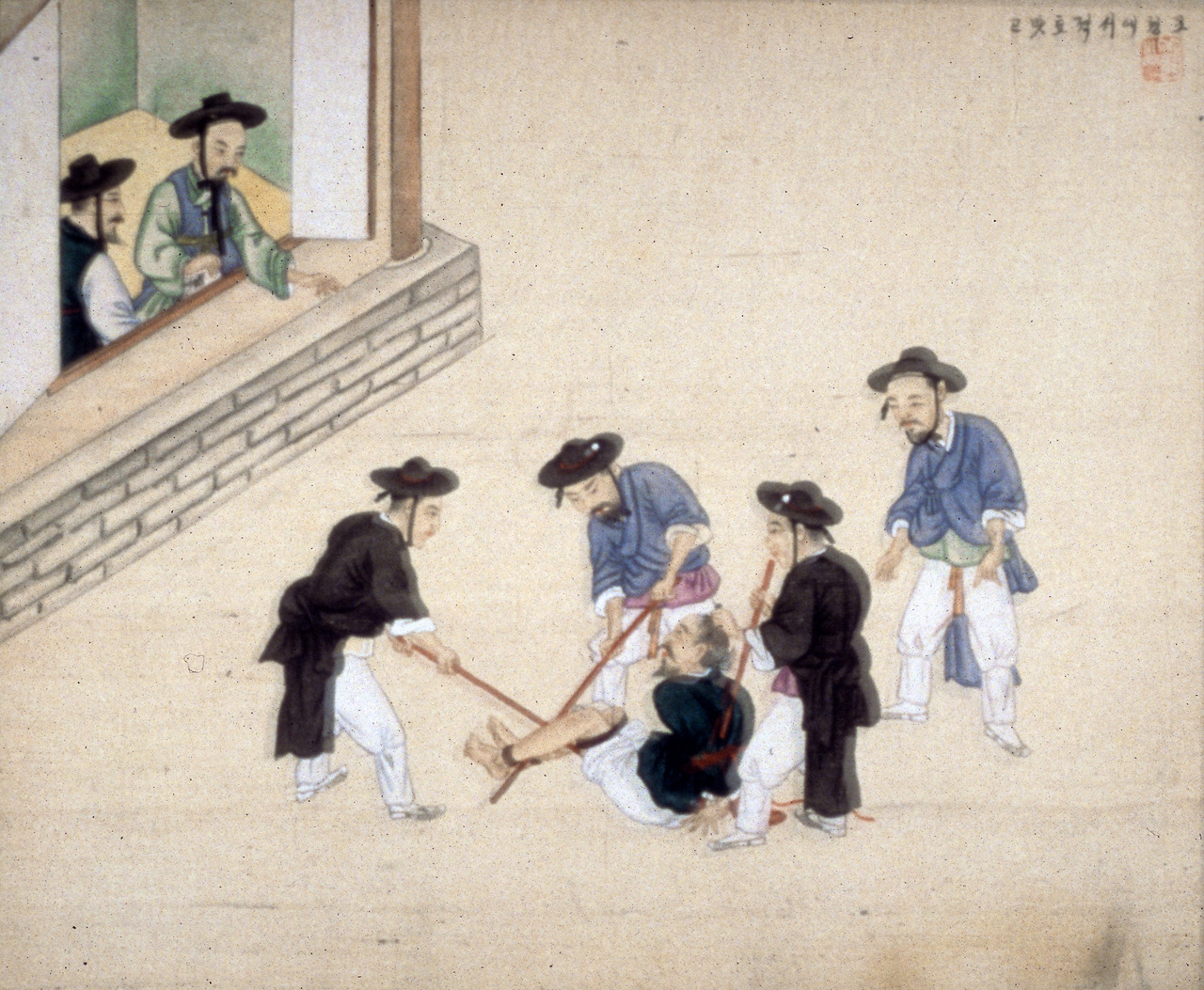
Uigeumbu was a judicial agency directly under the king that dealt with serious national crimes such as treason. Due to their political ramifications, cases involving wall writings or evil words were mostly investigated directly by Uigeumbu. The primary goal of the investigation was to uncover the forces behind the incidents, and in this process, torture (拷訊), or legal torture, was a routine procedure to obtain confessions. Confessions were considered the most decisive evidence, leading to the implementation of severe torture to extract them.
Types of False Information and Punishments in the Joseon Dynasty
| Crime Type | Joseon Era Term | Definition and Major Cases |
|---|---|---|
| Treasonous Speech/Writings | Evil Words (妖言)/Evil Writings (妖書) | Words and writings that mislead public sentiment or predict disasters, disrupting national order |
| Anonymous Posts | Wall Writings (掛書)/Wall Notices (壁書) | Anonymously posting content that slanders the state or individuals in public places |
| False Accusation | False Accusation (誣告)/Slander (讒訴) | Reporting false facts to authorities with the intent of causing criminal punishment to others |
| Groundless Rumors | Rumors (流言蜚語) | Spreading groundless rumors that cause social unrest |
Chapter 2: The Politics of Slander - Cases Where Information Became a Weapon
Despite legal control mechanisms, fake news in the Joseon Dynasty was often misused as a tool for political purges. The ‘political utility’ was prioritized over the truth.
Anonymous Wall Writings and Purges: The Yangjae Station Wall Writing Incident (Jeongmi Sihwa, 1547)
The Jeongmi Sihwa is a representative incident that shows how a single anonymous wall writing could bring about a massive political storm. In 1547, a wall writing was discovered at Yangjae Station stating, “The female ruler is taking power from above, and the treacherous Lee Gi and others are manipulating authority from below; the country will perish.” ‘Female ruler’ referred to Queen Munjeong, who was in a regency. The faction in power, the Soyun faction, used this as evidence of treason against their rivals, the Daeyun faction, leading to the purging of numerous scholars without evidence.
Whispers of Treason: The Jeong Yeon-rip Rebellion Incident (Gichuk Ok-sa, 1589)
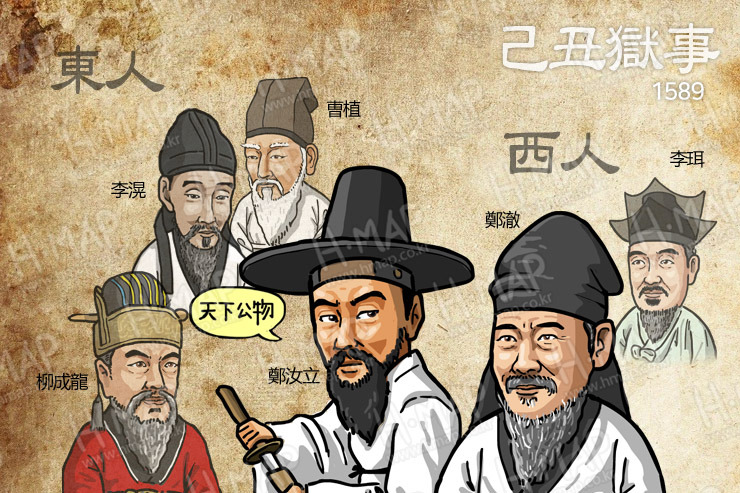
The Gichuk Ok-sa demonstrates how a treasonous accusation can lead to devastating consequences. When Jeong Yeon-rip, a member of the Dongin faction, was accused of plotting a rebellion with his secret organization ‘Daedonggye’, the Western faction’s Jeong Cheol used this as an excuse to initiate a large-scale purge. Relying solely on rumors and confessions obtained through torture without clear evidence, this incident resulted in the sacrifice of over 1,000 Dongin members over three years, severely weakening Joseon’s national power just before the Imjin War.
Deadly Accusations: The Na Gyeong-eon Accusation and the Tragedy of Crown Prince Sado (Imo Hwa Byeon, 1762)
A malicious accusation clouded the judgment of the highest authority, leading to an irreversible tragedy. When the conflict between King Yeongjo and Crown Prince Sado reached its peak, a low-ranking official, Na Gyeong-eon, accused the Crown Prince of plotting treason. King Yeongjo’s distrust of his son was already deep, and he ignored the cautious investigation requests from his ministers, believing the accusation to be true. This accusation directly triggered King Yeongjo to confine Crown Prince Sado in a rice chest until he died. Ironically, Na Gyeong-eon was executed for falsely accusing the Crown Prince, but his ‘fake news’ had already driven the heir to the throne to death.
Reflecting on these cases, what surprised me the most was that ’lack of evidence’ did not prevent purges. In fact, the absence of evidence allowed for greater imagination to amplify the scale of treason. Do you not witness moments today where ‘political necessity’ is prioritized over truth?
Chapter 3: The Ecosystem of Information, Belief, and Control
The Double-Edged Sword of Media: The Role of Daegan
The official media agency of Joseon, Daegan (Sahyeonbu, Sagwanwon), played a crucial role in forming public opinion by criticizing the king and officials. However, as factional struggles intensified, Daegan transformed from objective criticism to indiscriminately issuing impeachments based on rumors, becoming an attack dog for each faction. The public discourse arena became the frontline of factional information warfare.
Reading the Will of Heaven and Controlling Narratives: Astronomical Phenomena as Political News
In Joseon, where the theory of heavenly-human response (天人感應說) prevailed, astronomical phenomena such as the appearance of comets were interpreted as evaluations from heaven regarding earthly politics. The incident involving General Nam Yi in 1468 illustrates how this could be misused. His rival, Yu Ja-gwang, falsely accused General Nam Yi of saying that seeing a comet was a sign of sweeping away the old and welcoming the new. This monopolization of the interpretation of natural phenomena created a narrative of treason, ultimately leading to General Nam Yi’s execution.
The Bottleneck of Technology: State Monopoly and the Limitations of Printing
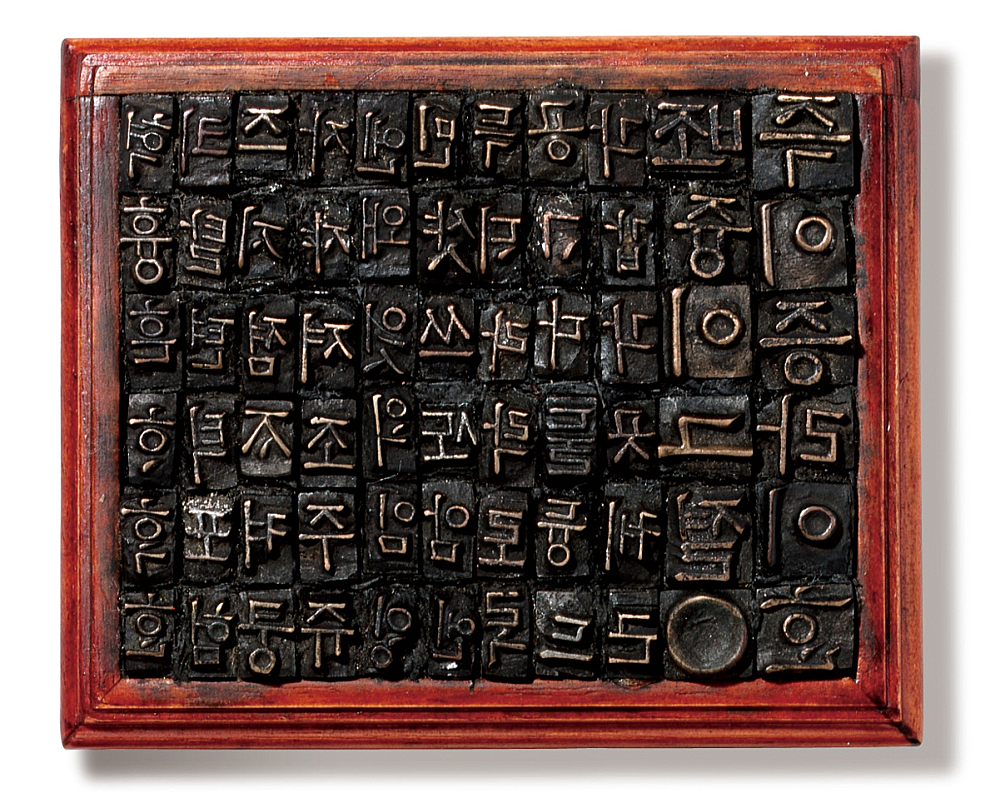
Unlike in Europe, where printing technology sparked the Reformation, Joseon’s printing technology was thoroughly controlled by the state. The technical issue of having to typeset tens of thousands of Chinese characters meant that books were the exclusive property of a small ruling class, and the state only printed a limited number of books necessary for maintaining the regime, such as Confucian classics. These technical limitations effectively blocked the large-scale spread of ‘fake news’ through printed materials, but conversely, they amplified the impact of orally transmitted rumors and wall writings.
Conclusion: The Echoes of Joseon Resounding in the Digital Age
The history of the Joseon Dynasty’s response to false information is a complex narrative woven from strict laws, extreme politicization, belief systems, and a limited media environment. Objective truth was powerless in the face of political survival logic, and accusations wielded more power than evidence.
The Joseon case leaves us with three important lessons today.
- False information is most dangerous when used as justification for actions that those in power already desired, rather than the falsehood itself.
- The ultimate defense against false information is not censorship, but the independence and integrity of judicial institutions and the press that must ascertain the truth.
- Like Joseon’s state-led ‘official echo chamber’, today’s social media algorithms create ‘personalized echo chambers’ that also pose risks of paralyzing critical thinking.
I hope this article serves as a critical reflection on the information wars we face today through the lens of Joseon Dynasty history.
References
- Rumors in the Joseon Era, Today’s Fake News - Mediaus
- [Social History of Crime and Punishment] Rumors and Anonymous Writings in the Joseon Era - Korean History Research Association
- Wall Writings (掛書) - Encyclopedia of Korean National Culture
- Yangjae Station Wall Writing Incident (良才驛壁書之變) - Sillok Wiki
- 19. A Brief History of Regulations Against Shamans - Beopbo Newspaper
- If False Accusation Leads to Murder, Consider the Punishment for Murder… Prosecutors Strengthen Punishment for False Accusation - Joongang Ilbo
- [Lee Deok-il’s Love] Black Propaganda and Banjwa-ryul - Chosun Ilbo
- Uigeumbu - Wikipedia, the Free Encyclopedia