
The Invisible Forces Governing Your Brain Between Probability and Certainty
- Understand why we are drawn to certain falsehoods over uncertain truths.
- Grasp the mechanisms of key cognitive biases (certainty effect, loss aversion, confirmation bias) that govern our decisions.
- Learn specific ways to embrace uncertainty and make better decisions.
Prologue: Why Do We Prefer ‘Certain’ Lies Over ‘Uncertain’ Truths?
“What people want is not accurate information. What people want is certainty.” This statement may provoke discomfort in our desire to believe we are rational beings. But is that really the case? This article explores why our brains are designed to fall into cognitive biases, hating uncertainty and obsessing over certainty, and the psychological reasons behind it.
Imagine you are making a dinner reservation for a very special occasion.
- Restaurant A: 100 reviews, average rating of 4.5 stars. A statistically low-risk, excellent, and reliable choice.
- Restaurant B: Only 3 reviews, but all perfect 5.0 stars.
Where does your mind gravitate more? Many people feel a stronger attraction to Restaurant B, which offers the promise of ‘perfection’ despite the lack of data. This is a choice driven by emotion rather than logic, opting for the ‘feeling’ of certainty over the data of probability.
Instinctive Attraction to Certainty: Three Representative Cognitive Biases
Our brain’s tendency to prefer certainty can be explained by several powerful psychological mechanisms, namely cognitive biases.
1. Certainty Effect: The Overwhelming Temptation of 100%
The Certainty Effect refers to the cognitive bias of grossly overvaluing certain outcomes over probabilistic ones.
What if you had the following two options?
- Option 1: Receive 1 billion won with a 100% probability. (Expected value: 1 billion won)
- Option 2: Receive 10 billion won with a 20% probability and nothing with an 80% probability. (Expected value: 2 billion won)
Mathematically, Option 2 is worth twice as much, but most people instinctively gravitate towards Option 1. The reason lies in the ‘100%’ certainty rather than the number ‘1 billion’. By choosing Option 1, we eliminate the possibility of emotional pain from ‘regret’ and purchase ‘psychological safety’.
2. Loss Aversion: The Pain of Losing is Twice as Great as the Joy of Gaining
At a deeper level of certainty preference lies the theory of Loss Aversion. Established by Nobel laureate Daniel Kahneman, the core of this theory is that humans psychologically feel the pain of loss about twice as intensely as the joy of equivalent gains.
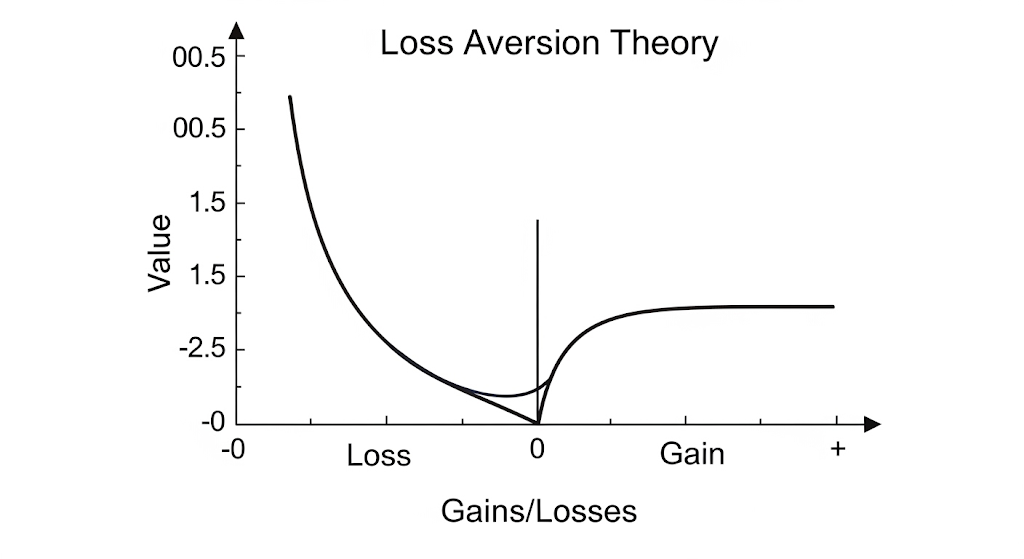
If there is a coin toss game where you win 150,000 won if heads and lose 100,000 won if tails, would you participate? The expected value is 25,000 won in profit, but most would decline. The fear of losing 100,000 won is much greater than the anticipation of winning 150,000 won.
I too have experienced holding onto stocks that were losing value, thinking, “It will go up someday.” This is a typical example of the loss aversion bias, trying to avoid the pain of confirming a ‘paper loss’ into a ‘real loss’. Thus, loss aversion creates a strong status quo bias, keeping us in the familiar present rather than embracing change.
3. Confirmation Bias: The Prison of Certainty “I Knew It!”
While loss aversion leads us to ‘seek’ certainty, Confirmation Bias helps us ‘maintain and reinforce’ that certainty. This refers to the tendency to only seek information that aligns with our existing beliefs and ignore opposing information.

- Historical Example: During the Pearl Harbor attack, Admiral Kimmel ignored numerous warnings that contradicted his belief that ‘Japan cannot attack’, leading to disastrous results.
- Modern Society: The ‘filter bubble’ and ’echo chamber’ of social media exacerbate confirmation bias, deepening political polarization. We become surrounded by similar views, taking our beliefs as ‘self-evident truths’.
These three cognitive biases reinforce each other, creating a vicious cycle that traps us in a ‘prison of certainty’.
Comparison: Rational Brain vs. Real Brain
Let’s compare how differently our brains operate ideally versus under the influence of cognitive biases.
| Area | Rational Brain Approach (Pursuit of Accuracy) | Real Brain Approach (Pursuit of Certainty) & Psychological Mechanisms |
|---|---|---|
| Investment | Chooses the portfolio with the highest expected value considering risk. | Prefers low-yield deposits with ‘principal guarantee’. Cannot sell losing stocks due to ‘sunk cost’. (Loss Aversion, Certainty Bias) |
| Information Consumption | Seeks diverse and opposing viewpoints to get a complete picture. Cross-checks sources. | Subscribes only to news and social media feeds that align with existing views. Dismisses opposing information as ‘fake news’. (Confirmation Bias) |
| Health | Relies on large clinical trials and statistical evidence for treatment decisions. | Trusts dramatic anecdotes like “My cousin took this and got better!” Avoids health check-ups for fear of bad news. (Confirmation Bias, Loss Aversion) |
| Career/Life | Open to new opportunities even if it involves risk. Ready to leave a comfortable position. | Stays in ‘familiar but unhappy’ jobs or relationships due to fear of uncertainty in change. (Loss Aversion, Status Quo Bias) |
| Beliefs | Modifies beliefs based on new and reliable evidence. | Distorts facts to fit beliefs when faced with opposing evidence. (Confirmation Bias) |
Overcoming Cognitive Bias: Two Ways to Befriend Uncertainty
The relentless pursuit of certainty leads to stagnation. True innovation and growth begin when we embrace uncertainty.

- Intentionally Seek Out Opposing Opinions Successful entrepreneurs constantly question their own thoughts. Taking on the role of ‘devil’s advocate’ in team meetings or habitually discussing with people who hold different views is one of the most effective ways to break the cycle of confirmation bias.
- Focus on the Process, Not the Outcome True confidence does not come from being 100% certain of every outcome. It comes from ’trust in oneself’ that I can handle whatever comes my way. We must focus on the process of growing without losing our center amidst change.
Ultimate freedom lies in achieving ‘comfort in uncertainty’. This is a journey of transforming our attitude towards the unknown from ‘fear’ to ‘curiosity’.
Conclusion
We crave certainty to understand the complex world, but this instinct often distances us from better choices.
-
Key Points:
- Certainty Effect: We irrationally prefer 100% certain outcomes over probabilistically better options.
- Loss Aversion: We feel the pain of loss about twice as intensely as the joy of gain, causing us to miss out on greater opportunities while avoiding potential losses.
- Confirmation Bias: To maintain once-formed beliefs, we selectively choose favorable information, trapping ourselves in a prison of certainty.
Next Action Suggestion (CTA): Now that you’ve read this article, what is the ‘certainty’ you value most in your life? If you dare to change the period at the end of that belief to a question mark, what new possibilities might open up? Start today by intentionally finding and reading an article that opposes your thoughts.
References
- Reddit r/samharris - Good books on biases, logical fallacies, and…
- Aladin Thinking 101: Exercises in Thinking for a Better Life
- Joongang Ilbo You Have to Get Used to It to Start, Love is Like That
- Economic Review [Book & Book] Your Hidden Desires in Concrete
- Weekly DongA You Have to Break Free from ‘Loss Aversion Bias’ to Become Rich
- Chosun Ilbo [WEEKLY BIZ] Why Can’t We Sell When Stock and Apartment Prices Drop…
- DongA Ilbo [Let’s Play with Newspapers!/People in the News] ‘Confirmation Bias’ Believing Only What You Want
- Miscellaneous Library Overcoming Confirmation Bias: The Path to Objective Thinking
- Wikipedia Confirmation Bias
- Incheon Ilbo [Debate] Confirmation Bias and SNS, and the Uncomfortable Relationship with Aggro
- Brunch Chapter 5: 1-3. “Confirmation Bias” Common Among Founders
- Namu Wiki Error of Hasty Generalization
- Fortune Korea Hiring Managers Say “Former Entrepreneurs Are Not Great”
- BE(ATTITUDE) Generative Art Seeping into the City
- Tistory Zhuangzi’s Quote 19. “Find True Freedom by Embracing Change and Uncertainty.”
- Brunch A Life for an Unshakable Me