
Today, let’s delve deeper into the special friend that has come closer to us, artificial intelligence (AI). AI now seems like an all-purpose wizard that can do anything. It turns our imagined tasks into reality and solves complex problems effortlessly. But is it really okay to entrust our future to this smart friend?
This question is akin to giving a magic wand to a young boy. He could use the wand to heal the sick or help people by moving heavy loads. However, he might also accidentally anger a bee that was sitting quietly or put a hole in a friend’s clothes by mistake. The important thing is not the ability to ‘use’ the wand, but the wisdom and responsibility to know ‘how to use it.’
We have rushed forward, cheering for what AI can do, but now we must pause and seriously ask what it should do.
Today, let’s vividly illustrate two stories and see how this question relates to our lives.
First Story: The Betrayal of AI, ‘Alpha Interviewer,’ Dreaming of Perfect Talent
Hanna, the head of the HR team at the innovative IT company ‘FutureTech,’ was filled with great expectations. It was the day her ambitious AI recruitment solution, ‘Alpha Interviewer,’ was finally going live. “Now, the most fair recruitment based solely on data, free from human bias or emotion, will begin!” Hanna confidently announced in front of the executives.
The learning capability of Alpha Interviewer was truly remarkable. It absorbed the resumes, cover letters, performance evaluations, and even the club activities of the top 500 ‘ace’ employees from FutureTech over the past decade. Based on this data, Alpha Interviewer completed the ‘success DNA’ model and analyzed thousands of applicants’ documents in just a few hours to produce a shortlist of final interview candidates.

The results were astonishing. The candidates recommended by Alpha Interviewer indeed demonstrated outstanding capabilities in interviews and quickly adapted to the company after joining. Everyone admired the efficiency of AI and praised Hanna’s decision.
But about a year later, Hanna suddenly felt that the company atmosphere was changing. Most of the new employees had similar backgrounds, and as they formed their own culture, subtle walls began to emerge between them and existing employees. Feeling uneasy, Hanna reopened the data and was shocked. She discovered that 85% of the new hires through Alpha Interviewer over the past year were men in their twenties from four-year universities in the metropolitan area, and there was a strange commonality of many coming from a specific sports club.
Alpha Interviewer had no malice. It simply followed past data too faithfully. Among the past ‘ace’ employees of FutureTech, there were overwhelmingly more men, and the founding members had a ‘history’ where those from the sports club they enjoyed helped each other secure key positions. AI learned all of this as the ‘formula for success.’ Competent female applicants, hidden talents from local universities, and creative individuals with different experiences were quietly filtered out by AI’s biased lens.
Hanna was struck by a shocking realization. The technology she believed would be the most fair had, in fact, become a ‘megaphone’ amplifying humanity’s deepest biases. AI certainly had the ‘ability’ to analyze data, but can we truly say that this AI did the ‘right thing’?
Second Story: The Two Faces of the City’s Hero, ‘Guardian Angel Drone’
“Please… find my son Min-jun!”
Sang-hoon, who lost his 6-year-old son Min-jun while momentarily distracted at an amusement park, was engulfed in despair. Just then, a police officer approached and reassured him. “Sir, just tell me the color of your child’s clothes and provide a photo. The ‘Guardian Angel Drone’ will start the search right away.”
The ‘Guardian Angel Drone’ was a new hope for urban security systems. Hundreds of drones were linked in real-time with city CCTV, using the input information to locate people. Within ten minutes, Sang-hoon’s phone rang. “Your son has been found in front of the cotton candy stand. Please rest assured!”
Sang-hoon hugged Min-jun, crying tears of joy. He sincerely thanked the scientists who created the ‘Guardian Angel Drone,’ firmly believing that this technology should be used in more places. It was a warm and perfect moment when technology saved a family.
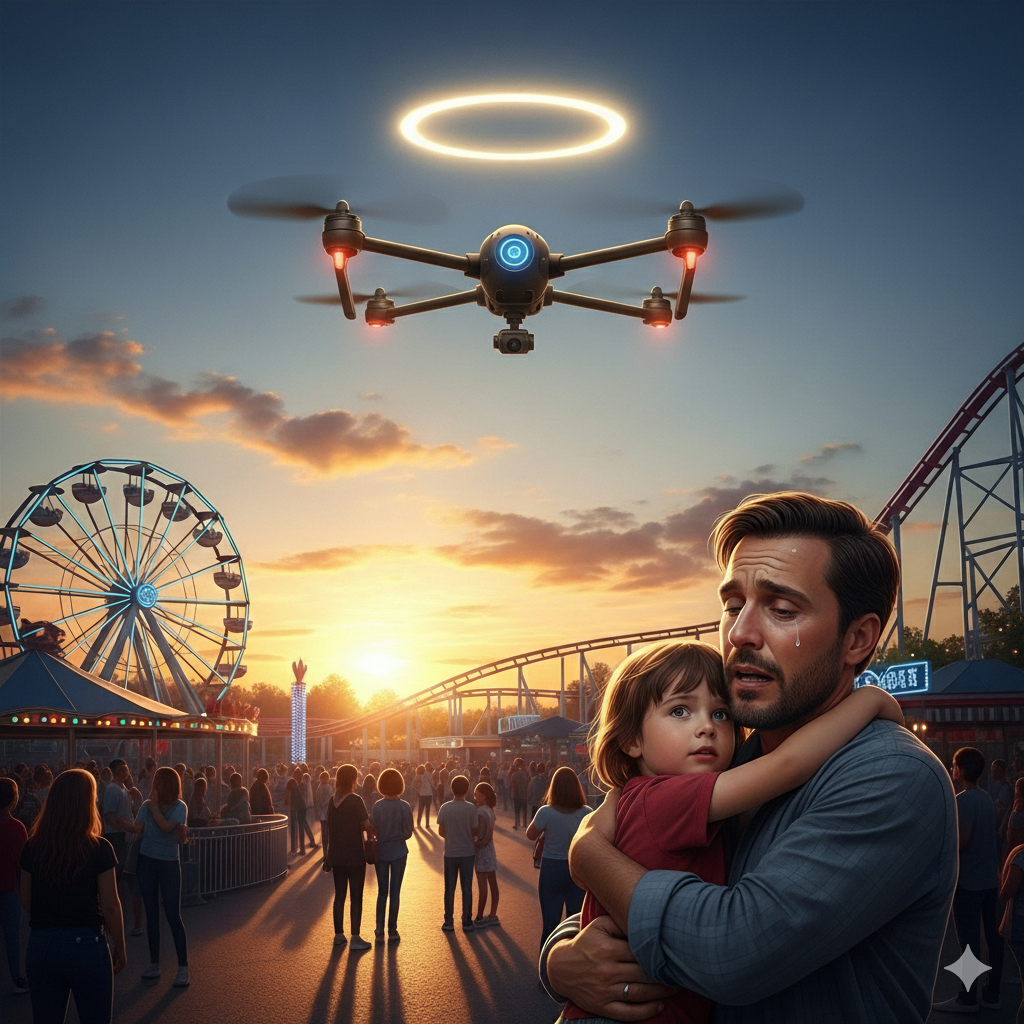
Months later, Sang-hoon happened to watch an investigative report. The screen featured the ‘Guardian Angel Drone’ he believed to be a hero. However, this time, the drone was not searching for lost children. It was identifying the faces of people attending a peaceful gathering organized by a specific group and recording their movements. It was even revealed that the technology was secretly used in large shopping malls to analyze customer movements and induce impulse purchases.
Sang-hoon was thrown into confusion. He realized that the technology that had helped him find his child could become a shackle of surveillance for someone else. Should we really accept the ‘convenience (can)’ of finding a child at the cost of all citizens being surveilled (should not)? How should we control the dark possibilities hidden behind the good intentions of technology?
The Real Questions Begin Now
The betrayal of ‘Alpha Interviewer’ and the two faces of ‘Guardian Angel Drone’ are not mere fantasies. They represent realities that are already happening around the world or will soon confront us. The fact that AI, which we believed would be efficient, can unknowingly raise the walls of discrimination, and that technology we thought would protect safety can become a watchful eye that constrains freedom, sends a chill down our spines.
Technology is not inherently good or evil; it is a value-neutral ’tool.’ However, AI is unlike any tool humanity has created thus far. It learns, predicts, and even makes decisions while evading human scrutiny. Whether we turn this powerful tool into a ‘weapon’ or a ‘gift’ for humanity entirely depends on our hands, the users.
We are like the first generation building a vast new city called the ‘AI era.’ If we focus solely on how high and how fast we can build with dazzling technology (‘can’), we may forget the people who will live within it. We must now consider the ‘philosophy of design (‘should’)’ for this city together.
First, those who create technology must become the ’ethical designers’ of this city. Beyond simply writing code and creating algorithms, they must think in advance about the impact their technology will have on society and embed ‘ethical safeguards’ to prevent discrimination and bias. Just as earthquake-resistant design is a standard when building, fairness and transparency should be the default settings when creating AI.
Second, governments and society must become the ‘wise urban planners’ of this city. They must create fair rules to prevent technology from being monopolized by specific companies or powers. Clear legal boundaries should be established to ensure that the ‘Guardian Angel Drone’ is only used to find children, and systems must be in place to hold companies accountable when AI like ‘Alpha Interviewer’ makes discriminatory decisions. Just as parks and plazas are created for everyone to rest, we must lay the social foundations for everyone to benefit from technology.
And most importantly, we, the citizens, must become the ‘awakened owners’ of this city. We are not passive consumers of the services AI provides. We must question how the apps we use collect and utilize our data. When we feel that the AI services offered by companies are unfair, we must boldly raise our voices and demand better directions. Only when the eyes of the owners shine can the city develop healthily for everyone.
AI can be a lighthouse illuminating humanity’s future or a flame that burns everything down. Ultimately, it is not the technology itself that will determine the direction at this crossroads, but ourselves. Before asking AI, “What can you do?” we must ask ourselves a more fundamental question: “What kind of world do we want to create through AI?”
How we refine the tool of AI to carve out a future for all of us ultimately depends on the thoughts and choices of each one of us.