
The Secrets of Seeds That Changed the World
Once upon a time, it was not only great empires or kings that moved the world. Small and seemingly insignificant things often changed the course of history. Just like salt, pepper, and sugar. Perhaps the civilization of humanity is a record of the immense desire to obtain these tiny grains. Interestingly, most of these precious commodities spread across the globe through Jewish merchants.
And here, alongside them, is another black seed that appeared on the stage of history: coffee.
In the early modern period, coffee was first mass-produced by Jews and began to establish a global distribution network. The influence of these merchants still casts a shadow behind the massive coffee brands we know today. In the modern global trade market, coffee is an enormous commodity, second only to oil in terms of trading volume. Approximately 7.5 million tons are traded each year, and a staggering 2.7 billion cups are consumed daily. At this very moment, one in three people in the world is drinking coffee.
However, when coffee first appeared in Europe, this black, bitter liquid was worth its weight in gold. There are records that France’s ‘Sun King’ Louis XIV spent the equivalent of about 20 million won today to buy coffee for his beloved daughter. What kind of magic is hidden in this small fruit that humanity has become so enamored with, sometimes even risking their lives?
To find the answer to this question, we must travel back up the river of time. Starting from the mysterious legends of Ethiopia, passing through the sacred nights of Islamic mosques, the perilous smuggling of Venetian merchants, the cafes that ignited the Enlightenment in London, and the black tears of colonization. Every cup of coffee you casually drink every morning contains stories of human greed and intelligence, revolution and exploitation. Once you follow this grand narrative, your coffee cup will no longer look the same.
Chapter 1: The Wine of Arabia, the Black Temptation of Islam
1. Kaldi’s Dancing Goats: The First Discovery of Coffee
The beginning of coffee lies in the mysterious fog of myths and legends. The most famous story is that of Kaldi, a shepherd from the ‘Kaffa’ region of Ethiopia around the 9th century. One day, Kaldi noticed that his goats were eating some red berries and dancing all night without sleeping. Curious, Kaldi tried the berries himself. He experienced an amazing sensation, feeling invigorated and alert.
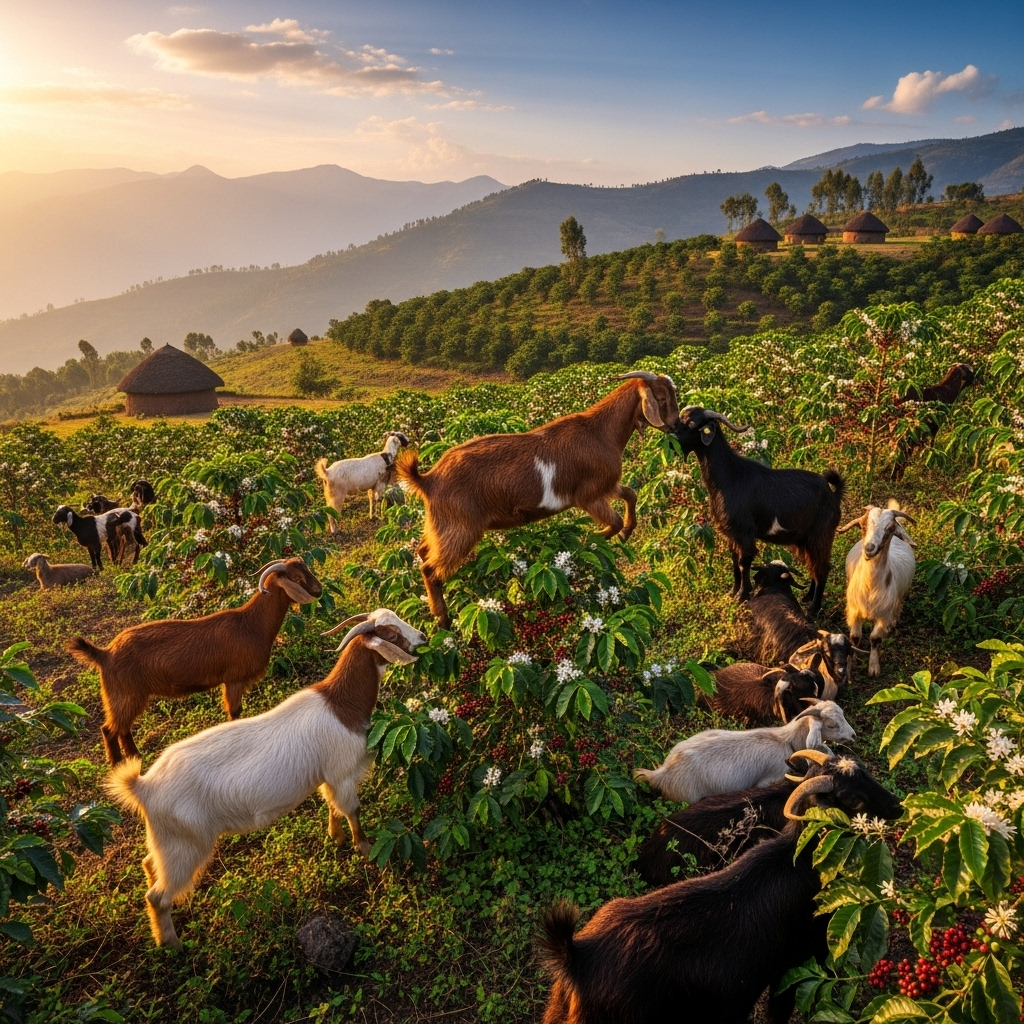
He shared this mysterious experience with a monk at a nearby Islamic monastery, but the monk initially dismissed it as ’the devil’s temptation’ and threw the berries into the fire. But what happened next? The aroma that wafted from the roasting beans was so intense and captivating. The captivated monk took the charred beans from the fire, brewed them in water, and was once again amazed by the effect. It seemed like a divine gift that chased away the dreadful drowsiness during the long hours of prayer. Thus, coffee first stepped into human history, meeting the religious rituals of Islamic Sufis.
Another legend tells that the archangel Gabriel presented a black potion called ‘Qahwa’ to Muhammad, the founder of Islam. The term ‘Qahwa,’ meaning ’that which gives vitality,’ later evolved into ‘Kahve’ in Turkish, which became the root of ‘Café’ and ‘Coffee’ in Europe.
2. Becoming ‘The Wine of Islam’
After leaving Ethiopia and arriving at the port of Mocha in Yemen across the Red Sea, coffee began to be cultivated and spread to the heart of the Islamic world. Since Islamic law strictly prohibited alcohol, coffee, which awakens the mind but does not intoxicate, became wildly popular as ’the wine of Islam.’
By the 15th century, coffee houses known as ‘Kaveh Kanes’ began to emerge in major Islamic cities like Mecca and Cairo. These places were not just for drinking coffee. People gathered to play chess, discuss business, and engage in heated debates about the latest news and politics. Kaveh Kanes served as a ‘public forum’ where intellect and information flowed in the Islamic world.
However, this free atmosphere was an eyesore to those in power. They believed that people gathering to discuss critical topics threatened the regime. Several times, coffee was banned under the pretext that it intoxicated people and violated the law. Yet, they could not stop the desires of those who had fallen under the spell of this black allure. Ultimately, coffee deeply rooted itself as a part of Islamic culture, and Arabian merchants implemented strict control policies to ensure that only roasted beans were exported, preventing any seedlings from leaving.
Chapter 2: The Devil’s Temptation Awakens Europe and the New World
1. The Black Seeds on Venetian Smuggling Ships
In the 16th century, the black beverage of Islam began to arrive on the ships of Venetian merchants dominating Mediterranean trade. Engaging with the Ottoman Empire, they recognized the commercial value of this mysterious stimulant at a glance. The first coffee to arrive in Europe was sold at a high price, referred to as ’the wine of Arabia,’ like a precious medicine.
However, the European perspective on this black, bitter drink from the unfamiliar Islamic culture was filled with suspicion. Catholic priests, in particular, referred to coffee as ’the drink of Satan’ and ’the blood of the devil,’ requesting the Pope to issue a ban.
Eventually, Pope Clement VIII decided to taste coffee himself. After smelling the aroma presented by his servant and taking a sip, he was so impressed that he declared, “This devil’s drink is too good to be left to the pagans. Let us baptize this drink and make it our own.” Thanks to the Pope’s ‘baptism,’ coffee transformed from ’the devil’s temptation’ into ‘God’s blessing,’ gaining a religious pardon to spread throughout Europe.
2. ‘Penny Universities’ and the Aroma of Enlightenment
In the mid-17th century, the opening of coffee houses in London marked the beginning of a shift in the course of history. At that time, the English were accustomed to drinking beer from morning until they were perpetually intoxicated, and coffee offered them a remarkable ‘awakening.’ For just one penny, they could enjoy a cup of coffee while discussing with the greatest minds of the time, earning London’s coffee houses the delightful nickname ‘Penny Universities.’

Coffee houses quickly became the center of everything in London. Merchants gathered to make contracts (the beginning of the world-renowned insurance company ‘Lloyd’s’), scientists debated and laid the groundwork for the Royal Society. Newspapers were distributed, stocks were traded, and politics were criticized. The ‘awakening’ that coffee provided perfectly aligned with the Enlightenment spirit that emphasized reason and rationality. Coffee houses served as the womb that birthed modern capitalism and democracy.
3. Tea in Boston Harbor: America’s Choice
The coffee house culture of Europe also spread to the American colonies across the Atlantic. However, at that time, Americans preferred tea due to British cultural influence.
But in 1773, this peaceful tea cup was thrown into the whirlpool of history. When Britain passed the ‘Tea Act,’ imposing excessive taxes on the colonies, enraged colonists threw boxes of tea into the sea from ships docked in Boston Harbor in the ‘Boston Tea Party.’
As a result of this incident, tea became an ‘unpatriotic’ beverage that complied with British oppression, while drinking coffee became a political act of resistance against Britain and the establishment of a new nation, ‘America.’ Coffee houses became secret meeting places for revolutionaries, and coffee firmly established itself as ‘America’s beverage.’ Whether by the campfire of cowboys during the westward expansion or among the supplies of soldiers in the Civil War, coffee was always present. A momentary political choice completely altered the taste map of a nation.
Chapter 3: The Golden Seed and Black Tears
1. The Courage to Break Arabia’s Monopoly
As the demand for coffee exploded in Europe and America, the prices soared due to Arabia’s monopoly. European powers employed every method to cultivate this ‘golden goose’ themselves.
The first to break this fortress-like monopoly was the Netherlands. At the end of the 17th century, a Dutch merchant successfully stole coffee seedlings from Mocha in Yemen. These seedlings were transported to the Dutch colony of Java in Indonesia, marking the beginning of large-scale cultivation. This is why ‘Java’ became synonymous with coffee.
France also entered the coffee cultivation scene with a story worthy of a movie. Navy officer Gabriel de Clieu was tasked with transporting a precious coffee tree from the Paris botanical garden to the Caribbean colony of Martinique. When water ran low during the voyage, he desperately shared his drinking water with the seedling, and this single tree later became the ancestor of all coffee trees in the Americas.
2. Black Gold of South America: The Era of Brazil
For South America to rise as the ‘Empire of Coffee,’ another secret smuggling was necessary. In 1727, Brazilian soldier Palheta was given the real mission of stealing coffee seeds while dispatched to French Guiana. He devised a meticulous plan to seduce the wife of the French governor, who, smitten by his charm, secretly hid coffee seeds in a farewell bouquet.
Once in Brazil, coffee took off. With vast territories, perfect climates, and an already established large-scale slave labor system for sugar plantations, Brazil’s coffee farms were built on the blood and sweat of millions of African slaves. While Europeans discussed freedom and equality in cafes, the coffee that fueled their awakenings was cultivated under the most inhumane exploitation. Amidst this brutal reality, Brazil emerged as the world’s largest coffee producer.
3. France’s Legacy in Asia: Vietnam
In the mid-19th century, France introduced coffee to its colony, Vietnam. The climate in Vietnam was more suitable for the robust and high-yielding Robusta variety than the delicate Arabica. The explosive growth of the Vietnamese coffee industry began after the war ended in the 1980s when government-led economic reforms were initiated. By adopting coffee as a strategic export crop, Vietnam quickly became the second-largest coffee producer in the world, following Brazil.
4. The ‘Coffee Belt’ Encircling the Equator and Its Shadows
Thus, coffee spread across the globe through the colonial exploits and smuggling of European powers. Interestingly, the cultivation areas concentrated between 25 degrees north and 25 degrees south latitude, centered around the equator, forming the ‘Coffee Belt.’
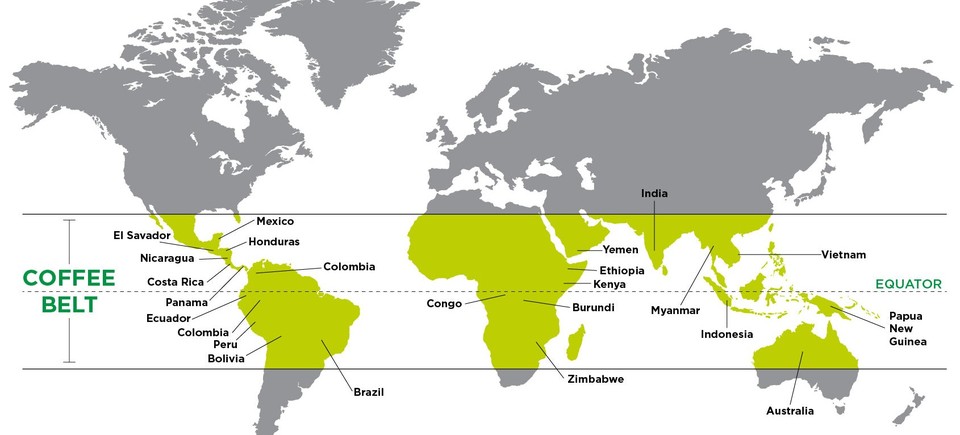
The formation of this Coffee Belt brought immense wealth to Europe, but it also cast a dark shadow of horrific sacrifices by indigenous peoples and slaves. The golden seed was black tears for someone.
Chapter 4: From the Farm to Your Cup
1. Industrialization: Making Coffee a Beverage for All
The Industrial Revolution of the 19th century transformed coffee from a luxury item for the wealthy into a necessity for factory workers. Thanks to steam engines, mass transportation and roasting became possible, lowering prices. For workers who had to work overnight, caffeine became a valuable ‘fuel’ that increased productivity.
In the 20th century, the invention of instant coffee completed the popularization of coffee. Its convenience, requiring only hot water, took over kitchens worldwide, and especially during the world wars, it became an essential supply for soldiers, further spreading coffee culture.
2. Arabica vs. Robusta: The Two Faces of Coffee
The coffee we drink is mainly divided into two varieties:
- Arabica: Accounts for 60-70% of global production. It is challenging to cultivate but has complex flavors, rich acidity, and good sweetness, making it the star of the specialty coffee market.
- Robusta: As the name suggests, it is sturdy and easy to grow. Its flavor is simple and bitter, with a higher caffeine content. It is primarily used for instant coffee or blends.
Naturally, the flavorful and aromatic Arabica is traded at a much higher price.
3. The Tragedy of the ‘C Market’: Why Are Farmers Always Poor?
But isn’t it strange? With so much coffee being sold every day, why do most coffee farmers remain trapped in poverty? The secret lies in the international coffee prices determined at the futures exchanges in New York and London, known as the ‘C Market.’
The global coffee prices are set based on speculative supply and demand in this market, regardless of the actual quality of the coffee or the farmers’ efforts. For instance, if Brazil has a bumper crop, global coffee prices plummet. Giant multinational corporations use this price as a basis to offer farmers meager compensation. Statistics show that from a cup of coffee we buy for 5,000 won, only about 50 won goes back to the farmer. This is akin to a modern-day slavery system, cleverly continuing the exploitative structures of the colonial era within the framework of modern capitalism.
Chapter 5: The Awakening Consumer: Questioning the Ethics of a Cup
1. Fair Trade: Planting Seeds of Hope
In the 1980s, as coffee prices plummeted and many farms went bankrupt during the ‘coffee crisis,’ movements began to change this tragic reality. This was the Fair Trade movement.
The principle of fair trade is simple. It ensures that farmers receive a ‘minimum guaranteed price’ that allows them to sustain their livelihoods, regardless of market prices, and additionally supports a ‘community development fund’ for local development. By purchasing fair trade certified products at a slightly higher price, consumers create a virtuous cycle that pays farmers fairly and helps them become self-sufficient. This movement has awakened us to the fact that the cup of coffee we drink is connected to the lives of someone on the other side of the globe.
2. The ‘Third Wave’ and the True Value of Coffee
Entering the 2000s, a new wave called ‘The Third Wave’ began to blow through the coffee market.
- First Wave: The era of instant coffee (quantity, convenience)
- Second Wave: The franchise era with Starbucks (brand, space)
- Third Wave: The specialty coffee era (quality, origin)
The ‘Third Wave’ regards coffee as an object to be enjoyed for its own taste and aroma, much like wine. People have started to consider ‘which farmer’ grew it ‘in what land’ and ‘in what way.’ Single-origin beans from individual farms are gaining popularity, and direct trade, where cafes visit the farms and contract with farmers, is on the rise. Coffee is returning as a ‘work of art’ that carries the faces and stories of its producers.
The Story in Your Cup
We have journeyed together from the dancing goats of Ethiopia through the prayer rooms of Islam, the revolutionary squares of Europe, the tears of colonization, to the ethical dilemmas of modernity, all encapsulated in a cup of coffee.
Coffee is a paradoxical product. It was the ‘beverage of awakening’ that ushered in the age of reason, yet it was a ‘product of exploitation’ that thrived on the tragedy of slavery. It served as a ‘medium of communication’ connecting people, yet the distance between producers and consumers remains vast.
Today, every cup of coffee we drink carries all this history layered within. The ‘Ethiopian Yirgacheffe’ you order holds the legend of Kaldi, the ‘Brazil Santos’ contains the tears of slaves, and the ‘Colombian Supremo’ embodies the hope of fair trade.
Now, take another look at the cup of coffee in front of you. The light and shadow of human civilization flicker together on its black surface. The choice of which coffee we select is also an answer to how we will respond to this grand history.
What story did you drink this morning?