
The Overture Resounding on the Chessboard
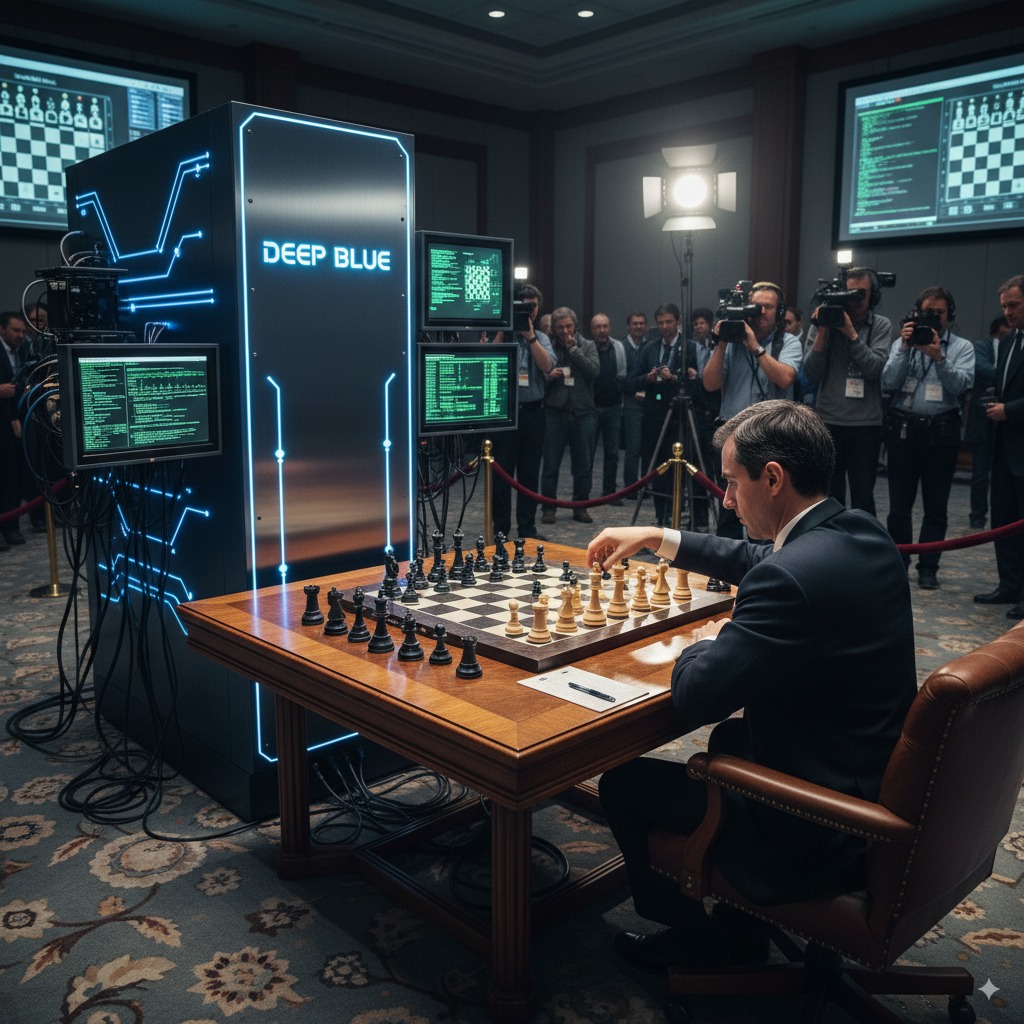
The story goes back about 30 years to 1997. At that time, the world was holding its breath for a historic showdown on the chessboard. On one side sat the world chess champion, ‘Garry Kasparov,’ hailed as humanity’s greatest intellect, and on the other side was IBM’s supercomputer ‘Deep Blue.’ Many believed that machines could never surpass human intuition and creativity, but the outcome was shocking. Deep Blue defeated Kasparov and claimed victory. (Interestingly, the 44th move made by Deep Blue was thought to be a bug that developers had fixed.) This was not just a simple win or loss in a chess game; it was a historic moment where machines challenged the intellectual domain of humans. Although it was a victory based on predetermined rules and vast computational power, this event marked the first note of a grand overture toward the future.
Chapter 1: The Divine Move and Humanity’s Awakening
As time passed to 2016, in Seoul, South Korea. If Deep Blue’s victory was in the realm of calculations, this time a different dimension emerged. The AI ‘AlphaGo,’ developed by Google DeepMind, challenged the world’s top Go player, Lee Sedol 9 dan. Go is so complex that the number of possible moves exceeds the number of atoms in the universe, making it a domain considered unique to humans that could not be conquered without intuition and creativity.
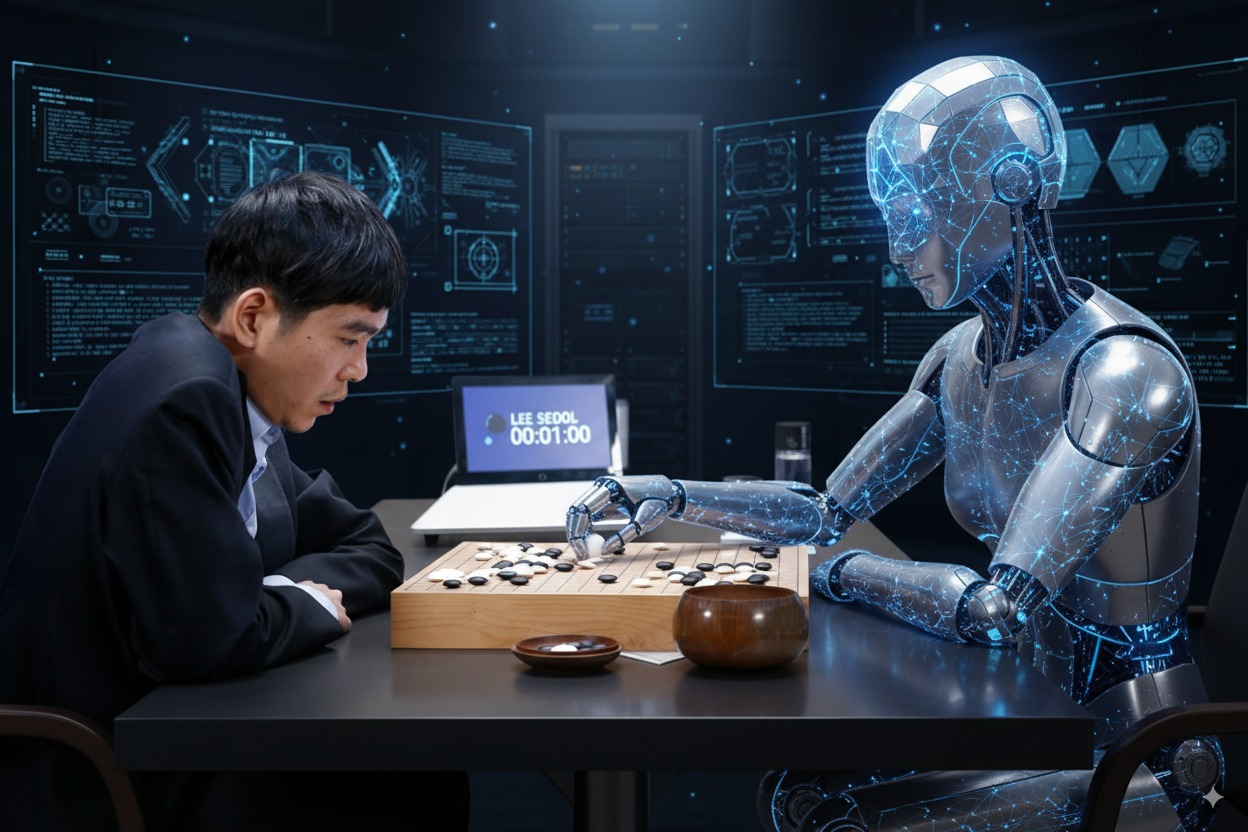
How did AlphaGo manage to step into this domain? The secret lay in its method of ’learning.’
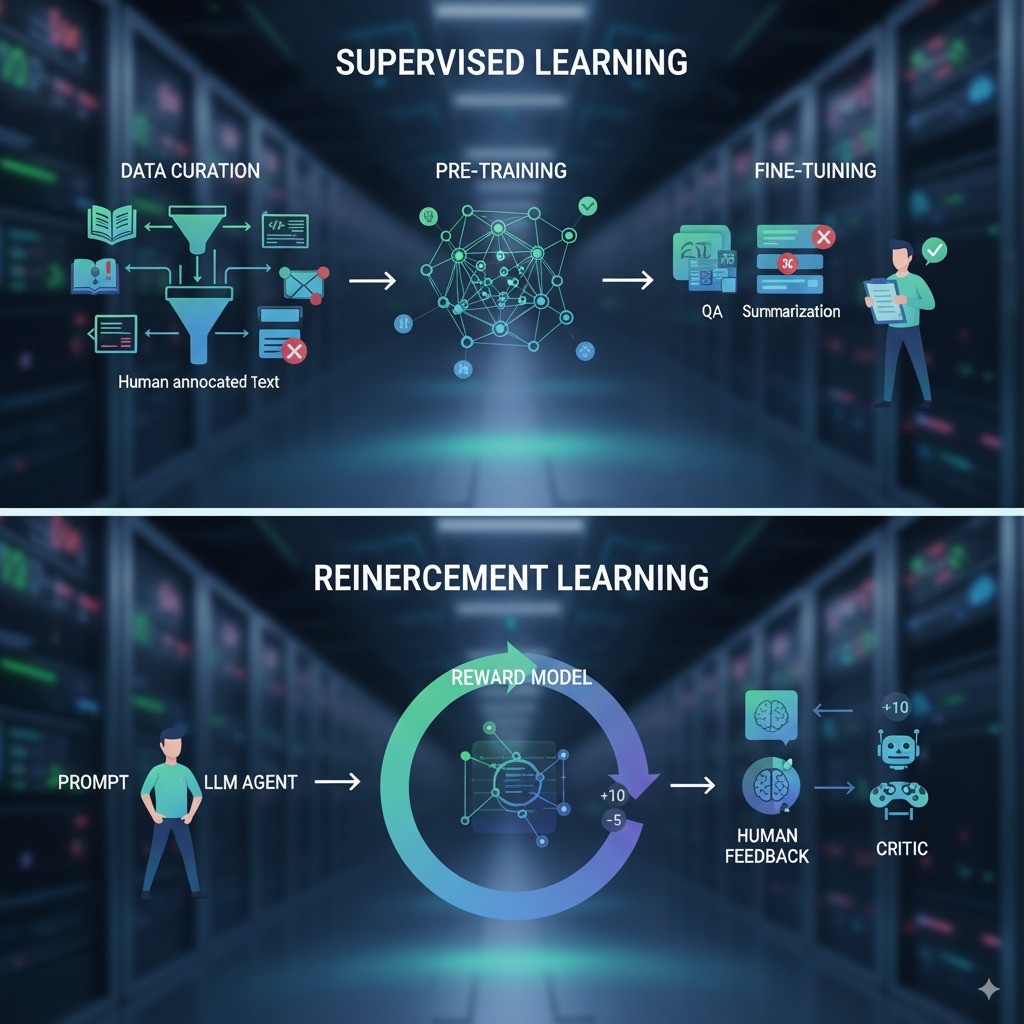
- Step 1: Learning on the Shoulders of Giants (Supervised Learning)
AlphaGo first learned the basic principles and patterns of Go by reviewing countless game records from professional players, much like how we learn through the teachings of great masters. - Step 2: Training Beyond Itself (Reinforcement Learning)
After mastering the basics, AlphaGo played millions and millions of games against itself. It learned which moves were better by receiving rewards for wins and penalties for losses. In this process, it began to discover completely new and creative moves that were not seen in human game records.Supervised Learning and Reinforcement Learning in LLM
As we all know, the result was AlphaGo’s victory with 4 wins and 1 loss. Particularly, the ‘divine move’ in the fourth game, where Lee Sedol exploited AlphaGo’s weakness to win, was a moment that showcased human creativity. However, at the same time, humanity witnessed the terrifying potential of artificial intelligence, leading to a profound awakening.
Chapter 2: Gaining Enlightenment Without a Master, AlphaGo Zero
The year after the match with Lee Sedol, in 2017, the AlphaGo development team published an even more shocking paper in the prestigious scientific journal
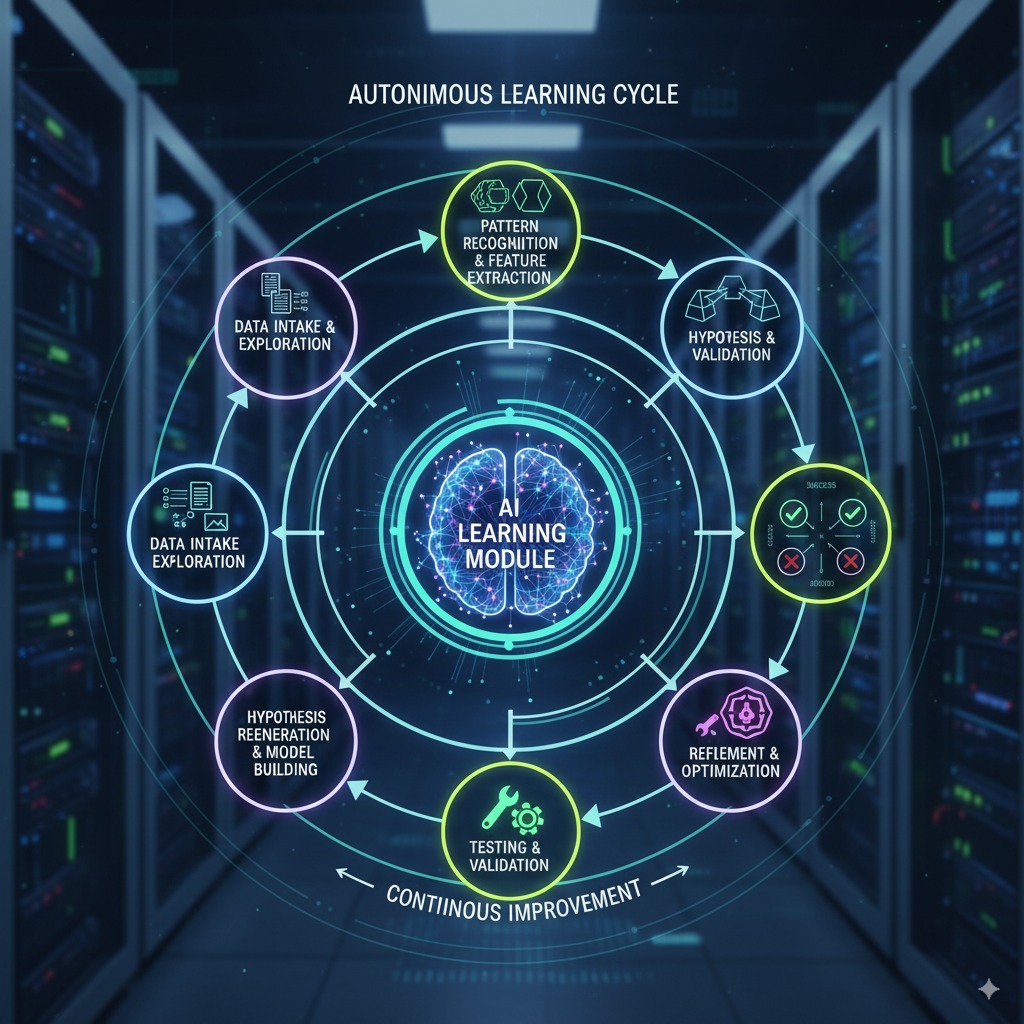
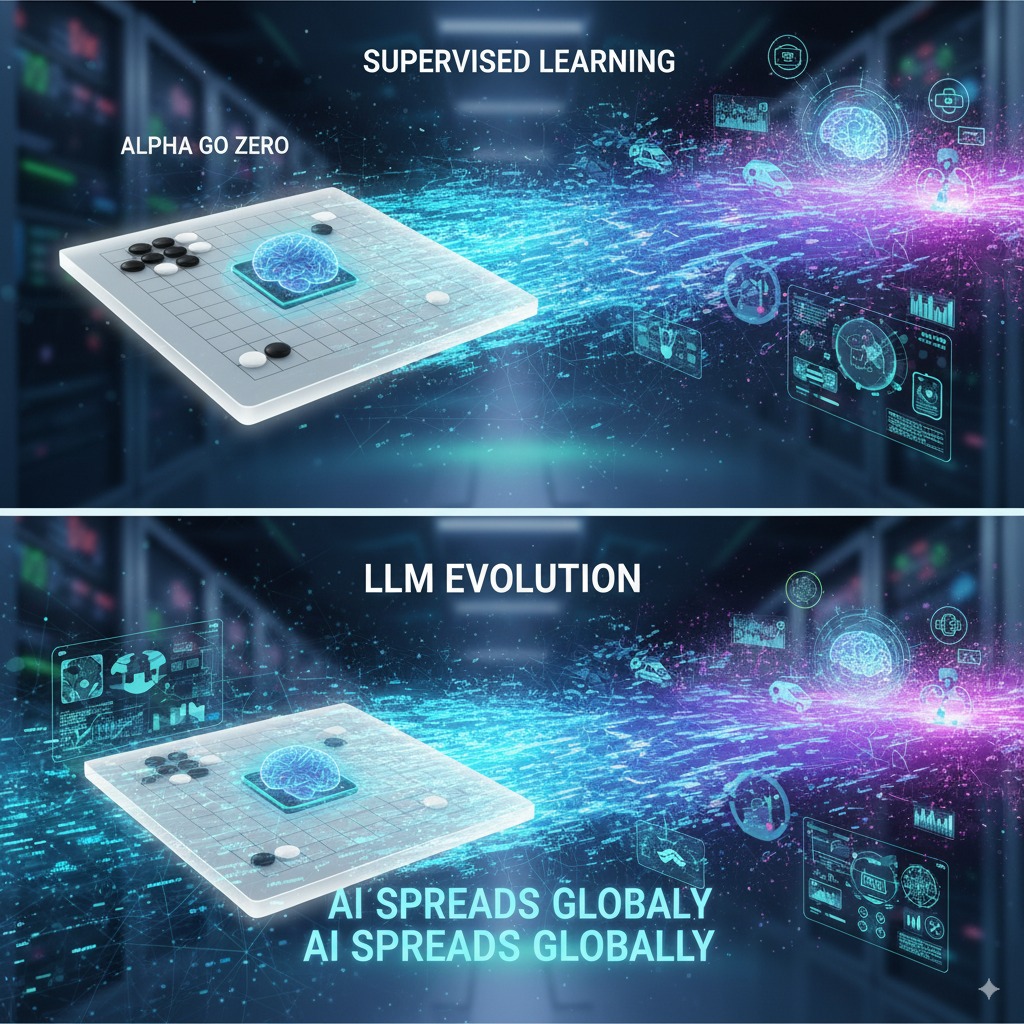
As the name ‘Zero’ suggests, AlphaGo Zero did not look at a single game record from humans. It was only taught the rules of Go and allowed to play against itself, much like a martial artist honing their skills alone in a deep mountain without a master. Remarkably, AlphaGo Zero overwhelmed ‘AlphaGo Lee,’ which had defeated Lee Sedol, with a record of 100 wins in 100 games in just three days, and after 40 days, it reached a level that could be called the god of Go.
The message this event conveyed to us was clear. Artificial intelligence can transcend the limitations of ‘data’ from human knowledge and experience, creating knowledge on its own and surpassing human cognitive abilities. At this point, AI emerged as a new paradigm that would shake the foundations of labor and our society, moving beyond being a mere tool. The emergence of AlphaGo Zero became the catalyst for the development of large language models (LLMs), and AI began to spread beyond the Go board into every corner of the world.
Chapter 3: New Job Scenarios Written by AI
The shock of AlphaGo Zero pushed the world into a massive whirlpool of AI. Like the gold rush era, everyone jumped in to find the gold vein of AI. Investors eagerly opened their vaults to the ambitious declarations of startups claiming, “We will change the world with AI.” Their strategy was clear: demonstrate the potential of AI technology, propose solutions to specific industry problems, and sell a vision of capturing the market with ‘super-gap’ technology.
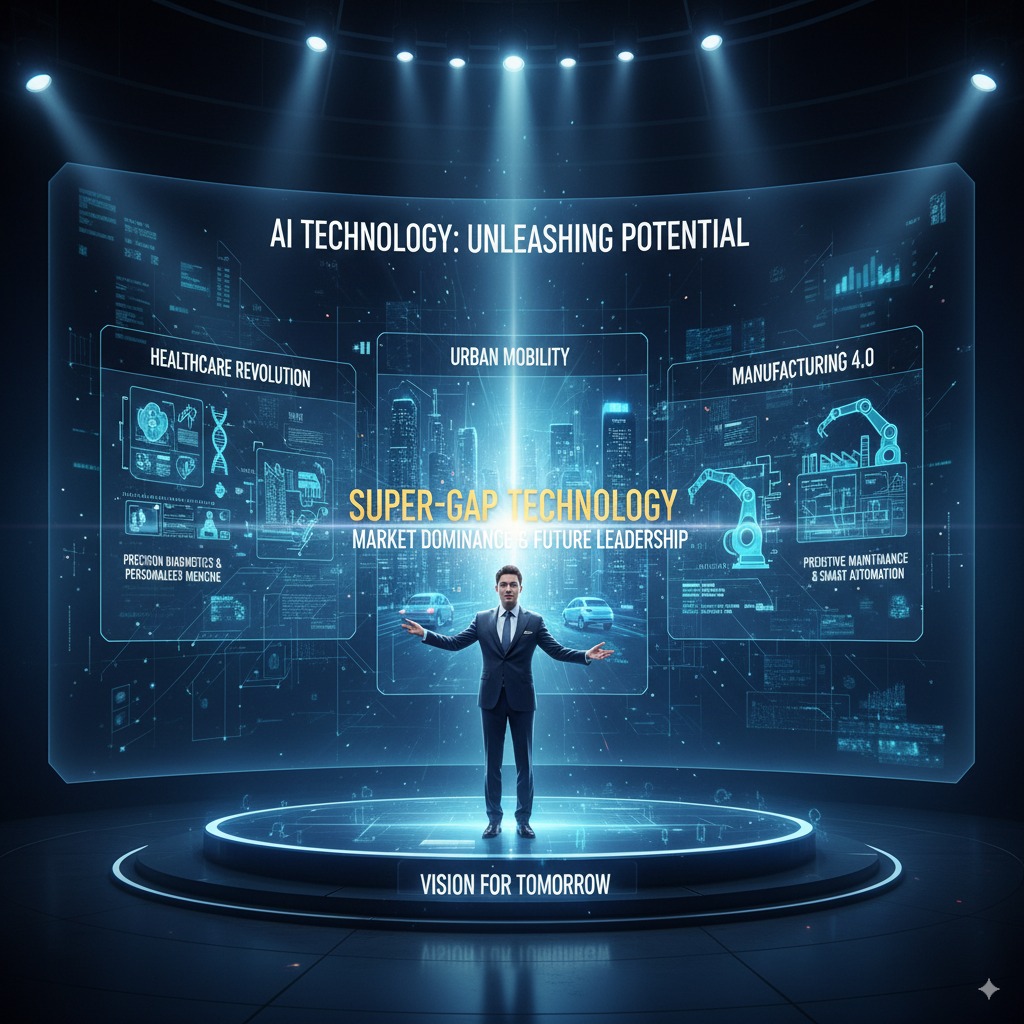
Through this massive investment, AI has now stepped closer to us. For some, it has brought dazzling opportunities, while for others, it has instilled overwhelming anxiety. Let’s take a closer look at two scenarios that AI is writing in our workplaces:
Scenario 1: People with AI Wings (Hope)
“This new drug candidate would have taken at least 5 years under normal circumstances.”
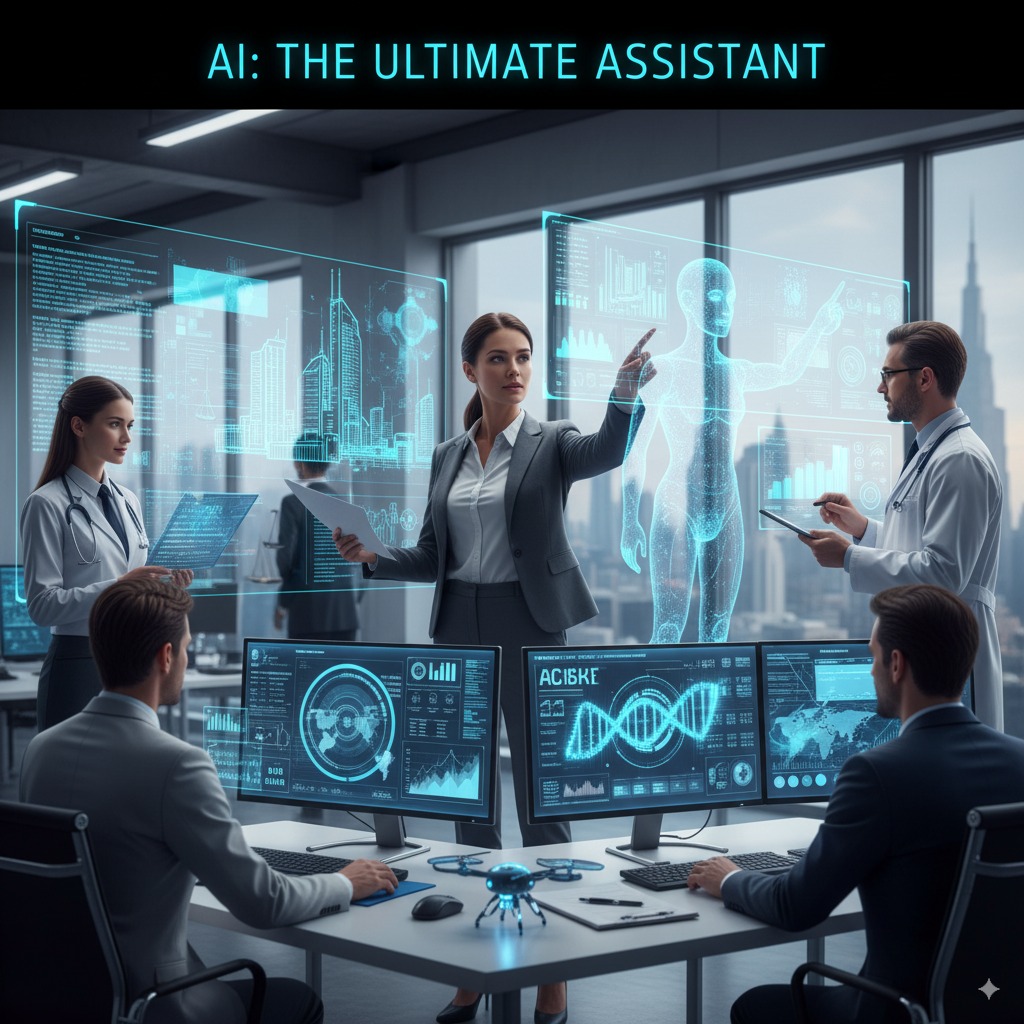
Ji-hye, a researcher at a pharmaceutical company, commutes to work with her AI colleague today as well. Her AI colleague analyzes millions of papers and clinical data in just a few hours, suggesting new compound combinations that human researchers might overlook. In the past, researchers had to stay up all night formulating hypotheses and finding candidate substances through numerous failures. But now, with AI taking care of data analysis and simulations, Ji-hye and her colleagues can spend more time validating hypotheses and generating creative ideas.
“Thanks to AI, we have been liberated from repetitive tasks. Now we can ask more fundamental and creative questions that dig into the root causes of diseases. AI is not a competitor that takes our jobs but the best partner that amplifies human intelligence.”
Scenario 2: People Left Behind by Machines (Concern)
“I’ve been doing this job for my whole life, but now I’m told I’m worse than a machine.”
Manager Sang-hoon, who has worked in loan assessment at a bank for 30 years, has recently had an unfamiliar program running on his desk. This AI assessment system tells the loan eligibility and limits in just a few seconds by inputting customer credit information, income, and debt history. The tasks that Manager Sang-hoon used to assess comprehensively with decades of experience and know-how are now being processed faster and more accurately by AI.
As a result, the company significantly downsized the loan assessment department, and Manager Sang-hoon had to leave the job he dedicated his life to.

“I argued that if AI learns from biased data, how can a machine understand human circumstances? But it was all in vain. Ultimately, my experience became outdated in the face of cost and efficiency. Now, I feel lost about learning new technologies and what I should do to make a living in the future.”
Manager Sang-hoon’s story is no longer a distant future. Tasks that involve repetitive work based on fixed rules, such as data entry, customer service, and production line inspections, are already being rapidly replaced by AI and automation robots. As a result, many people in those jobs are losing their jobs or suffering from employment insecurity, making ’technological unemployment’ a realistic social issue. This could exacerbate the income gap between those with technology and those without, threatening the stability of society as a whole.
The Crossroads of the Future: Jobs That Will Disappear vs. Jobs That Will Survive
Experts predict that the job landscape in the AI era will change significantly.
- Jobs at High Risk of Disappearance: Simple, repetitive jobs that make judgments based on standardized data. (e.g., telemarketers, data entry clerks, cashiers, some administrative positions, etc.)
- Jobs That Will Survive or Become More Important: Jobs that solve complex problems, communicate deeply with others, and generate creative ideas. (e.g., AI specialists, data scientists, psychological counselors, artists, strategic consultants, elderly care specialists, etc.)
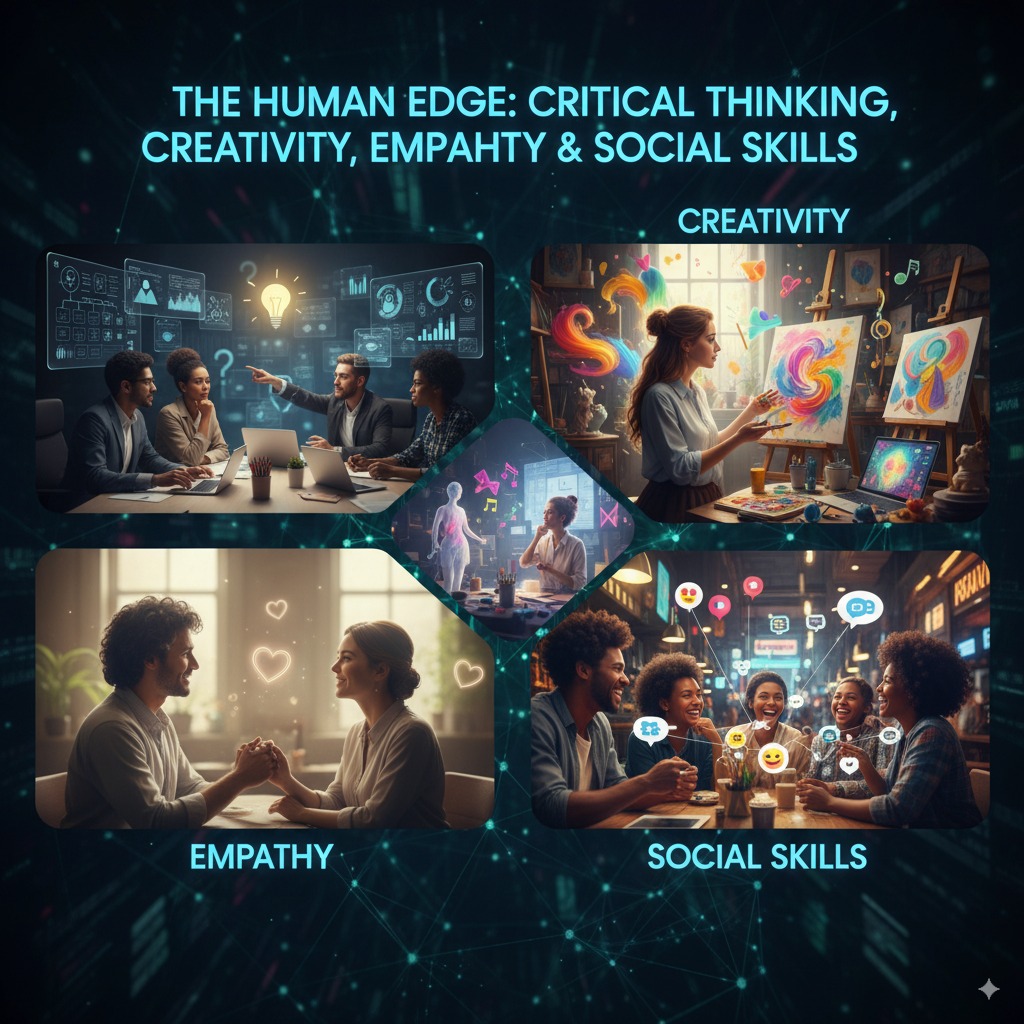
The important point is that it is not the ‘jobs’ themselves that will disappear, but rather the ’tasks’ that constitute those jobs will change. For example, the profession of a doctor will not disappear, but as AI assists in diagnosis, the role of doctors will shift toward deeper empathy with patients and comprehensive treatment planning. Ultimately, to survive in the future labor market, it will become crucial to cultivate uniquely human abilities that AI cannot replicate, such as critical thinking, creativity, empathy, and communication skills (social skills).
In the face of such a monumental change, we must also answer socially significant questions. How can we ensure that the benefits of AI development are shared by all? What social safety nets (such as discussions on basic income) and retraining systems should be established for those who lose their jobs? How can we create ethical standards and regulations to ensure that AI technology does not alienate humans and enhances human dignity?
The future that AI has laid out is still an unfinished scenario. Whether we make that scenario a utopia or a dystopia now depends on our society’s intense deliberation and consensus.
Epilogue: Between Frustration and Admiration, AI by Our Side
Do you remember? In 2011, when IBM’s AI ‘Watson’ defeated human champions on a famous American quiz show, we were thrilled and amazed by its intelligence. But just over a decade later, we find ourselves frustrated, saying to our AI speaker in the living room, “What? You don’t know that? Search again!”
This remarkable shift in perception is the most definitive evidence of how deeply and naturally AI has permeated our lives. Now, every time we open social media, we unconsciously consume content curated by AI that hits our preferences, and we marvel at a friend’s profile picture transformed into a stunning artwork created by AI. In a world where AI can turn an ordinary photo into a piece of art with just a few touches and recommend incredible background music for short videos, artificial intelligence has become a presence that shapes our daily lives, no longer a special genius confined to chess or Go boards, but an air-like entity in our hands.
From Deep Blue to AlphaGo Zero, and now to today’s generative AI, the rapid journey of technology has unfolded. Now, rather than vaguely fearing or celebrating the future that AI will change, it is time to seriously contemplate and find answers on how we can create a better world together with AI. Will we soar higher with AI’s wings like Ji-hye, or will we lose direction like Manager Sang-hoon, swept away by the wave of technology? At this monumental crossroads, the protagonist of the journey is not technology but ourselves.