
Have you ever gone to bed saying, ‘I will definitely wake up early to exercise tomorrow!’ only to hit the snooze button without a moment’s hesitation in the morning? Or have you sat down to write an important report, only to find yourself clicking on news articles without even realizing it?
In our lives, there exists a deep chasm between what we intend to do and what we actually do. We want to believe we are the ‘masters of our thoughts and actions,’ but perhaps we are not the captains of our ship called life. Most of the time, we leave the navigation to the ‘autopilot’ while the control room remains empty.

This story is a guide to understanding the identity of that autopilot and finally taking the wheel of my life, or the ‘steering wheel,’ into my own hands through five enjoyable navigation techniques. Let’s embark on a journey of ‘Conscious Alignment’ that aligns my deepest values and actions, rather than merely suppressing thoughts.
Step 1: Meet the Loyal ‘Autopilot’ Within Me
In fact, our ship has two navigators. One is the cautious and analytical ‘captain (myself),’ and the other is the fast and intuitive ‘autopilot.’ Nobel laureate psychologist Daniel Kahneman referred to these as System 1 and System 2.
- System 1 (Autopilot): This is our ‘autopilot.’ When you see the sign ‘2+2=?’, it immediately brings to mind ‘4’, and it reflexively makes you hit the brakes when a car suddenly cuts in. It is remarkably efficient with almost no energy expenditure, but sometimes it leads the ship in the wrong direction due to hasty judgments. In neuroscience, the ‘Default Mode Network (DMN)’ is the main stage for this friend when we are zoning out.
- System 2 (Conscious Captain): This is the part that recognizes ‘me.’ It comes into play when analyzing complex navigation charts and deciding on important routes. It is slow, cautious, and requires a lot of energy.
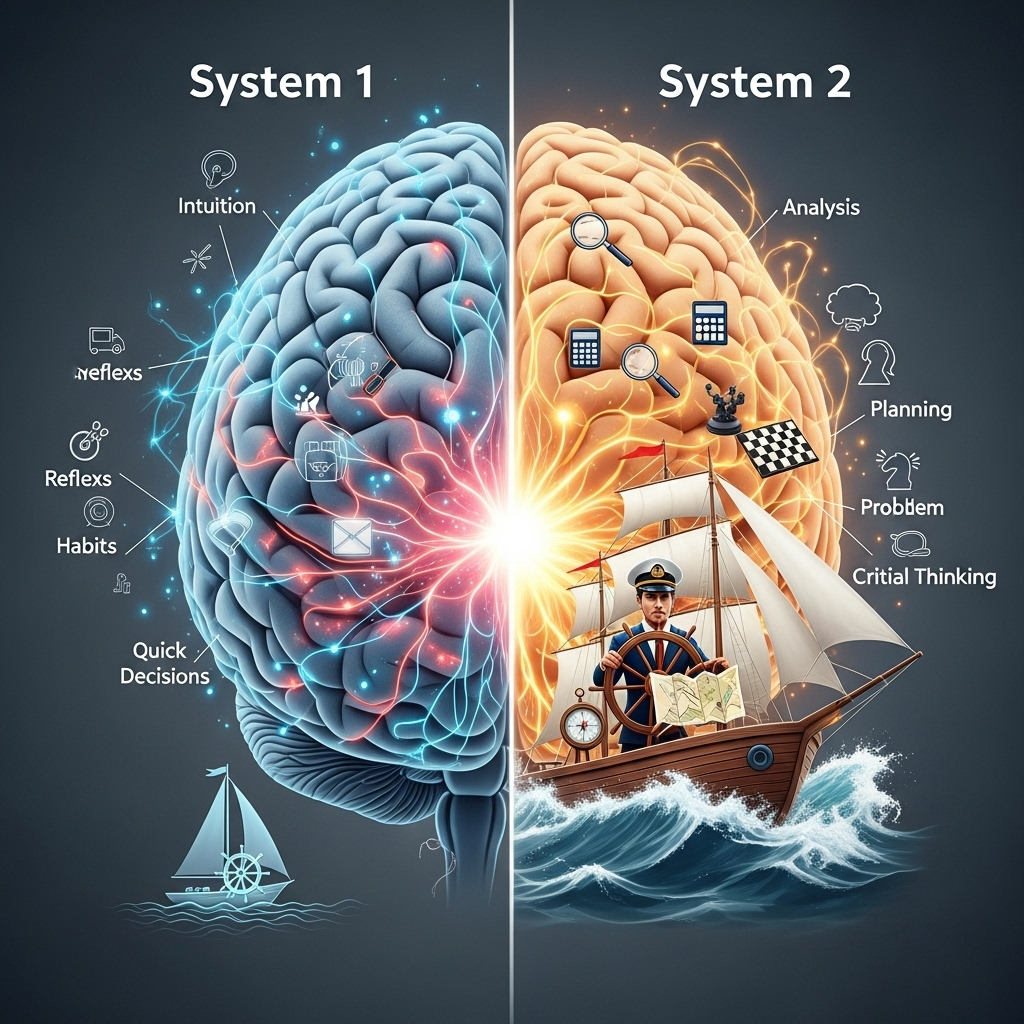
The problem is that this diligent ‘autopilot’ is navigating more than 90% of our daily lives. Often, we, as the ‘captain,’ are unaware of this fact. Psychologist John Bargh’s ‘Florida Effect’ experiment clearly demonstrates this. Just as students who saw words related to the elderly unconsciously walked slower, we are acting based on countless signals we do not recognize.
The first step to change is not to blame this autopilot. It is to warmly acknowledge and curiously observe, “Ah, I have this loyal and quick friend navigating the ship with me!”
Step 2: Climb to the ‘Observation Deck’ and View the Sea
Now that you are aware of the autopilot’s existence, it is time to practice climbing to the ship’s highest ‘observation deck’ before trying to forcefully steer it. This is Mindfulness.
Mindfulness is not the magic that stops the waves (thoughts) in your head. Rather, it is training to become an ‘observer’ who simply watches which waves come and go. It is understanding that thoughts are natural phenomena that appear, linger, and disappear like clouds in the sky. We are not the stormy waves but the vast ocean that encompasses all of it.

This ‘observer mode’ surprisingly changes our brain. Meditation training that focuses on the sensations of the present moment, like breathing, reduces the activity of the ‘autopilot (DMN)’ and strengthens the careful ‘captain (prefrontal cortex).’ In other words, the more we practice climbing to the observation deck, the more we gain the power to make wise decisions as the captain, free from the hasty judgments of the autopilot.
[Practical Exercise] 2 Minutes, ‘Dropping the Anchor of the Present’
- Posture: Sit comfortably with your back straight.
- Dropping the Anchor: Connect your attention to the anchor of ‘breath.’ Focus on the air brushing your nostrils or the rising movement of your abdomen.
- Noticing and Returning: It is natural for the waves of thought to come and shake the ship momentarily. Each time that happens, instead of criticizing yourself, gently bring your attention back to the anchor of ‘breath,’ acknowledging, ‘Ah, I drifted away to another sea of thoughts.’ This process itself is a strength training for the captain.
Step 3: Follow Where the ‘Emotional Compass’ Points
Sometimes, fierce storms (emotions) like anxiety or anger can sweep in. We often think the storm itself is the problem, but in reality, it is just the ‘result.’ Aaron Beck, the father of Cognitive Behavioral Therapy (CBT), said, “What causes us pain is not the event itself but our interpretation (thought) of the event.”
Intense emotions are the clearest signal that the ‘autopilot’ has just written a navigation log at the speed of light. The third technique is to become a detective who follows the compass of emotions to uncover the hidden ‘Automatic Thoughts’ that caused them.
If you receive a one-word message from your boss saying, “Urgent,” and your heart sinks, that is the time for the detective to spring into action. Instead of asking, “Why am I so anxious?” ask, “What thought flashed through my mind like lightning just before this anxiety hit?” You might discover automatic thoughts like, “I must have done something wrong again,” or “I will end up getting scolded.”
| Situation | Emotion (0-100%) | Automatic Thought (Thoughts that flashed through your mind) |
|---|---|---|
| Example: Received a one-word email from the boss saying “Urgent.” | Anxiety 90%, Worry 80% | “I must have made a big mistake and will get scolded.” “I will ultimately ruin this project.” |
Step 4: Become a ‘Thought Archaeologist’ and Validate the Old Map
Once you have found the old treasure map of automatic thoughts, it is time to become an ‘archaeologist’ who verifies whether that map is truly ‘fact.’ We often regard our thoughts as undeniable truths, but most automatic thoughts are merely unverified ‘hypotheses.’
Social psychologist Leon Festinger’s ‘Cognitive Dissonance’ experiment shows how much we struggle to rationalize our thoughts. People who did a boring task and received $1 could not bear the discomfort of 'lying for just $1’ and ended up modifying their thoughts (map) to say, “Actually, that task was quite fun.”
Like Socrates, we must take the shovel of questioning towards our old map within.
- Finding Evidence: “What evidence is there that this map is real? Is there any opposing evidence?”
- Finding Alternative Interpretations: “Is there a different way to interpret this route?”
- Worst-Case Scenario Simulation: “If this map is correct, what is the worst outcome? Is it something I can handle?”
- Seeking Advice from Fellow Captains: “If my best friend believed this map, what advice would I give them?”
- Utility Evaluation: “Is believing this old map helpful for my current navigation?”
Through these questions, we can escape the distorted map and draw a more realistic and balanced new navigation chart.
Step 5: Become a ‘Navigation Designer’ and Create a Specific Course
Now we reach the final step of leading thoughts to the harbor of action. No matter how good the map is, without a specific navigation plan, the ship cannot leave the harbor. We often blame ourselves for lacking willpower, but the real issue is the absence of a ‘system.’
Behavioral scientist Peter Gollwitzer’s research on ‘Implementation Intentions’ reveals a surprising fact. Students who simply thought, ‘I should do the assignment’ completed only 33% of it, while those who made a specific plan saying, “I will do this assignment [when] [where]” completed a whopping 75%.
Instead of a vague goal of ‘I should exercise,’ it is about making a specific ‘If-Then’ plan like, “If I wake up at 7 AM tomorrow, I will immediately change into workout clothes and do 20 squats in the living room.” This is the clear navigation manual you, as the captain, input for the autopilot in advance.
Additionally, raising the sails for the desired navigation in advance (e.g., placing workout clothes next to the bed) and dropping the anchor for unwanted navigation (e.g., charging your smartphone far from the bed) through ‘Environmental Design’ is a much stronger navigation strategy than relying on the fickle winds of willpower.
Conclusion: From Autopilot to Conscious Navigation
We have completed the five-step journey of exploring the sea of my thoughts as ‘observers,’ ‘detectives,’ ‘archaeologists,’ and ‘designers.’
- Identifying Reality: Acknowledge the existence of the ‘autopilot’ within me.
- Observing: Cultivate the power of ’noticing’ by watching the waves of thought without judgment.
- Exploring: Follow the emotional compass to uncover hidden ‘automatic thoughts.’
- Validating: Verify the old map through questioning and draw a new map.
- Designing: Create a course of action through specific plans and environmental design.

The ultimate destination of this technique is not a calm sea where thoughts are perfectly controlled. It is about cultivating Psychological Flexibility, the ability to calmly steer towards the most important values in my life without panicking in any storm.
Holocaust survivor Viktor Frankl said,
“Between stimulus and response, there is a space. In that space lies our power to choose our response, and in our response lies our growth and freedom.”
The five-step navigation technique you learned today is your compass and steering wheel that helps you discover that ‘space’ and cultivate the power to make wise choices within it. You are no longer a passenger swept away by the waves of thought. You are now a great navigator, steering the ship of your life towards your desired destination.