
If you pull a reed that stands one foot above the water’s surface until the tip touches the water’s edge, how deep is the pond?
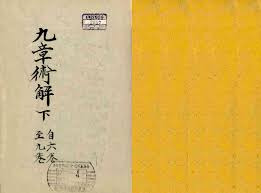
The key to solving this problem from the 『Nine Chapters on the Mathematical Art』 (Jiuzhang Suanshu) is the Gugohyeon Theorem.
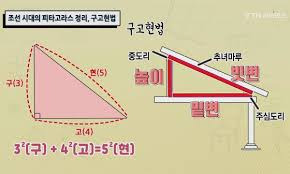
It is the same $a^2+b^2=c^2$ as the Pythagorean theorem; what differed was the method of proof.
The Gugohyeon Theorem was a ‘Method for Solving Problems’ in the 『Nine Chapters on the Mathematical Art』
Unexpectedly, the first systematic appearance of the Gugohyeon theorem was in a problem book.
Completed during the Western Han Dynasty, the 『Nine Chapters on the Mathematical Art』 is organized into chapters such as ‘Field Measurement’ for land area and ‘Civil Engineering’ for construction. The ninth and final chapter is named ‘Gugo’ (Right-angled Triangle). Since the short leg was called ‘Gu’, the long leg ‘Go’, and the hypotenuse ‘Hyeon’, the name of the theorem is essentially the names of the three sides of a triangle.
The book’s grammar is always the same: “Suppose (Jin-yu)…” to present the situation, and “The method says (Sul-wal)…” to provide the procedure. Not a single line explains why that procedure works.
The aforementioned reed problem is in that Gugo chapter. The pond is 10 feet wide, and the reed is in the middle, so the distance from the root to the water’s edge is 5 feet. The method instructs as follows: Square 5 to get 25, subtract the square of the 1-foot height above water (1), and divide the difference by twice the height above water (2). The answer is 12 feet for the water depth and 13 feet for the reed length. Expressed as an equation, $5^2+12^2=13^2$; a 5-12-13 right triangle was hidden inside the pond.
What I found interesting is this:
The theorem’s name is never mentioned, but the calculation sequence is provided, which would be impossible to derive without knowing the theorem.
Liu Hui was not the only one to prove the Gugohyeon Theorem
In the 3rd century, two Chinese mathematicians proved the Gugohyeon theorem with diagrams. While Liu Hui is commonly cited, Zhao Shuang, from around the same period, also left a separate proof.
While writing a commentary on the astronomy and mathematics book 『Zhoubi Suanjing』, Zhao Shuang included a short text and diagram called the ‘Gugoyuanbangdoju’.
According to the Hong Kong Education Bureau’s mathematics materials, his method is as follows: If you place four identical right triangles (red) around the inside of a square formed by the hypotenuse, a small yellow square with a side of $b-a$ remains in the center. Adding the area of the four triangles, $2ab$, to the center, $(b-a)^2$, results in $a^2+b^2$, which equals the area of the hypotenuse square, $c^2$. It is a proof that combines geometry and algebra, ending with a calculation after drawing the figure.
For reference, the 『Zhoubi Suanjing』 itself features a 3-4-5 right triangle in a dialogue between Duke of Zhou and Shang Gao even earlier. The book is generally estimated to have been compiled during the Han Dynasty.
In 263, Liu Hui chose a different path while writing his commentary on the 『Nine Chapters on the Mathematical Art』. He called the square with the ‘Gu’ as its side the ‘Red Square’ (Jubang) and the square with the ‘Go’ as its side the ‘Blue Square’ (Cheongbang). He then cut the protruding pieces and moved them to empty spaces to fill the hypotenuse square. This method of leaving parts that fit untouched and moving only the remainder is called Chul-ip-sang-bo (Complementary Dissection).
There is one point I want to emphasize here.
It would be a mistake to view Chul-ip-sang-bo as “a trick without logic.” This method is based on the premise that ‘area does not change when cut and rearranged.’ In Greece, such a premise would have been written down as an axiom first; Liu Hui used it without explicitly stating it. The difference lies not in whether there is logic, but in whether the premise is explicitly stated as a sentence.
Why did the Pythagorean theorem have to start from axioms?
What mattered in Greece was not “Is this calculation correct?” but “Why must it be correct?” That question drove the Pythagorean theorem toward proofs derived step-by-step from axioms.
The Pythagoreans believed that “number is the source of all things,” but their own theorem created a crack in that belief. The hypotenuse of a right triangle with two sides of length 1 is $\sqrt{2}$, which cannot be expressed as a ratio of any integers. This was the discovery of incommensurability—the irrational number. In the history of mathematics, this shock is often explained as the catalyst that pushed Greek mathematics toward deductive reasoning, where only what is proven, rather than what is seen, is trusted.
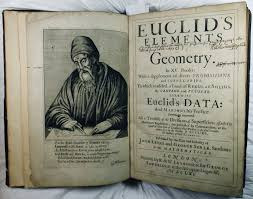
That method reached its pinnacle in Euclid’s 『Elements』. The Pythagorean theorem is Proposition 47 of Book I, and Book I ends with its converse, Proposition 48. The proofs start from definitions and postulates, building up through triangle congruence and the relationship between parallelogram and triangle areas. It does not ask the reader to move pieces around but shows that the conclusion is inescapable from previously accepted propositions. The “Q.E.D.” at the end of a proof is a later Latin translation of the closing phrase from the original Greek, meaning “that which was to be demonstrated.”
The Gugohyeon Theorem and the Pythagorean Theorem: The differences in proof methods
If we divide the differences between the Gugohyeon theorem and the Pythagorean theorem by literature, method, and application, they look like this:
| Feature | Gugohyeon Theorem (Ancient China) | Pythagorean Theorem (Ancient Greece) |
|---|---|---|
| Main Literature | 『Zhoubi Suanjing』, 『Nine Chapters』 Gugo chapter | Euclid’s 『Elements』 (Book I, Proposition 47) |
| Representative Proof | Zhao Shuang’s Hypotenuse Diagram, Liu Hui’s Chul-ip-sang-bo | Deductive reasoning starting from axioms/postulates |
| Proof Shape | Shape dissection/rearrangement + area calculation | A chain of logic connecting previous propositions |
| Main Application | Surveying, civil engineering, land area, astronomy | Pure geometry, number theory, foundation of philosophy |
There is one column in the table that is easy to misunderstand. It would be a mistake to interpret the Chinese method as ’less rigorous.’ The Chinese method was refined for different purposes, and those purposes become clear when looking at how this theorem was used in Korea.
How was the Gugohyeon Theorem used in Korea?
The usage confirmed by records is clearly in administrative education, recruitment exams, and land surveying. Following the Encyclopedia of Korean Culture’s ‘Mathematics’ entry, the flow is as follows:
- Silla: When the Gukhak (National Confucian Academy) was established in 682, they appointed instructors in mathematics and taught texts like the 『Nine Chapters』. The 『Zhoubi Suanjing』 was likely used to train astronomy officials, and the entry presumes the Gugo method was common knowledge among astronomers at the time.
- Goryeo: The state exam for mathematics (Myeongsan-eop) lasted two days, and the first day covered the 10 chapters of the 『Nine Chapters』. This means the 『Nine Chapters on the Mathematical Art』 remained the center of Goryeo mathematics.
- Early Joseon: King Sejong ordered the widespread study of mathematics, noting that people like Yi Sun-ji and Kim Dam had succeeded in land survey calculations. The tradition of astronomical calculation in the government offices of this period continued into Gwan-sang-gam’s weather forecasting and scientific innovation.
The most concrete scene is the land survey of 1653 (4th year of King Hyojong). According to Woori-yeoksa-net, irregular land shapes were categorized into five types—square, rectangular, trapezoidal, gyu-jeon, and gugo-jeon—to be recorded in land registers. For gugo-jeon, the area was calculated by multiplying the two legs and dividing by two.
Honestly, I was a bit surprised by this.
$a^2+b^2=c^2$ is not needed to calculate the area of a gugo-jeon. Measuring the two legs is enough. The theorem itself performs its role only when one side cannot be measured directly—for instance, when only the hypotenuse can be measured due to slopes or waterways. The statement “the Gugohyeon theorem was used for land surveys” is an expression that combines ‘calculated by dividing into right triangles’ and ‘found unknown lengths through the relationship of three sides,’ so it is more accurate to read them separately.
In the late Joseon period, books even appeared with ‘Gugo’ in their titles.
Nam Byeong-gil added diagrammatic explanations to the surveying techniques of old math books and published 『Cheungnyang-dohae』 and 『Gugosul-yodohae』.
The background of the interest in mathematics among scholars during the Silhak (Practical Learning) period can be seen in the text dealing with the theory of heaven-human resonance and Silhak. Conversely, during the two wars of Imjin and Jeongyu, math textbooks like 『San-hak-gye-mong』 and 『Yang-hwi-san-beop』 disappeared from the royal archives; it is interesting to compare how wars break the transmission of technology with the disconnection of Goryeo celadon and metal type.
Was Seokguram Grotto really designed using the Gugohyeon Theorem?
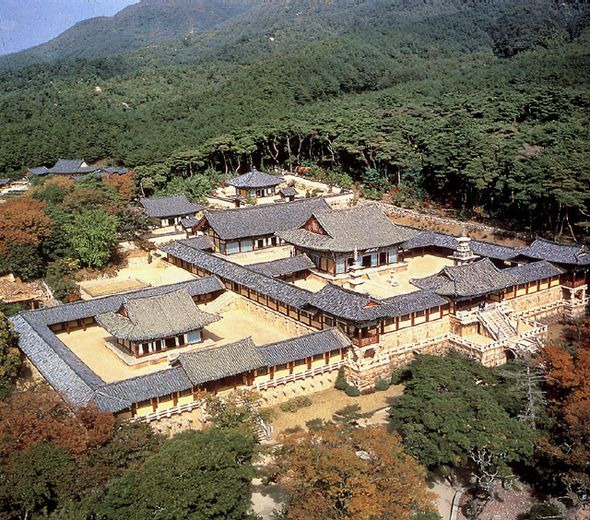
There is no record to confirm that definitively. Since the blueprints or calculation sheets for Seokguram or Bulguksa do not remain, the proportions discussed today are all interpretations read by later researchers through physical measurements.
The tools pointed to by those interpretations are quite specific. The aforementioned encyclopedia entry reads the development of squares and their diagonals, the division of equilateral triangles and perpendicular lines, and octagons and inscribed circles in the floor plan of Seokguram, and points to the 1:2:4:8 reducing proportions and the development of squares and diagonals in the Dabotap Pagoda of Bulguksa. The interpretation that a 1:√2 proportion flows through Seokguram also appeared early on, with art historian Kang Woo-bang recalling he was captivated by that research, and work to restore the original floor plan through measurements, such as the 2020 architectural history research paper, continues.
√2 is the diagonal of a square with a side of 1, which is the hypotenuse of a right triangle with two legs of 1. In that sense, the proportions of Seokguram and the Gugohyeon theorem are clearly linked. However, one does not need to know the theorem to draw a diagonal on a square. A single string is enough. Therefore, the statement supported by both records and measurements is that “Silla artisans used squares, diagonals, and equilateral triangles as design tools,” and “built with the Gugo method” is an interpretation that goes one step further.
Why the Gugohyeon Theorem left behind ‘Methods’ (Sul) instead of ‘Proofs’
The answer lies in who needed this mathematics.
Traditional Korean mathematics was almost exclusively state mathematics, and the mathematicians (Sansas) in charge of calculations were low-level technical officials handling taxes, storage, and accounting. What they needed were the procedures to produce the area of land to be taxed, the volume of earth to be piled, and solar eclipse dates without error. Trust in the procedures was guaranteed by the calculations that worked every time.
Perhaps for this reason, the encyclopedia entry notes that in East Asian math books, shapes were always objects for measuring area and volume, and construction problems involving drawing shapes with a ruler and compass never appeared. Even after Western-style textbooks were introduced during the enlightenment period, the habit of focusing on results while setting aside the proof of theorems remained for a while, so this difference lasted quite a long time.
Returning to the pond story, the water depth is 12 feet, and the reed is 13 feet. The 『Nine Chapters on the Mathematical Art』 demanded those two numbers, and the 『Elements』 demanded why those numbers could not be anything else.
References
- Nine Chapters on the Mathematical Art — Oriental Classics Database
- The Nine Chapters on the Mathematical Art — Wikipedia
- Exemplar 21: The Ancient Chinese Proofs on Pythagoras' Theorem
- Zhoubi Suanjing — Wikipedia
- Pythagorean theorem — Wikipedia
- Mathematics — Encyclopedia of Korean Culture
- Land Surveys in Early Joseon (5 types of land survey forms in the 4th year of King Hyojong) — Woori-yeoksa-net