
I just won a 1 million won pot, so why do my hands feel looser starting from the very next one?
It’s because of the House Money Effect—a psychological phenomenon where we mentally categorize winnings into a different pocket as “free money.” In a 1990 study, 77% of participants who had previously won money were willing to engage in additional gambling.
When Winnings Feel Like Free Money
Imagine Alex, a hypothetical player sitting at a cash game table.
Early on, they get a streak of good cards and win 1 million won. As the chips stack up, Alex starts calling raises with marginal hands they would normally fold, and even mixes in bluffs they wouldn’t usually attempt.
An hour later, the profit is gone, and even the original buy-in has dwindled.

Anyone who has played poker knows this flow.
Even though the 1 million won brought from the bank and the 1 million won won at the table are identical in value, the brain treats them completely differently.
Behavioral economics has given this phenomenon a name.
It is the House Money Effect, implying one is gambling with the house’s money.
The Numbers Behind the 1990 Thaler & Johnson Study
This term was cemented in academia by Richard Thaler and Eric Johnson’s 1990 paper, 「Gambling with the House Money and Trying to Break Even」.
When participants were told they had already won $15 and were asked if they would bet $4.50 on a coin toss, 77% agreed. Conversely, when offered a $2.25 coin toss after losing $7.50, only 40% agreed.
What’s interesting is the third condition.
Even in a losing state, if the bet offered a chance to “break even,” the agreement rate jumped back up to 60%. This is the latter part of the paper’s title: the break-even effect. Winners bet because they see it as free money; losers bet to get back to even. The two mindsets seen at a poker table were perfectly replicated in the lab. This effect has been confirmed in multiple subsequent studies, and a 2025 meta-analysis in Frontiers in Psychology re-examined how mental accounting influences risk-taking and spending.
Why Does the Brain Count the Same Money Differently?
Two theories are at play here.
First is Mental Accounting, a concept proposed by Thaler.
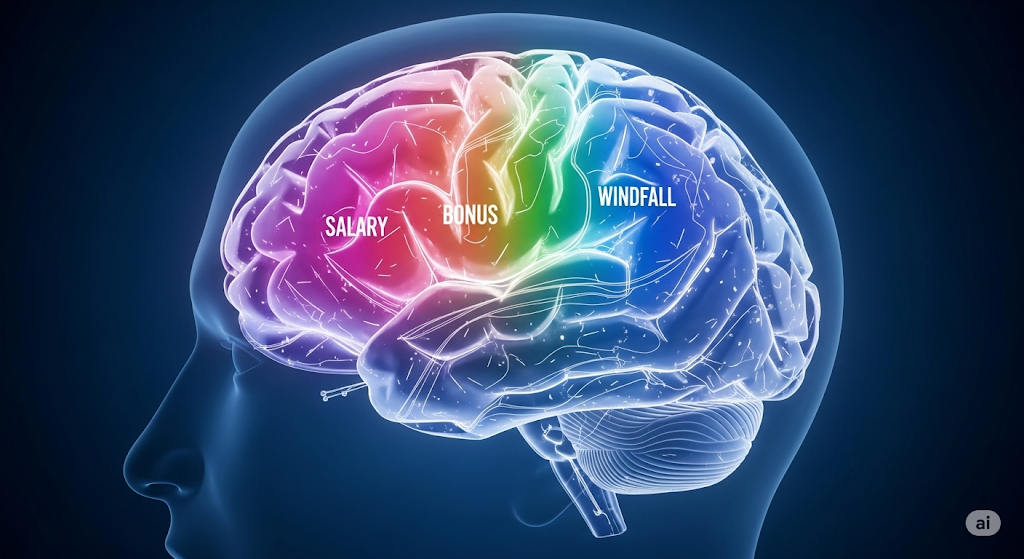
People label money by its source and purpose, placing it into different mental accounts. You might easily spend 1 million won from a tax refund on a high-end restaurant, but hesitate to spend the same amount from your salary on the same meal. This is because the refund goes into a ‘windfall account,’ while the salary goes into a ’living expenses account.’
Second is the Prospect Theory by Daniel Kahneman and Amos Tversky.
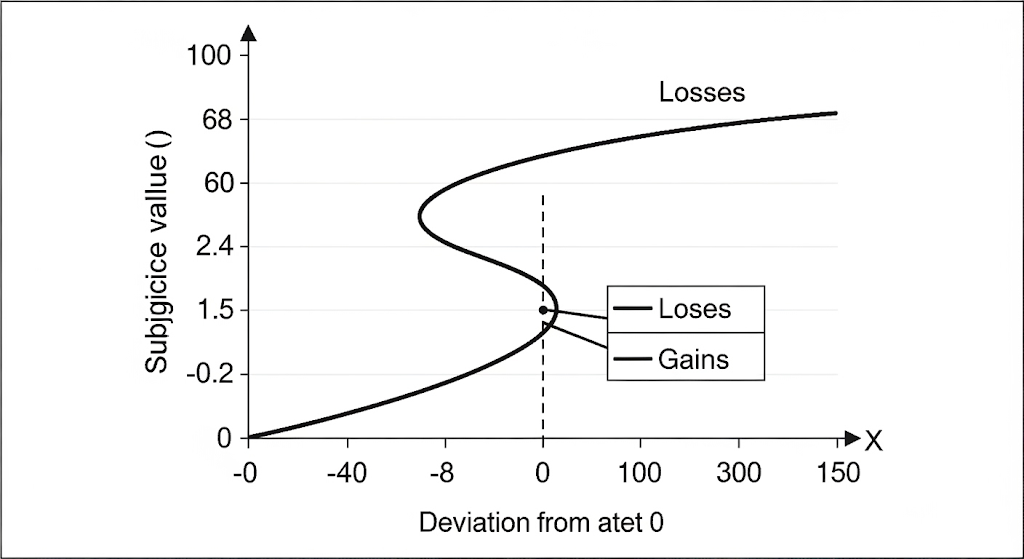
People evaluate results not based on their total wealth, but on how much it has increased or decreased from a reference point. Furthermore, losses feel significantly more painful than equal gains. The loss aversion coefficient estimated in a 1992 follow-up study is about 2.25, the basis for the common “loss feels twice as bad” rule. The value function flattens on the gain side (risk aversion) and steepens sharply on the loss side (risk-seeking to break even).
Combining these two theories explains the house money effect.
When you win a big pot, your brain separates the winnings from your ‘original money’ into a separate account.
However, your reference point remains the stack you started with. Therefore, losing the winnings feels like a ‘diminished profit,’ not a loss.
Because you are sliding along the flatter gain curve rather than the steep loss curve, the brake of loss aversion is weaker than usual. The root of the problem is failing to view all chips as part of a single account.
Reading this, I realized why the term ‘game money’ is so accurate. The chips you win really do look like a different bank account.
Three Illusions at the Table: After Winning and Losing
The House Money Effect After Winning. A player who just won a big pot with a set now has a gutshot straight draw. Their opponent makes a pot-sized bet on the turn. An hour ago, they would have folded because the pot odds weren’t there. Now, they make a negative EV call, thinking, “It’s the opponent’s money anyway.”
Chasing After Losing. On the flip side, there’s the break-even effect. A player who went all-in with AA and got beaten on the river falls into the loss zone of the value function, becoming risk-seeking. Their goal shifts from making good decisions to ‘getting back to zero.’ They re-raise with A-9 offsuit on the next hand and throw a reckless bluff on the river. This is what’s commonly called chasing.
Winner’s Tilt. While it looks similar to the house money effect, the root is different. If the house money effect is a calculation error, tilt is an emotional state. Some become loose after a winning streak, feeling invincible, while others become terrified of losing their winnings, folding even strong hands.
These three don’t operate in isolation. If you lose a big pot while playing recklessly due to the house money effect, the loss feels even more unfair because you were on a winning streak. That resentment fuels chasing, and if the chase fails, it leads to angry tilt.
Pros Tighten Up: The Reverse House Money Effect
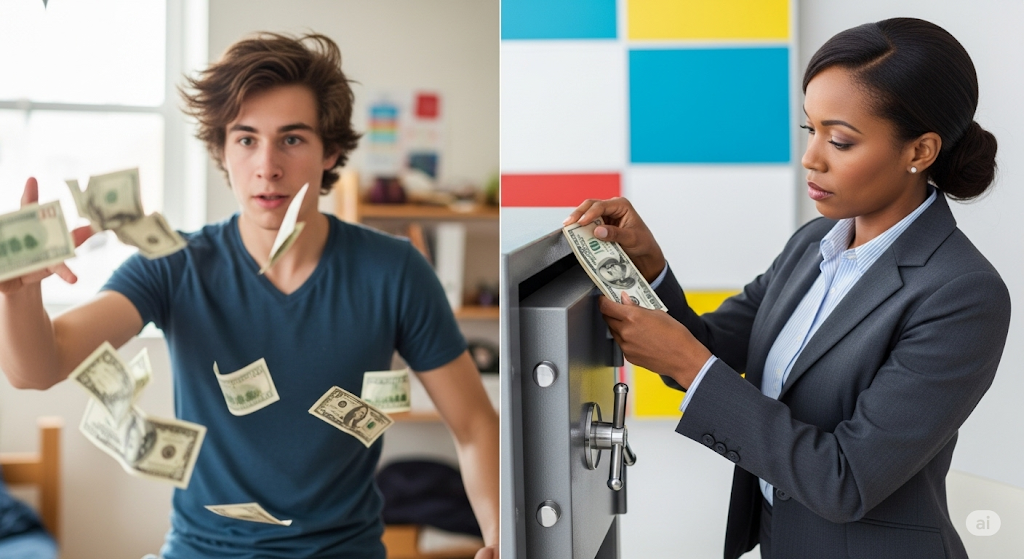
Not everyone behaves this way. A study by Eil and Lien analyzing the hand histories of experienced poker players observed that they tend to play tighter after winning and looser after losing. The tendency to become more conservative after winning is called the Reverse House Money Effect.
The difference comes from the labels.
For an amateur, a big win is a windfall for their fun account.
For a pro, it is money that is immediately integrated into their business capital—their bankroll. Even for a pro, the reference point rises after a win, but their goal is to protect the increased capital.
Losing the won money is not ‘diminished profit,’ but a depletion of their livelihood. Same theory, different labels, opposite behavior. It is worth noting, however, that the break-even effect of becoming loose after losing remained even for pros.
There are a few other variables that change behavior even after the same victory:
- Chips vs. Cash. In an experiment using chips, people bet more and more recklessly than with cash. Chips abstract the money and dull the pain of payment.
- Luck vs. Skill. Money won on a one-outer on the river is more likely to go into the windfall account, while money earned through precise value betting is easily classified as a reward for effort. Research showing that skilled players are less prone to biases like the gambler’s fallacy supports this ability to differentiate.
- How much was won. In prospect theory, the perception of change becomes duller as you move away from the reference point. The effect is likely strongest after a win or loss that is ’large’ relative to the usual stakes.
Ultimately, behavior after a win is not just about the win or loss, but a combination of skill, attribution, form of currency, and scale.
Bankroll Management: Bundling Chips into One Account
the first step of the solution is a mechanism to view all chips as a single account.
Bankroll Management (BRM) is a rule that separates money used only for poker and determines the stakes one can play based on that size. In behavioral economics terms, this is a pre-commitment device.
It is the calm ‘you’ locking up the excited ‘future you’ in advance.
The table below aggregates recommendations from various guides such as PokerNews, BlackRain79, and PokerCoaching.
Since numbers vary by site, it is better to view them as starting points rather than absolute standards.
| Game Format | Aggressive | Standard | Conservative |
|---|---|---|---|
| NLHE Cash Game (6-Max) | 30 Buy-ins | 50 Buy-ins | 100 Buy-ins |
| NLHE Cash Game (Full Ring) | 25 Buy-ins | 40 Buy-ins | 75 Buy-ins |
| PLO Cash Game (6-Max) | 50 Buy-ins | 100 Buy-ins | 150 Buy-ins |
| MTT (Small field, <200 players) | 100 Buy-ins | 200 Buy-ins | 300 Buy-ins |
| MTT (Large field, >200 players) | 200 Buy-ins | 400 Buy-ins | 500+ Buy-ins |
| SNG (9-man) | 30 Buy-ins | 50 Buy-ins | 100 Buy-ins |
Aggressive standards are for hobbyists with outside income who can replenish their bankroll, carrying the highest risk of bankruptcy. Standard is for serious amateurs and semi-pros, and conservative is for those who rely on poker as their primary income.
For example, to play a 100,000 won buy-in NLHE 6-Max conservatively, you need at least 10 million won in your bankroll. If it drops to 8 million won, you don’t read it as “I lost 20 buy-ins,” but as “a signal to move down a level.” Within this rule, the 1 million won you just won is just a part of your bankroll, leaving no room for a separate free money account.
How to Handle Tilt: Focusing on Decisions, Not Results
If the bankroll is the outer defense, mental training is the inner defense.

Mental coach Jared Tendler uses the Inchworm Concept.
Just as an inchworm moves by extending its front and pulling up its rear, improving your skill requires expanding your best play (A-game) while simultaneously raising the floor of your worst play (C-game). He recommends noting what your A, B, and C games look like and identifying the triggers that drop you into your C-game.
Daniel Negreanu gives more practical advice in his Masterclass.
While you can’t eliminate frustration itself, you can choose your reaction, so once you recognize the emotion, immediately return to the fundamentals of the hand at hand. After a session, ask about the process, not the results: “Did I put money in when I was behind? Did I bluff too much?” And if you see an opponent falling into the house money effect or tilt, adjust your strategy to exploit those predictable mistakes.
All of this was on display in the September 2022 Hustler Casino Live J4 hand.
Robbi Jade Lew called Garrett Adelstein’s all-in with J4 offsuit and took a massive pot. Her call was theoretically difficult to explain, leading to cheating allegations, but no conclusive evidence was found. What was clear was how the subsequent uproar showed how a bad beat can spiral into tilt.
Annie Duke, a former pro poker player who studied cognitive psychology, summarizes this in Thinking in Bets.
Separate the quality of the decision from the quality of the result.
A good decision can lead to a bad result, and a bad decision can lead to a good result.
Those caught in the house money effect believe, “I won, so I played well,” and those chasing believe, “I lost, so I must win it back.” Both are choosing their decisions based on the outcome.
Here are four things you can try immediately:
- Keep a log for the next 10 sessions. Note whether you made loose calls right after big wins and what triggered your C-game.
- Set your own standards from the table above, write them down, and follow them without exception for a month.
- Focus on correcting one C-game weakness (e.g., chasing losses) and mastering one A-game skill.
- At the end of every session, ask “Did I make +EV decisions with the information I had?” instead of looking at the profit.
Labels on money aren’t visible, but they are stamped clearly on your bet sizes.
Realizing that won chips are the same money as the chips you brought is a simple calculation that is much harder to maintain at the table than you’d think.
That this illusion isn’t just about poker is covered more broadly in how cognitive biases trip up smart people and the myth of the rational human broken by behavioral economics. The strategy of setting rules in advance to bind your future self continues in why New Year’s resolutions fail and commitment strategies.
References
- Richard H. Thaler, Eric J. Johnson, Gambling with the House Money and Trying to Break Even, Management Science (1990)
- Frontiers in Psychology, The role of mental accounting in risk-taking and spending: a meta-analysis of the house-money effect (2025)
- Wikipedia, Mental accounting
- KDI Center for Economic Education, Behavioral Economics Exploring Human Psychology
- Nicholas Barberis, Ming Huang, Tano Santos, Prospect Theory, Mental Accounting, and Momentum, Yale ICF
- Judgment and Decision Making, Why are gainers more risk seeking
- The role of chips in poker gambling: An empirical pilot study, ResearchGate
- Skilled poker players provide more accurate responses than amateur poker players to the Gambling Fallacies Measure, CDS Press
- Wikipedia, Tilt (poker)
- PokerNews, Poker Bankroll Management: An Introduction
- BlackRain79, Poker Bankroll Management - Ultimate Guide
- PokerCoaching.com, The Bankroll Bible
- Jared Tendler, The Inchworm Concept
- Jared Tendler, Truly Understanding C-game
- MasterClass, Managing and Exploiting Tilt | Daniel Negreanu Teaches Poker
- Annie Duke, Thinking in Bets (2018) Summary, The Deckle Edge