
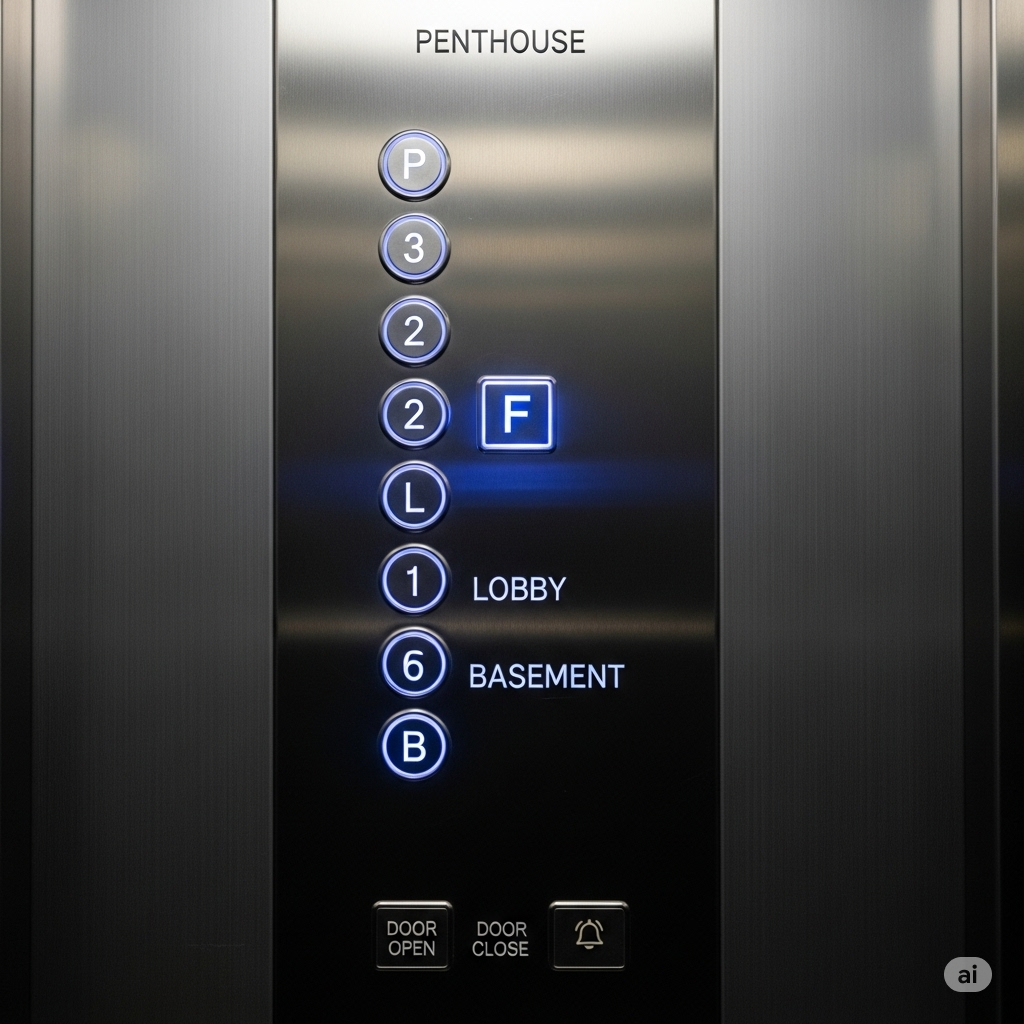
You get on an elevator, and there is no button for the 4th floor. Instead, there’s just an ‘F’ button sandwiched between the 3rd and 5th floors.
Everyone has encountered this scene at least once. While you might press the ‘F’ button without much thought, this isn’t just a random labeling choice—it’s a remnant of a linguistic reflex thousands of years old.
‘Tetraphobia,’ the fear of the number 4, goes far beyond simple superstition.
It leaves its mark everywhere: from building floor numbers and hospital room assignments to license plate auction prices and even heart disease mortality statistics. We traced these traces through Korea, China, and Japan.
The Real Reason the Number 4 Is Linked to Death
The culprit, unexpectedly, is ‘sound.’ The whole thing started because the Chinese character for ‘four’ (四) and the character for ‘death’ (死) happen to be pronounced the same. While their meanings are completely different, the pronunciations—already similar in ancient Chinese—have merged completely into ‘sì’ in modern Standard Chinese, ‘sa’ in Korean, and ‘shi’ in Japanese, inheriting the shadow of ‘death’ along the way.
What’s noteworthy here is the path through which this superstition spread.
In the past, Chinese characters were a yardstick and symbol for knowledge and power in East Asia. When Korea and Japan adopted this writing system, they didn’t just take the sounds and meanings; they brought the attached superstitions as a package deal.
Learning the script meant adopting the associations that the characters carried along with them.
This is why, unlike other regional superstitions, tetraphobia has remained so stubbornly persistent in all three countries.
Usually, superstitions are passed down by word of mouth and fade over generations, but tetraphobia spread via a much sturdier vehicle: writing.
Words may be forgotten, but written characters remain, and each new generation learning the script automatically inherits the phonetic pairings engraved within it. Since Sino-Korean vocabulary includes far more characters than there are phonetic syllables, it is common for two characters with opposite meanings to share the same sound. The pairing of 4 and death was simply a case where the number most frequently encountered in daily life collided with the heaviest word of all.
Honestly, even I have a split-second pause when I press the 4th-floor button in an elevator. I can’t explain why, but my finger hesitates for a half-beat. This is a cognitive shortcut created by language. Because the word ‘death’ is automatically triggered the moment you say the number, your body reacts before your logic kicks in.
This homophone-based superstition isn’t limited to just Korea, China, and Japan.
In Vietnam, which is also part of the Sinosphere, the sentiment of avoiding 4 persists, and you can see it omitted from building or shop numbers.
Conversely, in the West, 13 takes that spot. Stemming from the story of Judas Iscariot, who sat in the thirteenth seat at the Last Supper, this taboo often leads to the disappearance of the number 13 from hotel floors or airline seat arrangements in the West.
In Italy, 17 takes that role instead of 13. When written in Roman numerals, 17 is ‘XVII,’ which can be rearranged to form ‘VIXI’—Latin for ‘I have lived,’ which implies the past tense and is thus read as the words of someone already dead.
Though they started from different roots—language and religion—the behavioral pattern of ‘avoiding at least one unlucky number’ is surprisingly similar between the East and the West.
Why Does Korea’s Tetraphobia Only Remain as an ‘F’ Button?
Korea’s tetraphobia isn’t loud. Instead, it permeates like air, operating simply as a sense of ‘unease.’
The ‘F’ button in elevators is the prime example. It’s a clever compromise: acknowledging the number itself while avoiding speaking the ominous sound. The interesting part is that this compromise is only half-hearted. Many buildings still have ‘4th Floor’ written on directory boards or official documents. They only swap it for an ‘F’ on buttons and indicators—places that catch the eye every day. It is a practical compromise that minimizes inconvenience while eliminating that nagging sense of unease.
This quiet avoidance is also found in the military. The Republic of Korea Army has no ‘4th Infantry Division.’ In the past, a series of unfortunate incidents led to it being branded an ‘unlucky unit,’ eventually leading to its permanent decommissioning. It’s a case where a single number changed the organization of a group where logic and regulations should take precedence.
It’s a similar story in hospitals. Many still don’t assign a Room 4 or a 4-person ward, and this consideration becomes even more meticulous in spaces closely linked to death, such as OB/GYN clinics or funeral homes.

Korean-style tetraphobia is less about individual fear and more about ‘social risk management’—avoiding harm to communal harmony. It’s the result of choosing to take a quiet detour because there’s no gain in confronting the superstition head-on.
Interestingly, this avoidance is much more relaxed when it comes to phone numbers or license plates. Most people don’t care if a number contains a single 4, and only pay attention when two or more 4s appear together. People are strict about long-lasting things like spaces and institutions, but lenient toward numbers that are merely passing by.
However, this sensitivity flares up again during family events like weddings or funerals. Amounts containing a 4 in the leading digit, like 40,000 or 400,000 won, are rarely used in congratulatory or condolence money envelopes. It has become a convention to naturally skip to 30,000 or 50,000 won. Rather than a fixed rule, it’s an implicit agreement that everyone follows without really questioning why.
How China and Japan Handle Tetraphobia Differently
Though they started from the same root, China and Japan have cultivated this superstition in completely different ways.
China’s tetraphobia is overt and deeply intertwined with money. Since the number 8 (八, bā) sounds like ‘getting rich’ (發財, fācái), it has become a symbol of good fortune, creating a stark contrast between the ‘death’ of 4 and the ‘wealth’ of 8.
This contrast manifests in actual price tags.
At a 2025 Hong Kong Lunar New Year license plate auction, a plate containing ‘88’ sold for approximately 11.4 million HKD—about 1.5 billion KRW.
In 2016, a ‘28’ license plate was auctioned for a record-breaking 18.1 million dollars, while at the other end of the same auction, ordinary plates with no lucky numbers sold for the legal minimum of 1,000 dollars. Physically, they are the same license plates, yet the price gap exceeded ten thousand times.
At the other end of this gap lies the number 4. Plates loaded with 4s sell for pennies, and in the real estate market, it’s common to omit the 4th, 14th, and 40th–49th floors entirely.
Interestingly, this price difference isn’t bad for the government. For the Hong Kong government, which uses license plate auctions as a source of national revenue, the stronger the superstition, the higher the premium on ’lucky’ numbers, which increases tax revenue. They chose to leverage the superstition within the auction system rather than eliminate it.
In Japan, the number 4 doesn’t travel alone.
The number 9 (九, く) sounds like ‘suffering’ (苦, く), forming a powerful ‘duet of misfortune.’
This combination is especially potent in hospitals. Not only are rooms 4 and 9 avoided, but room 42 (which sounds like ‘going to die’) and room 43 in OB/GYN wards (which overlaps with ‘stillbirth’) are typically never assigned.
Interestingly, Japanese people often avoid the bad luck by reading the 4 as ‘yon’—which has nothing to do with death—instead of ‘shi.’ It’s a sophisticated avoidance technique that turns off the danger signal just by changing the pronunciation.
For places not encountered daily, such as parking garage levels or mailbox numbers, the number 4 is surprisingly often used as-is. The hallmark of Japanese-style tetraphobia is ‘selective avoidance’: strictly adhering to the taboo only in spaces where life and death actually intersect, like hospitals, and not worrying much about it elsewhere.
This combination also permeates gift culture.
When choosing gifts like sets of plates or glasses in Japan, it’s common to avoid sets of 4 or 9, opting for sets of 3 or 5 instead.
The custom of not bringing potted plants when visiting someone in the hospital follows a similar logic. The phrase ’nezuku’ (taking root) can be interpreted as staying stuck in a hospital bed. This delicate consideration to avoid the shadows of death and suffering without mentioning them directly has spread beyond just numbers into general lifestyle customs.

Did Tetraphobia Actually Kill Anyone?
From here on, it’s not about superstition; it’s about statistics.
In 2001, a study published in the British Medical Journal (BMJ) by sociologist David Phillips and his colleagues analyzed the death certificates of approximately 200,000 Chinese and Japanese Americans who died in the U.S. between 1973 and 1998. The result? Heart disease deaths were 13% more likely to occur on the 4th of the month than would be expected by chance, and in California, where the Asian population is particularly high, that increase jumped to 27%. Conversely, no such pattern appeared in the white control group during the same period.
The research team named this phenomenon the ‘Baskerville effect,’ after Sir Charles Baskerville, who died of a heart attack caused by extreme fear in a Conan Doyle novel.
Of course, these results weren’t quietly accepted by the academic community.
Statisticians pointed out that the team had selectively analyzed ‘chronic heart disease,’ which happened to show a spike on the 4th, among many categories of heart disease. They argued that if you perform a multi-comparison adjustment across all 28 days of a month, the initial dramatic significance level weakens significantly. The key counter-argument was that while the initial p-value was a very low 0.0015, it rose to 0.043 after adjusting for all 28 days. While still statistically significant, it’s not as overwhelming as first reported. In other words, while it’s hard to say there is no effect, it’s also hard to conclude that it is as dramatic as first announced. The consensus remains that it is not as extreme as the initial figures suggested.
Subsequent research conducted in Hong Kong expanded the target to include not just the 4th, but also the 14th and 24th—days that also ’evoke death’—confirming a similar trend and adding new evidence to the debate.
This study utilized death records from the Hong Kong Census and Statistics Department from 1995 to 2000, and it is significant because it targeted the local Hong Kong population, where tetraphobia is deeply rooted, rather than an immigrant society in the U.S.
This showed that the results weren’t just a byproduct of cultural adaptation stress in an immigrant society, but that the same traces remain in the land where the superstition was born.
This discovery, that the fear of numbers is physically ingrained, shows that even superstitions can be stress factors to which the body reacts. The common assessment among science writers who have revisited this study is that it’s too specific to be dismissed as mere superstition.
Thinking carefully, what these results point to isn’t the number 4 itself, but the mind that fears it.
The hypothesis is that in front of a date that evokes death, the stress hormones of someone whose body is already weakened spike, and that reaction places an additional burden on the heart. It means that superstition doesn’t kill people directly, but that the belief in the superstition affects the body indirectly through stress. This is a point where one shouldn’t reverse cause and effect.
What makes this research interesting is that the individuals themselves may not even be aware that they are afraid of the number 4. Even someone who claims they don’t believe in superstitions might find their heart feeling heavier if a hospital appointment is scheduled for the 4th. This is because the reflex planted by culture operates quietly, far below the level of conscious belief, at the level where the body reacts.
The Number 4 Was Originally a Symbol of Perfection
It’s equally unfair from the perspective of the number 4.
For a long time, across both East and West, this number has symbolized stability and perfection.
The four seasons of spring, summer, autumn, and winter, and the four cardinal directions represent the cyclical structure of the world, and the Western four-leaf clover is also considered a symbol of good luck in East Asia.
Traditions expressing perfection through the number 4, such as the ‘Four Gracious Plants’ (Sagunja) representing the virtues of a gentleman or the ‘Four Heavenly Kings’ guarding the Dharma, are deeply rooted.
It is in the same vein that ancient Greek philosophers explained the world through four elements—water, fire, air, and earth—and that we measure space through four axes: length, width, depth, and height.
The number 4, which we only knew as the number of death, has actually long been used as a number that completes the world.

Recently, a trend has emerged, especially among the younger generation, of treating this taboo lightly or even using the number 4 with pride.
More brands are not shying away from ‘4th Anniversary’ events for store openings, and self-deprecating jokes using the number 4 are common online.
There are cases where K-pop idols use the number 4 in their personal numbers or birthdays as an affectionate nickname, and more brands are intentionally including 4 in store names or product numbers.
As mentioned in various sources like Namuwiki, a significant number of people are completely unaware of or indifferent to the taboo against the number 4. Most people don’t blink at a phone number containing one 4, and there are even cultures, like Germany, that prefer the number 4.
This means that the centuries-old ‘4 = Death’ formula is not an absolute law, but a trend that varies in intensity depending on region and generation.
Superstition is not a fixed truth, but a living habit that fades as the times change.
Once You Understand Tetraphobia, Elevator Buttons Look Different
This story, which began with a small ‘F’ button in an elevator, shows how the pronunciation of a single character can touch language, economics, and even the body’s reactions. Korea digested the same superstition through consideration, China through price tags, and Japan through hospital room numbers, each in its own way. And beneath it all lies a stress response confirmed by actual statistics.
All three countries started from the same phonetic accident that ‘4 = Death,’ but each society handled that accident in a different way.
Looking back, this is ultimately a story about how powerful language is.
It isn’t a tangible danger, yet just because one pronunciation overlapped, that coincidence changed building blueprints, made auction prices differ by tens of thousands, and even left traces in death certificate statistics.
Even knowing there is nothing wrong with the number 4, we still hesitate for a beat in front of it. The fact that a single accidental association created by language can spread so widely and last so long is, in itself, astonishing.
And that coincidence is still determining the floor labels of new buildings and separating the prices of new license plates somewhere right now.
Next time you ride an elevator and see that ‘F’ button, it might be worth remembering that behind that one letter of the alphabet lie a Chinese character, a statistical paper, and several winning bids at an auction. And today, somewhere, a hospital is leaving room 43 empty and skipping straight to room 44.