
Watching fireworks burst across the night sky fills anyone with excitement. However, I was so curious about the origins of fireworks that I dug into the history, and it turns out that the thunderous roars that once tore through the New Year’s Eve sky were not meant to celebrate anything. Instead, they started as a desperate sound to drive something away.
Beginning with Chinese firecrackers, where raw bamboo was burned to ward off evil spirits, the history of fireworks branched into completely different forms across the three East Asian nations. In China, it became a symbol of imperial authority and a part of daily rituals; in Joseon, it served as a diplomatic tool and a top-secret military asset known as Gwanhwa (觀火); and in Japan, it evolved into Hanabi (花火), a summer festival for the common people to soothe the souls of the departed.
Why did fireworks, born from the same black powder, take such different paths in these three countries? I followed the hidden stories through the lens of ‘who launched the fireworks and who looked up at them.’
1. The Origin of Firecrackers (爆竹): A Sound-Based Ritual for Warding Off Evil
To find the oldest ancestor of fireworks, one cannot overlook the legend of the monster ‘Nian’ (年) in Chinese New Year folklore. This monster, which descended into villages every New Year’s Eve to harm people, had three fatal weaknesses: the color red, bright light, and loud noises.
Villagers would paste red paper on their doors, keep lights burning all night, and burn items to create loud, popping sounds to drive the monster away. This is the origin of the custom of ‘Guonian’ (過年), meaning to safely drive off the monster and welcome the New Year. Ultimately, the root of fireworks was a ritual of ‘Bixie’ (辟邪), or warding off evil spirits.
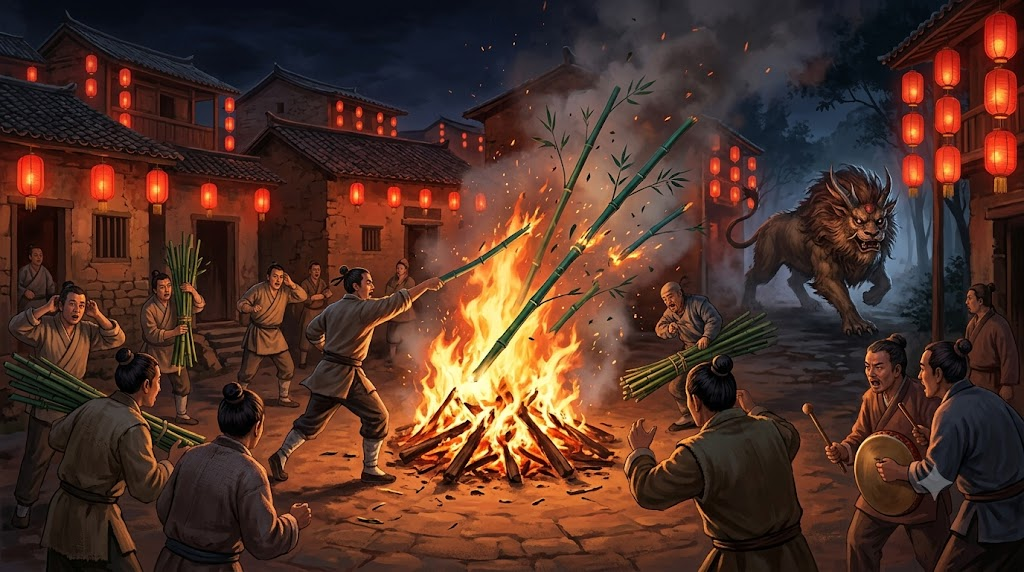
Interestingly, the tools people used before the invention of gunpowder were different. Instead of gunpowder, they threw raw bamboo into fires. The air trapped inside the bamboo nodes expanded rapidly from the heat, causing a satisfying ‘pop.’ This is why the word for firecracker (爆竹, bàozhú)—which we still use today—literally means ’exploding bamboo.’
Key Summary: The essence of early fireworks was not a visual spectacle of ’light,’ but an auditory ritual of using ear-piercing ‘sounds’ to ward off bad luck.
2. The Invention of Gunpowder and the Song Dynasty: From Folk Sounds to Imperial Light
Paradoxically, it was the Taoist alchemists dreaming of immortality who transformed the crude popping of bamboo into an art of brilliant light. During the Tang Dynasty, these monks, experimenting with mixtures of saltpeter, sulfur, and charcoal in search of an elixir of life, accidentally created black powder.
It was during the Song Dynasty (960–1279) that this gunpowder technology truly blossomed into the form of fireworks. Instead of bamboo, firecrackers made of tightly rolled paper filled with gunpowder appeared, and by mixing in metal powders and other substances to create diverse colors and shapes, ‘Yanhua’ (煙火)—the prototype of today’s fireworks—was born.
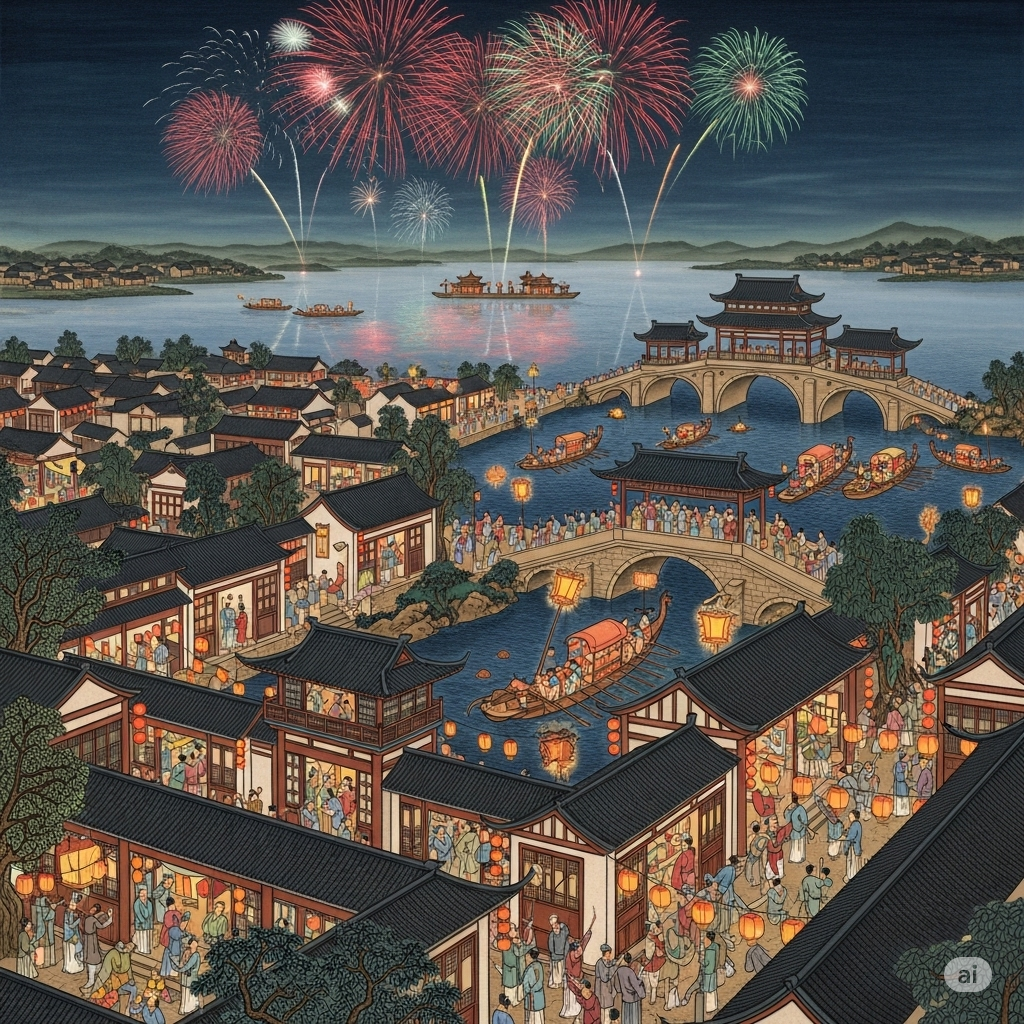
From this point, the entity controlling the fireworks changed. The Song court incorporated this mysterious and spectacular technology as a key attraction for royal banquets. Fireworks, which once chased away ghosts in rural villages, were elevated to colossal court stage equipment to flaunt the Emperor’s immense wealth and absolute authority.
However, there is one crucial twist we must not miss. The gunpowder that painted the night sky was also the material for lethal weapons like early firearms (fire lances) and bombs. The duality of gunpowder as both a ‘dazzling spectacle and a deadly weapon’ would later completely dictate how the neighboring Joseon Dynasty handled fireworks.
3. Joseon’s Gwanhwa (觀火): A Diplomatic Deterrent and Top-Secret Military Asset
By the time we reach the Joseon Dynasty via Goryeo, the ‘Gwanhwa’ (觀火) ritual, where fireworks were launched at the end of the ‘Narye’ (儺禮) ceremony to drive away the old year’s evil spirits, became established. While it adopted the Chinese custom of warding off evil, Joseon’s fireworks were different from the start because the state and the royal family held a monopoly on gunpowder and fireworks.
For the Joseon court, fireworks were not mere entertainment but a sophisticated diplomatic language and military strategy. Looking through the records of the Annals of the Joseon Dynasty, we can see how meticulously Joseon adjusted its attitude toward fireworks depending on the audience.
- Showing off to Japanese and Ryukyu envoys: When envoys from Japan or the southern islands arrived, the court deliberately launched the most spectacular and powerful fireworks. This was a silent show of force intended to impress upon them Joseon’s gunpowder manufacturing technology and formidable artillery power, warning them not to underestimate the kingdom.
- Strict secrecy before Ming envoys: Conversely, when Ming Chinese envoys visited, they tried to hide the fireworks. Officials during King Sejong’s reign even seriously argued, “Since our artillery and gunpowder technology is superior to China’s, we must not show Gwanhwa to the envoys and expose our technology.”
In short, the same firework was a means of intimidation to Japanese envoys and a state secret that must never be revealed to Ming envoys.
This military nature reached its peak during the nighttime military exercises at Hwaseong Fortress, known as ‘Yajo’ (夜操), during the reign of King Jeongjo. To demonstrate both powerful royal authority and military strength, Jeongjo held large-scale night drills, finishing them with a barrage of fireworks and the synchronized firing of Singijeon (multiple rocket launchers).
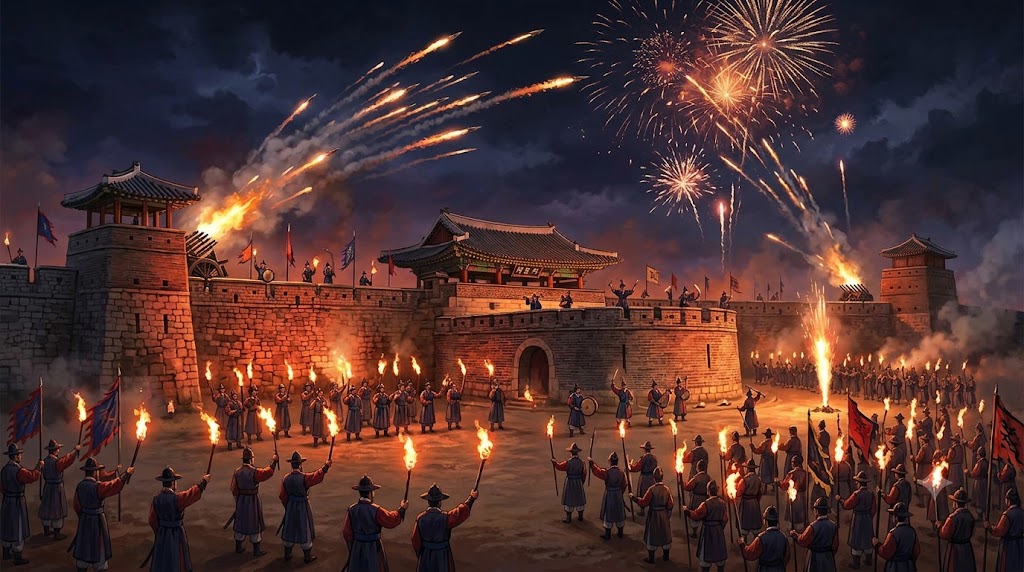
However, state-led court Gwanhwa had a fatal flaw. Since it involved burning gunpowder—a vital military resource—it was incredibly expensive. Under the influence of Neo-Confucianism, which strictly discouraged luxury, officials constantly submitted petitions against it. Eventually, court Gwanhwa declined, and in the private sector, it survived only in simple forms like ‘Daetbul-nori’ (bamboo fire play) or ‘Julbul-nori’ (string fire play). If you are curious about the weight of the rituals and authority carried by the Joseon royal family, reading the article [A Day in the Life of a Joseon King: The True Weight of the Royal Robes] will be very helpful in understanding the court culture of that time.
4. Japan’s Hanabi (花火): From Memorials for Famine Victims to Summer Festivals
Across the sea in Japan, fireworks evolved in a completely different direction. Unlike Joseon, where fireworks were confined under state control, they blossomed into a mass culture centered on the common people. Interestingly, the starting point of this spectacular festival was not joy, but deep mourning.
Considered the origin of today’s Japanese summer firework festivals is the water memorial service held on the Sumida River in Edo (Tokyo) in 1733 (the 18th year of the Kyoho era). After the horrific ‘Kyoho Great Famine’ and epidemics the previous year claimed countless lives, Shogun Tokugawa Yoshimune launched fireworks during a memorial service by the river to soothe the souls of the victims and ward off disease. This event instilled a unique sentiment of memorial and protection against evil into Japanese Hanabi.
During the long, peaceful Edo period, with gunpowder used less for warfare, the protagonists of fireworks shifted from shogunate authorities to common artisans (Hanabishi) and the commoners filling the riverbanks.
In particular, the technical competition between the two major firework artisan families on the Sumida River, Kagiya and Tamaya, became the top entertainment for Edo commoners. When the two families took turns launching fireworks from upstream and downstream, the crowds watching from the banks and boats would shout the name of the family they supported whenever a beautiful firework burst.
“Tamaya!” “Kagiya!”
Even today, when you go to a Japanese firework festival, people shout these two names when the fireworks explode—a vivid remnant of the rivalry between artisans from 200 years ago.
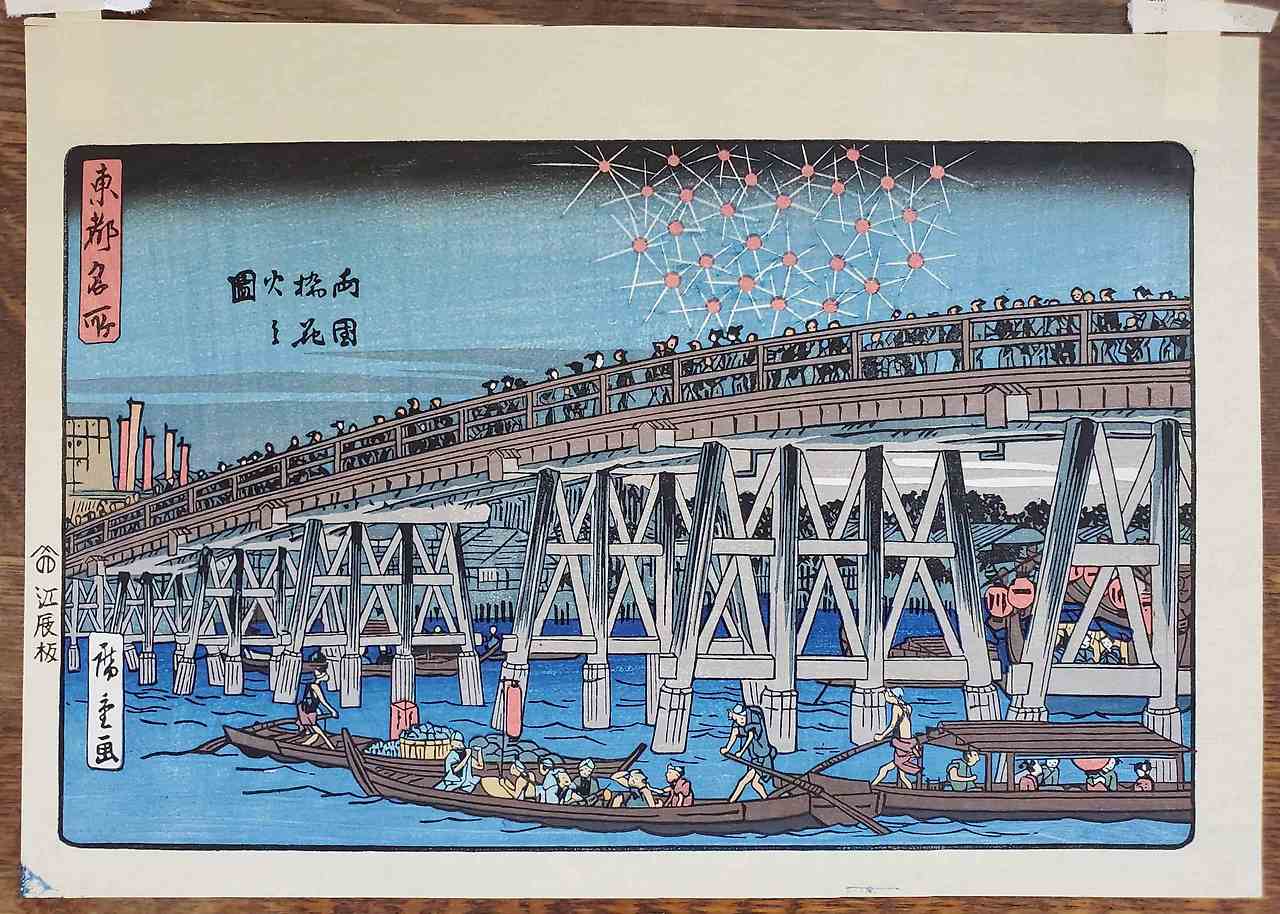
This intense commercial and artistic competition led to unparalleled technological advancement. Japanese artisans refined the spherical shell (tashan yanhua) technique, which spreads perfectly round like a chrysanthemum in all directions high in the night sky, making it the symbol of Hanabi.
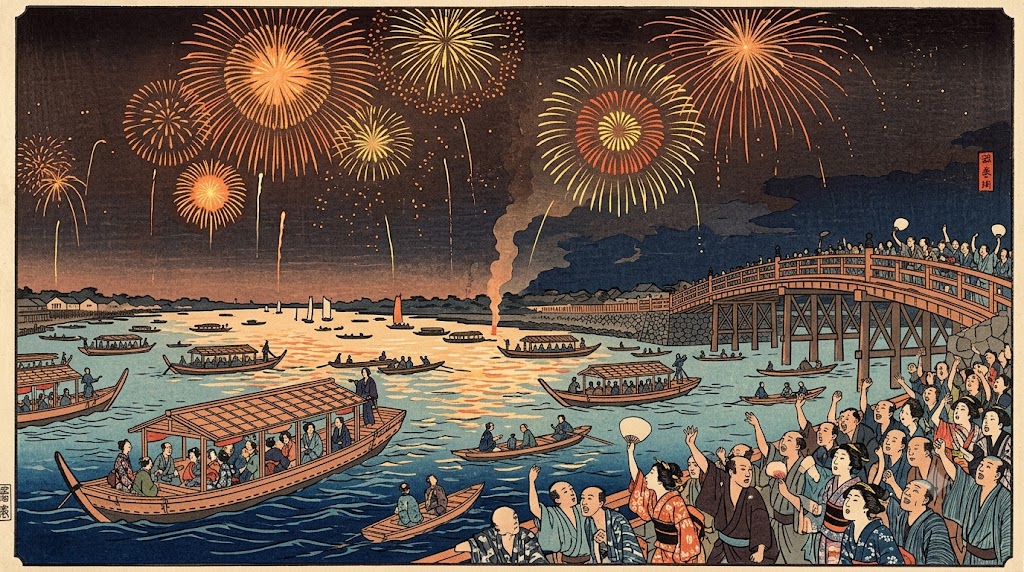
Feeling the transience and beauty of life while watching fireworks bloom most brilliantly in the black night sky, only to vanish without a trace in a few seconds, aligned with the unique Japanese aesthetic of ‘Mono no aware’ (the pathos of things) and became a staple of Japanese summer life.
Comparison of Fireworks in the Three East Asian Countries
| Category | China | Korea (Joseon) | Japan |
|---|---|---|---|
| Origin | Bixie: Driving away ‘Nian’, evil spirits | Bixie: Gwanhwa as part of court Narye | Memorial/Protection: Honoring famine/epidemic victims |
| Launcher | Folk → Song Imperial Court | State (Royal Court/Military) | Shogunate → Artisan Families |
| Relation to Power | Showcasing Imperial wealth/authority | Diplomacy (deterrence/secrecy), Jeongjo’s Yajo | Public event for stability |
| Technical Features | Invention of gunpowder/firecrackers | Combined with artillery technology | Spherical fireworks, artisan competition |
| Modern Form | Firecrackers for Lunar New Year/weddings | Court Gwanhwa declined, folk bamboo play | Summer tradition, local festivals |
6. Conclusion: Three Faces Created by ‘Who Held the Trigger’
Ultimately, the decisive turning point that led to the different fates of fireworks in the three East Asian nations was “who lit the fuse.”
- China, as the birthplace of gunpowder, started with folk bamboo popping to chase away evil spirits, moved through spectacular imperial displays, and left firecrackers as a ‘daily ritual’ used during the Lunar New Year and family events to this day.
- Joseon had the state strictly control and launch fireworks from the beginning, so they functioned strictly as a ’language of diplomacy and military.’ This led to the integration of fireworks with proprietary artillery and Singijeon technology, but due to the immense cost and Neo-Confucian aesthetic of restraint, it failed to spread widely as entertainment for commoners outside the palace walls.
- Japan started with memorial services for horrific disasters, but in the atmosphere of a peaceful era, fireworks passed into the ‘hands of artisans and commoners,’ went through commercial competition, and finally established themselves as a ‘popular art of summer festivals’ that the whole nation enjoys in yukata.
If you go to see a firework festival lighting up the night sky in the coming season, as the fireworks burst with a ‘pop’ above your head, you might want to consider that these brilliant sparks are layered with the desperation of ancient people chasing monsters with bamboo, the meticulous calculations of the Joseon royal family trying to intimidate foreign envoys, and the cheers of Edo commoners who forgot their worries while shouting “Tamaya!”
If you are curious about other signals of the era that people of the past tried to read while looking up at the night sky, I recommend reading [Comets in Korean History: The Story of ‘Flesh-stars’ That Changed the Fate of Dynasties] and [Gwansanggam: Joseon’s Weather Forecast and Scientific Innovation].
References
- Pressian, What is the significance of Chinese Lunar New Year customs?
- YTN, [3-Minute China] Are Chinese New Year firecrackers for driving away monsters?
- Youth Daily, Origin of Chinese firecrackers
- National Folk Museum of Korea, Encyclopedia of Korean Folk Culture, Firecracker play
- Digital Sunchang Cultural Center, Burning Bamboo
- Wikipedia, Black Powder
- Dance Webzine, National Gugak Center Narye (Exorcism Ritual)
- Chosun Ilbo, Lee Han-woo's WHY in History (2008-08-29)
- Jungdo Ilbo, [Cheongyang Multiculturalism] Japan "We enjoy fireworks in summer" (2021-08-21)
- Shingu University Newspaper, Bomb that chases away evil? NO! Fireworks that bewitch people!