
Following the Journey of Humanity’s Fundamental Narrative through World Creation Myths and Modern Science.
- Types of world creation myths across different cultures and their commonalities
- The story of the universe’s origin told by science, from the Big Bang to the birth of life
- The powerful influence of origin stories on social order and individual psyche
The Storytelling Being: Exploring Humanity’s Origin Stories
Humans are storytelling beings, or ‘Homo Narrans’. The impulse to find one’s place in the vast universe and weave the chaotic fragments of experience into a meaningful order is one of humanity’s deepest instincts. The engine that drives this instinct is the ability to create ‘origin stories’.
According to cognitive science, our brains are designed to organize information into narrative structures with causal relationships. Stories are efficient survival tools that compress complex information and foster empathy for others’ experiences. On a deeper level, origin stories serve as psychological defense mechanisms that manage the fear of death. ‘Terror Management Theory’ explains that humans construct cultural worldviews that explain the universe’s origin and the purpose of life to overcome their finitude. Thus, the creation of origin stories can be seen as an essential ’narrative necessity’ for human survival and mental well-being.
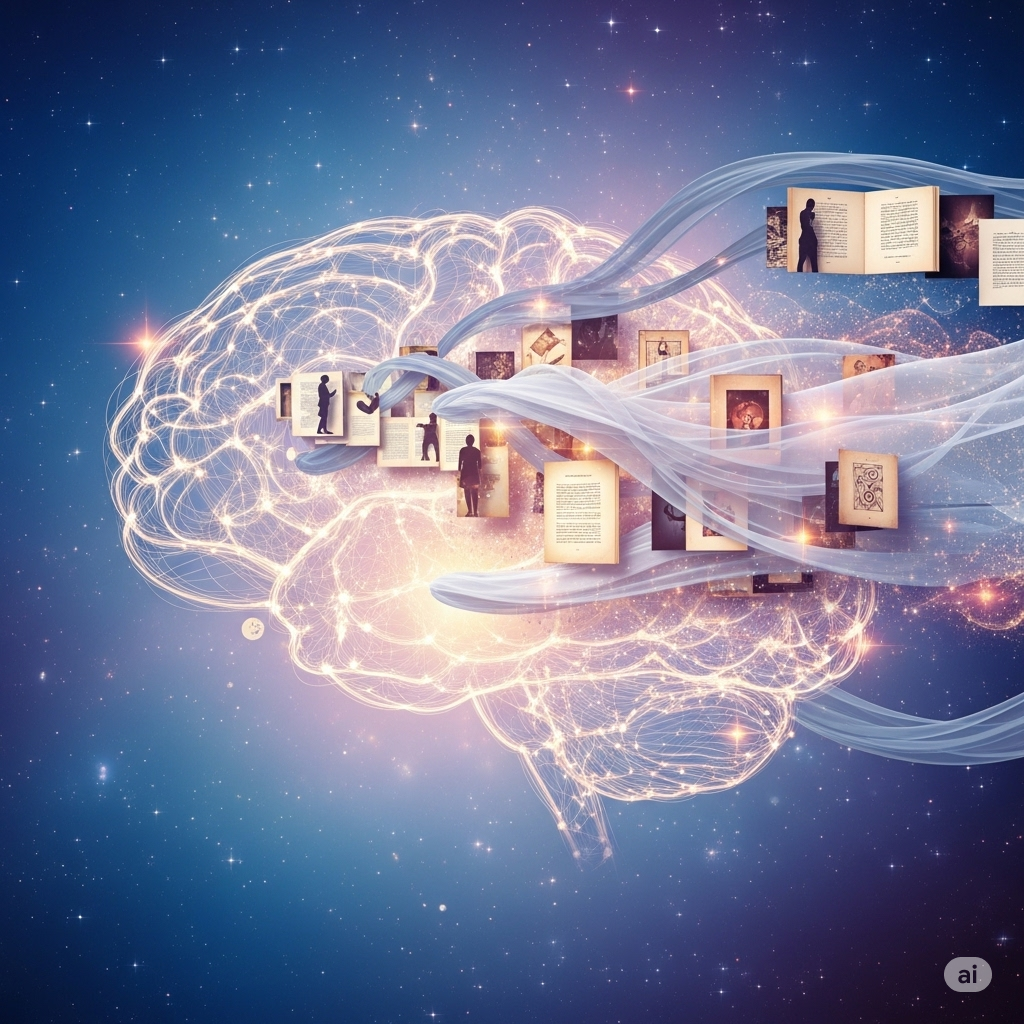
Origin Stories in Myths: How Did the World Begin?
Creation myths from around the world share remarkably similar structures and archetypes. This shows that humanity, regardless of location, has pondered the immense question of the universe’s origin in similar ways.
Comparative Analysis of World Creation Myth Archetypes
| Culture | Core Archetype | Creation Method and Result |
|---|---|---|
| Greek-Roman | Creation from Chaos | Gods emerge from the empty void (Chaos), and a dynamic world is formed through generational struggles. |
| Egyptian | Creation from the Abyss | Hills rise from the primordial waters (Nun), and the hermaphroditic god Atum gives birth to gods, establishing order (Ma’at). |
| Abrahamic | Creation from Nothing (Ex Nihilo) | The monotheistic god creates the world through a word (Fiat), characterized by a hierarchical order with a clear distinction between creator and creation. |
| Chinese | Cosmic Egg & Sacrifice of Giants | The giant Pangu, born from the chaos egg, separates heaven and earth, and upon death, his body becomes all things. |
| Norse | Sacrifice of Giants | Gods kill the giant Ymir and create the world from his body, reflecting a combative and fatalistic worldview. |
| Hindu | Sacrifice of Giants & Cycles | The ritual sacrifice of the primordial human Purusha creates both the universe and social classes (varna) simultaneously. |
| Korean | Separation of Heaven and Earth & Competing Gods | The giant god Mireuk separates heaven and earth but is outsmarted by the cunning Buddha, explaining the world’s imperfection. |
A World Born from Chaos and the Abyss
The most common type is the story that the world originated from a chaotic primordial state. In Greek mythology, Chaos represents an ’empty space’ from which everything naturally emerges. In Egyptian mythology, creation begins from the primordial waters Nun, symbolizing the eternal cycle of order and chaos. Conversely, the ‘creation from nothing (ex nihilo)’ in Abrahamic religions shows a linear conception of time, where the monotheistic god created the world through will and word, establishing a clear distinction between creator and creation.
Cosmic Egg and Sacrificed Creator
Another powerful archetype is the story that the world was created through the sacrifice of a primordial being. In Norse mythology, the gods kill the giant Ymir and create the world from his body. Similarly, in Chinese mythology, Pangu dies and becomes all things.
The Purusha myth in Hinduism takes this a step further. It explains that through the sacrifice of the primordial human Purusha, not only is the universe created, but four social classes (varna) are born from his body parts. This functions as a powerful ideology that equates social order with cosmic order, justifying the divine origins of the caste system. Thus, the motif of ‘sacrifice’ reflects a profound worldview where creation occurs at the cost of destruction or sacrifice, presenting an interesting contrast to the ‘creation from nothing’ narrative.
Scientific Origin Stories: From the Big Bang to the Birth of Life
The dominant origin story in modern society is scientific cosmology based on empirical evidence and mathematical logic. This scientific narrative explains that the universe has evolved through the interaction of universal physical laws and chance, rather than divine will or purpose.
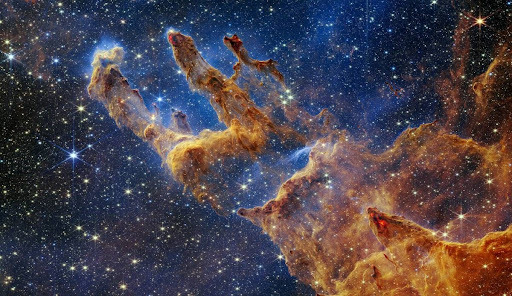
The scientific creation story begins with the Big Bang about 13.8 billion years ago. The decisive evidence for this explosive expansion of space and time is the ‘afterglow’ of the early universe, known as cosmic microwave background radiation (CMB).
The hydrogen and helium created by the Big Bang coalesced to form the first stars. Through stellar nucleosynthesis, carbon and oxygen were created, and heavy elements like gold and uranium were formed during the final moments of massive stars in supernova explosions. The phrase that we are made of ‘star dust’ is not just poetic but a scientific fact.
So, how did life begin? Science explains this process through chemical evolution. Recently, the hypothesis that deep-sea hydrothermal vents, rich in energy and chemicals, were the cradle of life has gained traction. Additionally, the dilemma of genetic information (DNA) and biochemical reactions (proteins) is explained by the ‘RNA world hypothesis’, suggesting that RNA, which has both genetic and catalytic functions, came first.
Unlike myths, the scientific origin story presents a narrative of ‘chance’ and ’emergence’ rather than ‘purpose’. Our existence is not the result of a predetermined plan but an astonishing outcome that emerged from a series of countless coincidences.
The Power of Origin Stories: A Blueprint for Building Society and Mind
Origin stories serve as a powerful ‘social blueprint’ and ‘map of the mind’ that shapes not only explanations of the past but also the current society and individual psyche.
Just as the Hindu Purusha myth justifies the caste system, and the Chinese Mandate of Heaven grants legitimacy to dynasties. The biblical phrase “Be fruitful and multiply, and fill the earth and subdue it” has become the foundation of Western environmental ethics, while the story of Adam and Eve’s disobedience has laid the groundwork for the concept of original sin, explaining human flaws in Western social structures.
Psychologist Carl Jung viewed myths as expressions of the ‘collective unconscious’ shared by all humanity. Comparative mythologist Joseph Campbell argued that myths worldwide follow a common narrative structure of ‘separation-initiation-return’, known as the ‘Hero’s Journey’. This can be seen as a projection of the growth process that humans experience in their lives onto a cosmic dimension.
Modern Origin Stories: Where Is Humanity Headed?
The human desire for mythic narratives is evolving into new forms in modern times.
Digital folklore of the internet age, such as the SCP Foundation, and the exploration of modern dilemmas through ’new gods’ like superheroes in the Marvel Cinematic Universe (MCU) can be seen as today’s myths. I, too, was reminded of the coexistence of destruction and creation in ancient myths when I saw MCU’s Thanos attempting to eliminate half the population for cosmic balance.
Furthermore, gene editing technology CRISPR is shifting humanity’s role from being a ‘product’ of origin stories to that of ‘authors’. The potential emergence of Artificial General Intelligence (AGI), the colonization of Mars, and the multiverse hypothesis, which suggests that our universe is just one of many, are fundamentally shaking our worldview by transforming ‘absolute origin stories’ into ‘one of many possible narratives’.
Conclusion
Humanity’s origin stories are the result of a continuous effort to understand ourselves across time and culture. Through this long journey, we can discover several important truths:
- Narrative Necessity: Humans are instinctive beings who create stories to find meaning and impose order amidst chaos.
- From Myth to Science: The way we explain origins has shifted from divine will to universal physical laws, but the fundamental desire to understand the world remains unchanged.
- Evolving Narratives: Genetic engineering, artificial intelligence, and space exploration technologies are writing new origin stories that pose the question, ‘What does it mean to be human?’
Ultimately, the future of humanity depends on the stories we choose to tell and create. What origin story do you find most intriguing in explaining our existence? Please share your thoughts in the comments.
References
- Why We Tell Stories Psychology Today
- The Power of Storytelling: How Our Brains Are Wired for Narratives Innovative Human Capital Solutions
- Terror management theory Wikipedia
- Big Bang Wikipedia
- Abiogenesis Wikipedia
- SCP Foundation Wikipedia
- Multiverse Wikipedia