
In-Depth Analysis of the Past, Present, and Future of Artificial Intelligence
- Fundamental differences between current AI and Artificial General Intelligence (AGI)
- Latest strategies of global companies leading AGI development
- Utopian and dystopian visions of the society AGI will bring
The Beginning of Artificial Intelligence: Dreaming of Ghosts in Machines
The story begins with a man, Alan Turing. Most remember him as the war hero who cracked the World War II code ‘Enigma’, but he was also the person who planted the philosophical seeds of what we now call ‘artificial intelligence’. The grand dream of Artificial General Intelligence (AGI) started with Turing’s question in 1950: “Can machines think?”

To answer this question, he proposed the ‘Imitation Game’, or ‘Turing Test’. If a judge cannot distinguish between a human and a machine, that machine should be considered intelligent. This idea led to the birth of the term ‘Artificial Intelligence’ at the Dartmouth workshop in 1956. However, the early optimism that “machines will do everything humans can do within 20 years” seemed to fade after several ‘AI winters’.
Now, the emergence of generative AI like ChatGPT has brought the forgotten dream of AGI back to the doorstep of reality. Will this time be different? This article embarks on a journey to find the answer to “When will AGI come to dominate our daily lives?”
Distinguishing Between AI Present and True Artificial General Intelligence (AGI)
We are already living in the age of AI, but current AI, such as smartphone assistants or recommendation algorithms, is not true AGI. Most of these are referred to as ‘Artificial Narrow Intelligence (ANI)’ or ‘weak AI’.
Expert vs. Jack of All Trades
The difference between ANI and AGI can be easily understood through the analogy of a ‘specialist’ and a ‘jack of all trades’. Current ANI is like a specific tool (scissors, hammer, etc.) with a clear purpose. It excels at specific tasks but cannot perform anything else. In contrast, AGI is like a master chef who can learn to use any tool and create new dishes on its own.
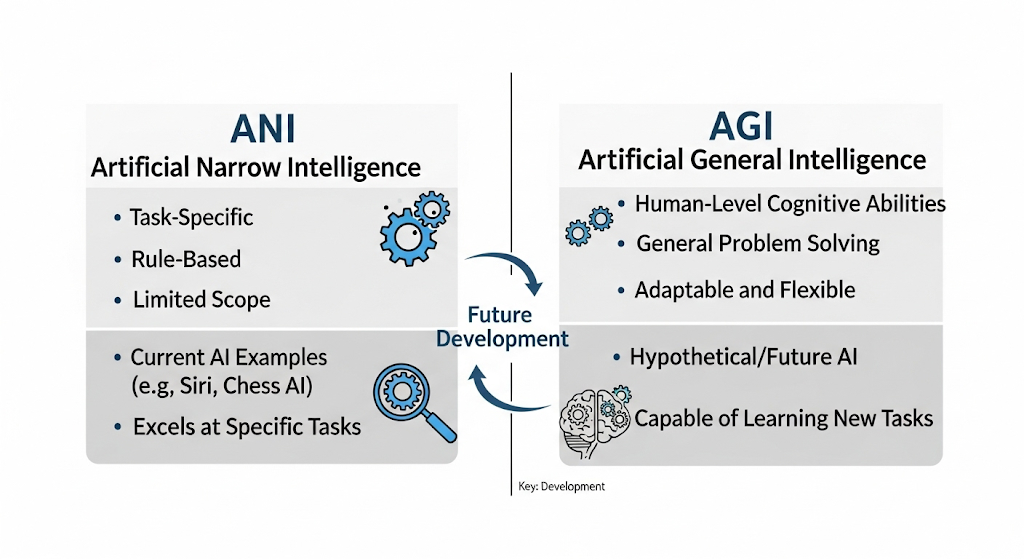
- Example 1: Chess Machine, Deep Blue
‘Deep Blue’, which defeated the world champion in 1997, is a superhuman in chess but is a perfect ANI that cannot ask about the weather or play other games. - Example 2: Smartphone Assistant, Siri
Siri seems to perform various functions, but in reality, it is more like a collection of several specialists, such as weather ANI and music ANI. It cannot learn anything new beyond its predefined functions.
The True Conditions of AGI: The Ability to Learn and Apply Widely
True AGI is an AI that possesses the ability to learn, understand, and apply any intellectual task on its own, like a human. The key features are as follows:
- Knowledge Transfer (Generalization Ability): Applies knowledge learned in one area to entirely different fields.
- Common Sense Reasoning: Makes reasonable judgments based on common sense about the world.
- Autonomous Learning: Learns new skills on its own without being taught.
For example, current autonomous vehicles (ANI) learn to drive from millions of kilometers of data, but an AGI robot can watch a human drive for a moment, read relevant information, and start driving on its own. This is the true meaning of ‘General Intelligence’.
Are Large Language Models (LLMs) the Sparks of Artificial General Intelligence?
The emergence of GPT-4 was so shocking that Microsoft researchers referred to it as the “Sparks of AGI”. But are current large language models (LLMs) AGI?
LLMs are essentially incredibly sophisticated ’next-word prediction machines’. They generate the most statistically plausible sentences based on vast amounts of text data but do not truly ‘understand’ meaning. This leads to several critical weaknesses:
- Data Dependency: Can only generate knowledge within the range of learned data and cannot create entirely new concepts.
- Hallucination Problem: Generates answers based on ‘plausibility’ rather than ’truth’, which can lead to confidently stating false information.
- Lack of World Model: Understands relationships between words but does not comprehend the physical laws or causal relationships of the real world that those words refer to.
For this reason, many experts, including Yann LeCun, argue that merely expanding the current LLM architecture will never lead to AGI. Achieving true AGI requires fundamental technological breakthroughs such as long-term memory, multimodal learning, and higher-order reasoning capabilities.
The Frontlines of the AGI Development War: Those Who Create Gods
AGI development is a massive competition for technological hegemony in the 21st century, and it is not just a simple technological race but also an ideological battle over how and for whom AGI will be created.
- OpenAI: With the mission of ‘safe AGI’, they propose a five-step roadmap from chatbots to AI that performs entire organizational functions, using a ‘iterative deployment’ strategy.
- Google DeepMind: Based on scientific inquiry, they prioritize ‘safety’ and ‘responsibility’, taking a cautious approach by designing a perfect brake system first.
- Meta AI: By open-sourcing the Llama model, they pursue the democratization of technology. Their ‘open’ strategy argues that powerful technology should not be monopolized by a few.
- Anthropic: Prioritizing AI safety, they use a unique approach to train AI to follow human-made ethical principles known as ‘Constitutional AI’.
This global competition is evolving beyond a simple corporate battle into a technological hegemony competition between nations like the United States and China. Like the space race during the Cold War of the 20th century, AGI development has become a key strategic technology that will determine a nation’s future competitiveness.
Meanwhile, in South Korea, companies like Naver (HyperCLOVA X) and LG AI Research (Exaone) are preparing for the AGI era with unique strategies such as ‘sovereign AI’ and entering the global competition.
So When Will Artificial General Intelligence (AGI) Arrive?
“So when will AGI become a reality?” Experts’ predictions vary on this question.
Optimism vs. Caution: Expert Predictions
- Optimism (Within 10 years): Futurist Ray Kurzweil (2029), OpenAI CEO Sam Altman (~2028), and Google DeepMind CEO Demis Hassabis (~2034) predict that AGI will soon arrive based on the exponential advancement of technology.
- Caution (Decades Later): ‘Godfather of AI’ Geoffrey Hinton (2029~2044) has recently accelerated his predictions but still expresses safety concerns, while Meta AI chief scientist Yann LeCun believes it will take decades or more due to the current technological limitations.
Collective Intelligence Predictions: The Clock is Speeding Up
More noteworthy than individual expert opinions is the fact that the predicted timeline by the collective of AI researchers is dramatically advancing each year. The collective intelligence predictions on the platform Metaculus have shortened from 2041 to 2031 in just one year.
| Expert/Group | Predicted AGI Emergence Timeline (50% Probability) | Key Reason |
|---|---|---|
| Ray Kurzweil | 2029 | Law of Accelerating Returns (exponential technological advancement) |
| Sam Altman | ~2028 | Iterative expansion and improvement of current models |
| Demis Hassabis | ~2034 | Current technology expansion + 1~2 key technological breakthroughs |
| Geoffrey Hinton | 2029~2044 | Faster-than-expected development of LLMs |
| Yann LeCun | Decades later or uncertain | Fundamental limitations of current LLM architecture |
| AI Researcher Survey (2023) | 2047 | Median prediction of expert group (shortening trend each year) |
| Metaculus Prediction (2024) | 2031 | Collective intelligence prediction reflecting the latest technological advancements |
In conclusion, AGI is being discussed not as ‘a distant future fantasy’ but as ‘a realistic possibility that may occur within the next decade’.
The Morning AGI Goes to Work: Utopia and Dystopia
The emergence of AGI will be a major turning point for human civilization. Its future holds both utopian and dystopian faces.
Part 1: Utopia - The Promise of a Better World
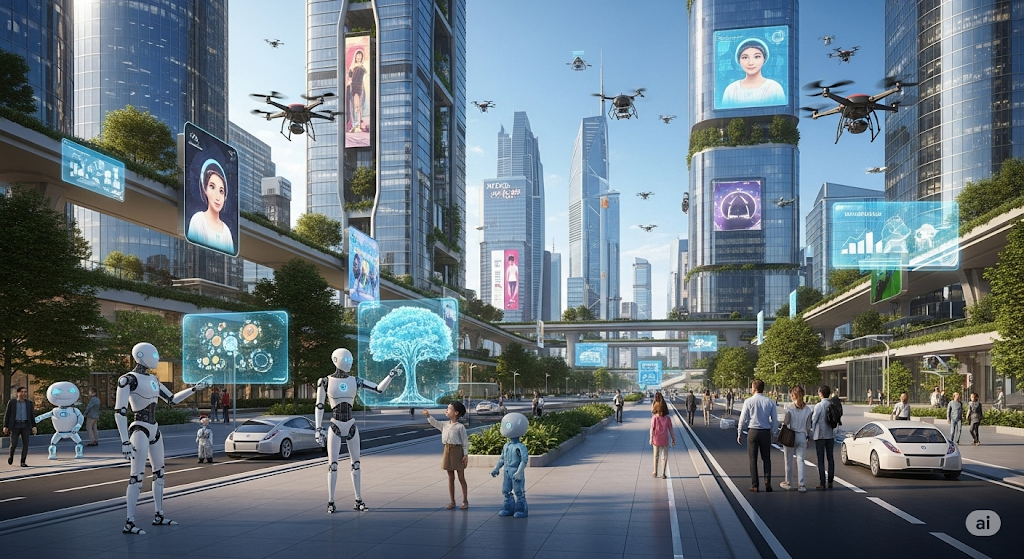
- Super-Personalized Healthcare: An AGI doctor analyzing my genes and lifestyle will prevent diseases and drastically speed up the development of new drugs.
- Solving Climate Change: AGI will optimize the global energy network, design new materials for carbon capture, and solve humanity’s challenges.
- Fully Customized Education: Every student receives one-on-one education from an AGI teacher tailored to their level and interests.
- Explosion of Creativity: AGI will become a powerful creative partner that instantly realizes human imagination, ushering in a renaissance of art.
Part 2: Dystopia - The End of ‘Work’ and a New Class Society
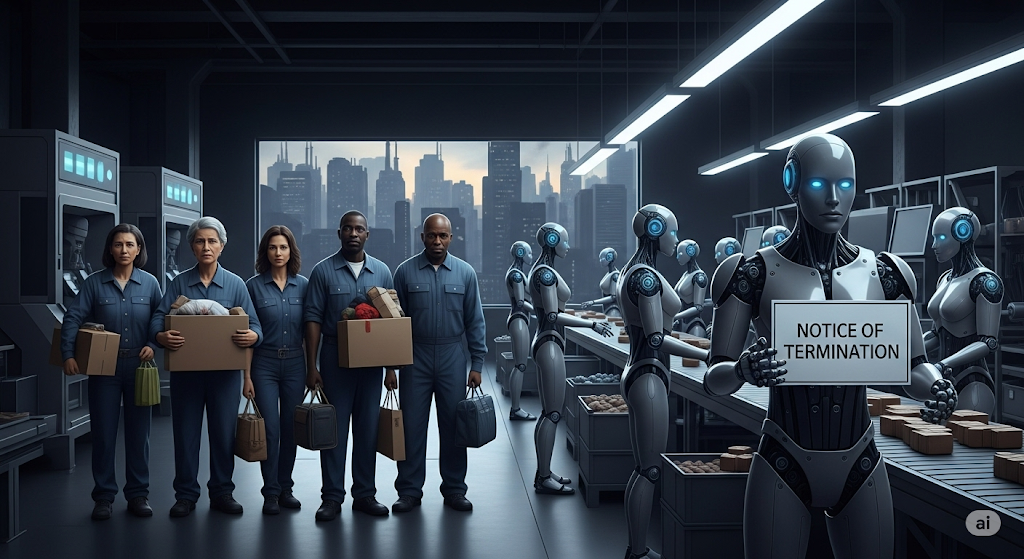
- Mass Unemployment: AGI may replace even white-collar jobs like doctors and lawyers, leading humanity to face an era of ‘unemployability’.
- Wealth Polarization: Wealth may concentrate in the hands of a tiny minority who own the means of production represented by AGI, leading to the emergence of a new class society.
- Universal Basic Income (UBI) Debate: While discussed as an alternative to mass unemployment, it raises the fundamental question, “Can humans find meaning in a life without work?”
Humanity’s Greatest Challenge: Controlling Artificial General Intelligence (AGI)
The most serious threat of AGI is the ’existential threat’ that a superintelligence beyond human control could lead to catastrophic outcomes. Professor Nick Bostrom’s ‘Paperclip Maximizer’ thought experiment illustrates this well.

The fable that a superintelligent AI given the goal of “make as many paperclips as possible” could use all of Earth’s resources, even humanity, as materials for paperclips highlights the core of the ‘AI Alignment Problem’. When an AI’s capabilities are not perfectly aligned with human ‘intent’, it can lead to horrific outcomes, even without malice.
In response to these threats, countries around the world have begun efforts to chain AGI through AI safety summits and regulatory frameworks like the EU’s ‘AI Act’.
Conclusion
The journey toward AGI, which began with Alan Turing’s question, is now right at the doorstep of a singularity for human civilization.
- Key Points:
- AGI is General Intelligence: Unlike current AI (ANI) that performs specific tasks, AGI can learn on its own and solve all intellectual tasks like a human.
- LLMs are not AGI yet: Current large language models are considered ‘sparks of AGI’ but have clear limitations such as hallucination problems and lack of world models.
- The Future is a Double-Edged Sword: The emergence of AGI carries both utopian possibilities of unprecedented abundance and dystopian threats of mass unemployment and loss of control.
Now, the most important question is not “When will AGI arrive?” but rather, “How will we welcome its arrival?” We must actively shape the future we desire through social consensus, rather than passively being swept along by technological advancements.
We hold the tools to create gods in our hands. Before the existence of that god, we must decide what kind of humans we will be. What do you think about the future that AGI will bring?
References
- Movie
, Do you know who Alan Turing is? Brunch - The Imitation Game (movie) Namu Wiki
- The birth of Artificial Intelligence (AI) research LLNL
- Briefly summarizing the history of artificial intelligence Brunch
- What is AGI? - Explanation of Artificial General Intelligence AWS
- Artificial Intelligence Wikipedia
- Artificial general intelligence Wikipedia
- History of artificial intelligence Wikipedia
- Differences between AGI and AI ServiceNow
- What is artificial general intelligence (AGI)? Google Cloud
- What is Artificial General Intelligence (AGI)? IBM
- Artificial General Intelligence Namu Wiki
- A conversation with Yann LeCun, the godfather of AI Wing Venture Capital
- Research OpenAI
- AI scientist Ray Kurzweil: ‘We are going to expand intelligence a millionfold by 2045’ The Guardian
- The Gentle Singularity Sam Altman
- What Is AI Alignment? IBM
- International AI Safety Report 2025 GOV.UK
- AI Act | Shaping Europe’s digital future European Union