
What comes to mind when you think of science? Probably ‘precise prediction.’ Since Newton, humanity has believed that if we knew all the laws of the universe, we could perfectly predict the future. The mathematician Laplace even imagined, “If we knew the current positions and velocities of all particles in the universe, we could compute the past and the future.”
But in the late 20th century, a huge crack opened in this clockwork view of the universe. That crack was the emergence of Chaos Theory.
You might think ‘chaos’ just means everything is a messy jumble because of the word’s everyday meaning. But the true message of chaos theory is the opposite. It’s about phenomena where “rules are clear, yet prediction is impossible.” In other words, “determined” does not imply “predictable” — a revolutionary idea.
The core of this theory is summarized by the captivating phrase ‘butterfly effect’. Like the story that a Brazilian butterfly’s wingbeat could cause a tornado in Texas, it means that a tiny difference at the start can lead to unimaginable outcomes later.
In this article we will properly explore the mysterious and powerful world of ‘chaos theory.’ Beyond mere mathematical curiosity, we will follow how this theory has fundamentally changed weather forecasting, the financial markets, modern AI, and even our understanding of bodies and brains.
Part 1: Chaos is not ‘disorder’ but ‘hidden order’
The heart of chaos theory lies in mathematics. It can be a bit dry, but you need to know this skeleton to really enjoy the subject.
Deterministic chaos and the ‘butterfly effect’
The phrase ‘deterministic chaos’ itself sounds contradictory. How can something be ‘determined’ and yet be ‘chaotic’?
The phenomenon was first discovered by meteorologist Edward Lorenz. While simulating weather on a computer, he re-entered numbers to restart a calculation midway. The original number was 0.506127, but for convenience he rounded it to 0.506 at the fourth decimal place.
The result was shocking. The graph produced a completely different weather outcome. That tiny difference created a wholly different future. This is the ‘butterfly effect,’ technically called ‘sensitive dependence on initial conditions.’
Mathematicians devised a tool to measure how quickly this divergence happens: the ‘Lyapunov exponent.’ If this number is greater than 0, you can say, “Ah, this system is chaotic!” This discovery broke the centuries-old scientific belief that “determined = predictable.” Mathematically, it proved that as long as we cannot know initial conditions to infinite decimal precision, long-term prediction is ‘impossible’ in practice.
A map of infinite complexity: strange attractors and fractals
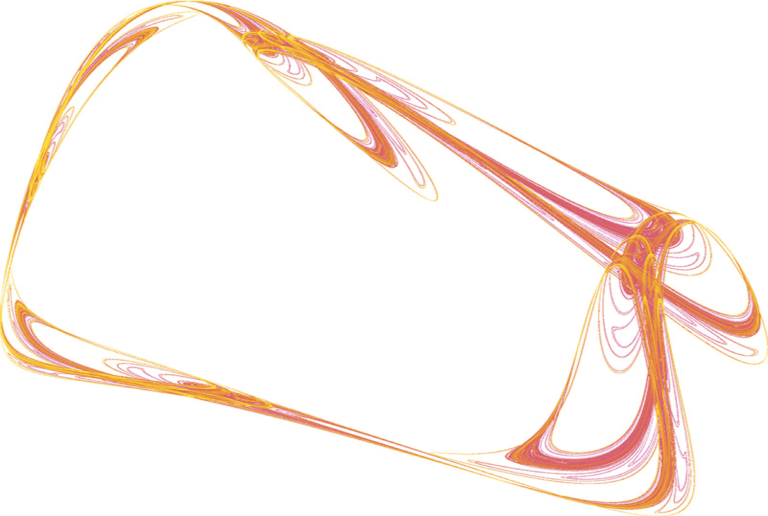
That doesn’t mean a chaotic system flies off randomly into outer space. Lorenz’s simulated weather moved complexly yet remained confined within that ‘butterfly-shaped’ region.
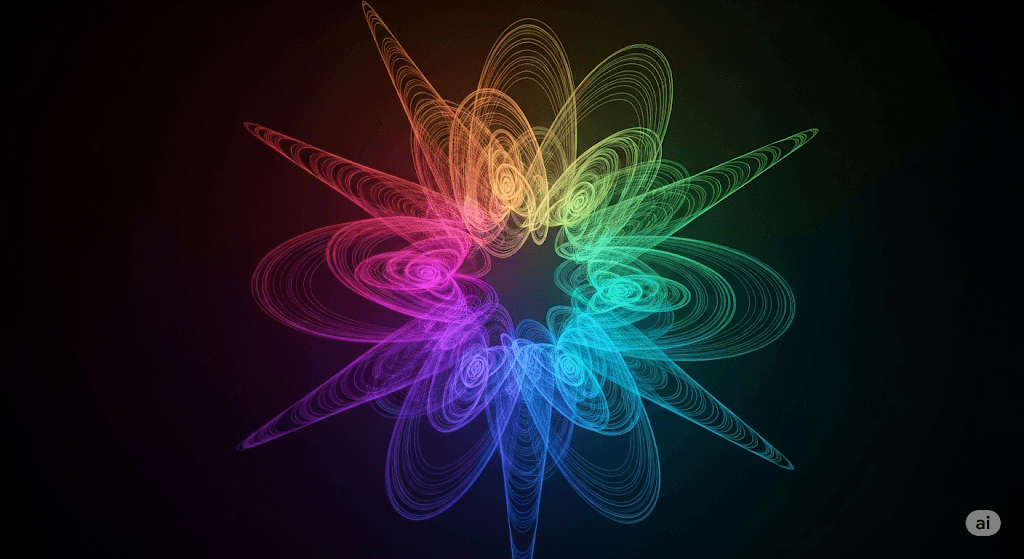
The region the system is eventually drawn into is called an ‘attractor.’ But the attractors of chaotic systems are so oddly complex in shape that they are called ‘strange attractors.’
Even more astonishing is that if you zoom in on these attractors again and again, you keep finding ever more complex structure with no end. This property is called a ‘fractal.’ Coined by Benoît Mandelbrot, it refers to structures possessing self-similarity — parts that resemble the whole.
Why must strange attractors be fractal? Think about it: trajectories must never exactly overlap or repeat (or else it wouldn’t be chaotic), yet they must remain confined to a limited region. To cram an infinite-length curve into a finite space, it inevitably folds and folds into a fractal structure. Fractals are the inevitable ‘patterns’ created by chaos.
The engine that creates chaos: stretch and fold
So why does this happen? Mathematician Stephen Smale explained it beautifully with the ‘horseshoe map’ metaphor. The engine that creates chaos is the infinite repetition of two processes: ‘stretching’ and ‘folding.’

- Stretching: Pull the dough long in one direction. (This hugely amplifies tiny differences — the ‘butterfly effect’)
- Folding: Fold the stretched dough into a horseshoe shape.
- Re-insertion: Put it back into the original space and repeat from step 1 infinitely!
This simple ‘stretch-and-fold’ is the core engine of chaos. ‘Stretching’ amplifies differences (Lyapunov exponent > 0), while ‘folding’ keeps the system within the bounded region known as the ‘attractor.’
The path to chaos is set? The Feigenbaum constant
There are many ways to reach chaos, but one famously eerie route is through ‘period doubling.’
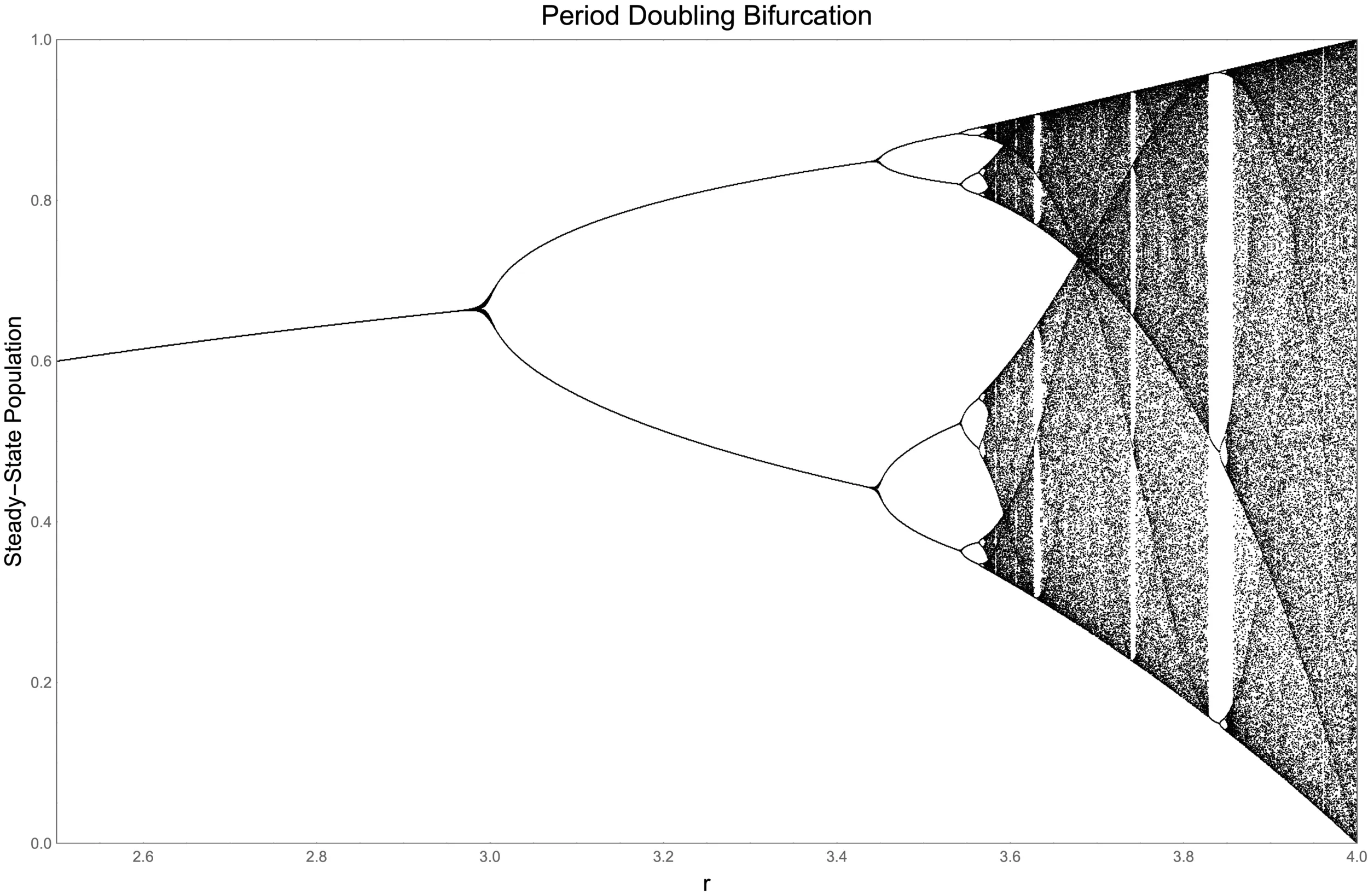
Consider the very simple equation originally used to model population growth (the logistic map: $x_{n+1} = rx_n(1-x_n)$). If you slowly increase the parameter r, the system is initially stable (period 1), then it oscillates between two values (period 2), then four values (period 4), eight (period 8)… the period keeps doubling. After crossing a certain threshold… boom! Chaos erupts.
What Mitchell Feigenbaum discovered is that the ratios of the intervals between these period-doublings converge to a specific number, \delta \approx 4.6692… The astonishing part is that this number appears regardless of the system: population models, electronic circuits, fluid dynamics — different systems show the same behavior.
This is called the Feigenbaum constant, and the phenomenon is known as ‘universality.’ Hidden mathematical laws govern the route to chaos across seemingly unrelated systems.
Table 1: Convergence to the Feigenbaum constant ($\\delta$) in the logistic map
| n (period) | Bifurcation parameter $a_n$ | $a_n - a_{n-1}$ (interval) | $(a_{n-1} - a_{n-2}) / (a_n - a_{n-1})$ (ratio $\\delta_n$) |
|---|---|---|---|
| 1 (2) | 3.0 | - | - |
| 2 (4) | 3.449489… | 0.449489… | - |
| 3 (8) | 3.544090… | 0.094601… | 4.7514… |
| 4 (16) | 3.564407… | 0.020317… | 4.6562… |
| 5 (32) | 3.568759… | 0.004352… | 4.6683… |
| 6 (64) | 3.569692… | 0.000933… | 4.6691… |
| 7 (128) | 3.569891… | 0.000199… | 4.6692… |
| $\\infty$ | $a_\\infty \\approx 3.5699456...$ | 0 | $\\rightarrow \\delta \\approx 4.669201...$ |
| Note: This table shows where period-doubling bifurcations occur in the logistic map. Look at the last column. The ratios of consecutive intervals rapidly approach the Feigenbaum constant $\\delta \\approx 4.6692$. |
Part 2: Limits of prediction and new possibilities: from weather to AI
Now let’s look at how chaos theory shakes up real-world prediction problems, especially in weather and AI.
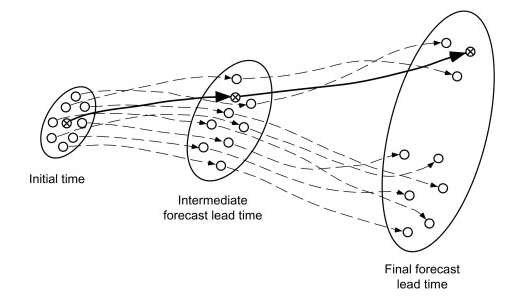
Why isn’t there just one weather forecast? Ensemble forecasting
We now understand why weather forecasting is so hard: the butterfly effect. We cannot measure the initial states of every air molecule on Earth precisely.
So modern meteorology has abandoned the idea of a single perfect forecast. Instead it uses ’ensemble forecasting.’
You run dozens of forecasts concurrently with slightly perturbed initial conditions (deliberately injecting small errors representing chaotic uncertainty).
- If 50 forecasts all say “rain,” then -> “High probability of rain.”
- If 25 say “rain” and 25 say “clear,” then -> “Very high forecast uncertainty.”
This way you predict the uncertainty of the prediction itself. Leading meteorological centers each have their own philosophy for generating those tiny perturbations (SV, BV).
Table 2: Comparison of Singular Vectors (SV) and Bred Vectors (BV) in ensemble forecasting
| Feature | Singular Vectors (SV) | Bred Vectors (BV) |
|---|---|---|
| Major users | ECMWF (Europe) | NCEP (USA) |
| Theoretical basis | Errors that will grow fastest in the short term | Natural error growth of the system (approximate Lyapunov vectors) |
| Computational method | Complex (requires adjoint model) | Relatively simple (run model twice) |
| Goal | Capture ’that day’s errors’ (the most dangerous seeds) | Imitate the system’s natural instabilities |
| Note: This table shows how top meteorological centers address the same ‘chaos’ problem differently. |
A game-changer: the shock of AI ‘GraphCast’
Recently, a game-changer has shaken up traditional weather forecasting: artificial intelligence (AI).
Google DeepMind developed ‘GraphCast’, which knows none of the physical equations. Instead, it learned whole patterns from 40 years of past weather data. In effect, it memorized “when these weather patterns occur, that weather follows.”
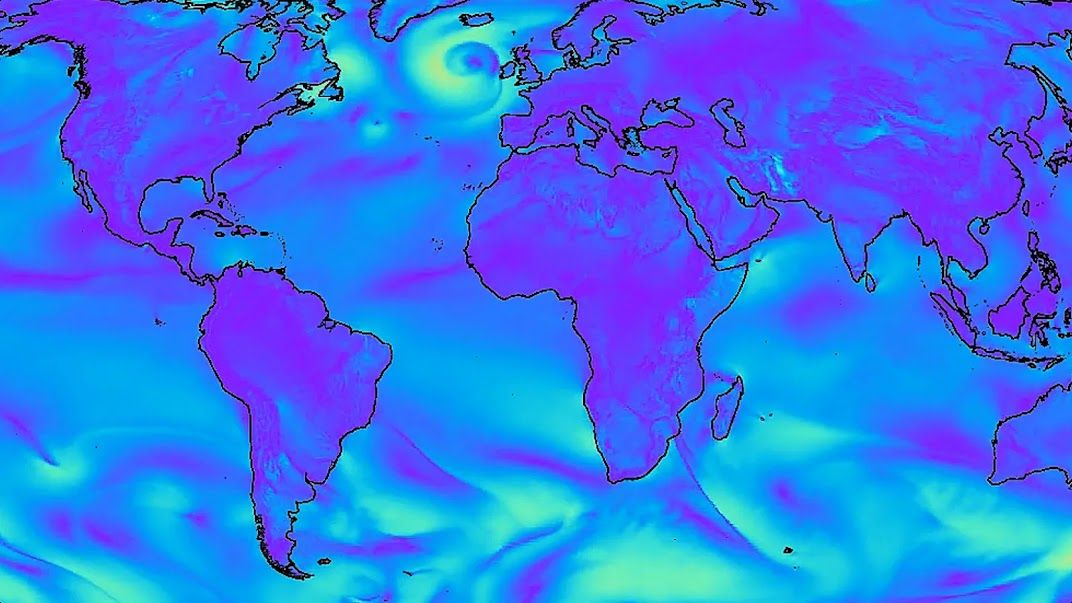
The results were stunning. On more than 90% of 10-day forecast metrics, it outperformed supercomputer-based solutions that took hours to compute. And this AI did it in under a minute. AI learned the statistical shape of the chaotic system’s attractors rather than the physical laws that generate them.
Table 3: Performance comparison: GraphCast (AI-based) vs. HRES (NWP-based)
| Comparison Item | GraphCast (AI-based) | HRES (NWP-based) |
|---|---|---|
| Basic principle | Data-driven pattern learning (40 years) | Physical equations (fluid dynamics) |
| Computation speed | Very fast (10-day forecast < 1 minute) | Very slow (supercomputers take hours) |
| Main strengths | 10-day forecast accuracy (over 90%), cyclone track | Physical consistency, precipitation intensity |
| Main weaknesses | Precipitation intensity, lack of physical interpretability | Computation cost, sensitivity to initial conditions |
| Note: AI is excellent at learning “results,” while traditional models have the advantage of knowing the “reasons.” In the future, hybrid models combining both will likely dominate. |
The meeting of data and physics: Physics-Informed Neural Networks (PINNs)
Does this mean physical laws are now useless? “No way!” Enter ‘Physics-Informed Neural Networks (PINNs).’
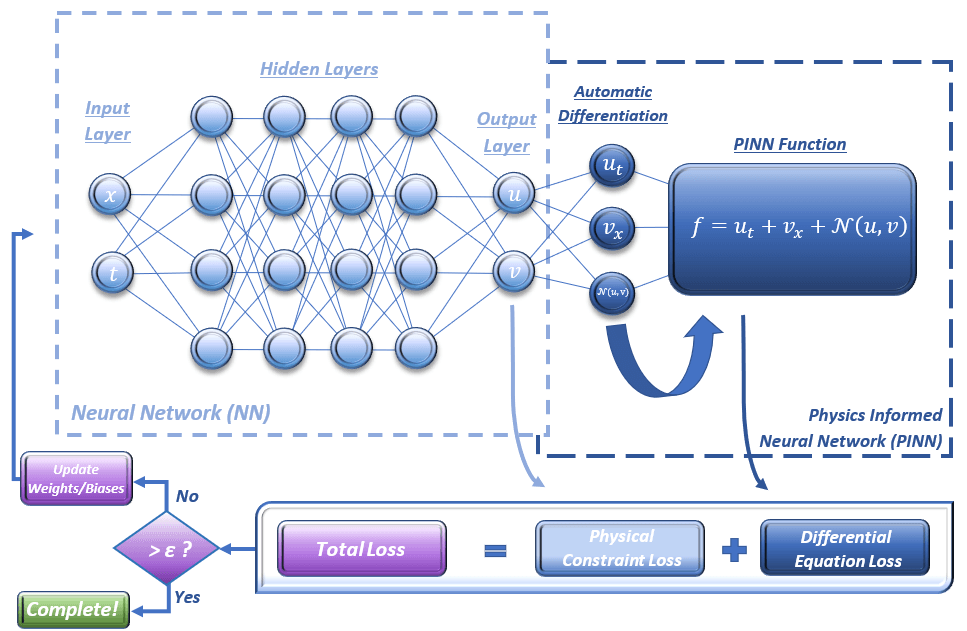
PINNs are hybrid models combining neural networks and physical laws. When training the AI on data, you give it a second mission: “Fit the data, but don’t violate the physical laws (differential equations)! If you do, you’ll be penalized.”
This approach lets AI intelligently fill gaps when data are scarce or noisy by relying on physics as a guide. Data are the ’teacher’ and physics is the ’textbook.’
Part 3: Is money also chaotic? Economics and financial markets
Now to money — which directly affects our lives. Chaos theory poses a major challenge to how we view economics and financial markets.
Financial markets are extremely volatile. Are they truly random, or are they chaotic?
‘Efficient Market’ vs ‘Fractal Market’
The conventional economic orthodoxy is the ‘Efficient Market Hypothesis (EMH).’ It states that markets are so efficient that all information is immediately reflected in prices, and price movements are unpredictable ‘random walks.’
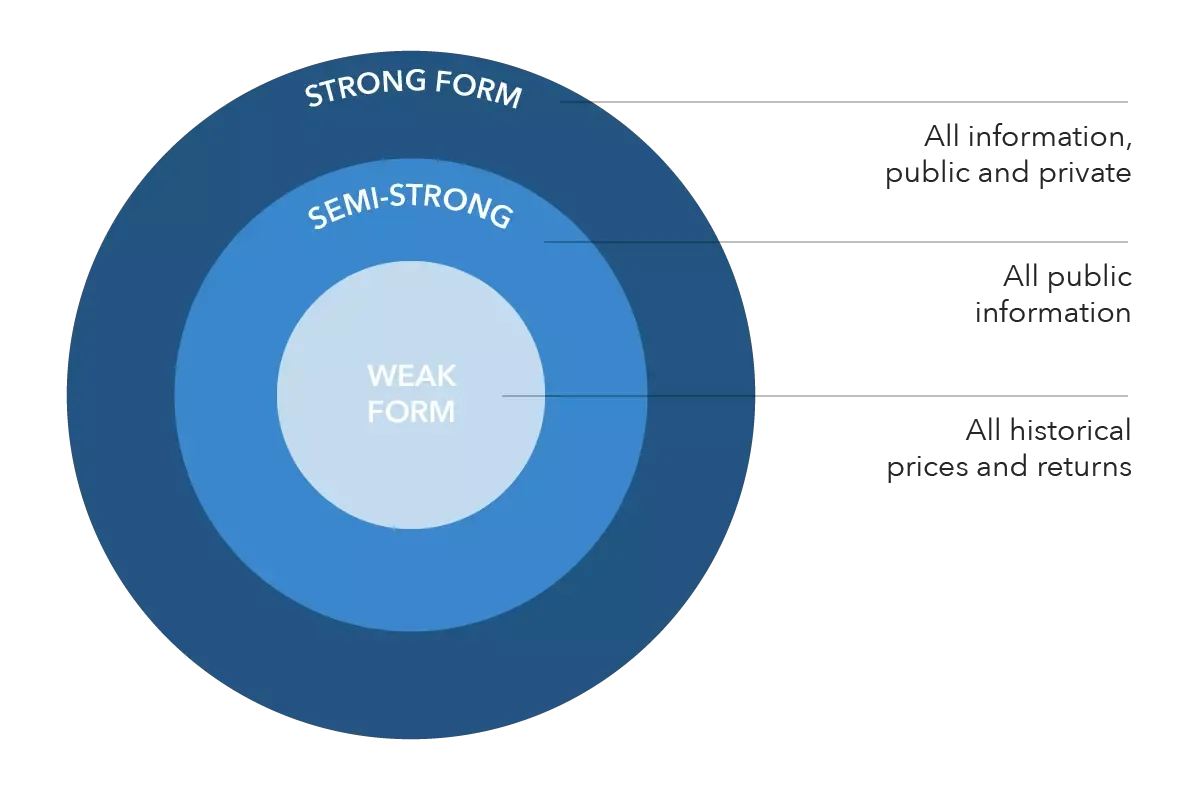
But chaos theorists proposed the ‘Fractal Market Hypothesis (FMH).’ They argue markets are not purely random but are complex nonlinear systems of the sort described by chaos theory.
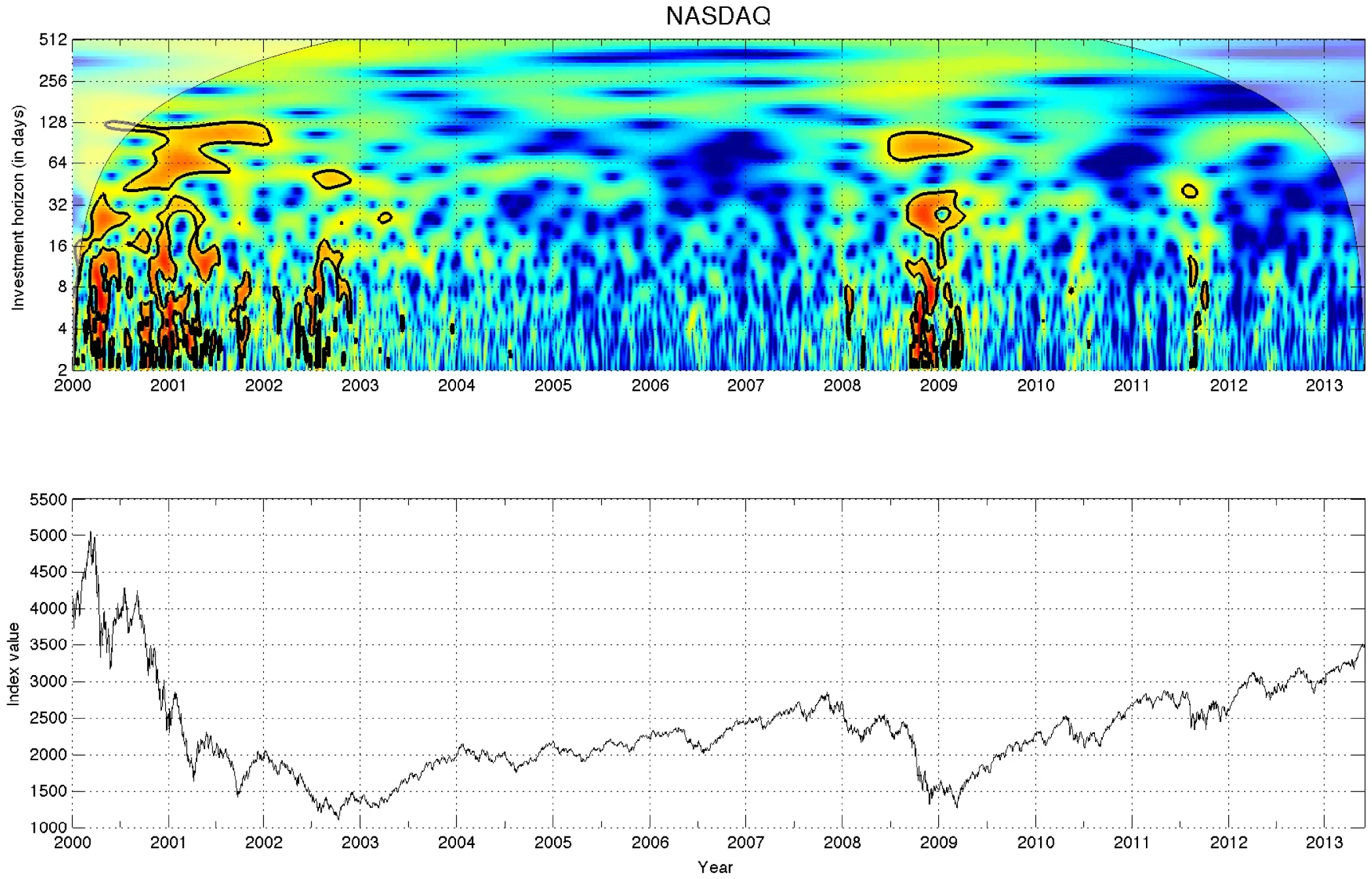
- Fractal structure: Price charts look similar whether you zoom in on a day or a year (fractal).
- Long memory: Markets don’t forget; past movements influence the future.
- Stability and diversity: For a market to be stable, investors with diverse time horizons (long/short term) must be present.
In short, “markets look disordered, but there is chaotic order hidden within.”
Detecting signs of financial crisis
Are massive market crashes like the 2008 global financial crisis merely random bad luck? Chaos theory seems better suited to explain such sudden collapses.
Analyses of market data using the ‘moving Lyapunov exponent’ (a measure of chaos) showed that before events like the dot-com bubble around 2000, the 2008 financial crisis, and the 2020 COVID-19 shock, the instability index spiked.
Of course, you cannot predict “the exact date of the crash.” It’s chaos. But you might give an early warning: “The system is highly unstable now and could collapse from a small shock.” That possibility is what these analyses suggest.
Chaos playground: the cryptocurrency market
The wildest market today is the cryptocurrency market — a playground for chaos analysis. Studies testing Bitcoin and Ethereum price data mostly conclude, “This is not a simple random walk.”
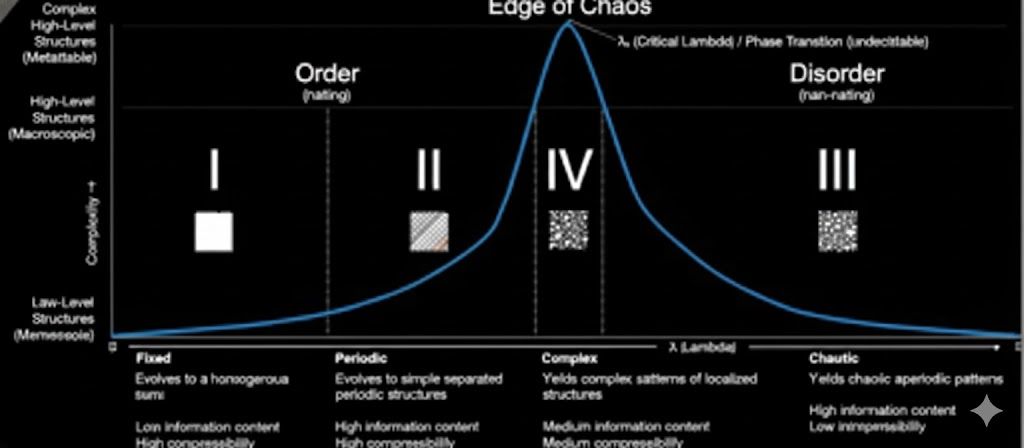
Many analyses place crypto markets at the ’edge of chaos’ — neither fully ordered nor fully random, but balanced precariously on that boundary. The ’edge’ is where the system is most complex, processes information most actively, and reacts most sensitively to small perturbations.
Sharp criticism: “That might not be chaos”
Of course, there is strong criticism. The most powerful objection is: “How do you tell whether what you call ‘chaos’ is truly mathematical chaos or just an enormous amount of noise?”
Frankly, they can look nearly identical, making discrimination very difficult.
A bigger problem is that markets’ rules themselves change over time (‘structural breaks’). Central banks raising rates or wars breaking out change the very ‘rules’ of the market. Chaos theory assumes fixed rules, but reality often does not.
Part 4: Chaos in our bodies, brains, and robots
Chaos theory is deeply relevant not only to weather and money but also to life itself and the technologies we build.
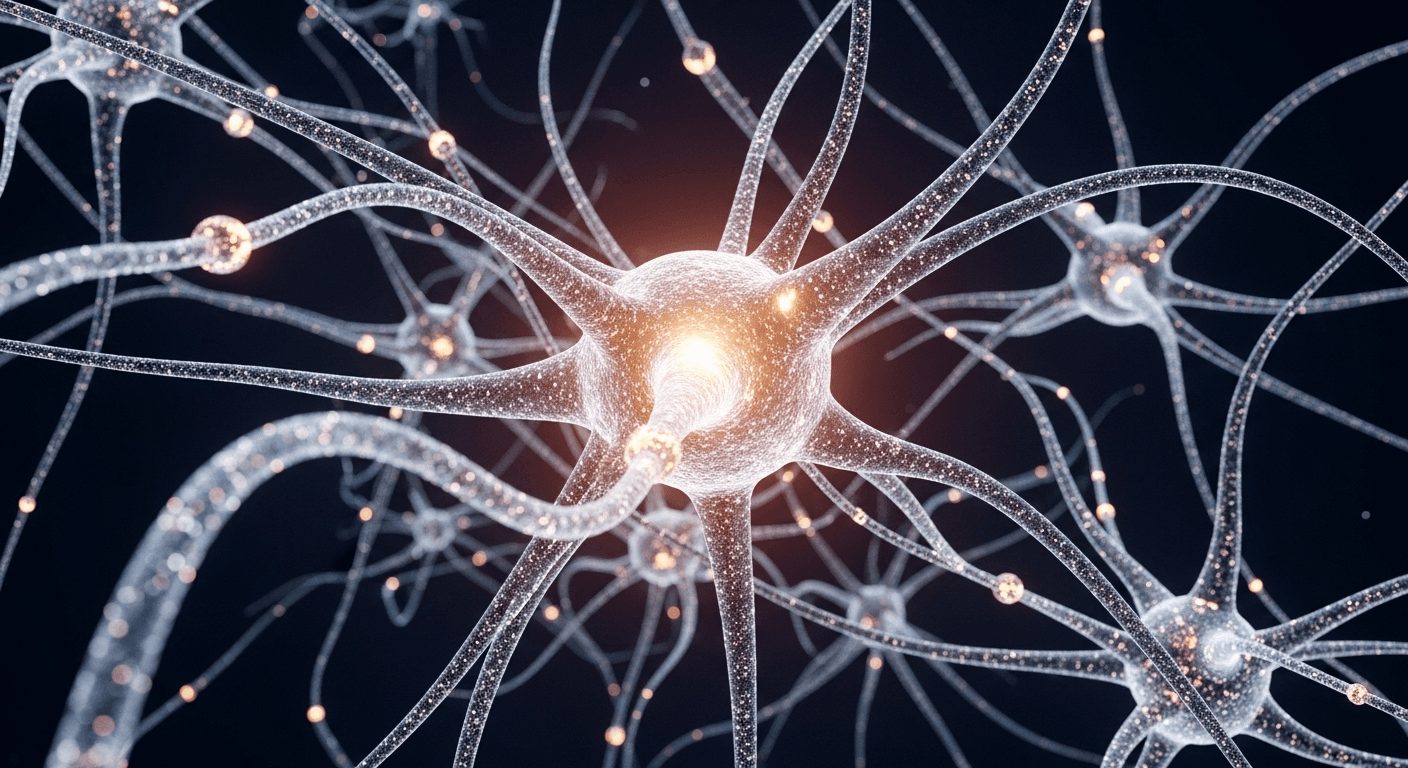
Complexly entangled neural networks. Creativity emerges at the boundary between ‘order’ and ‘chaos.’
Creative brains walk the ’edge’
The ’edge of chaos’ idea that we saw in financial markets is also important in neuroscience. There’s a hypothesis that our brains process information, learn, and especially display creativity when they are in this state.
- If the brain is too orderly -> rigid thinking and stereotyped behavior.
- If the brain is too chaotic -> thoughts are fragmented and unconnected.
Creativity is the ability to base ideas on stable memory (order) and then break and recombine them in new ways (chaos). In other words, exceptional information processing and creativity arise at that delicate boundary between order and chaos.
A healthy heart beats ‘irregularly’: HRV analysis
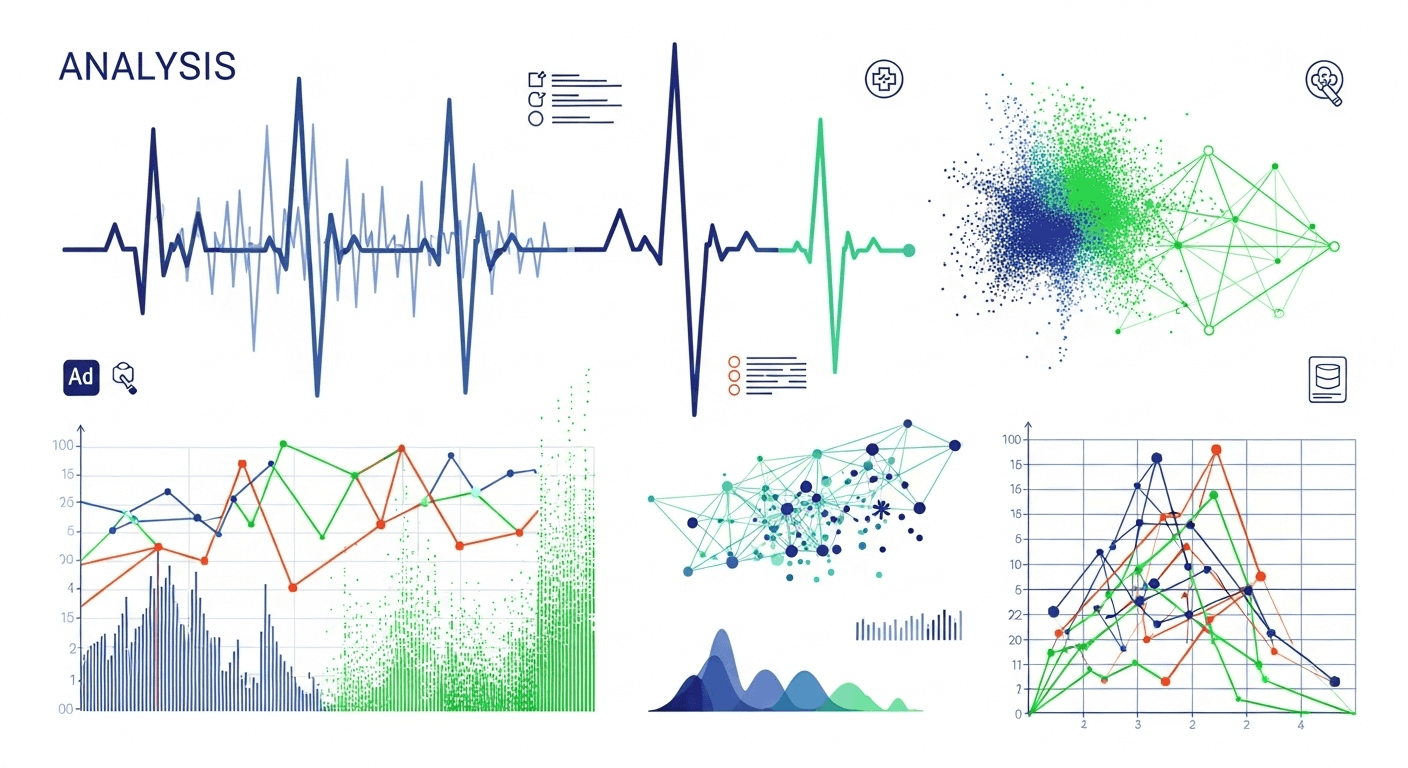
Question: Is a healthy heartbeat perfectly clocklike and regular?
Surprisingly, the answer is ’no.’ A healthy heart beats not perfectly regularly but with small, complex irregularities. This is called Heart Rate Variability (HRV).
Clinical studies found that when this complexity (fractal characteristics) decreases and the heartbeat becomes too monotonous and regular, it can be a warning sign of disease. HRV-based chaos analysis is a powerful predictor of mortality in certain heart disease patients. Perhaps chaos is, paradoxically, another name for ‘healthy vitality.’
Technologies that use chaos: cryptography and robotics
Engineers have also harnessed chaos.
- Cryptography: Sensitivity to initial conditions (the butterfly effect) seemed like a perfect random number generator. But finite precision in digital computers causes repeating cycles, creating periodicity that is fatal for cryptographic strength.
- Robotics: When planning paths for robots exploring unknown terrain, chaotic systems are used to create trajectories that are unpredictable yet ensure thorough coverage of regions (via strange attractors). This is more efficient than a simple random walk while remaining hard to predict.
Conclusion: Unpredictable order — a new way to see the world
Putting it all together, the greatest gift chaos theory gave us is a ’new way to see the world.’
We long believed “If there are rules, then we can predict.” Chaos theory shattered that stubborn belief.
“Determined, but not predictable.”
Through this profound paradox we began to understand the ‘unpredictable order’ hidden behind phenomena that appear random and complex (weather, life, markets).
From setting fundamental limits on weather forecasting to challenging traditional financial theories and offering new diagnostic tools for health, chaos theory’s influence is enormous.
And the journey is far from over. Chaos theory is now meeting powerful tools like GraphCast and PINNs in artificial intelligence. We can analyze complex chaotic systems in ways we never imagined and perhaps even hope to exert some control over them.
What new stories will humanity’s quest to understand the unpredictable order hidden within deterministic laws tell us next?