
The story of the most private space where status, culture, technology, and superstition intersect
- The forms and meanings of toilets differing by social class in the Joseon Dynasty
- The wisdom of ancestors utilizing excrement as a resource
- The advanced technology and social concepts embedded in toilets of the time
Grand royal processions and splendid court banquets. The scenery we envision when thinking of the Joseon Dynasty is generally majestic. But what did the toilets of the Joseon Dynasty look like behind this grand historical stage? This space, unavoidable for humans, was a microcosm of society, encapsulating the era’s social hierarchy, economic realities, scientific advancements, and even mental anxieties.
From the king’s luxurious portable toilet to the farmer’s essential dung storage, the journey through the toilets of Joseon will lead us into the innermost corridors of Joseon society.
Table 1: Comparison of Toilet Culture by Social Class in the Joseon Dynasty
| Feature | Royal | Yangban | Commoner |
|---|---|---|---|
| Main Form | Portable toilet (maehwa-teul) | Independent roofed building | Pit-style toilet/privy |
| Excrement Disposal | Subject to medical analysis | Considered unclean waste | Essential agricultural fertilizer |
| Cultural Significance | Tool of governance | Symbol of Confucian purity | Economic asset, ’treasure trove' |
The King’s Excrement: The Royal Maehwa-teul as a Mirror of Governance
For the king, excretion was not a personal matter but a national signal. The king’s excrement was the beginning of an elaborate ritual involving the ‘maehwa-teul (梅花틀)’.
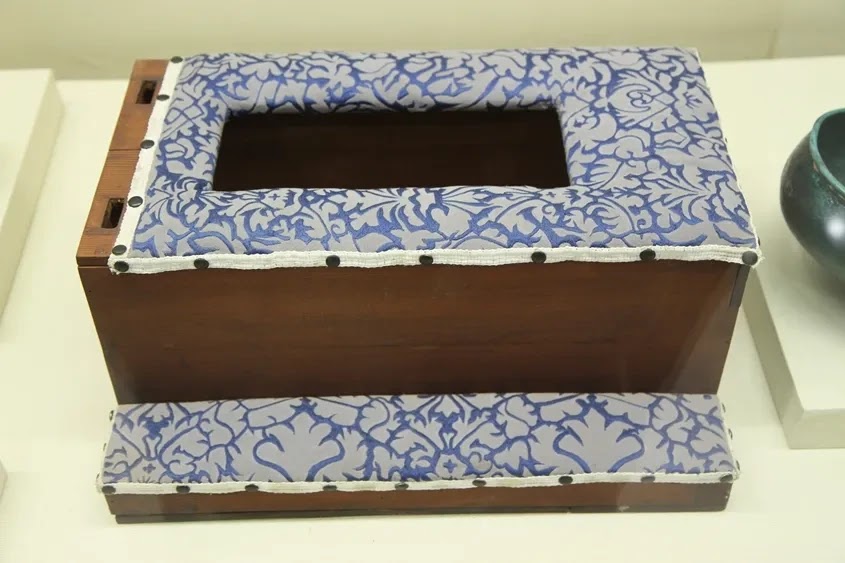
The maehwa-teul was a wooden frame shaped like ‘ㄷ’, wrapped in red silk, with copper or porcelain bowls inserted like drawers below. Feces were revered as ‘maehwa (梅花)’, while urine was called ‘bi (雨)’, and finely chopped fodder ‘maechu’ was laid down to reduce sound and odor.
The climax of this ritual occurred after excretion. The ‘king’s maehwa’ was transferred to the royal medical office, where physicians would analyze its color, shape, smell, and even taste to diagnose the king’s health. This illustrates that the king’s body was a public asset and a symbol of governance.
Advanced Technology of the Palace: Gyeongbokgung’s Public Toilet
In 2021, a massive communal toilet site was excavated near the East Palace of Gyeongbokgung. This facility, measuring 10.4m in length and 1.8m in depth, was perfectly waterproofed with stone and clay, accommodating up to 150 people a day.
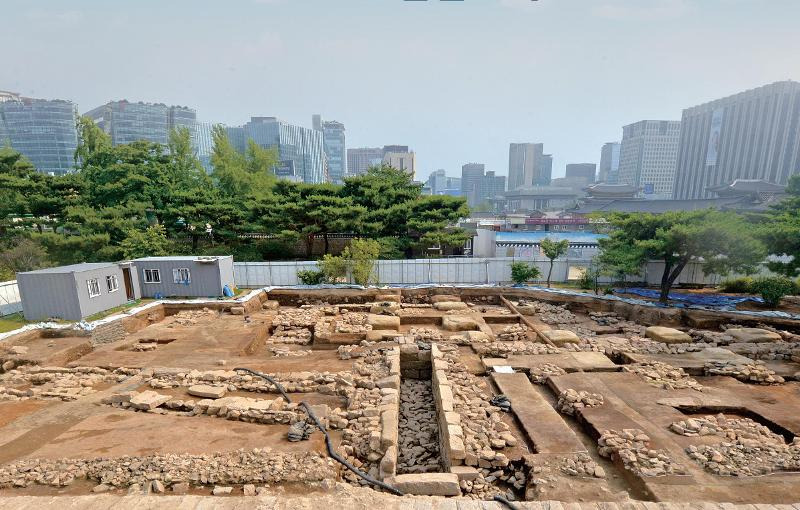
Even more astonishing was the scientific purification system comparable to modern septic tanks. The inlet was designed to be about 80cm higher than the outlet, allowing water to pool and promote microbial fermentation. In this process, solids settled, and only purified wastewater flowed out. This is identical to the basic principles of anaerobic digesters today, proving that the palace was a pinnacle of advanced public health technology to prevent disease and odor.
The Privy Symbolizing Yangban’s Face
In yangban households, the ‘privy’ was located far behind the house. As the saying goes, “The further the in-laws and the privy are, the better,” this distance was an expression of Confucian worldview. It strictly separated the ‘civilized’ ‘pure’ living space from the ‘unclean’ excretion space to maintain the ideological purity of the home.
Due to this inconvenience, the portable toilet known as ‘yogang’ was essential. For the yangban class, separated from agricultural production, excrement was treated not as an economic resource but merely as unclean ‘waste’.
The Treasure Trove of Farmers: The Dung Storage
For commoners, the privy was the center of ‘circulation’. The toilet, referred to as ‘jaekgan’, was a core infrastructure of the farm, the only source of fertilizer in an era without chemical fertilizers. The saying, “You can give a bowl of rice, but not a sack of dung,” clearly illustrates its value.
There was even a custom called ‘dung debt’. If one used a neighbor’s toilet, they had to invite them the next day to relieve themselves or repay with vegetables. For commoners, the toilet was not a waste disposal site but a ’treasure trove’ itself.
Jeju’s Wisdom: The Coexistence of Humans and Pigs in ‘Tongsil’
On the barren volcanic island of Jeju, there was a unique toilet called ’tongsil’. This structure combined a human toilet with a pigsty, where the ‘dung pig’ would immediately eat the excrement as it was produced.
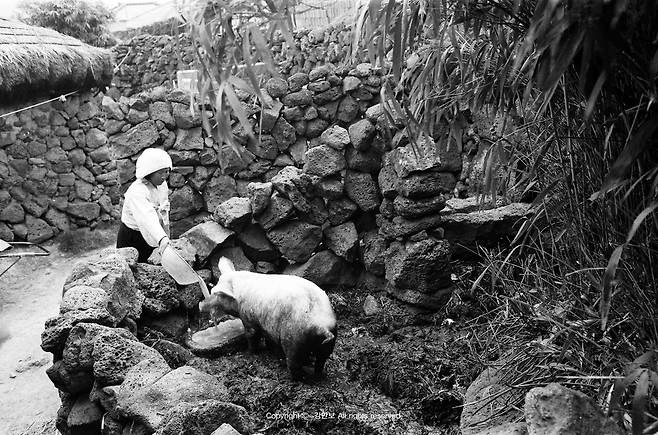
The excrement produced by the pigs became the highest quality fertilizer, ‘doggeureum’, enriching the barren land. Tongsil was the heart of a perfect symbiotic ecosystem connecting humans, animals, and land.
The Toilet Ghost and Social Order
The dark and secluded location of toilets evokes a universal sense of unease. Joseon people named this fear ‘cheoksin (厠神)’, or ’toilet ghost’. Depicted as a young woman who died with resentment, it was believed that if one opened the door without knocking, she would become angry and cause illness.
This functioned as a social mechanism enforcing a culture of knocking for privacy. More deeply, the belief that a woman with resentment lingered in an ‘unclean’ space reflected the gender anxieties of the patriarchal society of the time.
Conclusion
What can we learn from the toilets of the Joseon Dynasty? The most intriguing aspect I found while examining these materials was that the most private space transparently reflects the public aspects of the era.
- The king’s maehwa-teul: A symbol of governance, observing state affairs through the king’s health.
- The commoner’s dung storage and Jeju’s tongsil: Showcasing the wisdom of a circular economy that utilized excrement as a core resource for agricultural production rather than mere waste.
- The palace’s public toilet: Demonstrating the importance of social infrastructure managing collective hygiene by applying scientific principles comparable to modern technology.
By peering into the most humble spaces, we confront the profound and intimate landscapes of a bygone era. Next time you visit Gyeongbokgung or a folk village, why not imagine the location of the ‘privy’ hidden beyond the splendid halls?
References
- Was the maehwa-teul used by the king a plum blossom vase? Newseum
- Privies and toilets Brunch
- The origin and terminology of public toilets Seoul Metropolitan Government
- Maehwa-teul, the king’s portable toilet | Joseon Dynasty Story Animation YouTube
- Maehwa-teul Namu Wiki
- Your Majesty, you must relieve yourself only in front of the court ladies Ohmynews
- Major discovery of toilets in the Joseon Dynasty palace… But? / YTN YouTube
- [At this moment] Why were spoons and bowls found in the public toilets of the Joseon Dynasty? JoongAng Ilbo
- Gyeongbokgung’s privy with a septic tank… The site of the Joseon royal palace toilet was revealed 150 years ago Hankyoreh
- Korean toilet culture Restroom Culture Citizen Alliance
- The privy! The name of the privy and the stories it contains Yeongnam Cultural News
- The ‘waste balloon’ summoned the methods of excrement utilization in Korea, China, and Japan News Free Zone
- Tongsil Digital Seogwipo Cultural Encyclopedia
- Tongsil Korean Folk Encyclopedia
- [Again! Jeju Culture] (33) “Is the dung pig dirty?… There was a reason for everything!” Yonhap News
- Privy Korean Folk Encyclopedia
- Jeongrang-gakshi Namu Wiki