
What multilayered history lies behind the powerful symbol of the ‘White-Clad Nation’?
- The custom of wearing white clothes among the Korean people in ancient Chinese records
- The real reason behind the Joseon Dynasty’s prohibition of white clothing
- The turning point that transformed ‘White-Clad Nation’ into a symbol of resistance
- Two common misconceptions about white clothing and the truths behind them
The Image of the ‘White-Clad Nation’ in Our Minds
‘White-Clad Nation (白衣民族)’. This nickname we use to refer to ourselves has become a powerful symbol embodying purity, innocence, and an indomitable spirit of resistance. Like the refrain in the military song ‘Waving Taegukgi’, “We are the descendants of the White-Clad Nation Dangun”, this image has deeply permeated our national identity.
However, we must question this romantic image. Did our ancestors truly wear only white clothing? Was this choice a unique aesthetic preference, a manifestation of deep spiritual beliefs, an economic necessity due to a lack of dyes, or an expression of political resistance against oppression?
To conclude, the stories surrounding white clothing are not mere fragments of fact but a complex and multilayered historical narrative. The term ‘White-Clad Nation’ itself is a concept that emerged relatively recently within a specific political context. This article aims to trace the journey of white clothing through historical records, from ancient materials to colonial propaganda, exploring the more nuanced and intriguing truths hidden between myth and reality.
Chapter 1: The First Appearance of White Clothing in Ancient Texts
The Earliest Record: The Reverence for White Clothing in Buyeo
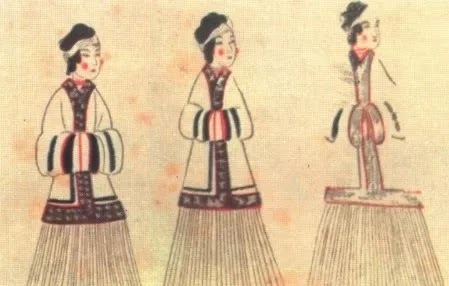
The oldest record of the Korean people’s custom of white clothing surprisingly comes not from our own records but from ancient Chinese historical texts. The ‘Records of the Three Kingdoms’ (三國志) compiled by Chen Shou around the 3rd century contains crucial evidence of our people’s love for white clothing.
In the section on Buyeo, there is a specific description:
“在國衣尙白, 白布大袂, 袍·袴, 履革鞜(재국의상백, 백포대몌, 포·고, 이혁답)”
This translates to “When in the country, they revere white clothing, wearing wide-sleeved robes made of white fabric and leather shoes”. This is not a vague impression but a detailed description of the form and material of clothing, suggesting that the preference for white clothing among the people of Buyeo was a distinct cultural characteristic noticeable to outsiders.
The Love for White Clothing Continues in Silla
As time passed into the Silla period, this trend continued. Later Chinese historical texts such as the ‘Book of Sui’ (隋書) and the ‘Book of Northern Dynasties’ (北史) also noted the clothing of the Silla people. These texts include the key phrase “服色尙素(복색상소)”, meaning “the color of clothing reveres simplicity (white)”.
Here, ‘素’ refers to the natural color of un-dyed fabrics like silk or hemp. The ‘Book of Sui’ goes further to state that “the color of clothing reveres white”, clearly indicating the Silla people’s preference for white.
Spiritual Roots: Why White?
The choice of ancient people was not coincidental. It was rooted in deep spiritual and religious beliefs.
- Sun Worship: Scholars like Choi Nam-seon (崔南善) argued that for the ancient Korean people, white symbolized the sacred light and the sun itself.
- Rituals to Heaven (祭天儀式): In sacred ceremonies to offer sacrifices to the heavens, participants, including priests, were required to wear white clothing. The use of white rice cakes and white wine as offerings emphasizes the religious significance of this color.
- Purity and Cleanliness: Descriptions of Goguryeo people as ‘clean and clear (潔淸)’ and records of Byeonhan people wearing ‘clean (淨潔)’ clothing show that the values of purity and cleanliness symbolized by white were shared throughout society at the time.
Thus, historical texts recorded by outsiders objectively prove that the Korean people’s preference for white clothing was a key cultural characteristic defining the identity of ancient society, beyond mere aesthetic preference.
Chapter 2: The Color of the Court vs. the White of the People
Delving deeper into history reveals an intriguing paradox. On one hand, the state sought to maintain social order through strict color regulations, while on the other, the people stubbornly clung to white clothing.
The War on White Clothing: Centuries of Prohibition
The Silla caste system strictly distinguished the colors of clothing that could be worn according to social status: purple (紫色), scarlet (緋色), blue (靑色), and yellow (黃色). In the Goryeo and Joseon periods, officials wore different colored robes according to their ranks. Color was synonymous with power and status.
However, the common people mostly wore white clothing, and this trend was so prevalent that the term ‘백의(白衣)’ became synonymous with ‘commoners without official positions’. This ‘clothing conflict’ between the state and the people led to the history of the ‘Prohibition of White Clothing (白衣禁令)’ lasting for centuries.
King Gongmin of Goryeo attempted to prohibit white clothing based on the theory of yin and yang, while the Joseon Dynasty systematically suppressed it. King Yeongjo lamented, “The people of the East have revered white since ancient times, and even if prohibited by law, it has become a custom that cannot be changed.”
| Dynasty/Period | Monarch (Year) | Reason for Prohibition |
|---|---|---|
| Goryeo | King Gongmin (1357) | Ideological: Theory of Five Elements (In the Eastern country/Wood, the color of the West/Metal is ominous) |
| Joseon | King Taejo (1398) | Establishing Order: Suppressing luxury trends |
| Joseon | King Taejong (1401) | Social Order: Strengthening class order and encouraging colored clothing |
| Joseon | King Sejong (1425) | Economic/Ideological: Preventing waste of grains for bleaching, encouraging blue clothing |
| Joseon | King Myeongjong (1550s) | Symbolic: White clothing is funeral attire (素服) and thus inappropriate for everyday wear |
| Joseon | King Yeongjo (1738) | Ideological/Practical: Reemphasizing the theory of Five Elements, promoting black/blue clothing |
| Korean Empire | (1894-1906) | Modernization: Hygiene, economic efficiency, severing ties with a ‘sad’ past |
Attempts That Were Bound to Fail
However, these state efforts repeatedly failed. The people stubbornly insisted on wearing white clothing. The reasons included a deep spiritual bond like sun worship, economic realities of being unable to afford expensive dyes, and the practicality of being easy to wash with ash water.
Ultimately, the state’s top-down orders could not overcome the massive wall of the people’s bottom-up cultural practices. This is a powerful testament to the persistent vitality of cultural customs deeply rooted in the lives of the people. While it was not a conscious political struggle, the people neutralized state policies simply by adhering to their ways. I believe that at this point, we can discover the archetype of the people’s quiet yet most effective cultural resistance against state coercion.
Chapter 3: White Clothing Transformed into a Color of Resistance
The Japanese colonial period was a decisive turning point where the meaning of white clothing fundamentally and permanently changed. The Governor-General of Korea launched a massive ‘Color Promotion Movement’ as part of its policy to eradicate national culture.
Campaigns of Violence and Humiliation
While the Joseon Dynasty’s prohibitions were enacted through legal means, the Japanese approach was much more violent and humiliating.
- Propaganda and Stigmatization: The Governor-General and its puppet media belittled white clothing as ‘unsanitary’, ‘uneconomical’, and even likened it to ‘ghost clothing (幽靈服)’, branding Korean culture as primitive.
- Physical Violence: The most notorious acts involved police or henchmen forcibly splattering ink on people wearing white clothing in public places like markets. This was a public humiliation and a violent act that tarnished the dignity of the nation.
- Administrative Pressure: Wearing white clothing could lead to being denied entry to government offices, and officials were pressured to wear colored clothing to ’lead by example’.
Backlash: Rising as a Symbol of Resistance
However, such fierce repression had the opposite effect. What had previously been a simple cultural symbol transformed into a powerful symbol of national identity and anti-Japanese spirit in the face of oppression. Now, the act of wearing white clothing became an expression of quiet yet resolute resistance against foreign powers attempting to eradicate our culture.
This popular resistance was further solidified as nationalist intellectuals like Choi Nam-seon actively used and spread the term ‘White-Clad Nation’, completing it as a stronger symbol. Ultimately, the wave of white-clad crowds during the March 1st Movement indelibly etched this symbol into the hearts of the entire nation.
Ironically, the Governor-General of Korea, in trying to eliminate the custom of white clothing, became the catalyst that forged the powerful and political national symbol we know today.
Chapter 4: Reexamining the Notion of ‘White-Clad Nation’
Notion 1: “They couldn’t dye their clothes because they were poor”
This is the most widely held notion, but it is a simplistic explanation that does not align with historical facts.
- Counterargument: Korea has long possessed sophisticated dyeing techniques. Records from the Song Dynasty, such as ‘Gyerimji (雞林志)’, praised Goryeo’s dyeing techniques, particularly the beauty of red and purple.
- Truth: The dazzlingly white ‘white color’ also required considerable labor and resources (such as grains for bleaching), making it close to a luxury item. In fact, maintaining clean white clothing was a symbol of wealth and diligence, thus carrying the opposite meaning of being a sign of poverty. In reality, commoners primarily wore unbleached hemp or naturally colored fabrics, known as ‘素色 (so color)’.
Notion 2: Colonial Perspective and ‘The Beauty of Sorrow (悲哀の美)’
Japanese folk art scholar Yanagi Muneyoshi (柳宗悦) greatly influenced the explanation of Korean beauty. He viewed the essence of beauty felt in Korean white porcelain and white clothing as stemming from the tragic history of the nation, characterized by ‘han (恨)’ and ‘sorrow’.
- Critical Analysis: While Yanagi’s contributions to preserving Korean cultural heritage should be acknowledged, his aesthetic theory fails to transcend the limits of ‘sympathetic Orientalism’. This reduces the entire aesthetics of a nation to a single emotion of ‘sorrow’, overlooking other aspects such as joy, resilience, and sanctity contained within. Ultimately, this perspective objectifies Korea as a passive and tragic entity, unconsciously reinforcing a colonial viewpoint that strips away political subjectivity.
Substantial Truth: The Diverse Aspects Captured in Genre Paintings
The most definitive counterargument to such a singular interpretation is found in late Joseon genre paintings.
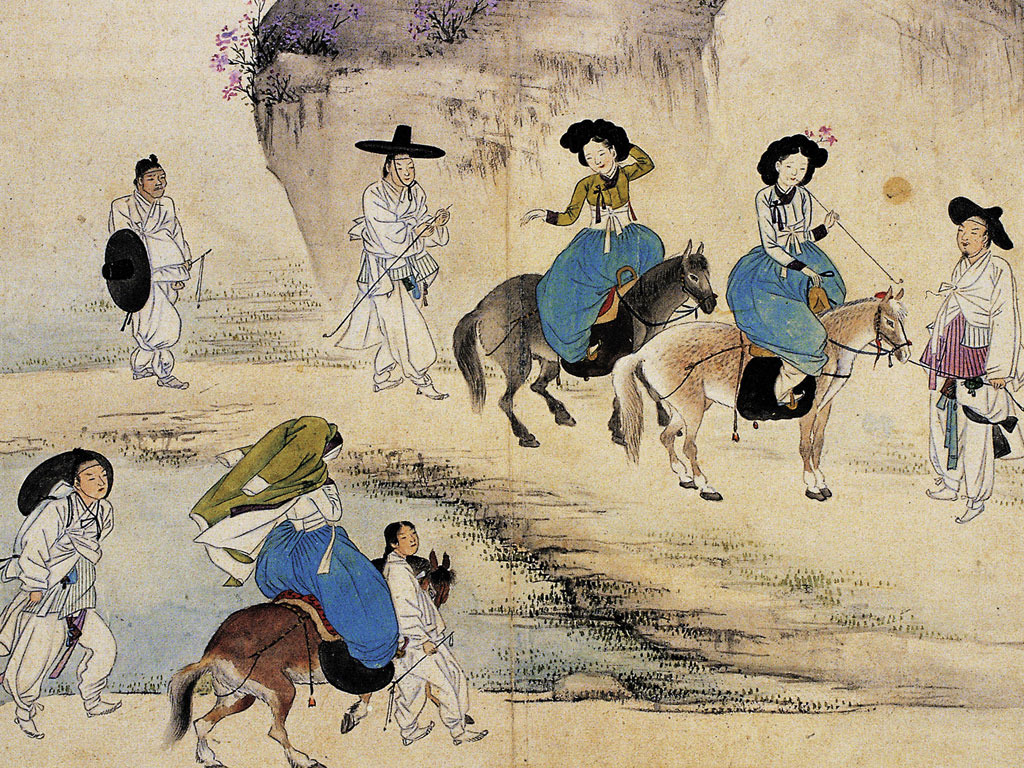
The commoners in Kim Hong-do’s paintings predominantly wear simple colors like white, beige, and light jade. In contrast, the courtesans and yangban in Shin Yun-bok’s paintings display a vibrant array of bright red, yellow, and blue skirts and jeogoris, showcasing a feast of colors.
The works of these two artists serve as decisive evidence that the ‘White-Clad Nation’ does not literally mean that everyone wore only white clothing. Attire varied significantly based on status, gender, occupation, and circumstances. True history lies in understanding the intricate meanings of this diversity.
Conclusion: Beyond the Constructed Symbol of the White-Clad Nation
The image of the ‘White-Clad Nation’ is a powerful symbol, but it is not a universal historical fact in the literal sense. It is a concept that has been layered with meaning and recreated over time.
- Beginning: The preference for white clothing began with the spiritual reverence for light and the heavens in ancient times.
- Conflict: It later became a cultural preference and a symbol of quiet resistance against the prohibitions of the ruling class seeking to control social order.
- Completion: Finally, it was forged into a political symbol of national identity amid the oppression of foreign powers attempting to eradicate it.
Ultimately, the story of white clothing is a microcosm of the history of the Korean people, who have built a strong identity through a long tradition, resilience against authority, and struggles against oppression. The truth of the ‘White-Clad Nation’ exists not in a single photograph painted entirely in white, but within the dynamic narrative exploring what that white meant to the people living through the ages.
Do you know any other stories about the ‘White-Clad Nation’? Please share your thoughts in the comments.
View References
- White-Clad Nation - Namu Wiki [Link]
- White-Clad Nation (白衣民族) - Encyclopedia of Korean Culture [Link]
- Why Are We the White-Clad Nation… Is It Because of 'Ash Water'? - Chosun Ilbo [Link]
- [Historical Walk] Why Did Our Nation Become the White-Clad Nation? - Monthly Chosun [Link]
- White-Clad Nation - Wikipedia, The Free Encyclopedia [Link]
- We Were Originally Not the White-Clad Nation - Historical Recovery - Korean Historical Policy Research Institute [Link]
- The Origin and Meaning of the White-Clad Nation - Our History Net [Link]
- Records of the Three Kingdoms (Commentary by Baesongji) / Volume 30 - Wikisource, The Free Library [Link]
- White Clothing (白衣) - Encyclopedia of Korean Folklore [Link]