
As the heart of the digital revolution beats faster, humanity is once again facing the most powerful and controversial energy source: nuclear power.
- Understand why artificial intelligence (AI) consumes vast amounts of electricity and the scale of this demand.
- Explore the background of the global shift from nuclear phase-out to nuclear power generation policies.
- Examine the advantages of next-generation Small Modular Reactor (SMR) technology and the realistic challenges facing nuclear power.
The Invisible Engine of Digital Miracles
Recently, while asking generative AI complex questions or creating fantastic images with just a few words, I found myself wondering: where does the energy that powers this magical technology come from?
All these processes occur almost magically, smoothly, and instantly. However, behind this digital miracle lies a vast, invisible physical infrastructure. Thousands of kilometers away, data centers consume enormous amounts of electricity alongside the heat emitted by countless servers. The entity that seemed like a ghost inside machines is, in fact, a massive physical presence that devours tremendous energy.

At this point, the greatest paradox of modern technology is revealed. The AI revolution, which once seemed like a symbol of an immaterial future, is creating the largest and most centralized energy demand in human history. This enormous demand is forcing a fundamental re-examination of global energy policies, leading governments and Silicon Valley tech giants to embrace the energy source they once turned away from: nuclear power generation. This article deeply tracks the power crisis triggered by AI, the resurgence of nuclear power, and the challenges we face.
1. The Predator in the Machine: Quantifying AI’s Energy Crisis
The reason AI consumes vast amounts of electricity is not merely because servers operate 24/7. The essence lies in the extremely intensive computational power required for training and inference processes of large language models (LLMs).
Dissecting AI’s Appetite: Why So Much Power is Needed
First, AI computations rely on parallel processing that utilizes thousands of high-performance graphics processing units (GPUs) simultaneously. Each GPU consumes significant power, and when they come together to train a massive model, the power demand increases exponentially. For example, the power required to train a large model like GPT-3 is about 1.3 gigawatt-hours (1.3 GWh), which is equivalent to the amount of electricity used by thousands of households in a day.
Second, intense computations generate tremendous heat. Without cooling, semiconductor chips would melt. Therefore, data centers must allocate a significant portion of their power not for computing but for cooling systems. It is estimated that about 40% of the power used in data centers is consumed for cooling, which is a key factor exacerbating AI’s power consumption.
The Shocking Scale of Surge
These technical characteristics are leading to an unprecedented surge in power demand. The International Energy Agency (IEA) projects that global data center power consumption will more than double from 460 terawatt-hours (TWh) in 2022 to 1,050 TWh by 2026. In some high-growth scenarios, this figure could reach up to 1,700 TWh by 2035.
This increase in demand is concentrated in the United States and China. It is analyzed that about 80% of the expected increase in global data center power consumption by 2030 will occur in these two countries. By 2030, the power consumption allocated to each American from data centers is expected to exceed 1,200 kilowatt-hours (kWh) annually, which is an enormous amount, nearly 10% of the annual power consumption of an average American household.
Projected Data Center Power Consumption
| Region/Country | 2022 (TWh) | 2026 Projection (TWh) |
|---|---|---|
| Global | 460 | 1,050 |
| USA | ~190 | ~430 (by 2030) |
| China | ~100 | ~275 (by 2030) |
The Paradox of Climate Change
The problem is how to meet the explosively increasing power demand. The growth of AI is rapidly surpassing the supply capacity of existing power grids, and the most readily mobilizable energy source in the short term is ultimately fossil fuels. The IEA forecasts that more than 40% of the new power demand increase from data centers will be met by natural gas and coal generation by 2030.
This creates a ‘climate change paradox’ where the AI revolution directly conflicts with humanity’s decarbonization goals. AI data centers are typical demand sites for ‘baseload’ power, which requires stable, high-density electricity supply 24/7 throughout the year. The pace of AI growth is outpacing the spread of renewable energy and energy storage systems (ESS), highlighting the urgent need for a stable and carbon-free new baseload power source, namely nuclear power.
2. A Global U-Turn: The World Embraces Nuclear Again
After the Fukushima nuclear disaster in 2011, the world has been in a ’nuclear phase-out’ trend for over a decade. However, with the addition of climate change, energy security, and the new variable of AI, this trend is experiencing a dramatic reversal. The ’nuclear winter’ is over, and there is a clear movement to embrace nuclear power globally again.
- USA: Through the Inflation Reduction Act (IRA), it has shifted policy weight by providing nuclear power with tax credit benefits equivalent to renewable energy. Additionally, it has established a ‘Nuclear Project Management and Supply Working Group’ to address past project delays.
- Europe (France & UK): Traditional nuclear power stronghold France has announced plans to build up to 14 new large reactors by 2040. The UK has also presented a roadmap to quadruple its nuclear power capacity by 2050.
- Asia (Japan & Korea): Even Japan, which experienced the Fukushima accident, has approved the restart of existing reactors and eased regulations for operational periods from ‘40 years, up to a maximum of 60 years.’ Korea has officially abandoned its nuclear phase-out policy through the 11th Basic Plan for Power Supply and Demand, announcing plans to build three new large reactors by 2038 and commercialize SMR by 2035.
3. Unexpected Alliances: When Silicon Valley Meets Reactors
Perhaps the most surprising aspect of the nuclear renaissance is that tech giants from Silicon Valley have emerged as its most ardent supporters. Those who led the RE100 campaign promising ‘100% renewable energy use’ are now reaching out to nuclear power.
- Amazon: Acquired a data center complex next to the Susquehanna nuclear power plant in Pennsylvania to establish a model that directly supplies power from the nuclear plant.
- Microsoft (MS): Signed a 20-year power purchase agreement (PPA) with Constellation Energy, the largest nuclear power company in the US, to utilize nuclear power for its Virginia data center.
- Google: Formalized plans to utilize nuclear energy for its data centers starting in the 2030s by signing a power purchase agreement for 500MW with SMR startup Kairos Power.
4. Small, Safe, and Scalable: Is SMR the Universal Solution?
At the center of the new nuclear renaissance is the Small Modular Reactor (SMR), a key technology. SMRs are small reactors with an electrical output of 300 megawatts (300 MWe) or less, changing the paradigm of nuclear power with a different approach than traditional large reactors.
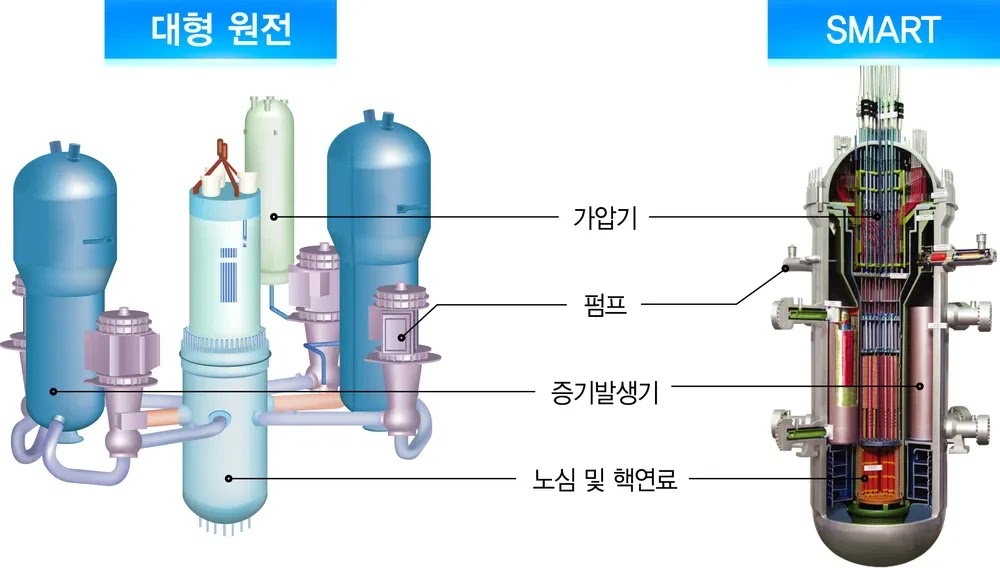
Key Advantages of SMR: 3S
- Safety: The most significant feature of SMR design is the ‘passive safety system.’ This concept allows the reactor to be safely cooled without external power supply or human intervention in emergencies.
- Scalability & Siting: SMRs are small enough to be utilized as ‘distributed power’ built right next to data centers.
- Speed (Theoretically): By mass-producing core components in factories and only assembling them on-site, construction time can be dramatically reduced.
5. The Harsh Reality: The Eternal Obstacles on the Path of Nuclear Power
Despite the rosy outlook, the path to illuminating AI’s future with nuclear power is fraught with numerous challenges. Unproven economics, nuclear waste disposal issues, and securing public trust remain significant tasks to be addressed.
Ultimately, the greatest barrier to the nuclear renaissance may not be technological or economic, but rather social and political issues. Establishing a robust social and political consensus that can endure over the decades-long lifecycle of projects is of utmost importance.
Comparison/Alternatives
What are the differences between traditional nuclear power and next-generation SMRs? Comparing the characteristics of the two methods can help us better understand the future of nuclear power.
| Feature | Large Nuclear Power Plants | Small Modular Reactors (SMR) |
|---|---|---|
| Output | Over 1,000 MWe | Under 300 MWe |
| Construction Method | On-site construction (long-term) | Factory production, on-site assembly (short-term) |
| Site | Large area, coastal preferred | Limited, possible near inland/cities |
| Safety | Active safety systems (requires external power) | Passive safety systems (self-cooling) |
| Utilization | Centralized baseload | Distributed power, direct supply to data centers |
Conclusion
The endless energy demand of AI is unexpectedly catalyzing a global reassessment of nuclear power. This raises significant questions about the future of technology and energy policy.
-
Key Summary:
- Surge in AI’s Power Demand: AI technology demands a stable amount of electricity that is unprecedented compared to existing industries, placing a significant burden on current energy systems.
- Resurgence of Nuclear Power: Nuclear power is once again being highlighted as the most realistic alternative for the 24/7 carbon-free baseload power required by AI data centers, prompting governments and big tech companies to expand investments.
- Complementary Future: The future energy solution lies not in a binary choice of ‘renewable energy or nuclear power,’ but in building a complementary system that utilizes both renewable energy and nuclear power.
We stand at a critical crossroads. Decisions made regarding energy infrastructure over the next decade will define not only the achievement of climate goals but also the ultimate limits of the AI revolution. This is a fundamental choice about what kind of technological and environmental future we will build.
References
- Samil Accounting Corporation - PwC AI Eats Electricity
- Goover AI Data Center Power Solutions: Energy Strategies through SMR and Agrivoltaics
- KEEI Current Status and Outlook of Global Data Center Power Supply (IEA)
- Today Energy [Issue] Power Surge Amid AI Boom… Data Center Consumption to Double by 2030
- Daum US, Europe, Japan Also ‘Return of Nuclear Power’… Supporting New Construction and Operational Period Extensions
- Chosun Ilbo New Nuclear Plans Emerge After 9 Years… Three Additional Large Reactors by 2038
- Apple Economy Energy Crisis ‘Data Center’… Is the ‘Nuclear Era’ Opening?
- Chosun Ilbo Big Tech’s ‘Nuclear Renaissance’… Amazon Bets $500 Million
- Greenium Google Expresses Intent to Utilize Nuclear Power in Data Centers… Third After Amazon and MS
- Chosun Ilbo As AI Data Centers Increase, This is Rising as an Alternative Power Supply
- International Newspaper [Professor Kim Hae-chang’s Energy Transition Story] <46> Discussing the Issues and Challenges of Nuclear Fission Energy