
Exploring the fascinating timeline of Korean dabang, which has nurtured the culture and thoughts of the era beyond just being a simple tea house.
- Where was the first dabang in Korea, and how did coffee culture begin?
- The transformation of dabang from a haven for artists to a center of youth culture.
- The evolution of traditional dabang into modern cafes today.
Dabang (茶房) was not just a place to drink tea and coffee. Understanding the history of Korean dabang is akin to grasping the social stage that has nurtured the culture and thoughts of an era as a ’third space’ beyond home and workplace, traversing through tumultuous history. Contrary to its name, which means ’tea room’, the history of dabang has been intertwined with coffee, a symbol of modernism.
As a social hub for elites and a refuge for artists, sometimes a political exile and a liberation space for youth, the story of dabang encapsulates the modernization process of Korea over the past century.
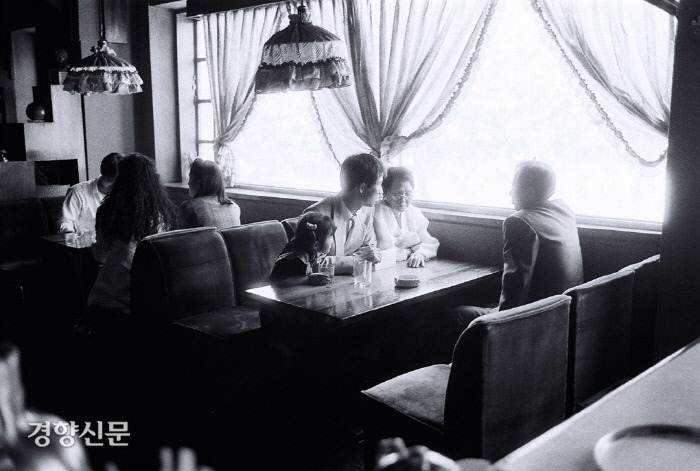
Chapter 1: Dawn of a New Era – The Beginning of Dabang Culture
The origins of coffee and dabang in Korea are intertwined with various stories, making it difficult to define clearly, but each ‘first’ showcases different facets of Korean society facing a new modern era.
A Beverage for the Emperor
The story begins within the palace walls. Coffee, known as ‘gabae (珈琲)’ or ‘yangtanguk (洋湯菊)’, was first introduced to the upper echelons of the Korean Empire. Notably, Emperor Gojong was known to be a coffee enthusiast, enjoying coffee at Deoksugung’s Jeonggwanheon (靜觀軒). The ‘Kim Hong-ryuk solo tea incident’ in 1898 illustrates how rare and politically sensitive coffee was as a symbol of the elite at that time.
The Salon of Diplomats – The Sontak Hotel
Often cited as the first coffee house, the Sontak Hotel, operated by German woman Antoinette Sontak around 1902, served as a social space for foreign diplomats and high-ranking officials of the Korean Empire, differing in nature from the public dabang that would later emerge.
Competing ‘Firsts’ – The Story of Two Cafes
So, where was the first dabang aimed at the public? For a long time, it was known to be ‘Futami (二見)’, opened by a Japanese person in Chungmuro in 1923, but a newspaper article from November 3, 1909, revealed that a Japanese person opened a ‘kisa-ten (喫茶店)’ at Namdaemun Station, rewriting history.
However, the true turning point in the history of Korean dabang came in 1927 when film director Lee Kyung-son opened ‘Kakadu’ in Gwanhun-dong. This was the first modern-style dabang operated directly by Koreans, aiming to be a space purely for cultural exchange, unlike the Japanese-style ‘cafe’ that sold alcohol, and it presented the prototype of Korean dabang culture.
History and Characteristics of Early Dabang
| Facility Name | Estimated Year Established | Key Features and Significance |
|---|---|---|
| Sontak Hotel | Around 1902 | Coffee house within a Western-style hotel, primarily for foreign diplomats and Korean elites. Considered a precursor to public dabang. |
| Kisa-ten (喫茶店) | 1909 | Japanese-style coffee shop (kissa-ten). Confirmed through a newspaper article in 1909, presumed to be the first public coffee sales point in Korea during the colonial era. |
| Futami (二見) | 1923 | Known as the first modern-style dabang in Seoul until the discovery of the kisa-ten article. |
| Kakadu (Kakadu) | 1927 | The first modern-style dabang established and operated by Koreans. A cultural center for artists run by a film director, establishing the identity of Korean dabang. |
Chapter 2: The Turbulent 1930s – The Salon of the Avant-Garde
The 1920s and 30s marked a golden age when dabang emerged as the center of Korean modernism. During this era, dabang was a cultural project planned and directed by the artist-owners themselves.
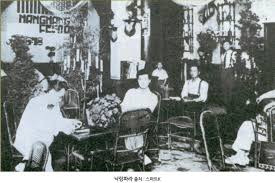
The Birth of ‘Kakadu’, the Artist’s Hideout
Lee Kyung-son’s ‘Kakadu’ was an artwork in itself, featuring candlelight, Indian-style tablecloths, and masks from Bongsan Talchum. It was a living space where actual cultural events, such as a roundtable commemorating Tolstoy’s 100th birthday, took place.
The Meeting of Classics and Modernity, ‘Nangnangpara’
In 1932, artist Lee Soon-seok opened ‘Nangnangpara (樂浪parlour)’, which embodied the will to create Korean modernism from its very name. It served as a designated space for the literary group ‘Guin-hui (九人會)’ and was frequented by poet Lee Sang and novelist Park Tae-won. This place also appears in Park Tae-won’s representative work, ‘A Day in the Life of a Novelist Gu Bo’.
The Poet’s Melancholic Stage, ‘Jebi Dabang’
In 1933, genius poet Lee Sang (李箱) opened ‘Jebi Dabang’ in Jongno. As an architect, he showcased modern attempts to blur the boundaries between inside and outside, finishing the front with large glass. This dabang, where his lover Geum-hong served as the madam, reflected Lee’s literary world but ultimately failed in management and closed after just over two years.
Chapter 3: Ashes and Canvas – Dabang in Post-War Korea
After the Korean War, the dabang of the 1950s transformed from a refined salon of modernists into a vital survival space and refuge for artists who survived the ruins.
A City of Ruins, Culture in Exile
As the war destroyed cultural infrastructure, dabang became a multipurpose space filling that void. Painters held exhibitions, and writers received manuscript commissions. Dabang transcended being just a meeting place, becoming a site of struggle for survival.
Myeongdong Romance – The World of Lee Jung-seop
The tragic life of painter Lee Jung-seop symbolically illustrates the role of dabang during this period. He burned his last artistic spirit while moving between dabang like ‘Dolce’ and ‘Mona Lisa’ in Myeongdong and ‘Mildawon’ in Busan.
- Art for Survival: An anecdote where he handed a fellow painter the most basic white paint while signaling that he was starving shows that dabang served as a minimal safety net for solidarity and survival among fellow artists.
- Temporary Canvas: ‘Eunji-hwa (銀紙畵)’, where he painted on the silver foil found in cigarette boxes because he couldn’t afford paper, proves that dabang was a minimal physical space that made art possible even in poverty.
- The Human Side of Artists: Dabang was a close-knit community where artists shared not only their struggles but also their small, human aspects, such as appearing with bandages to settle their stiff hair.
Post-war dabang was a desperate crucible for survival, transcending being just a space for artistic experimentation.
Chapter 4: The Voice of a Generation – Music, Youth, and Revolution
From the 1950s to the 1980s, dabang became the central stage for youth culture and political resistance. It evolved into music dabang, bursting with the energy of young intellectuals.
Classroom 25, ‘Hakrim Dabang’
Opened in 1956 in Daehak-ro, ‘Hakrim Dabang’ was a beloved gathering place for Seoul National University students, often referred to as ‘Classroom 25’. Particularly during the military dictatorship of the 1970s and 80s, Hakrim served as a secret meeting place for students leading the democratization movement and a hotbed for heated discussions. The ‘Hakrim Incident’ in 1981 proved that this dabang left an indelible mark in the history of Korea’s democratization struggle.
DJ in a Glass Room – The Era of Music Dabang
The 1970s marked the heyday of ‘music dabang’. In an era when personal audio was rare, music dabang was the only refuge where one could listen to the latest foreign pop LPs. The DJ in the glass ‘music box’ played requests while adding witty commentary, becoming a planner of contemporary popular culture.
Chapter 5: The Fading Light and New Dawn – A Great Eruption
In the late 1980s and 90s, as Korean society underwent rapid changes, the era of traditional dabang gradually came to an end.
The End of an Era
The proliferation of home audio systems and CD players, along with the emergence of new recreational spaces like karaoke rooms and arcades, narrowed the position of dabang. The ‘coffee shop’ that emerged during this period boasted bright, modern interiors and self-service, catering to the tastes of the new generation, and soon ‘dabang’ became a space for the old generation, while ‘coffee shop’ became a space for the new generation.
Dark Shadows – The Emergence of ‘Ticket Dabang’
Some dabang that fell behind in competition sought a way out through the irregular operation of ’ticket dabang’. Here, female employees known as ‘regis’ would charge hourly fees to accompany customers, leading to a form of quasi-prostitution that significantly tarnished the image of the word ‘dabang’ for decades.
The Final Transformation – The Arrival of Starbucks
The arrival of Starbucks, which opened its first store in front of Ewha Womans University in 1999, marked the end of the traditional dabang era. Franchise cafes led by Starbucks spread a new consumer culture of efficiency, standardized taste, and ’takeout’, dismantling the complex functions that dabang once held.
Comparison: The Two Pillars of 70s Dabang Culture
Hakrim Dabang and music dabang shared the same name but had distinctly different roles and characteristics. This reflects two different aspirations held by Korean society at the time.
| Category | Hakrim Dabang (Political Counterculture) | Music Dabang (Social Counterculture) |
|---|---|---|
| Main Customers | University students, intellectuals, democratization activists | Young office workers, university students |
| Core Role | Social critique, academic discussions, secret meetings | Enjoyment of the latest popular culture, meeting with the opposite sex |
| Symbolism | Cradle of resistance and intellect, ‘Classroom 25’ | Liberation space for youth, ‘music box’ and DJ |
Conclusion
The history of Korean dabang serves as a mirror reflecting the changes in our society, transcending mere beverage trends. The roots of the cafe culture we enjoy today are infused with the traces of the intense lives of the past century.
-
Key Summary
- ‘Third Space’: Dabang was an important social stage that captured the culture and thoughts of the era beyond just being a commercial facility.
- Portrait of the Era: Constantly changing according to the demands of the times, it fulfilled its role as a salon for artists, a discussion space for democratization, and a liberation space for youth.
- Legacy of Spirit: Although the traditional form of dabang has disappeared, the spirit of being a space for creativity and exchange has been inherited by countless cafes today, living and breathing in our daily lives.
As I head to a cafe today with my laptop, I can’t help but think that my steps are not so different from those of past artists seeking inspiration in dabang. Next time you visit a cafe, why not reflect on this fascinating history contained in a cup of coffee? What does ‘cafe’ mean to you? Share your thoughts in the comments!
References
- Dabang (r286 edition) Namu Wiki
- A New Cultural Axis Originating from Dabang POSTECH Times
- [Cultural History of Brands] Story of Dabang 1 Brunch
- Dabang (茶房) Encyclopedia of Korean National Culture
- Kwon Young-sim’s ‘The Awkward Story of Coffee and Tea’ Sontak Hotel, the First Coffee House Han韓 Culture Times
- [Coffee Story] Sontak, who served coffee to Gojong… Korea’s first barista Joongdo Ilbo
- Korea’s First Dabang… Sold ‘This’ Besides Coffee Bravo My Life
- The Evolution of Gyeongseong (京城) Dabang Monthly Chosun
- [History of Korean Coffee] The First Dabang Opened by Koreans in Gyeongseong Waltz and Dr. Man
- [Barista Talk #2] The First ‘Dabang’ in Korea, Different from Japanese ‘Cafe’ NBN Media
- The Hideout of Gyeongseong Artists, Nangnangpara Maili
- ‘Jebi’ Dabang Opened in 1933, Its Owner Was Poet Lee Sang Joongang Ilbo
- Seo Jeong-joo, Gu Sang, Lee Jung-seop… Artists Nurtured by Dabang Weekly Chosun
- Hakrim Dabang Humanities 360
- [SPECIAL 7080] Hakrim Dabang – A Place Where History and Memories Blend with the Present Seoul Newspaper
- Hakrim Dabang Remains a Hot Place Even Now Junsungki
- [Choi Byeong-ryeol] Music Dabang in Anyang in the 70s that Scouted Popular DJs Anyang Citizen Society Alliance
- [Professor Lee Jeong-hak’s Coffee Story] ⑦·(End) Coffee and … After the 1980s to 2000s Ulsan Daily
- Starbucks/Korea Namu Wiki
- Reasons Why Modern People Love Cafes Brunch