
A 1,500-Year History and Cultural Story in a Glass
- Fundamental differences between Sikhye and traditional Gamju (ingredients and principles)
- The decisive historical background that led to the interchangeable use of the two names
- The remarkable wisdom of our ancestors embedded in the names
Prologue: The Ongoing Sweet Confusion
Have you ever ordered a refreshing Sikhye at a restaurant, only to hear an elder at the next table shout, “Bring me a bowl of Gamju!”? If you were curious about the difference between Sikhye and Gamju but couldn’t find a clear answer, you are standing in the midst of a sweet confusion that has lasted for centuries.
Today, many people consider Sikhye and Gamju to be the same beverage, but in fact, they are fundamentally different from their origins. Traditionally, Gamju (甘酒) is a ‘sweet alcohol’ made from rice and ’nuruk’, which has a low alcohol content. In contrast, Sikhye (食醯) is a ‘sweet beverage’ made from rice that is fermented with ‘malted barley’, containing no alcohol.
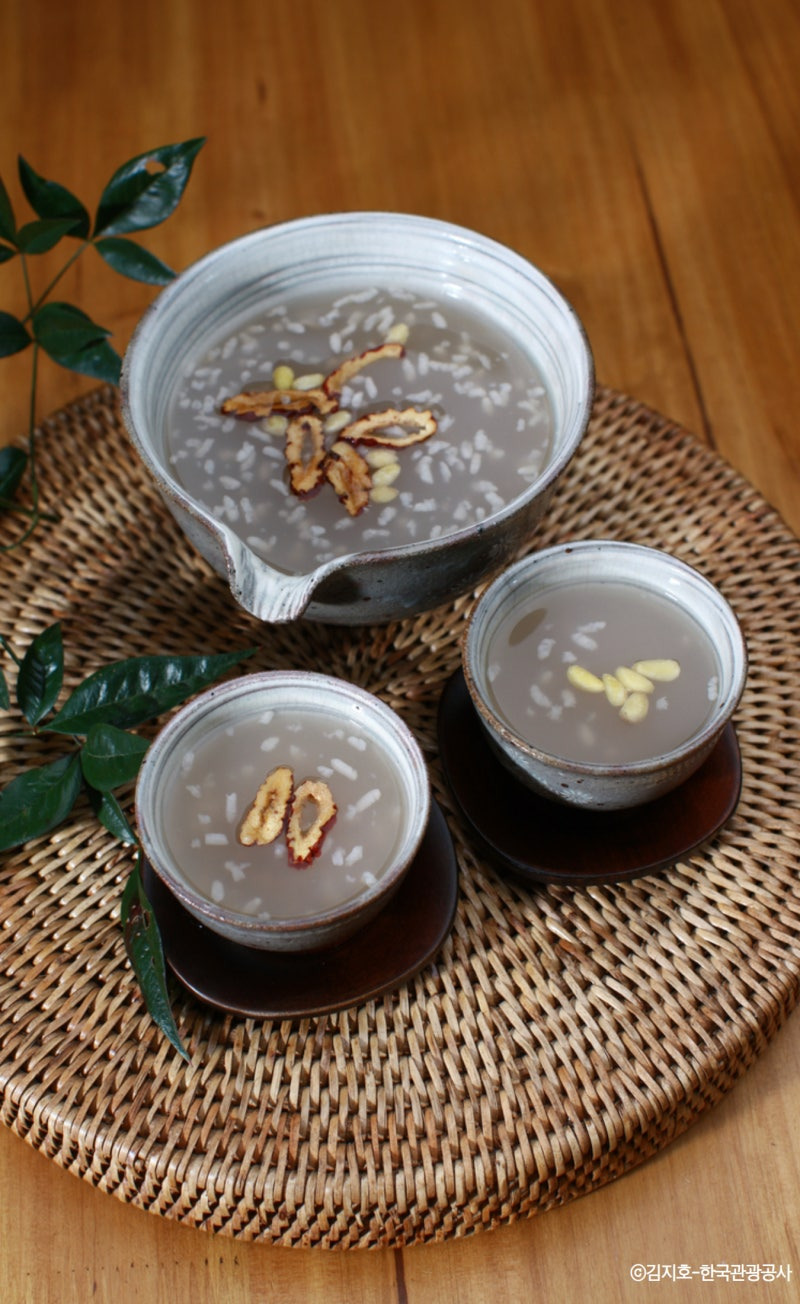
So how did these two entirely different beverages come to be referred to by the same name? Let’s embark on a time travel to find the answer.
Key Differences Between Sikhye and Traditional Gamju
| Category | Sikhye (食醯) | Traditional Gamju (傳統 甘酒) |
|---|---|---|
| Key Ingredient | Malted Barley | Nuruk (Fermentation Starter) |
| Manufacturing Process | Saccharification | Saccharification & Alcoholic Fermentation |
| Alcohol Content | None | Low (about 1~3%) |
| Active Agents | Enzymes (Amylase) | Enzymes & Yeast |
| Modern Classification | Beverage | Traditional Alcohol - Sweet Alcohol |
The Sacred Beverage of Ancient Kingdoms: Gamju
Our time travel begins about 1,500 years ago, on a page of the Samguk Yusa (삼국유사). In the section titled Garakgukgi (가락국기), there is a record of the founding myth of Gaya, where offerings of ‘alcohol, Gamju, rice cakes, rice, tea, and fruits’ were placed on the sacrificial table of the founding king, Suro.
The noteworthy word here is ‘Gamju’. In some original texts, it is written with the character ‘예 (醴)’, which means ‘sweet alcohol that ferments overnight’, indicating that it was closer to the form of traditional Gamju with alcohol. Thus, Gamju first appeared not on an ordinary dining table, but on a sacred sacrificial table dedicated to the founding ancestor of the nation.
One Name, Two Recipes: Records from the Joseon Dynasty
As time flowed into the Goryeo and Joseon dynasties, our sweet beverage was recorded in history in a more concrete form. In particular, the cookbooks of the Joseon Dynasty show a decisive moment where two different paths diverged under the name ‘Gamju’.
Standing at the Crossroads: Two Types of Gamju in Sangayo Log (산가요록)
In the mid-15th century, a cookbook titled Sangayo Log (산가요록) written by royal physician Jeon Sun-ui (전순의) surprisingly records two entirely different recipes under the name ‘Gamju’.
- A beverage similar to today’s Sikhye using malted barley
- A sweet alcoholic drink using nuruk powder
This point marks a crossroads in history. In 15th-century Joseon, ‘Gamju’ was not a specific name for a beverage but a broad concept referring to ‘fermented beverages made from rice that have a sweet taste’.
The Secrets of Noblewomen and the Knowledge of the People
In the 17th century, Eumsik Dimibang (음식디미방) written by the Andong Jang family introduces a type of Gamju called ‘jeomgamju (점감주)’, with the key ingredient being ’nuruk’. This shows that the tradition of Gamju using nuruk was firmly maintained in noble households.
Jumping to the 19th century, Gyuhap Chongseo (규합총서) by Lee of the Bingham family finally presents a recipe almost identical to today’s ‘Sikhye’. This indicates that the non-alcoholic beverage made with malted barley was fully established under the independent name ‘Sikhye’ by the 19th century.
A Decisive Event: The Prohibition of Alcohol by King Yeongjo
King Yeongjo, who reigned the longest in the 500-year history of the Joseon Dynasty, implemented a strict prohibition of alcohol (禁酒令) that had a massive impact on the history of Sikhye and Gamju.
In 1756, Yeongjo banned the production and consumption of alcohol throughout the country under the pretext of preventing waste of grain due to famine. With the law prohibiting the brewing of alcohol, it became difficult to prepare ‘sweet alcohol (醴)’ for sacrificial rites.
At this point, the non-alcoholic beverage ‘Sikhye made from malted barley dramatically emerged on the historical stage. Since Sikhye is not alcohol, it did not violate the prohibition, yet it was sweet enough to be called ‘sweet alcohol’ and became a perfect alternative to alcohol. As Sikhye replaced the traditional Gamju that disappeared from sacrificial tables, people naturally began to call this beverage by the original name it held in that place, namely ‘Gamju (甘酒)’. This trend was particularly strong in some regions like Gyeongsang-do, where the culture of referring to Sikhye as Gamju continues to this day.
The Hidden Secret in the Name: Why Does Sikhye (食醯) Use the Character for Vinegar ‘혜’?
Sometimes, the essence and history of a subject are embedded in its name. Gamju (甘酒) clearly shows its identity as ‘sweet alcohol’ by using the characters for ‘sweet (甘)’ and ‘alcohol (酒)’.
The issue lies with Sikhye (食醯). The character for ‘rice (食)’ is surprisingly combined with the character for ‘vinegar (醯)’. Why would a sweet beverage have the name of a sour vinegar?
The key to solving this riddle lies in the common process of ‘fermentation’. Alcohol and vinegar are part of the same family along the continuum of fermentation processes. Our ancestors noted that although Sikhye is not alcohol, it undergoes a process of ‘fermenting (삭히는)’ rice with malted barley. Therefore, the character ‘혜 (醯)’ was used not to symbolize taste, but to represent the principle of fermentation. Additionally, the expression ’to eat (食)’ despite being a liquid indicates its identity as a food enjoyed with floating rice grains.
Conclusion
From the sacrificial table of the Gaya Kingdom, through the prohibition of alcohol in the Joseon Dynasty, to our tables today, the story of Sikhye and Gamju is an epic that contains the wisdom and history of our people beyond just a simple beverage.
Key Summary Points:
- Fundamental Difference: Sikhye is a non-alcoholic beverage made from ‘malted barley’, while traditional Gamju is a low-alcohol drink brewed from ’nuruk’.
- History of Interchangeability: The culture of calling Sikhye ‘Gamju’ began when Sikhye was served instead of alcohol on sacrificial tables due to King Yeongjo’s prohibition.
- Meaning of the Name: The ‘혜 (醯)’ in Sikhye (食醯) symbolizes the wisdom of our ancestors, representing the fermentation principle of ‘fermenting’ rice rather than a vinegar taste.
Now, if someone looks at Sikhye and says, “This Gamju looks refreshing,” you can simply smile and say, “That story is very long and very interesting.”
References
- What’s the difference between Sikhye and Gamju? Link
- Is ‘Gamju’ the same as ‘Sikhye’? Link
- Sikhye and Gamju, and the differences between them - Health Trends Link
- Garakgukgi (가락국기) - Encyclopedia of Korean National Culture Link
- Sikhye (食醯) - Encyclopedia of Korean Folklore Link
- Gamju (甘酒) - Sillok Wiki Link
- Sikhye Recipe Traditional Food Traditional Cuisine Ancient Cookbook Gyuhap Chongseo (閨閤叢書) - Lamp Cook Link
- Wikipedia: Sikhye Link
- Namu Wiki: Gamju Link