
A Comparative Analysis of Chiu (蚩尤) Across Fiction, History, and Myth
- Understanding the hero’s portrayal in Lee Woo-hyuk’s novel ‘Chiu Cheon-wang-gi’
- Comparing the contrasting images of Chiu in historical records such as ‘Records of the Grand Historian’ and ‘Classic of Mountains and Seas’
- Understanding the process of how Chiu has been accepted and transformed in Korean folklore and modern culture
The Unending Mystery of the God of War
Chiu Cheon-wang is a remarkably diverse and fluid figure in East Asian history and mythology. In Chinese official history, he is recorded as a brutal rebel who opposed the founding emperor of Chinese civilization, Huangdi, while simultaneously being a powerful military god to whom emperors offered sacrifices for victory in war. Additionally, for the Korean people, he has become the archetype of a guardian deity (goblin) that drives away evil spirits in folk beliefs, and in modern times, he has been resurrected as a symbol of national greatness. Thus, Chiu embodies a paradoxical identity as a monster, a rebel, a god of war, a revered ancestor, and a modern national hero.
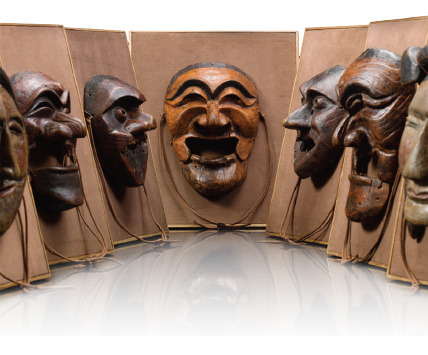
Lee Woo-hyuk’s epic fantasy novel ‘Chiu Cheon-wang-gi’ is at the pinnacle of attempts to reconstruct this complex and contradictory legacy of Chiu into a modern narrative. This work can be evaluated as a conscious ’re-mythologizing’ effort to recreate the character of Chiu, who has been fragmented and sometimes depicted antagonistically in history, into a coherent and heroic national narrative for contemporary Korean readers.
In this post, we will comprehensively illuminate how the fictional imagination, history, and mythology interact to shape the multifaceted portrait of a single figure by comparing the portrayal of Chiu Cheon-wang in the novel with historical records and folk traditions.
‘Chiu Cheon-wang-gi’: Creating a New Hero
Lee Woo-hyuk begins the story by completely overturning the negative image of Chiu found in historical records. The novel reimagines Chiu as the ideal ancestor of the Korean people and a hero with moral depth.
The Portrait of the Hero in the Novel: Chiu Cheon and Chiu Bi Brothers
The novel features twin brothers, Hine (later Chiu Cheon) and Narae (later Chiu Bi), as protagonists. In particular, the elder brother Chiu Cheon is depicted as a principled leader with deep thought and warm humanity, in stark contrast to the ‘brutal’ rebel described in Chinese literature. He struggles to protect his beliefs and his people, never taking life lightly and even showing tolerance towards his enemies. The author projects the spirit of ‘Hongik Ingan’ (弘益人間), the founding ideology of Korea, onto Chiu Cheon, elevating him from a mere war hero to an ideal ancestor of the nation.
A World Shaped by Myth: The Zhu Shen Tribe vs. The Jin Tribe
The narrative of ‘Chiu Cheon-wang-gi’ is set around 2700 BC in Northeast Asia, depicting the conflict between the ‘Zhu Shen Tribe’ to which the protagonists belong and the ‘Jin Tribe’ led by the legendary Huangdi. This framework provides a grand scale of ethnic struggle over ancient hegemony, immersing readers in the story. The author intricately weaves historical and mythical elements, such as ancient Egypt, Sumerian civilization, and Turkic mercenaries, into the fantasy narrative, adding depth and persuasiveness.
The Battle of Takrok: Subverting Historical Records
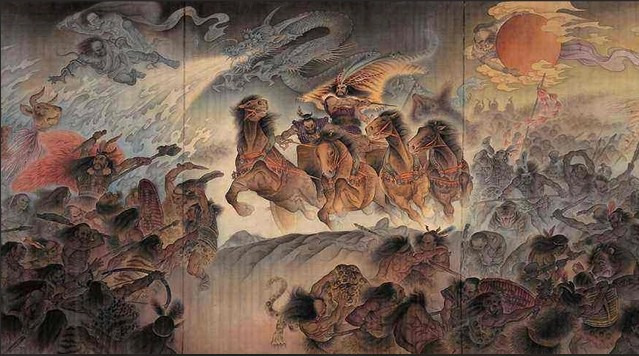
In the climax of the novel, the Battle of Takrok (涿鹿大戰), the author attempts the most dramatic historical reinterpretation. In the novel, Chiu Cheon-wang defeats the army of Huangdi with overwhelming strategy and leadership, achieving a decisive victory. This setting directly contradicts the official historical record in which the emperor is said to have triumphed. Through this, the author completes the narrative of Chiu Cheon-wang ascending to the throne as the legitimate ruler of the Korean people, ‘Zhao Ji Hwan Ung (慈烏支桓雄)’, firmly establishing him as a victor rather than a loser.
The Many Faces of Chiu in History and Myth
So, what does Chiu look like in actual historical and mythical records? Unlike the novel, his portrayal in records is very contradictory and complex.
Chinese Records: Rebel in ‘Records of the Grand Historian’ vs. Sorcerer in ‘Classic of Mountains and Seas’
The most influential record about Chiu is Sima Qian’s ‘Records of the Grand Historian (史記)’. This work defines Chiu as the “most brutal (最爲暴)” rebel who incited a rebellion as the reign of the Flame Emperor declined. It records that the emperor captured and killed him on the plains of Takrok, thus unifying the world, depicting Chiu as a barbaric force threatening the civilized order.
In contrast, the mythical collection ‘Classic of Mountains and Seas (山海經)’ portrays Chiu not as a political rebel but as a being with supernatural powers. He appears as a powerful sorcerer who calls upon the Wind God and Rain Master to create thick fog and attacks the emperor’s army. Although he is defeated by the drought goddess Ba (魃) sent by the emperor, his mysterious abilities left a deep impression on later generations.
The Paradox of Worship: God of War, Bing Zhu (兵主)
The most interesting point is that the defeated rebel Chiu was worshipped as the supreme God of War (兵主) in Chinese history. ‘Records of the Grand Historian’ mentions that Qin Shi Huang, who unified the world, honored Chiu as one of the ‘Eight Gods (八神)’ in his sacrifices. Even Liu Bang, the founder of the Han dynasty, offered sacrifices to Chiu before his final battle with Xiang Yu, praying for victory and later establishing a shrine for him in the capital. This paradox shows the practical perception of ancient people who, despite viewing him as a rebel in terms of national ideology, recognized the need for his powerful military might to achieve victory in war.
Acceptance in the Korean Peninsula: Alternative Historiography and Folk Beliefs
In the Korean Peninsula, Chiu has been accepted and transformed in a completely different manner than in China. In the alternative historiography text ‘Hwandangogi (桓檀古記)’, Chiu is depicted as ‘Zhao Ji Hwan Ung’, the 14th Hwanung of the Baedal nation, a great heroic ancestor who won all 73 battles against the emperor. (However, ‘Hwandangogi’ is considered a pseudo-historical text by mainstream historians.)
In folk traditions, his powerful and fearsome image has transformed into a symbol of national protection.
- Dukje (纛祭): He was worshipped as a military god in national sacrifices held during the Goryeo and Joseon dynasties, praying for victory in war.
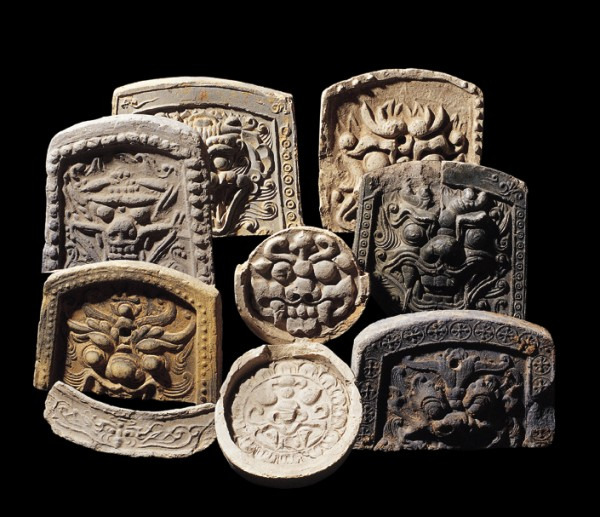
- Goblin and Gwi-myeon-wa (鬼面瓦): Chiu’s image with a “copper head and iron forehead” became the archetype of goblins that drive away evil spirits and is connected to the image of Gwi-myeon-wa, tiles with faces of spirits that block evil energy from buildings.
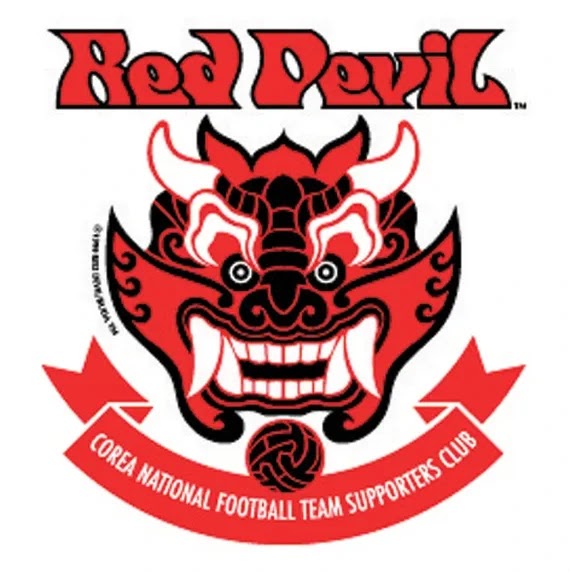
This trend has led to the official emblem of the ‘Red Devils’, the supporters of the South Korean national football team in the 21st century, where Chiu has been perfectly reborn as a modern icon symbolizing indomitable spirit.
Comparative Analysis: How is Chiu Remembered?
By comparing the attributes of Chiu as depicted in the novel and various records, we can clearly see the different purposes behind each narrative’s portrayal of him.
| Attribute | Narrative Distinction | Content |
|---|---|---|
| Identity/Title | Novel ‘Chiu Cheon-wang-gi’ | King of Zhu Shen (珠申), Zhao Ji Hwan Ung |
| Chinese Official History (‘Records of the Grand Historian’) | Rebel, Leader of Gu Li (九黎) | |
| Chinese Myth (‘Classic of Mountains and Seas’) | Warrior who challenged the emperor | |
| Korean Alternative Historiography (‘Hwandangogi’) | 14th Hwanung of Baedal | |
| Korean Folklore and Rituals | Military God (軍神), King of Goblins | |
| Character | Novel ‘Chiu Cheon-wang-gi’ | Wise and compassionate principled leader |
| Chinese Official History (‘Records of the Grand Historian’) | “Most brutal (最爲暴)”, rebellious | |
| Chinese Myth (‘Classic of Mountains and Seas’) | Aggressive and belligerent challenger | |
| Korean Alternative Historiography (‘Hwandangogi’) | Great warrior king, benevolent (仁) | |
| Korean Folklore and Rituals | Fearsome and powerful, yet protective being | |
| Outcome of the Battle of Takrok | Novel ‘Chiu Cheon-wang-gi’ | Victory, strategically overpowering the emperor |
| Chinese Official History (‘Records of the Grand Historian’) | Killed after defeat by the emperor | |
| Chinese Myth (‘Classic of Mountains and Seas’) | Killed after defeat by the emperor | |
| Korean Alternative Historiography (‘Hwandangogi’) | Victory, capturing the emperor and making him a subject |
This table shows that Lee Woo-hyuk systematically subverts the negative attributes of Chiu (brutal rebel, loser) found in ‘Records of the Grand Historian’ and combines the victorious narrative of ‘Hwandangogi’ with the mystical abilities from ‘Classic of Mountains and Seas’ and the protective imagery from Korean folklore to create his own complex hero.
Conclusion: The Resurrected Hero Narrative in Modern Times
The story of Chiu Cheon-wang is a product of history that has been continuously reinterpreted according to the perspectives and needs of those recording it. Which portrayal of Chiu resonates most with you?
- Key Summary 1: In Chinese official history, Chiu is a ‘rebel’ defeated by the emperor, yet paradoxically worshipped as the most powerful ‘God of War’.
- Key Summary 2: In the Korean Peninsula, he was accepted as a guardian deity (Dukje) and a symbol of warding off evil (Gwi-myeon-wa, goblins), and in modern times, he became an icon of the ‘Red Devils’.
- Key Summary 3: Lee Woo-hyuk’s novel ‘Chiu Cheon-wang-gi’ successfully reassembles these contradictory records to create a narrative of a ‘victorious hero’ that aligns with the identity of modern Koreans, portraying him as compassionate and wise.
Thus, mythology and history are not fixed pasts but can be recreated according to present needs. The story of Chiu Cheon-wang prompts us to reconsider the power of a strong narrative today.
References
- Wikipedia Chiu
- Wikipedia Battle of Takrok
- Namuwiki Chiu
- Namuwiki Chiu Cheon-wang-gi
- Encyclopedia of Korean Folklore Dukje
- Hankyoreh Chiu Cheon and Chiu Bi ‘Twin Hero Narrative of the Korean People’
- Channel Yes How Lee Woo-hyuk Writes Fantasy Novels