
What was the weight of the flavor contained in a bowl of jang as the general returned home?
- The history and cultural significance of jang: We explore the value of jang, which transcended simple food to encompass the well-being and history of a household.
- The science of fermentation that determines the flavor of jang: We understand the miraculous activities of microorganisms occurring within meju and jars.
- Various types of traditional jang and modern transformations: We examine jang with regional characteristics as well as the factory-produced soy sauce we consume today.
Jang (醬), Meaning Beyond a Simple Seasoning
General Kim Yushin of Silla was preparing for a battle that would determine the fate of Baekje. As he led his troops, his path fortuitously passed by his home. It had been a long time since he had seen his family due to prolonged wars, but the general, faced with the monumental task of unifying the Three Kingdoms, could not be swayed by personal emotions.
Holding the reins of his horse, he passed by his house and instructed a subordinate to bring a bowl of jang (醬) from home. Moments later, as he tasted the jang brought by his subordinate, a faint smile spread across Kim Yushin’s face. The flavor of the jang had not changed at all. From that unchanging taste, he confirmed the health of his elderly mother and the peace of his household, and finally set off to the battlefield with a steady heart.
I believe this anecdote symbolically illustrates what Korean traditional jang means to us Koreans. It serves as a measure of a household’s well-being and order, as well as a medium for spiritual connection among family members. The process of making and managing jang is a laborious and precise task that lasts throughout the year, and without peace and diligence in the household, it is impossible to maintain good flavor.
Thus, the unchanging flavor of jang is the most certain proof that the household is safe, providing the general with a greater psychological stability than any message could convey. In this way, Korean soy sauce and doenjang transcend mere food ingredients; they are vessels that encapsulate the history and spirit of a family, and indeed, the soul of a nation.
The Origins of Korean Jang, Embracing a Millennium of History
The fermentation culture of the Korean Peninsula has very deep roots. One of the oldest records of jang can be found in the 3rd-century Chinese historical text, Records of the Three Kingdoms (三國志), which states that the Goguryeo people were skilled in “jangyang (藏釀)"—a term that encompasses the techniques of making fermented foods, including jang and alcohol.
However, a definitive record that clearly shows the identity of Korean jang dates back to the Silla period. According to the History of the Three Kingdoms (三國史記), in 683 AD, when King Sinmun of Silla welcomed the daughter of Kim Heumun as his queen, the list of gifts included jang (醬) and si (豉).
‘Jang (醬)’ and ‘Si (豉)’, The Beginning of Uniqueness
The fact that ‘jang’ and ‘si’ were recorded as separate items in King Sinmun’s gift list is the most important clue to understanding the history of Korean jang.
Here, ‘si (豉)’ refers to fermented soybean lumps, which correspond to the modern meju. ‘Jang (醬)’ is interpreted as the liquid (soy sauce) extracted from soaking this ‘si’ in saltwater or the remaining solids (doenjang).
This is the first documented evidence that the unique Korean method of jang production, which yields both liquid and solid seasonings from a single fermentation process, was established over 1,300 years ago during the Silla period.
Jangdokdae, Becoming a Sacred Space in the Home
Traditionally, one of the most important spaces in a Korean home is not the kitchen or the main room, but the jangdokdae (醬督臺). Located in the sunniest and most ventilated area of the house, the jangdokdae served not just as a storage place for jang but also as a sacred altar wishing for the household’s peace and prosperity.
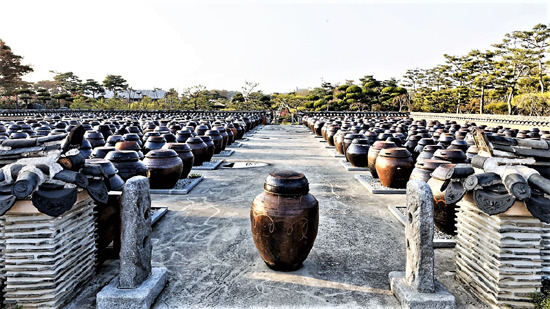
The jangdokdae, neatly arranged in a sunny spot, symbolized the peace and prosperity of the household.
Making Jang, A Traditional Ceremony Embracing Science
The process of making jang is not merely a cooking procedure; it involves strict taboos and procedures, forming a ceremony.
- Choosing an auspicious day (吉日): Jang was not made on just any day. It was essential to select an auspicious day, such as ‘malnal (午日)’, when all things are vibrant and alive, according to the lunar calendar.
- The ritual of the golden thread (禁繩): The jars used for making jang were wrapped with a golden thread, which consisted of red pepper, charcoal, and white paper twisted together to the left. This signified that jang is a sacred entity that must be protected from external evil energies and contamination.
- Purification of body and mind: The person making jang had to purify both body and mind. They would bathe and refrain from visiting places of mourning or conflict, and even speaking harshly was taboo.
The flavor of jang born from such dedication was akin to a prophecy regarding the household’s fortune. Proverbs like “A talkative household has bitter jang” and “If the flavor of jang changes, the household will perish” illustrate how people of that time equated the flavor of jang with the fate of the household.
Surprisingly, this sacred custom, when viewed through the lens of modern science, is a rational method of microbial management. Choosing clear days and using golden threads to block access from outsiders effectively prevents the proliferation of harmful bacteria and fundamentally blocks cross-contamination from external microorganisms.
The Science Inside the Jar, The Secrets of Korean Traditional Jang
The deep and complex flavors produced by Korean jang are the result of the miraculous activities of microorganisms occurring within the jar, a process known as ‘fermentation’.
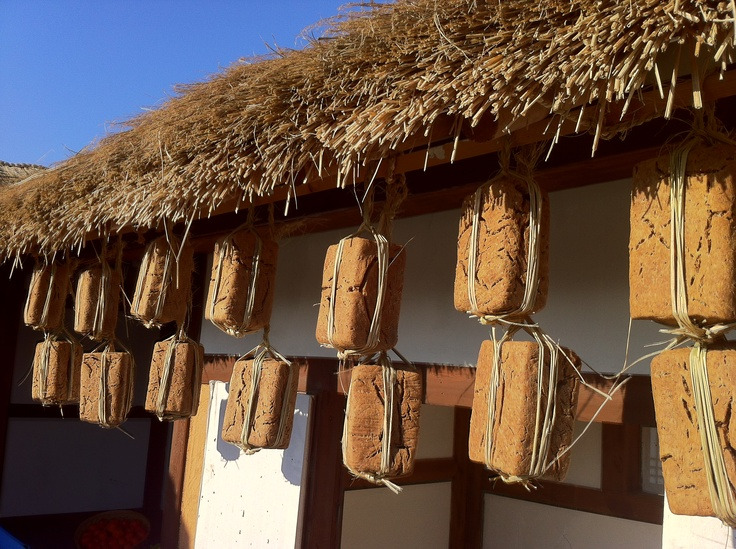
Meju, naturally fermented with straw and airborne microorganisms, is the key to Korean jang flavor.
From Soybeans to Meju: A Collaboration of Natural Microorganisms
The first step in making jang is to boil well-ripened soybeans and mash them into ‘meju’. When hung under the eaves and woven with straw, various wild molds from the air and Bacillus subtilis from the straw settle on the meju.
This microbial army, especially Aspergillus oryzae, produces powerful enzymes that break down the proteins in soybeans into amino acids and carbohydrates into sugars.
After the well-fermented meju is placed in a jar of saltwater and several months pass, the components of the meju dissolve into a dark liquid, which becomes soy sauce, while the remaining solids are crushed and aged separately to become doenjang.
This ‘wild fermentation’ method creates different microbial environments in each household, aligning perfectly with the concept of ’terroir’, where the soil and climate of vineyards determine the flavor of wine. The saying “Each household’s jang flavor is different” is thus a scientific fact.
Jang from Eight Provinces, A Feast of Different Flavors
Korean jang has developed into a diverse array of flavors, each with its own personality, influenced by the region’s climate and specialties. Which jang do you like the most?
- Eoyukjang (魚肉醬): A high-quality jang from the Joseon Dynasty, made by layering precious ingredients like beef, pheasant, and fish with meju.
- Makjang: A jang made by grinding meju and mixing it with barley or wheat for a quick fermentation, popular in Gyeongsang and Gangwon provinces.
- Cheonggukjang: A quick-fermented jang made from whole boiled soybeans in 2-3 days, known for its strong aroma and excellent health benefits.
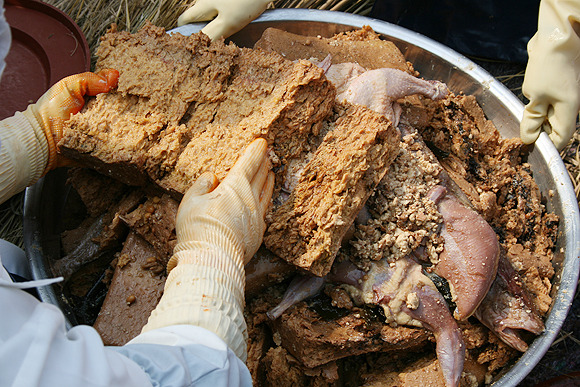
Eoyukjang, made with beef and fish, boasts a deep and rich umami flavor.
The Treasure of Jeju, The Story of Blue Bean Jang
Jeju’s ‘Blue Bean Jang’ is a special story created from native resources and the efforts of artisans. It is made with a native blue bean known as ‘Blue Doksae Gi Kong’, which has a strong sweetness and rich texture. This blue bean, which almost disappeared, was revived through the efforts of artisans and was registered in the Ark of Taste by the International Slow Food Association in 2013.
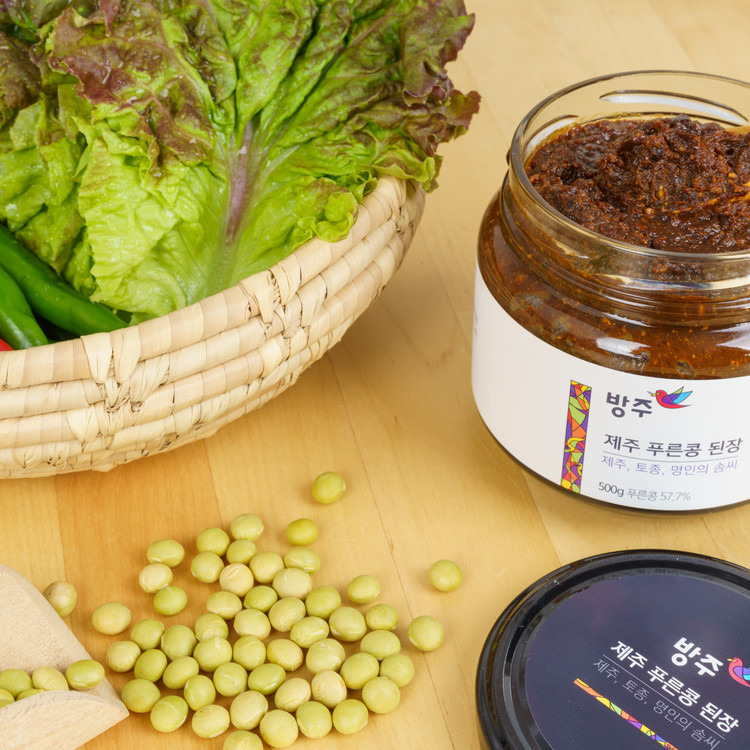
Blue bean jang made from Jeju’s native ‘Blue Doksae Gi Kong’ is a precious culinary heritage of Jeju.
Modern Jang, At the Crossroads of Tradition and Industry
Today, most of the jang on our tables is produced through modern industrial processes. Using pure cultured strains in controlled environments for temperature and humidity, uniform quality jang is produced in large quantities year-round.
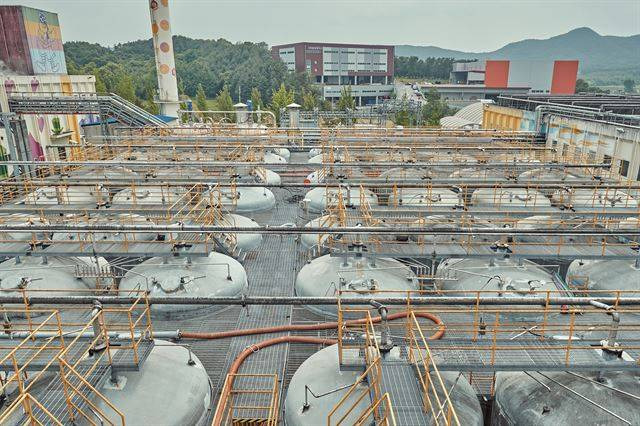
Modern factory equipment allows for the mass production of jang with uniform quality.
Comparison/Alternatives
Comparison of East Asian Soybean Fermented Seasonings
Korean jang production differs significantly from that of China and Japan in that it produces both soy sauce and doenjang from a single meju.
| Feature | Korea (Jang, 醬) | Japan (Miso, Shoyu) / China (Doubanjiang, etc.) |
|---|---|---|
| Main Products | Simultaneous production of soy sauce (liquid) and doenjang (solid) | Japan: Separate production of shoyu (liquid) and miso (solid) China: Jiangyou (liquid), Doubanjiang/Doushi (solid), etc. |
| Key Ingredients | Soybeans, salt, water | Japan: Soybeans, salt, water, koji (rice/barley culture) China: Soybeans, salt, water, with added flour, chili, etc. |
| Manufacturing Method | Uses meju (naturally fermented soybean lumps) | Japan: Mixes koji with boiled soybeans for fermentation China: Various methods, many direct inoculation methods |
What’s Different About Store-Bought Soy Sauce?
The soy sauces easily found in supermarkets vary in taste and use depending on their manufacturing methods.
| Type | Main Features | Recommended Uses |
|---|---|---|
| Korean Soy Sauce (Joseon Soy Sauce) | Made with only soybeans, salt, and water. Light in color with strong salty and savory flavors. | Soups, stews, seasoned vegetables |
| Brewing Soy Sauce (Wae Soy Sauce) | Uses koji made from soybeans and wheat. Darker in color with rich sweetness and umami. | Sashimi, pancake sauce, braising, stir-frying |
| Acid Hydrolyzed Soy Sauce | Protein is broken down with hydrochloric acid. Lacks fermentation flavor and is inexpensive. | |
| Mixed Soy Sauce | A blend of brewing soy sauce and acid hydrolyzed soy sauce. | It’s advisable to check the content of brewing soy sauce. |
Checklist or Step-by-Step Guide
Traditional Jang Making, The Three Key Steps
- Making Meju (Late Fall): Boil well-ripened soybeans, mash them into shape, and bind them with straw to ferment in a well-ventilated place for 2-3 months.
- Making Jang (January): Wash the well-fermented meju clean and place it in a jar filled with saltwater, adding charcoal, red pepper, and jujube.
- Separating and Aging Jang (40-60 days later): When the saltwater turns into a dark red soy sauce, remove the meju, crush it, and age it separately to make doenjang, while the soy sauce is boiled and stored.
Conclusion
From the story of General Kim Yushin of Silla to modern smart factories, Korean traditional jang is not just a seasoning but the very history and wisdom of our people.
- Jang is science: Jang is a product of the sophisticated scientific techniques of our ancestors, who experienced and managed microbial activities.
- Jang is culture: The reverence for jangdokdae and the perception of making jang as a ceremony reflect the worldview of Koreans who sought to live in harmony with nature.
- Jang is history: The different flavors of jang in each household are living records that encapsulate the unique tastes and histories of each family.
Today, we easily consume jang produced quickly and uniformly in factories, but what might we be losing in that convenience? It could be the depth created by time, nature, and human dedication—the ’taste of time’ infused with the soul of a nation.
Now, how about taking another look at the soy sauce and doenjang on our dining table? Feel the long story contained within them.
References
- Soy Sauce Namu Wiki
- [Manmul Sang] Chinese Doenjang and Gochujang Chosun Ilbo
- [Taste Stealer] Which is the origin of ‘Doenjang’ among Korea, China, and Japan? Chosun Ilbo
- Curator Ahn Jeong-yoon’s recommendation National Folk Museum
- Exploring Korean Taste, Traditional Jang / YTN DMB YouTube Link
- The History of Jang Products Korean Soybean Research Association
- Factory-made Doenjang using Miso Manufacturing Method Regional N Culture
- Let’s Learn ‘Traditional Jang Making’ Ohmynews
- Soy Sauce (간醬) Encyclopedia of Korean Ethnic Culture
- Golden Thread Encyclopedia of Korean Folklore
- Proverbs / Republic of Korea Namu Wiki
- The Fermentation Science Contained in Doenjang / YTN Science YouTube
- Manufacturing Methods of Doenjang by Type, The Root of Korean Cuisine, Doenjang Lamp Cook
- Diversity of Bacillus Groups Isolated from Soy Fermented Foods (Doenjang and Soy Sauce) and Their Fermentation Characteristics Korean Journal of Food Storage and Distribution
- Korean Fermented Foods Gaining Global Attention MICHELIN Guide
- Jeju Blue Bean Jang Registered in 2013 Lamp Cook
- [Puzzle] The Disappearing Jeju Blue Bean Jang… I Tried Mixing It with Cold Water Joongang Ilbo
- A Good Day to Read Korean Cuisine Korean Food Promotion Institute
- Delicious Doenjang Farm Tour… In Search of Jeongdokganjang, Eoganjang, Eoyukjang Pressian
- Doenjang Namu Wiki
- Cheonggukjang Namu Wiki
- Confused About How to Distinguish Soy Sauce? SisaIN