
How Did Ancients Predict Political Futures Through Natural Phenomena?
- Understand the meaning of ‘Heavenly Response Theory (天人感應說)’, a core thought in ancient East Asia.
- Examine how various jaeyi, such as eclipses and comets, were interpreted throughout history.
- Discover how jaeyi operated as a dynamic political system beyond mere superstition.
Have you ever imagined that the stars in the night sky or the heavy rain are messages from the heavens? While these may seem like ordinary natural phenomena to modern people, every change in the heavens and earth carried a significant message for our ancestors. In particular, the strange natural changes known as jaeyi (災異) served as a mirror reflecting whether the king was governing well. This belief not only conferred heavenly authority upon the king but also provided a crucial channel for criticism, allowing people to say, “Your Majesty, you are doing wrong!”.
This article follows the voices of nature recorded in texts like the ‘Samguk Sagi’ and ‘Annals of the Joseon Dynasty’, embarking on an exciting journey to understand how our ancestors sensed the storms of history from the expressions of the heavens.
Heavenly Response Theory: The Secret Dialogue Between Kings and Heaven
In ancient East Asia, there existed an important thought known as ‘Heavenly Response Theory (天人感應說)’. It means “Heaven and man feel each other,” where ‘man’ refers to the king who governs the nation.
The Heavy Responsibility of the Son of Heaven
The core of Heavenly Response Theory is simple. If the king governs the nation well with virtue (德), heaven is moved and shows auspicious signs. Conversely, if the king oppresses the people, heaven becomes angry and sends terrible disasters, known as jaeyi (災異), such as droughts, floods, and earthquakes.
Thus, jaeyi was not merely bad luck; it was a ‘rebuke’ from heaven to the king. Initially, heaven would lightly warn through disasters like droughts or floods, and if the king still did not listen, it would show strange phenomena like eclipses or comets as a more significant warning. Thanks to this belief, the king was respected as a sacred ‘Son of Heaven (天子)’, but he also had to bear the heavy responsibility of always being under heaven’s watch.
Jaeyi in Joseon: A System of Communication and Checks
This thought was transmitted to our country from the Three Kingdoms period and became a core governing ideology during the Goryeo and Joseon dynasties. Particularly in the Confucian state of Joseon, responses to jaeyi were political in themselves.
Jaeyi was a double-edged sword. When jaeyi occurred, officials would gain a legitimate reason to submit a petition (上疏), saying, “Your Majesty, heaven is angry, so there must be a mistake in governance!” This was a sacred right to criticize the king.
Of course, the king did not remain passive. When an eclipse occurred, he would perform a ritual called Gusikrye (救食禮), and during droughts, he would issue a Guyan Gyoseo (求言敎書) to seek the people’s opinions. Additionally, he would take the opportunity to showcase his virtue through amnesty (赦免令) or policies to relieve the suffering of starving people, thus strengthening his legitimacy as a ruler. Ultimately, jaeyi was a dynamic political system where the king and officials confirmed their roles and balanced power.
Types and Meanings of Warnings from Nature
The unusual phenomena shown by heaven and earth were interpreted as warnings with different meanings, and there was a hierarchy among them.
The Most Terrifying Warning from Heaven: Sun, Moon, and Stars
- Solar Eclipse (日蝕): The solar eclipse, where the sun, a symbol of the king, loses its light, was considered a ‘red card’. It was interpreted as the worst omen, indicating that the king’s authority was threatened or that a great crisis was approaching the nation.
- Comets (彗星) and Guest Stars (客星): Comets, as unfamiliar stars, were seen as ominous visitors foretelling wars, rebellions, or the death of the king.
- Other Phenomena: Events like shooting stars falling like rain or the appearance of Venus during the day (태백주현) were also recorded as important signals indicating national unrest.

Warnings from the Earth and Ecosystem
- Earthquakes (地震) and Landslides (山崩): The shaking of the earth and the collapse of mountains indicated that the foundation of the nation, namely public sentiment or conflicts among officials, had reached an extreme.
- Floods (洪水) and Droughts (旱災): These disasters, which directly inflicted pain on the lives of the people, were seen as evidence that the king had failed to gain heaven’s harmony, serving as direct triggers for relief policies.
- Locusts (蝗蟲) and Upsetting of Natural Order: Swarms of locusts were interpreted as the greed of corrupt officials, while events like hens turning into roosters were seen as ominous signs of the fundamental order of the world being overturned.
While there was a clear hierarchy among these signals, their interpretations varied depending on the political situation. During intense power struggles, even minor jaeyi could become a powerful weapon to attack opponents. This flexibility of interpretation is what allowed the theory of jaeyi to survive at the center of politics for so long.
Jaeyi: A Political Drama Turning Crisis into Opportunity
When jaeyi occurred, both the king and officials played their roles and engaged in high-level political maneuvers.
The King’s Response: Humility and Restoration of Authority
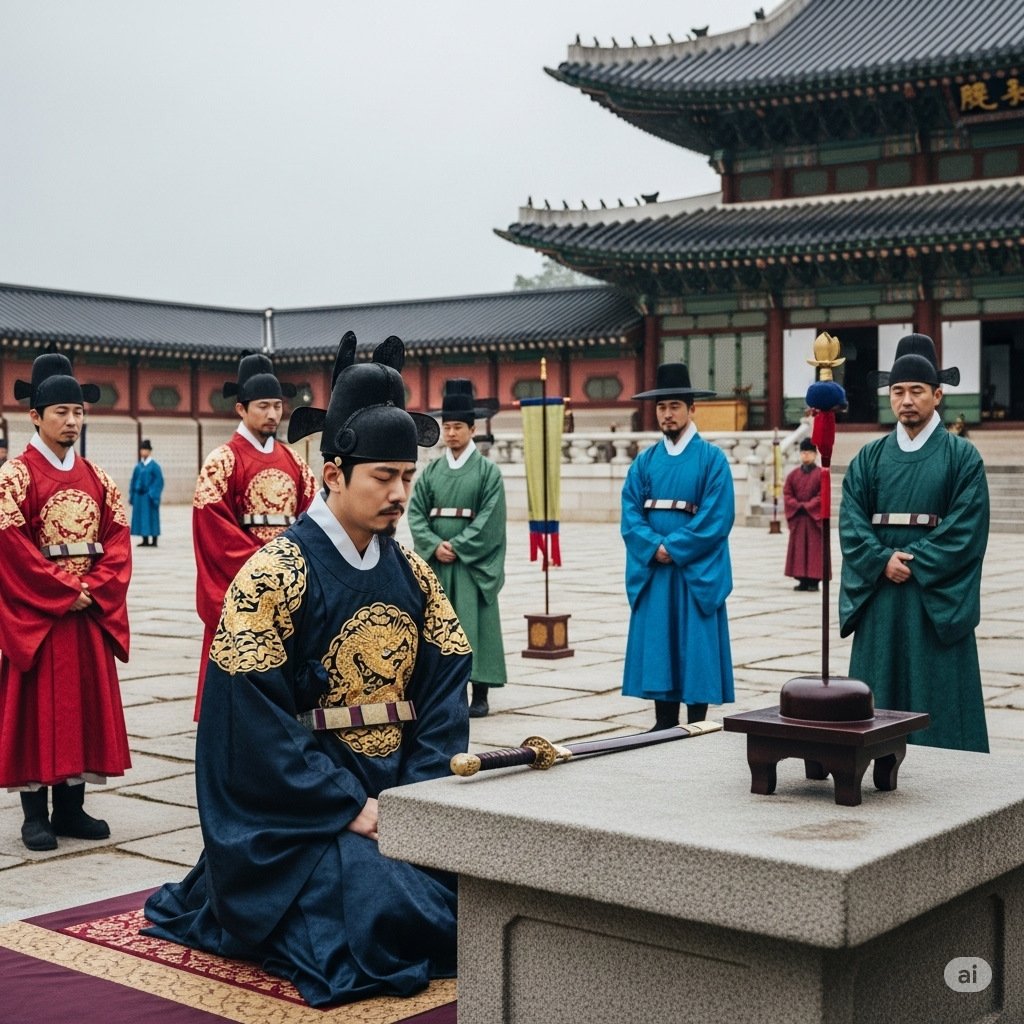
When jaeyi occurred, the king would issue a Guyan Gyoseo stating, “Everything is due to my shortcomings, so anyone can correct me,” thus lowering himself. At the same time, he would issue amnesty and implement relief policies to show his benevolent heart. Particularly during droughts, he would personally conduct a Giwuje (祈雨祭) to appeal to heaven’s heart. This was a clever strategy to gain public sentiment and strengthen royal authority through crisis.
The Officials’ Counterattack: Life-and-Death Petitions
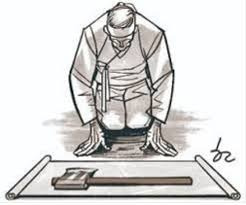
For officials, jaeyi was a sacred sword to criticize the king. Particularly, ‘Jibusangso (持斧上疏)’ involved placing an axe at the palace gate and shouting, “If I am wrong, then strike my neck with this axe!” This scene illustrates how powerful a political weapon jaeyi was as a sign from heaven.
Gwanseonggam: Experts Reading Heaven’s Will
The scientific basis for all this political drama came from Gwanseonggam (觀象監), a state institution that observed and officially interpreted astronomy, geography, and meteorology. Interestingly, the goal of Gwanseonggam was not purely scientific inquiry. For example, the task of accurately predicting eclipses was to ensure that the national ritual of Gusikrye was conducted on time. If predictions were wrong, the responsible officials faced severe punishment. This illustrates how scientific accuracy served to maintain the political and religious order of the state.
Jaeyi: The Heavenly Warnings That Became History
Jaeyi is invariably recorded at the turning points of history. This was not only the belief of the people at the time but also a narrative device used by later historians to emphasize the inevitability of events, saying, “That nation was bound to fall; heaven had already warned them.”
| Period / Event | Recorded Jaeyi (災異) | Political Turmoil (變亂) |
|---|---|---|
| Late Baekje | Appearance of foxes, rivers turning blood-red, sounds of ghosts crying. | Fall of Baekje due to King Uija’s misrule and the invasion of the Silla-Tang allied forces. |
| Goryeo Military Rule Period | Several records of ominous astronomical anomalies. | Coup by Jeong Jung-bu and establishment of military rule. |
| Late Goryeo | Increase in jaeyi such as frequent earthquakes, eclipses, and comets. | Retreat from Wihwa-do and the founding of Joseon. |
| Eve of Imjin War | Appearance of comets and frequent earthquakes. | Invasion by Japan leading to a seven-year war. |
| Eve of Byeongjahoran | ‘Taebaekjuhyeon’ phenomenon where Venus is visible during the day. | Invasion by the Qing Dynasty and humiliation at Samjeondo. |
| Muo Incident (1498) | Records of jaeyi around the time of Kim Il-son’s document issue. | Mass purging of the Sarim faction. |
| Mid Joseon | Incident of hens turning into roosters. | Criticism of royal women’s involvement in state affairs or political disorder. |
Conclusion
Ancient people read the will of heaven through the lens of jaeyi (災異) and shaped history. Jaeyi was a dynamic system that evaluated the king’s morality and maintained political balance, transcending mere superstition.
-
Key Summary:
- Heavenly Response Theory: Jaeyi was believed to be a warning from heaven regarding the king’s misrule.
- Political System: Jaeyi served as a communication channel providing the king with opportunities for reflection and officials with grounds for criticism.
- Historical Compass: Jaeyi is invariably recorded during national crises or dynastic transitions, endowing events with historical inevitability.
Today, when major disasters occur, we analyze their causes with scientific data and evaluate the government’s response capabilities. In this process, might we still find the enduring wisdom of our ancestors, who reflected on societal issues through the changes in nature, albeit dressed in the garb of science?