
The Story of the Deep and Longing Aspiration for a Peaceful Era Embedded in the Symbol of the President of South Korea, the Phoenix.
- Understand the symbolic meaning of the Phoenix in mythology.
- Learn what the Phoenix meant to rulers and the people throughout history.
- Identify why the Phoenix is used as a symbol of the President in modern South Korea.
The Bird of Myth Becomes a Symbol of Reality
Under the sky of the Presidential Office in Seoul, a blue flag flutters in the wind. In the center of that flag, a brilliant golden pair of birds embraces the national flower, the Mugunghwa. This is the ‘Phoenix Flag (鳳凰旗)’, the flag symbolizing the President of South Korea. In the 21st century, as this dynamic republic leads the world with semiconductors and K-POP, why do we still adopt a mythical bird from thousands of years ago as the symbol of our highest national leader?
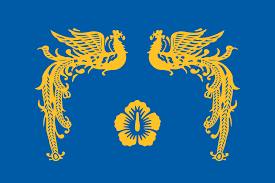
This is not merely decoration. It embodies a dream that our nation has longed for throughout history, namely ‘Taepyeongseongdae (太平聖代)’, a golden age achieved by a wise and virtuous leader, a ‘Sage King (聖君)’, who brings peace and prosperity. The story of the Phoenix is, in essence, the story of our land’s deepest and oldest desires. Let us now unfold this grand narrative together.
Chapter 1: The Anatomy of Legend - What is the Divine Bird, the Phoenix?
If you thought of the Phoenix merely as a ‘beautiful bird’, you have just taken your first step at the threshold of its immense symbolism. The Phoenix is not just a bird; it is a sacred being that condenses the cosmology and philosophy of East Asia, known as the Divine Bird (神鳥). Ancient Chinese texts such as the ‘Shan Hai Jing (山海經)’ and ‘Shuo Wen Jie Zi (說文解字)’ describe this mysterious bird in astonishing detail.
The Phoenix is said to embody the most sacred and outstanding parts of various animals. It has the head of a chicken (trust), the neck of a snake (longevity), the beak of a swallow (fortune), the back of a turtle (wisdom), and the tail of a fish (abundance). Its head symbolizes the sun, its back the moon, its wings the wind, its tail trees and flowers, and its legs the earth, representing the entire universe.
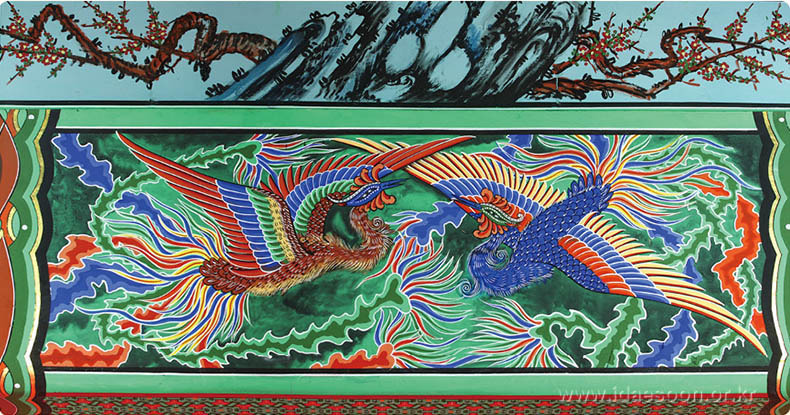
Moreover, the name Phoenix refers to a pair of male and female. The male is called ‘Bong (鳳)’, and the female is called ‘Hwang (凰)’, symbolizing perfect harmony and balance when they come together.
The nobility of the Phoenix reaches its peak in its habits.
- Diet: It only eats bamboo seeds, known as ‘Juksil (竹實)’, and drinks only the clearest spring water, symbolizing purity and nobility.
- Resting Place: It does not dwell anywhere but on the sacred Paulownia tree.
- Character: It embodies peace and benevolence (仁愛), never harming living insects or breaking grass. The proverb “The Phoenix does not peck at millet even when hungry” illustrates its integrity and moral character.
Comparison: Phoenix vs. Phoenix, What is Different?
Sometimes, the Western immortal bird ‘Phoenix’ is confused with the Phoenix, but they are fundamentally different symbols.
| Category | Phoenix (鳳凰) | Phoenix (Phoenix) |
|---|---|---|
| Core Symbol | Harmony, Peace, Taepyeongseongdae | Rebirth, Resurrection, Immortality |
| Conditions of Appearance | Selection of a Sage King (聖君) | Every 500 or 1000 years |
| Meaning | A blessing from heaven for the world, a certificate | The power to overcome death and chaos |
Thus, the Phoenix is not a result of overcoming chaos but a blessing and certification from heaven for a world where supreme virtue and good governance are realized, making it the highest political symbol.
Chapter 2: The Dream That Could Not Be Reached - Waiting for the Phoenix in the Age of Chaos
Singing of the Phoenix in the Age of the Sage King
The reason the Phoenix rose to the pinnacle of political symbolism is due to the belief that “the Phoenix appears when a Sage King governs and opens the era of Taepyeongseongdae.”
The ruler who came closest to this ideal in our history is undoubtedly King Sejong. Having achieved brilliant accomplishments, Sejong proudly regarded his era as Taepyeongseongdae and created the ‘Phoenix Song (鳳凰吟)’ for court banquet music, declaring, “My virtuous governance has created a Taepyeongseongdae worthy of the Phoenix to descend upon this land.”
The Land the Phoenix Turned Away From, the Age of Chaos
Unfortunately, the history of Joseon was not always peaceful. There may have been longer periods of extreme chaos and division where the Phoenix could not dare to descend.
- Endless Conflicts, Factional Politics: Initially, there were positive aspects of mutual criticism and checks, but it soon deteriorated into severe factional strife. The ‘Yesaeng Controversy (禮訟論爭)’ during King Hyeonjong’s reign, regarding the mourning period of Queen Dowager Hyosun, is a representative event that concealed the conflict between royal legitimacy and the power of the king and the state.
- Bloody Purges, Factional Political Massacres: By the time of King Sukjong, it led to a political massacre known as ‘Hwan-guk (換局)’. The king’s support for a specific faction led to the overnight purging of the opposition, destroying the principle of coexistence. Ultimately, the efforts of Kings Yeongjo and Jeongjo for equitable governance became meaningless as a few powerful families monopolized power in ‘Sedo Politics (勢道政治).
- The Tears of the People, the Disorder of the Three Policies: During the period of Sedo politics, the tax system fell into the worst exploitation system known as ‘Samjeong-ui Munran (三政의 紊亂)’. Horrific exploitation was rampant, such as taxing the dead with ‘Baekgoljingpo (白骨徵布)’ and collecting taxes from newborns with ‘Hwanggucheomjeong (黃口簽丁)’.
Witnessing this reality, Dasan Jeong Yak-yong (丁若鏞) wrote a poem called ‘Aejelyang (哀絶陽)’ after hearing the story of a father who, unable to bear the tax burden due to his newborn son, castrated himself. In a country where a father felt guilty for having a child and had to castrate himself, how could a auspicious Phoenix possibly descend?
Chapter 3: The Palace of Dragons and Phoenixes - The Symbolism of Power and Virtue
In the Joseon royal family, the symbol of the ruler was undoubtedly the Dragon (龍). The dragon symbolized the king’s absolute authority and power. However, throughout the palace, the Phoenix harmoniously coexisted with the dragon, symbolizing ‘virtue and legitimacy’ that supports the dragon’s ‘power and authority’.
Geunjeongjeon, the Dialectic of Dragon and Phoenix
Geunjeongjeon (勤政殿) in Gyeongbokgung dramatically illustrates this harmony. On the ceiling above the king’s throne, the ‘Seven-Clawed Dragon (칠조룡)’ symbolizes absolute power and sits imposingly. When I first visited this place, I thought it was merely a splendid decoration showcasing the king’s majesty.
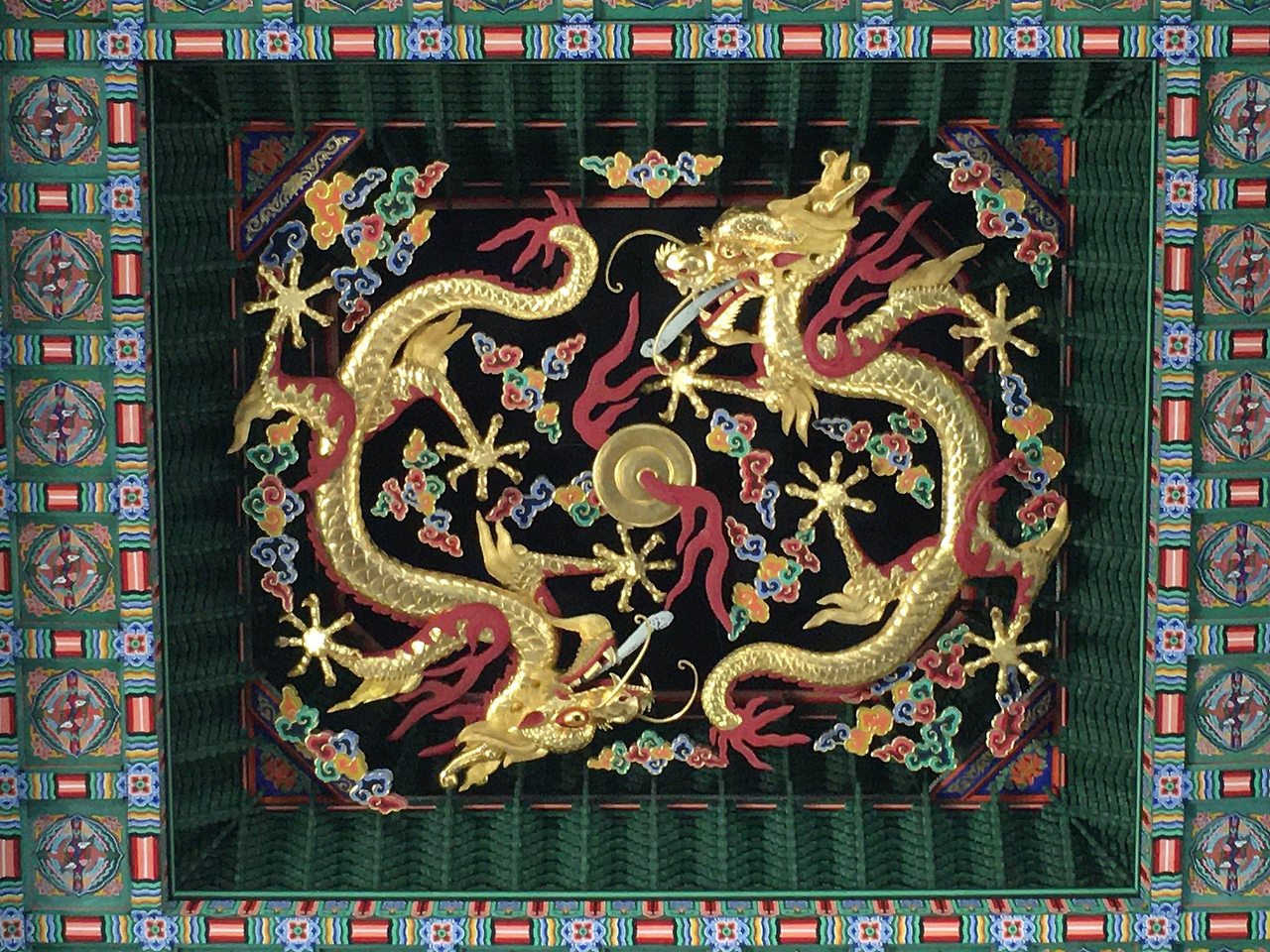
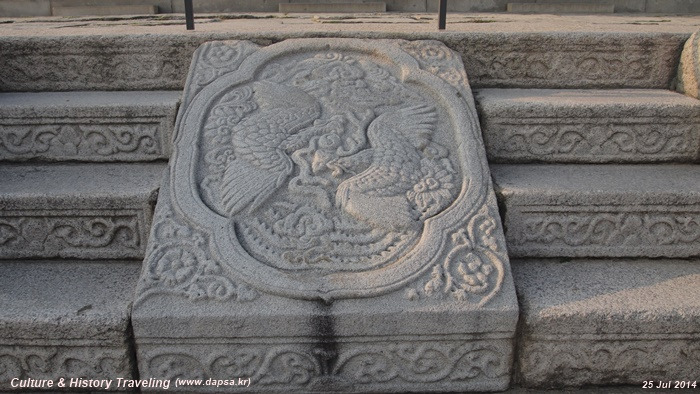
However, beneath it, in the central pathway (답도) that the king must pass to ascend the throne, a pair of Phoenixes is engraved. This signifies that while the king is the highest being under heaven (the dragon), his governance must be based on virtue (the Phoenix) to gain legitimacy. It teaches that a ruler with power but no virtue can never be a Sage King.
The Queen’s Garment, Embroidered with Phoenixes
In the palace, the Phoenix flourished in the ceremonial attire of the queen and royal women. The queen’s ceremonial robe ‘Jeogui (翟衣)’ and her everyday working attire ‘Dangui (唐衣)’ were embroidered with Phoenix patterns to signify their status. While the king symbolizes the authority of the state as a dragon, the queen symbolizes the peace and prosperity of the nation and the flourishing of descendants as a Phoenix, completing the legitimacy of the royal family.
Chapter 4: The Rebirth of the Symbol of the Phoenix in the Republic
With the end of the dynasty and the people becoming the masters, the President of South Korea needed a new symbol.
The Birth of the Presidential Emblem
The Phoenix Emblem (표장) symbolizing the President of South Korea was officially established during President Park Chung-hee’s era in 1967. A pair of Phoenixes face each other with wings spread, embracing the Mugunghwa in the center.
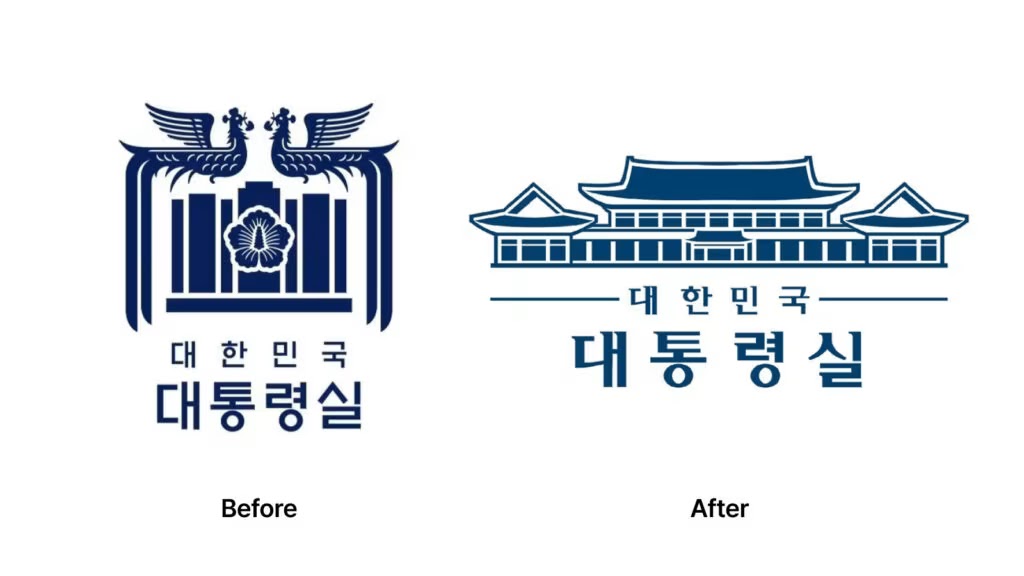
This emblem embodies the national aspiration to achieve eternal prosperity through the stability and harmonious development of South Korea.
The Phoenix in Daily Life, a Symbol of Authority
Subsequently, the Phoenix emblem became the most important symbol representing the authority and duties of the President.
- National Seal (國璽): The handle of the national seal used to stamp important state documents is in the shape of a Phoenix.
- Presidential Aircraft and Vehicles: The fuselage of ‘Air Force One (Code One)’ and the vehicles used by the President bear the Phoenix emblem.
- Appointment Letters (任命狀): The top of the appointment letters for high-ranking officials appointed by the President is embossed with a golden Phoenix emblem, symbolizing the delegation of national governance.
Conclusion
As times changed, in 2008, there were discussions about abolishing the Phoenix emblem due to its ‘authoritarian’ connotations, and in 2022, a new symbolic system (CI) for the Yongsan Presidential Office was announced. These discussions prompt a reevaluation of the modern significance of the Phoenix as a symbol.
- Key Point 1: The Phoenix is not just an imaginary bird but a symbol of Taepyeongseongdae, or peace and harmony, achieved through the virtuous governance of a Sage King (聖君).
- Key Point 2: Throughout history, the Phoenix has been a yearning for ideal governance and simultaneously a mirror reflecting chaotic times and a moral yardstick.
- Key Point 3: In a democratic republic, the Phoenix symbolizes not just one leader but the aspiration for an ideal state dreamed of by all citizens.
The Phoenix flag fluttering in the sky of Yongsan is not a symbol of the President’s personal authority but a landmark for our community’s direction and a sharp gaze from the people. Perhaps the gaze of the Phoenix asks the President every day, and all of us:
“Are we creating a country where the Phoenix would willingly descend today?”
Building a nation that can answer that question with pride is the true challenge that the legend of the Phoenix poses to our era.