
The massive AI is leaving data centers and entering your hands through 1-bit quantization technology.
Overview
- The limitations of cloud AI and why on-device AI is necessary
- How the innovative technology of 1-bit LLM (
BitNet) miniaturizes AI - Strategies of big tech companies like Apple and Google, and the future shaped by AI
Why On-Device AI Now? The Reason We Couldn’t Fit ChatGPT’s Brain into a Smartphone
On-device AI is a technology that performs AI computations on user devices like smartphones and cars without remote servers. Just like my surprise at using real-time translation without the internet during my first overseas trip, this technology is quietly permeating our lives.
Currently, powerful AIs like ChatGPT exist in massive data centers thousands of kilometers away. We simply send questions through our smartphones and receive answers. This cloud-based approach is powerful but has three fundamental limitations.

- Latency: The time it takes for data to travel to and from the server is critical for tasks requiring immediate responses, such as real-time translation or augmented reality (AR).
- Privacy: Personal questions, confidential work data, and voice data are always at risk of exposure as they are sent to external servers.
- Cost & Energy: Data centers consume astronomical costs and energy, leading to serious economic and environmental burdens.
So why can’t we just put this powerful AI into smartphones? The issue lies in the ‘billions of parameters’ that determine the size of the AI model. These parameters, which constitute the knowledge of LLMs (large language models), are represented as very precise numbers (32-bit floating point), meaning even a relatively small model like LLaMA-13B occupies over 26GB of memory. This size is beyond the capacity of most smartphones.
This ‘scale competition’ has concentrated AI power in big tech companies and created unsustainable energy barriers. The movement towards on-device AI is an inevitable rebellion against this massive paradigm, marking the beginning of a shift in AI development philosophy from ‘scale’ to ’efficiency’.
The Key to AI Dieting: 1-Bit Quantization Technology
The solution to fitting the massive AI brain into our handheld devices lies in a compression technology called ‘quantization’. It is similar to compressing a high-quality photo into a JPEG file to reduce its size. By slightly lowering the precision of the numbers representing the AI model’s parameters, we can drastically reduce its size.

This compression journey has progressed from 32-bit to 16-bit, 8-bit, 4-bit, and finally reached the ultimate goal of ‘1-bit’.
The Miracle of 1.58 Bits: BitNet
Microsoft’s BitNet b1.58 is a game changer in this field. The parameters of BitNet only take on -1, 0, +1 values. This is called a ’ternary’ system and can theoretically be represented in 1.58 bits.
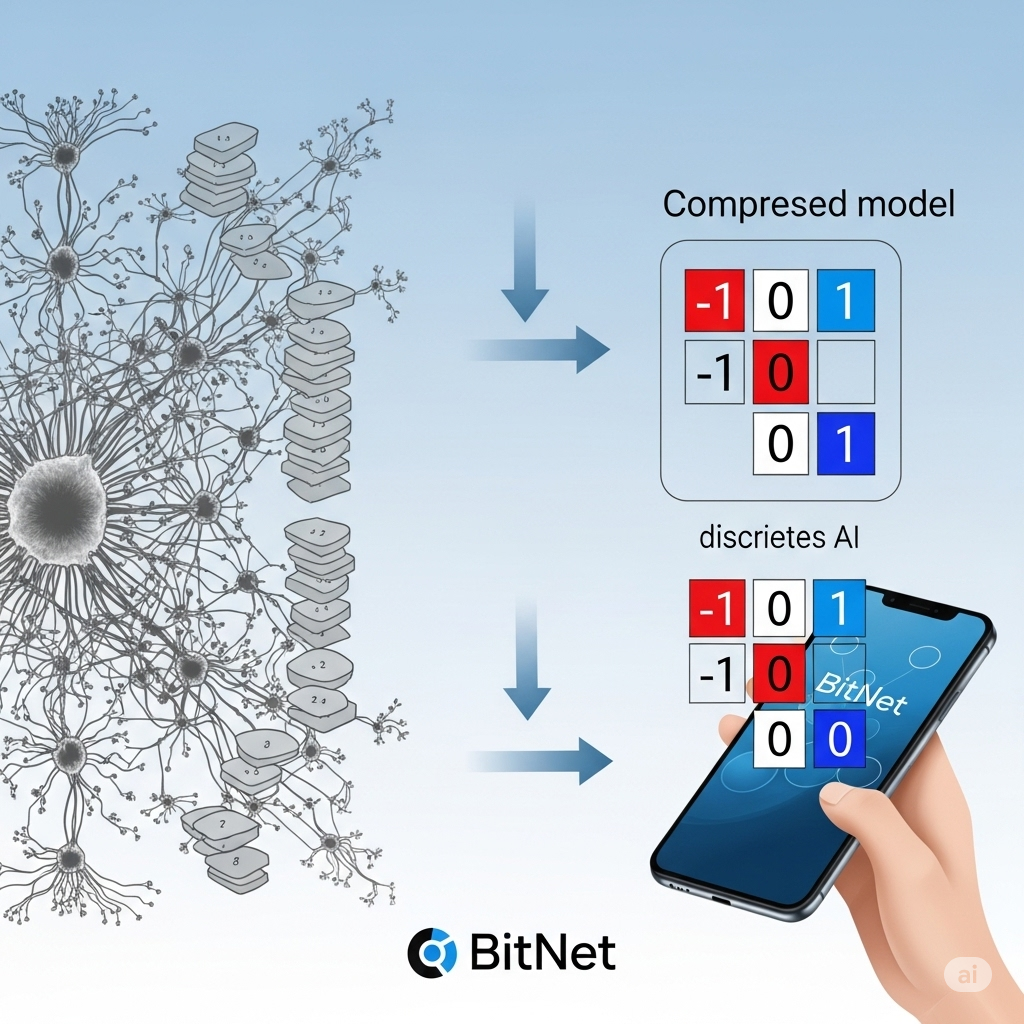
The core innovation is that complex multiplication operations are eliminated and replaced with simple addition/subtraction. This dramatically reduces computational costs and energy consumption. Remarkably, despite such extreme compression, models with over 3 billion parameters perform comparably to existing 16-bit models.
| Precision Level | Meaning (Analogy) | Key Advantages | Key Disadvantages |
|---|---|---|---|
| FP32 (32-bit Float) | “RAW photo original” | Maximum detail and accuracy | Very large file size and slow |
| FP16 (16-bit Float) | “High-resolution JPEG” | Good balance, industry standard | Still too large for most smartphones |
| INT8 (8-bit Integer) | “Web JPEG” | Much smaller and faster, sufficient for many tasks | Slight quality degradation |
| 1.58-bit (Ternary) | “Black and white sketch” | Extremely small and fast, replaces multiplication with addition | Maintaining performance is a technical challenge |
This success is thanks to a more complex training methodology called ‘Quantization Aware Training (QAT)’. The model learns to operate under extreme constraints from the training process, leading to optimal efficiency through close cooperation between hardware and software.
How On-Device AI Changes Our Daily Lives
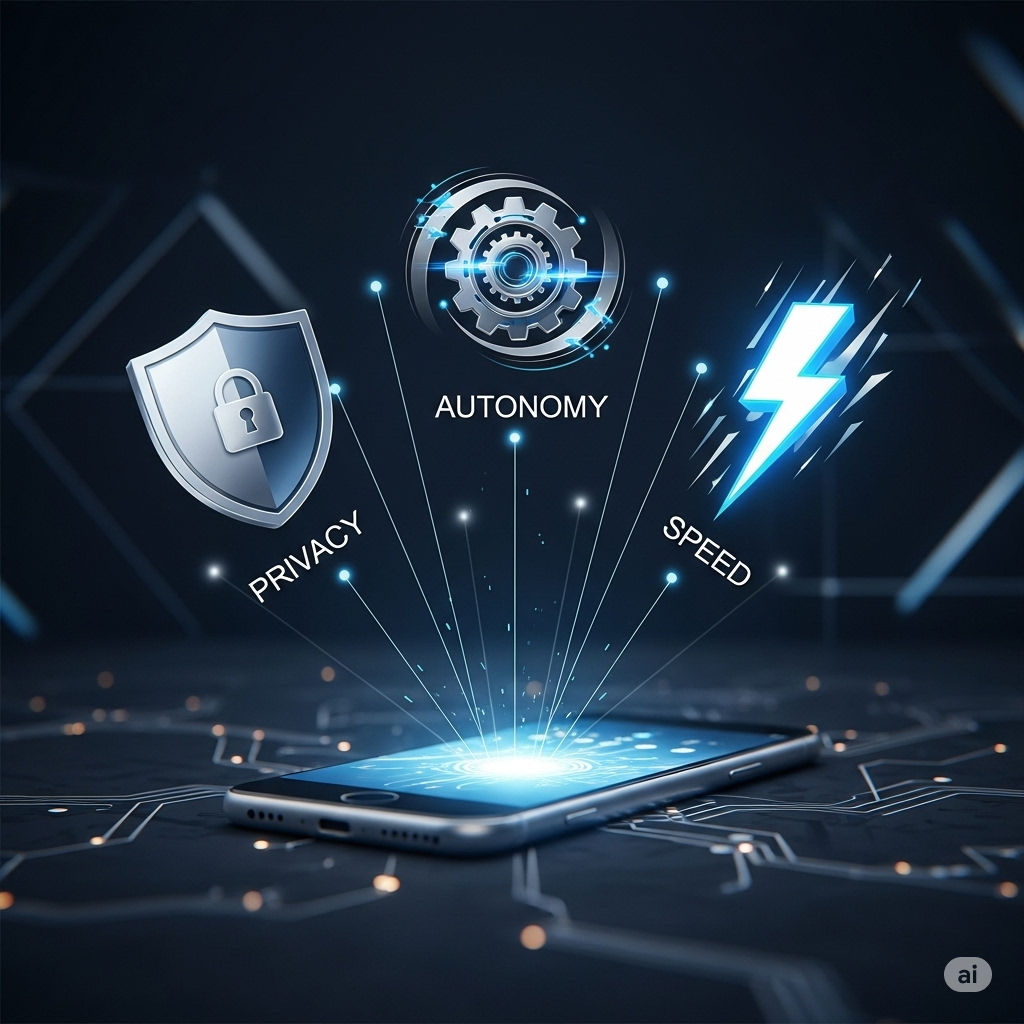
Quantization technology frees AI from the shackles of the cloud, offering three powerful values: privacy, speed, and autonomy.
- Hyper-Personal Assistant: An active collaborator that drafts emails in your style, summarizes complex group conversations, and predicts your schedule to suggest tasks in advance.
- Perceptive Cars: Recognizes the driver to customize the indoor environment, provides information about surrounding landmarks, and predicts component failures to maximize safety and efficiency.
- Personal Doctor on Your Wrist: Analyzes biometric signals collected by smartwatches directly on the device to alert you to health anomalies early, perfectly protecting the privacy of sensitive medical information.
- Personal Teacher for Every Child: Children in areas with limited internet access can receive personalized education through AI tutors, contributing to closing the education gap.
Of course, the future will be a ‘hybrid model’ where cloud AI and on-device AI coexist. Simple commands will be processed on the device, while complex queries will be handled in the cloud, forming a complementary relationship.
The New Battleground for Big Tech: AI in Your Pocket
As the era of on-device AI unfolds, tech giants are entering fierce competition to capture users’ pockets.
- Apple’s ‘Privacy Fortress’: ‘Apple Intelligence’ emphasizes on-device priority. Difficult requests are sent to a ‘Private Cloud Compute (PCC)’ that does not store user data and is inaccessible even to Apple employees, maximizing privacy.
- Google’s ‘Ambient Intelligence’: The ‘Gemini Nano’ model is integrated into Pixel phones, enhancing existing Google services with features like message style transformation and offline recording summaries, blurring the lines between on-device and cloud experiences.
- Samsung’s ‘Practical Hardware’: ‘Galaxy AI’ handles real-time translation on-device while offering features like ‘Circle to Search’ through partnerships with Google, giving users options to choose how their data is processed to address privacy concerns.
This competition signals a ‘resurgence of hardware-software symbiosis’, where companies that vertically integrate everything from chip design to models and operating systems gain an advantage.
The Shadows of On-Device AI: Challenges to Overcome
Behind the rosy future lie technical and ethical challenges that need to be addressed.
- Balancing Performance: Extreme quantization can lead to performance degradation in tasks requiring subtle nuances. ‘Good enough’ performance may not apply in every situation.
- Bias Hidden in Bits: AI models learn biases from training data. It remains an important research question whether the process of compressing information through quantization amplifies or mitigates these biases.
- The Privacy Paradox: A smartphone that learns everything about you can become a ‘single point of failure’ leading to catastrophic privacy breaches if lost, stolen, or hacked.
The greatest concern is the emergence of ’echo chambers for individuals’. An AI trained solely on your data can reflect your biases and reinforce them through all the information you receive. This poses a serious ethical challenge, potentially creating the most powerful and inescapable personalized echo chamber in human history.
Comparison: Cloud AI vs. On-Device AI
| Feature | Cloud AI | On-Device AI |
|---|---|---|
| Processing Location | Massive remote data centers | User’s personal device |
| Performance (Power) | Virtually unlimited | Limited by device hardware |
| Performance (Speed) | Dependent on network (latency occurs) | Immediate (no latency) |
| Privacy | Data sent to external servers | Data remains on the device |
| Connectivity | Internet connection required | Can operate offline |
| Cost | Server/API usage fees, high energy costs | No API costs, low energy consumption |
| Optimal Use Cases | Large-scale data analysis, model training | Real-time, personalized, privacy-sensitive tasks |
Conclusion
On-device AI represents a monumental turning point that will fundamentally change our lives. How much smarter can your smartphone become in the future?
-
Key Summary
- Independence of AI: 1-bit LLM and quantization technology have liberated AI from massive data centers and brought it to our handheld devices.
- New Values: Privacy, speed, and autonomy are the core values offered by on-device AI, fundamentally changing how we interact with technology.
- Opportunities and Challenges: A hyper-personalized future offers tremendous convenience but also comes with challenges such as performance degradation, bias amplification, and the privacy paradox.
This quiet revolution has already begun. Now, prepare for the true era of ‘personal intelligence’ that will unfold in your hands.
(CTA) Next Action Suggestion: Check your smartphone settings now for ‘advanced intelligence features’ or related AI options, and experience firsthand which features are already operating on-device.
References
- 04 Episode Key Advantages and Uses of On-Device AI - Brunch
- The Era of On-Device AI Competition Driven by Generative AI - Monthly CEO
- On-Device AI | Technology | Samsung Semiconductor
- What is Galaxy AI? | Samsung AI Features Explained | Samsung UK
- AI on the road: Why AI-powered cars are the future | Qualcomm
- On-Device Artificial Intelligence - Namu Wiki
- Why AI uses so much energy—and what we can do about it - PennState
- Explained: Generative AI’s environmental impact | MIT News
- Understanding the Basic Concepts of LLM (Large Language Model) - Tistory
- OneBit: Towards Extremely Low-bit Large Language Models - arXiv
- Deep Learning Study at Mogae Forest - 10. The Era of 1-bit LLMs - Tistory
- Understanding “Quantisation” with examples and analogies - Medium
- Microsoft Reveals AI Model Powered by ‘1-Bit’ - Popular Science
- Review of the Paper ‘BitNet: Scaling 1-bit Transformers for Large Language Models’ - DevHwi
- The Era of 1-bit LLMs: All Large Language Models are in 1.58 Bits - Hugging Face
- Ultra-light AI running solely on CPU developed by Microsoft, Bitnet… - Marcus Story
- The Revolutionary Potential of 1-Bit Language Models (LLMs) - HackerNoon
- What is Quantization Aware Training? - IBM
- In the Coming AI Era, What is On-Device AI - Sungkyunkwan University Newspaper
- Intelligent Technology Innovating Everyday Life, On-Device AI - YouTube
- Human-centric, Hybrid AI Opens Up New Possibilities - Samsung Newsroom
- Apple Differentiates Strategy with On-Device AI… “Betting on Privacy” - Korea Future Daily
- Why Apple Decided to Focus on On-Device AI Instead of ‘Developing Massive AI’ - Chosun Ilbo
- Apple’s AI Strategy is ‘On-Device’ - AI Times
- Core Security & Privacy Requirements - Apple Documentation
- Gemini Nano Multimodal Capabilities on Pixel Phones - Google Store
- Gemini Nano on Android: Building with on-device gen AI - YouTube
- Use features with Galaxy AI on your Galaxy phone and tablet - Samsung
- Generative AI in Automotive - IBM
- Exploring the Main Privacy Concerns Surrounding the Integration of Artificial Intelligence in Healthcare Systems - Simbo AI
- Intel Brings Offline AI, Opportunity to Students in Guatemala - Intel Newsroom
- Ethical Considerations in LLM Development - Gaper.io
- Ethical Considerations in AI Large Language Models - Bitfount