
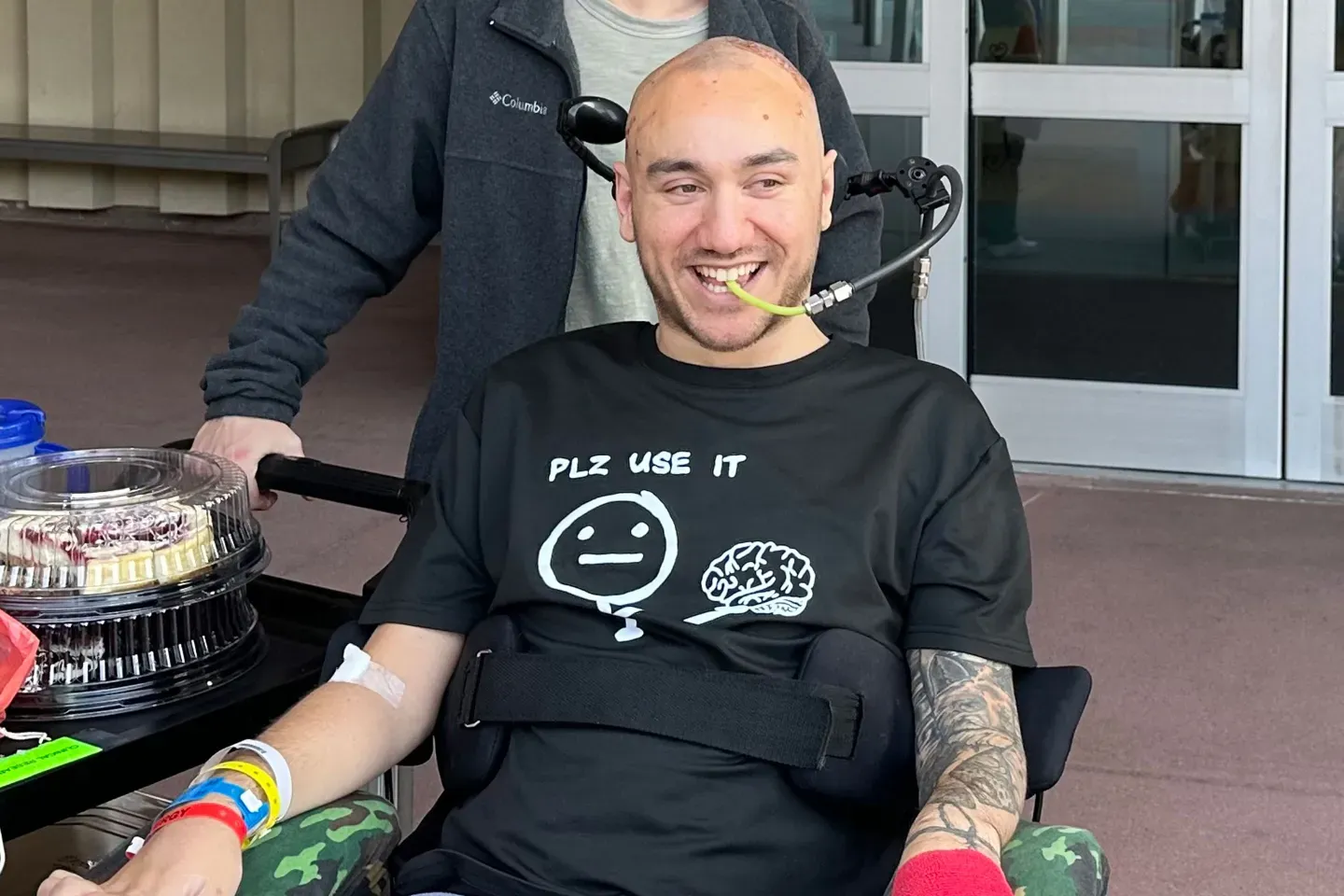
At 6 AM, there is a young man who cannot leave his monitor until the sky outside turns bluish.
He was engrossed in the strategy game <Civilization VI> and stayed up all night. Does this scene look like a normal, lazy landscape where you might hear nagging like, “What about going to work tomorrow?”?
However, this scene is a moment that will be recorded as a miracle in the history of human science.
The young man enjoying the game, Noland Arbaugh, is a quadriplegic patient with no sensation below his shoulders. How could he, unable to move a finger, build an empire and command an army all night long?
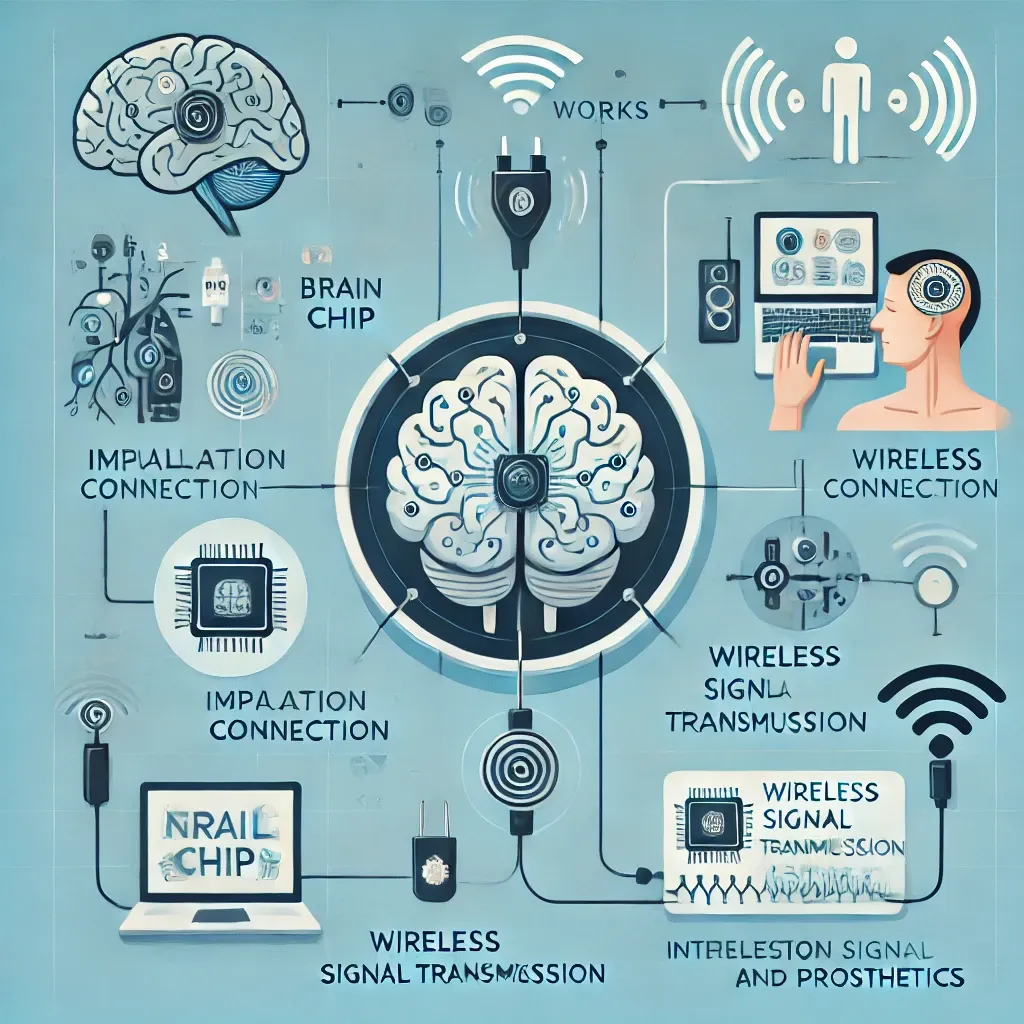
There was no mouse or keyboard beside him. There was only ’thought’. This is because the coin-sized chip implanted in his skull, ‘Telepathy’ created by Elon Musk’s Neuralink, read the brain signals to control the computer.
We are now on the verge of a singularity where science fiction movies turn into morning news. This is not just an introduction to new technology. This is a dizzying and fascinating story of humanity evolving from Homo habilis, who held tools in their hands, to Homo Deus, who incorporates tools into their bodies.
1. The Supercomputer in the Brain: The Pinnacle of Engineering, the N1 Chip
While the media romantically calls it ‘Telepathy’, its reality is a chillingly precise crystal of micro-engineering. The core idea is simple: “How can we convert the brain’s analog electrical signals into digital signals of 0s and 1s without loss?” How did Neuralink solve this challenge?
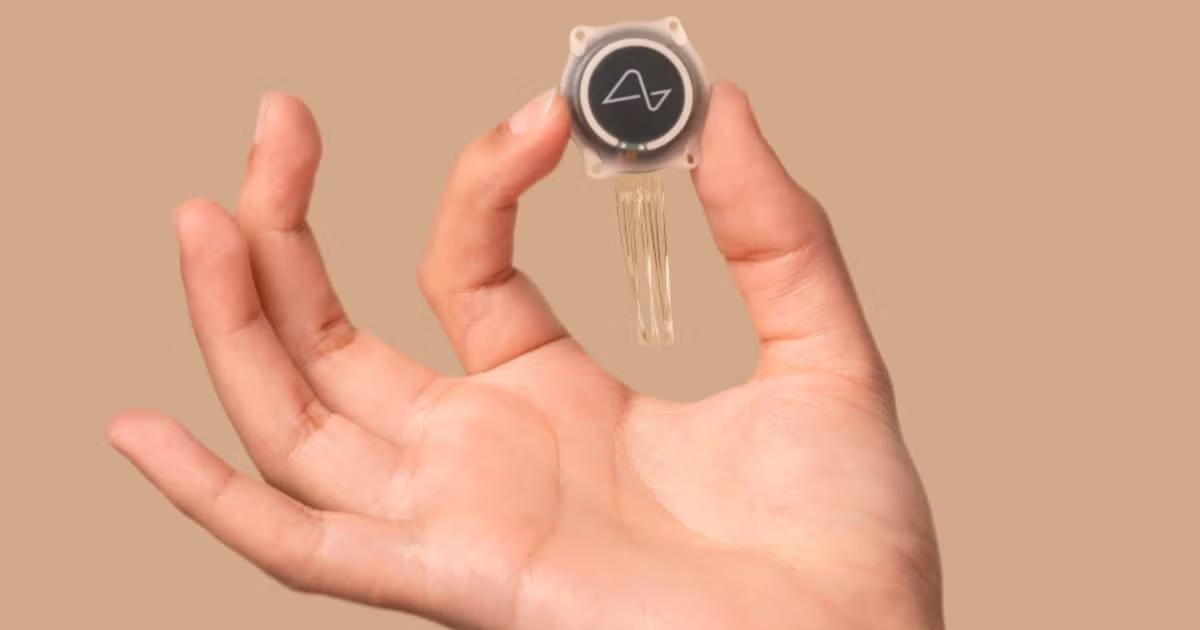
① The 500 Won Coin in the Skull, N1
Traditional brain-computer interfaces (BCIs) required thick wire connectors at the back of the head, like in the movie <The Matrix>. The risk of infection was high, and it was unsightly. However, Neuralink’s N1 chip is different.
- Completely Wireless: Everything is housed within a circular case, 23mm in diameter and 8mm thick. Charging is also done wirelessly via inductive charging, like a smartphone.
- Overwhelming Channel Count: While existing medical devices use fewer than 100 channels, the N1 boasts 1,024 channels. Electrodes attached to 64 threads capture the brain’s voice in high resolution.
- Ultra-High Speed Processing: It reads ‘spikes’, the electrical waves by which brain cells (neurons) communicate, at a speed of 20,000 times per second (20kHz). It doesn’t miss signals down to the nanosecond.
② ‘Soft Threads’ That Don’t Harm the Brain
Sticking needles into the brain sounds horrifying, doesn’t it? Past electrodes were made of hard metal, piercing brain tissue and causing damage with every movement. However, Neuralink uses a material called Polyimide. These flexible threads, only 1/20th the thickness of a human hair (about 5 micrometers), move with the brain’s pulsations, minimizing damage.
③ The Surgeon with the Hands of God, Robot R1
It’s impossible for a human to insert such thin threads by hand. That’s where the surgical robot R1 comes in.
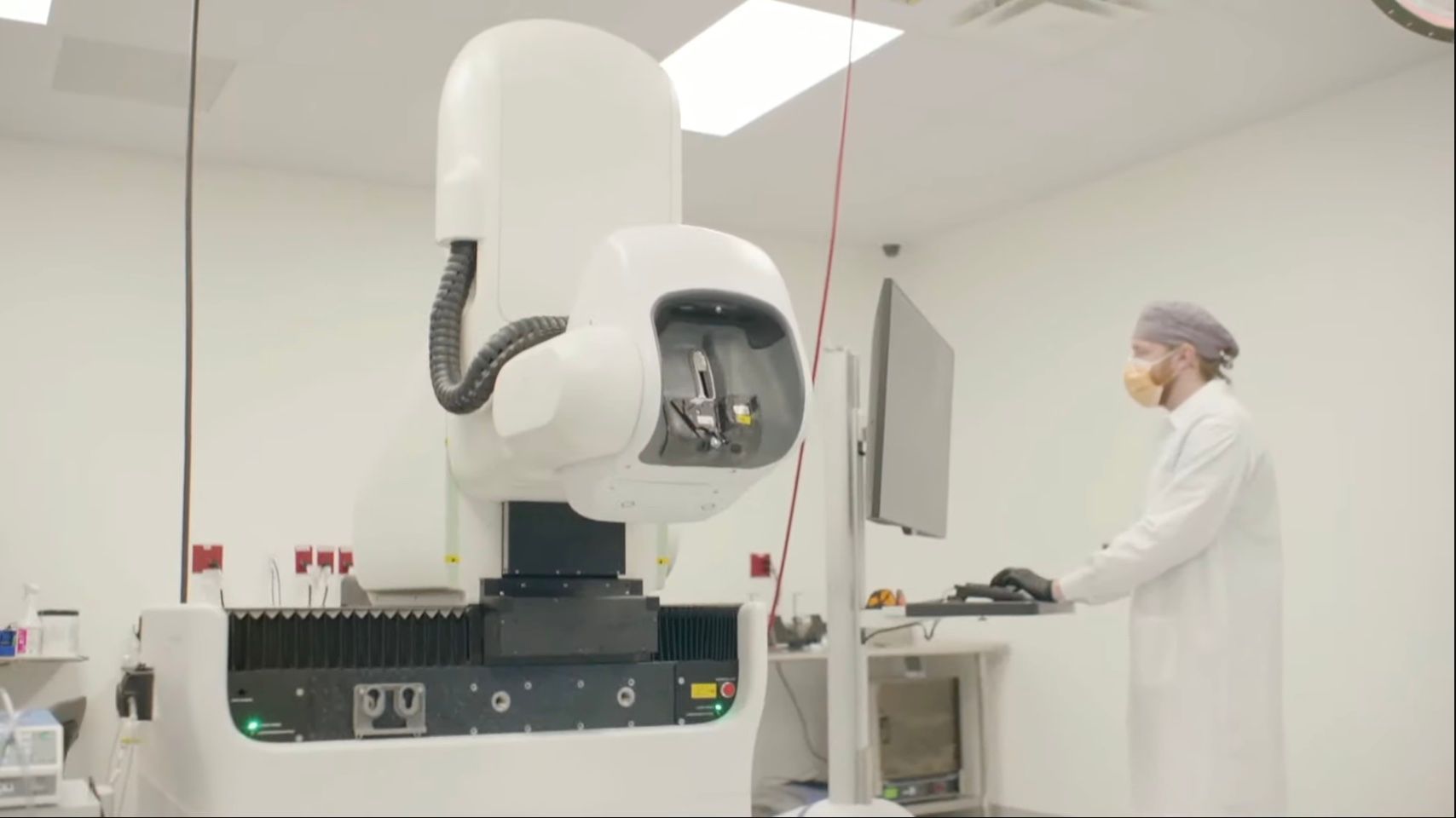
- Avoiding Micro-Vessels: R1 scans the brain surface in real-time and implants electrodes while avoiding blood vessels. The goal is ‘Zero Bleeding’.
- Sewing Machine Speed: It accurately and rapidly inserts electrodes about 3-4mm deep into the motor cortex, drastically reducing surgery time.
2. A Miracle Made Reality: The World Noland Arbaugh Showed Us
Does the technical explanation feel difficult? You’ll understand it immediately when you see how this technology has changed one person’s life 180 degrees.
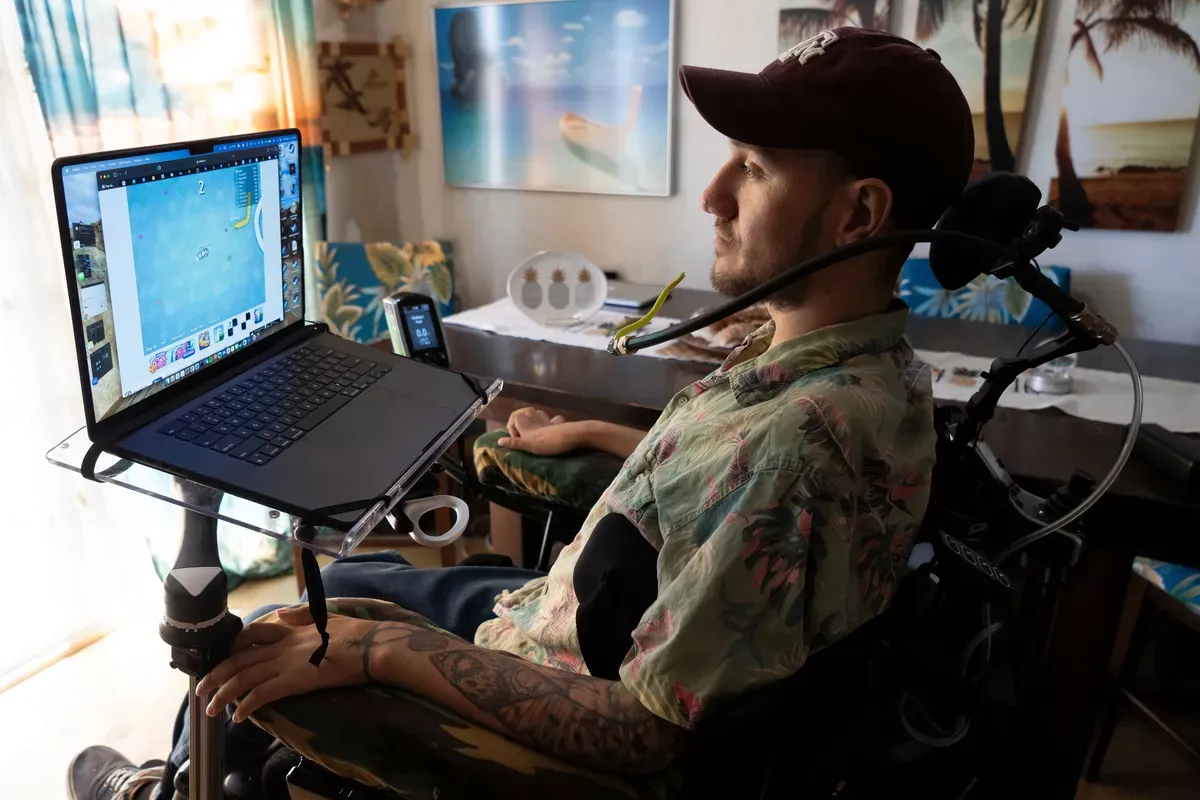
Feels Like Using the ‘Force’ from Star Wars
Immediately after surgery, Noland Arbaugh trained to move the mouse cursor with his thoughts. His description is fascinating.
“At first, I had to strain my brain, like using the ‘Force’ in Star Wars.
But after a few days, I just had to think ‘move the cursor there,’ and the cursor was already there.”
8 Hours of Gaming, and Overcoming Challenges
He sent messages just by looking at the on-screen keyboard and competed equally with non-disabled players in the racing game <Mario Kart>.
Especially, long gaming sessions that were impossible with eye-tracking devices due to eye fatigue were achieved.
Of course, there were crises. A month after surgery, a Retraction phenomenon where some of the electrode threads inside the brain came out caused a sharp drop in data reception rate.
This was a serious situation that would normally require re-surgery.
However, the Neuralink team opted for a ‘software update’ instead of touching the hardware.
They solved the problem by modifying the algorithm to respond more sensitively to fewer signals.
The device implanted in the human body was fixed with a remote update, much like a Tesla car.
3. Beyond Gaming: From Healing to Expansion
Neuralink’s ambition doesn’t stop at moving a mouse cursor. They dream of a ‘Write’ function beyond the brain’s ‘Read’ capability.
Regulating Depression and the Mind’s Weather
What if there was a patient (Mr. K) with severe depression that didn’t respond to medication?
Neuralink chips monitor Mr. K’s amygdala 24 hours a day.
When signs of an oncoming wave of depressive emotion are detected (a surge in specific beta waves), the chip immediately sends micro-electrical stimulation in the opposite pattern.
Just as a pacemaker regulates an irregular heartbeat, it is a future where the brain’s ’emotional arrhythmia’ is restored to normal.
This is the evolution of Parkinson’s disease treatment (DBS) to a hyper-precise level.
Silent Conversation, True Telepathy
Imagine a boardroom in 2035.
No one speaks, but the meeting is intense.
Elon Musk defines this as “the transmission of compressed data.”
When we try to describe a mental image with words, there is significant information loss.
However, in the future, a designer could directly transmit a 3D model they imagined to a colleague’s brain.
A world where, instead of saying, “No, make it rounder,” you ’transmit’ the round shape. It’s the moment the language barrier collapses.
4. Pandora’s Box: The Terrifying Dangers We Will Face
However, the brighter the light, the deeper the shadow. Before we get intoxicated by the benefits of technology, we must soberly face the worst-case scenarios that could occur.

① What if the Brain is Hacked? (Brainjacking)
If a smartphone is hacked, photos are leaked, but if the brain is hacked, we lose ‘our self’.
- Body Hijacking: A hacker could take control of the motor cortex and force your arm to perform unwanted actions.
- Sensory Ransomware: “We have locked your visual cortex. Send 1 Bitcoin, or you will never see again.” This scenario, horrifying even to imagine, has no perfect security measures yet.
② The ‘Heat’ Problem, the Stove in My Head
When chips transmit data, they inevitably generate heat. Brain cells are extremely sensitive to temperature changes. If the chip overheats and the brain tissue temperature rises even by 1 degree, it can cause permanent brain damage or seizures.
③ The Absence of Neuro-rights
What if companies require “chip implantation for work efficiency” as an employment condition?
Or what if an insurance company buys your brain data and informs you, “We refuse to provide insurance because you lack impulse control”?
Legal systems to protect mental privacy are not keeping pace with technological advancements at all.
Conclusion: At the Twilight of Homo Sapiens
Neuralink’s clinical success is an event comparable to Neil Armstrong’s moon landing in human history.
While the moon landing was an expansion to the outside (space), Neuralink is an entry into the inside (the brain).
We will soon witness miracles: patients with spinal cord injuries walking again, the blind seeing light, and trapped souls communicating with the world.
This is an undeniable blessing.
But at the same time, we must ask:
Can a being that merges with machines and possesses intelligence comparable to AI still be called ‘human’?
What we need to be wary of is not technology itself.
It is the speed without brakes.
Pandora’s box has been opened.
Whether the future it contains will be a utopia or a dystopia depends not on the engineers who build the chips, but on the wise choices of our entire society.
References
- Neuralink Progress Update / Livestream (2024) \[Neuralink Official X\]: Reports on Noland Arbaugh’s surgical progress, gameplay data, and electrode retraction phenomenon.
- An integrated brain-machine interface platform with thousands of channels (2019) \[bioRxiv\]: Detailed paper on the N1 chip architecture and R1 robot surgery mechanism.
- Neuralink’s First Patient: ‘It Was Like Using The Force’ \[Bloomberg\]: Quotes from patient interviews and real-use experiences.
- Towards new human rights in the age of neuroscience \[Life Sciences, Society and Policy\]: Ethical considerations on neuro-rights and cognitive freedom.