
When ChatGPT first debuted, people declared that writing was over. The following year, they said art was finished too.
Yet there was one question almost nobody thought to ask.
What happens when this brilliant brain steps outside the screen?
Washing the dishes, picking up parts on factory floors, carrying meal trays down hospital corridors. Until now, AI remained trapped behind glass. In 2026, that boundary is beginning to crumble.
The Handless Genius
By now, everyone knows how smart LLMs are. They solve complex math exam problems, pass the bar, and write intricate code.
Yet this genius suffers from one decisive weakness.
It cannot pick up a cup.
Consider the sheer volume of information a human hand processes just to grasp a single mug, and the scale of the challenge becomes obvious. Is it glass or paper? How full is it? Is it hot? How much should the wrist tilt? Humans make these split-second assessments unconsciously in less than 0.3 seconds.
Conventional industrial robots solved this problem quite differently: by not thinking at all. They place the exact same object in the exact same spot and repeatedly execute hundreds of thousands of lines of trajectory code. That has been the reality of factory automation for the past forty years.
It is fast and precise, but it fails at one single thing: adapting to change. Shift a component by just two centimeters, and it halts. Change the lighting, and it stops. Let an unexpected object enter its path, and it freezes. These robots were never geniuses; they were merely master memorizers.
A system that binds a powerful AI brain to real hardware—allowing it to see, judge, and act. Physical AI is the endeavor to rewrite this equation entirely. And stepping right into the center of this battle is a company that spent decades building refrigerators and washing machines.
Robot Parts Hidden Inside Refrigerators
At first glance, hearing that LG makes robots sounds unfamiliar. LG is a company known for washing machines, air conditioners, and OLED TVs. When people think of robotics companies, names like Boston Dynamics, Tesla, or Figure AI immediately come to mind. LG was never on that list.
This sense of unfamiliarity comes from looking only at the surface.
To build a washing machine, you need a motor. A precision motor that never breaks down even after millions of rotations. LG’s Direct Drive (DD) motor drives the drum directly without belts or gears, and the precision torque control technology it relies on shares the exact same roots as the servo motor technology that moves robotic joints. The inverter technology that fine-tunes air conditioner compressors down to tens of microseconds works on the identical principle.
It wasn’t merely a washing machine parts maker; it was a robotics parts maker all along. Those components had simply stayed hidden inside the casings of refrigerators and washing machines for sixty years.
Once you adopt this perspective, every subsequent piece falls into place differently. Batteries, cooling systems, telecommunications. The components that LG Group affiliates have been selling in separate markets are now reuniting inside a single body: the robot.
The final destination for this robot is not a laboratory, but a living room. An elderly person living alone, working couples trying to reclaim their evenings, dishwashing duties in households with young children. LG’s home robot roadmap targeted for 2028 points directly toward this reality. A robot gaining functional joints ultimately means handing thirty minutes of someone’s evening back to them.
Why a company that once sold home appliances is now seizing control of robotic joints overlaps closely with a lesson the semiconductor industry taught us long ago: the companies that control key components inside finished products survive and win far longer than those that merely assemble the final shell.
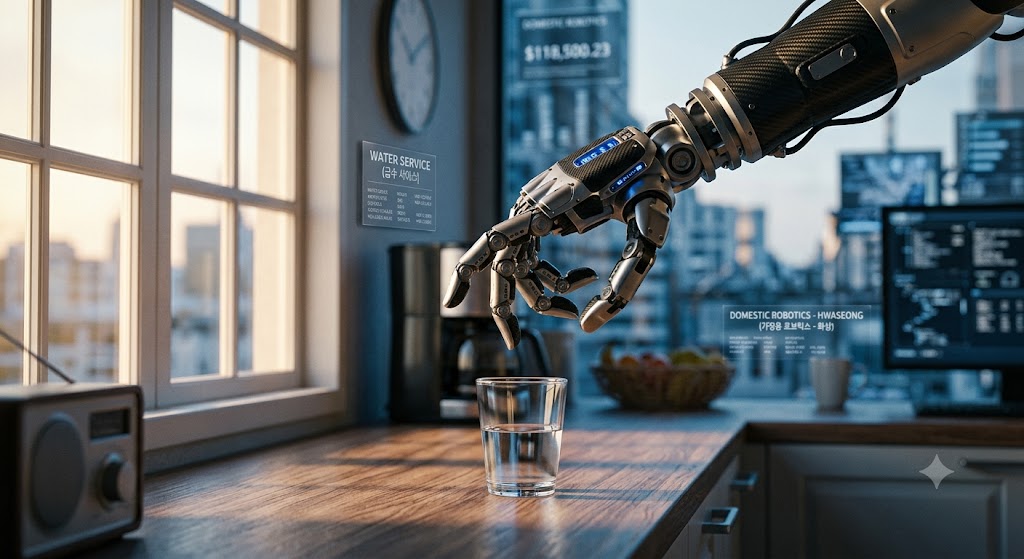
What EXAONE Teaches the Robot
The traditional way robots recognize objects is simple: store the 3D point cloud of an apple and match it against incoming camera images. While this method works well in controlled settings, it has a fatal flaw—it stops cold when confronted with an unfamiliar object.
In reality, apples can be sliced in half, peeled, or bruised and wrinkled. You cannot possibly load every variation into a static database.
The latest version of EXAONE from the LG AI Research Institute took a different path. It trains language and vision together. As a Vision-Language Model (VLM), EXAONE 4.5 binds the phrase “a halved brown apple” directly with its visual context. This means it can infer concepts through language even when encountering an object for the very first time. Upon seeing an apple with its core exposed, it can even deduce that it must handle it gently.
Pushing this one step further is EXAONE Deep. Introduced as Korea’s first reasoning AI model, it goes beyond asking “what is this?” to planning “in what order should this be done?” Given a single prompt like “clean the room,” it scans the space to map obstacles, prioritizes tasks based on object size and material, and automatically slows down or stops if a child or pet is detected. The AI independently constructs the very judgments a human makes unconsciously every morning.
In robotics, the truly difficult problem lies elsewhere: what researchers call Long-Horizon Tasks. “Pick up the cup” is easy. It is a single action with an immediate outcome. But “clear the table, load the dishes into the dishwasher, start the cycle, check if they are dry, and put them away in the cupboard” is an entirely different beast.
How many dishes are there? Is there enough space inside the dishwasher? How does it verify drying is complete? Which dish goes onto which shelf in the cabinet? These decisions must be executed sequentially.
Furthermore, what should the robot do during the 40 minutes the dishwasher runs? Can it return precisely when the cycle finishes?
EXAONE 4.5 concentrates its architectural capabilities on calculating these continuous causal chains and inter-object relationships along a time axis. This had long been the final barrier preventing household service robots from achieving commercialization.
Joints and Reducers: Components Holding 30% of the Cost
Software can get off the ground with a few servers and a team of engineers. Hardware is entirely different. Mass-producing precision components requires decades of manufacturing know-how and hundreds of billions of won in capital equipment. This is the real reason LG poses a serious threat in the robotics landscape.
A human elbow joint does not merely bend. It modulates force, absorbs impact, and repeats movements tens of thousands of times without wearing out. In robotics, the component handling this role is the actuator. A joint module integrating a motor, driver, and reducer, this single part accounts for 20% to 30% of the total manufacturing cost of a humanoid robot.
Historically, Japanese and Swiss firms held a virtual monopoly over these critical components. Robotics companies had no choice but to import them at steep prices, frequently halting production lines whenever supply shipments lagged.
LG Electronics targeted this vulnerability directly. The servo motor design capabilities originally built through washing machine DD motors were redirected into developing actuators that reduce power consumption by 30% while boosting instantaneous rotational torque. In the first half of 2026, initial production runs of robot actuators entered mass manufacturing. This marks the first time a Korean enterprise has directly manufactured robotic joints at scale.
Reducers are tracing a similar trajectory. While the motor generates high-speed rotation, the reducer transforms that speed into slower, stronger, and more precise torque. The power of a motor spinning at 3,000 RPM must be converted into a strong torque of 30 RPM so a robotic arm can grasp objects securely. The precision with which these gear teeth are machined determines whether a robot can pick up a raw egg without cracking it. LG Electronics is internalizing precision mechanical design and proprietary surface treatment processes to secure independence in this domain as well.
On the humanoid platform KAPEX, designed by the Korea Institute of Science and Technology (KIST), LG Electronics’ mass-production know-how and modular design are actively being integrated. If a single joint fails, only that module needs replacement—there is no need to disassemble the entire robot. Manufacturing costs drop, maintenance becomes effortless, and high-volume mass production turns into reality.
This is the true legacy of sixty years in consumer electronics. The core advantage is not merely how smart you can build it, but how many you can produce and how affordably you can deliver them.
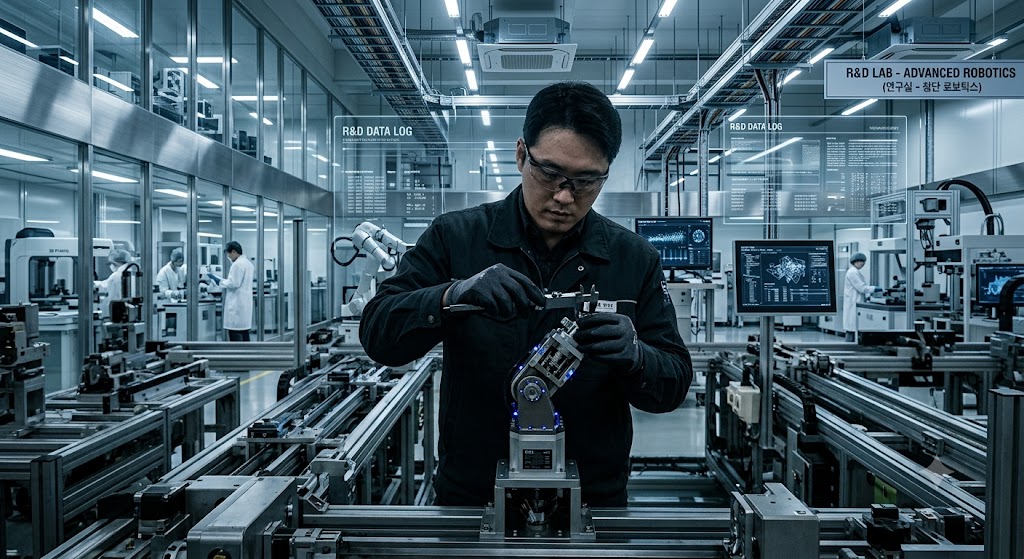
Keeping the Robot on Its Feet
The biggest psychological barrier to bringing robots into homes is safety. Among potential risks, fire hazards are paramount.
Conventional liquid lithium-ion batteries risk catching fire if an impact causes electrolyte leakage. While factories or warehouses can manage this hazard to some degree, a residential home is another story. There are children, the elderly, and pets.
LG Energy Solution played a decisive card here: all-solid-state batteries utilizing solid electrolytes. They do not catch fire upon impact and offer higher energy density than conventional cells. LG projects this technology will expand operating runtimes on a single charge from 1.5–2 hours to 4–5 hours.
This difference extends far beyond simple numbers. Preparing a single meal takes around 45 minutes. With a 1.5-hour battery, a robot might have to retreat to its charging dock before dinner is even ready. With 4 to 5 hours of continuous operation, it can finish an entire day’s routine tasks. The dividing line between a usable robot and an unusable gadget lies squarely within those extra few hours.
What NVIDIA Lends and What LG Builds
In May 2026, the collaboration between LG Electronics and NVIDIA captured the market’s attention. Viewing this simply as a routine partnership between corporate giants misses the underlying essence.
NVIDIA’s Isaac Platform serves as an operating system for robotics software. It houses algorithms for object perception and motion planning, real-time sensor fusion pipelines, and inference engines finely tuned for GPUs. Jetson serves as the edge computing platform that runs this software directly inside the robot at low power. By mounting this stack, LG dramatically accelerates the robot’s computing speeds while keeping power draw to a minimum.
The relationship flows in reverse as well. NVIDIA lacks hardware manufacturing partners capable of translating intelligent software into physical reality. Building factories to churn out tens of thousands of robots, mass-producing precision actuators, and leveraging established appliance distribution networks to reach millions of households—these are capabilities a chip designer cannot create alone. What LG Electronics possesses is precisely what NVIDIA lacks.
There is another frequently overlooked element in this partnership: NVIDIA’s Omniverse platform. Training robots exclusively on physical hardware incurs astronomical costs. Machines break, objects shatter, and accidents happen. Repeating tens of millions of trial-and-error cycles in physical space is practically impossible.
Omniverse provides a 3D virtual simulation environment that faithfully mirrors real-world physics—including gravity, friction, material elasticity, and light reflection. LG Electronics trains tens of thousands of virtual robots simultaneously within this digital space and transfers the resulting intelligence directly to physical hardware. This approach identifies engineering flaws in advance and dramatically elevates arm control precision.
A robot that has already trained tens of thousands of times without failing once in the real world. This is the very capability creating a true competitive gap in the race today.
Another Company Cooling the GPUs
The alliance between LG and NVIDIA extends far beyond robotics. Here emerges an entirely distinct revenue stream.
AI data centers densely packed with NVIDIA’s high-performance GPUs generate immense heat. A single GPU can draw up to 700W. When tens of thousands operate together, power consumption rivals that of a mid-sized city. If this heat is not extracted effectively, GPUs throttle performance or shut down entirely.
Here, LG Electronics’ air conditioning expertise transforms into mission-critical infrastructure in a completely new context. Large-scale chillers are specialized cooling systems that regulate ambient temperatures across vast facilities housing hundreds of server racks, and LG Electronics is one of the world’s leading manufacturers in this sector. Microsoft has already agreed to source LG Electronics’ ultra-large chillers for its Azure data centers.
To transcend the physical limits of air cooling, liquid cooling has taken center stage. A CDU (Cooling Distribution Unit) circulates coolant directly to cold plates mounted on top of GPU dies to extract heat at the source. Its efficiency is tens of times higher than traditional air cooling. LG Electronics is currently pursuing official NVIDIA hardware certification for its CDU lineup.
As long as demand for AI compute surges, data center cooling demand climbs alongside it. While robotics remains an emerging growth market, cooling infrastructure is already experiencing explosive expansion. LG is effectively betting on both the present and the future simultaneously.
A portion of this cooling infrastructure feeds straight back into robotics. That convergence happens at the 200-megawatt data center LG Uplus is building in Paju, designed to house up to 120,000 GPUs. The complex reasoning tasks that a robot cannot easily process on-device are offloaded to this server farm in real time, with results returned immediately for physical execution.
If latency between request and response exceeds 100 milliseconds, practical usability falls apart. The target benchmark is under 10 milliseconds. LG Uplus’s ultra-high-speed dedicated leased lines and edge computing nodes are engineered specifically to hit this standard.
Within the LG Group, the telecom arm was long viewed as a domestic utility. In the era of robotics, ultra-low-latency networks become the robot’s living nervous system.
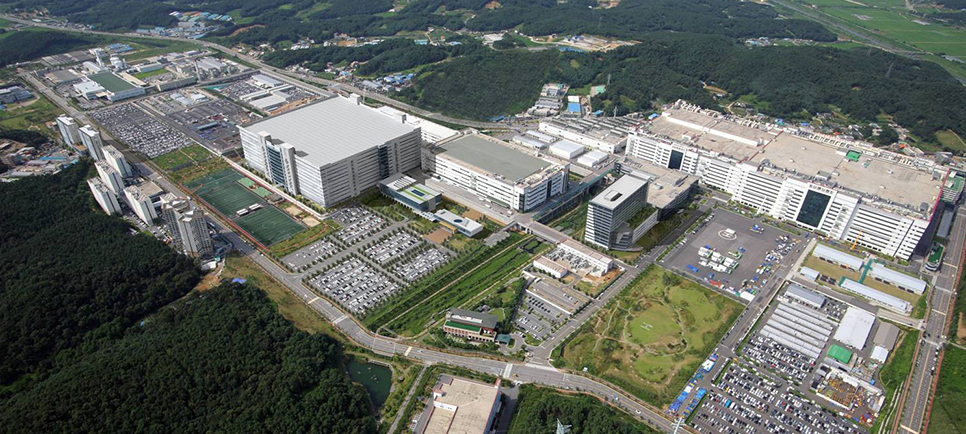
The One Who Controls the Components Wins
Laying all these pieces out side by side reveals a familiar historical pattern.
In the smartphone era, Apple captured iconic fame by selling the finished device. Yet Samsung Electronics, supplying the underlying components—displays, memory chips, and batteries—generated massive profits whether Apple won or Huawei gained share. Whoever controls the component supply chain rarely loses, regardless of which final brand claims victory.
The robotics industry is heading into the exact same structural dynamic.
LG AI Research develops the brain: EXAONE. LG Electronics builds the body and joints: KAPEX, CLOi, and actuators. LG Energy Solution provides the heart: all-solid-state batteries. LG Uplus supplies the nervous system: 5G/6G connectivity and the Paju AI data center. LG CNS integrates the entire architecture across smart factories and logistics hubs.
For a competitor to replicate this ecosystem, they must separately source, negotiate, and coordinate across an AI lab, a robotics OEM, a battery supplier, a telecom carrier, and a systems integrator. Every corporate interface introduces friction and creates bottlenecks.
LG executes all of this under a single roof.
This is not merely a matter of operational efficiency; it is an issue of development velocity. When the robot’s AI model is upgraded, the battery management system and network protocols can be optimized on the exact same day. There is no need to wait on third-party component lead times or renegotiate vendor contracts.
The Market Recalculates the Multiples
For decades, LG Electronics stood as a quintessential example of an undervalued stock in the Korean equity market.
The reason was straightforward: home appliances are cyclical. When people buy new homes, they purchase refrigerators; when real estate values rise, they upgrade TVs. When a recession hits, they hold off on both. Confined within this predictable ceiling, the company’s price-to-earnings (P/E) ratio hovered between 6x and 8x, while its price-to-book (P/B) ratio stayed below 1x—meaning it traded below the net value of its physical assets.
That framework is now breaking down.
Data center cooling revenue is insulated from consumer economic cycles. Demand for AI compute expands regardless of broader macroeconomic conditions. Revenue generated here is highly predictable without seasonal volatility. Actuator supply contracts operate under the same logic: once integrated into a supply chain, they convert into long-term B2B revenue streams.
Subscription-based robotics—RaaS (Robot as a Service)—takes this transformation even further. Instead of selling robots as one-off hardware, companies lease them and collect recurring monthly fees. When software upgrades, continuous maintenance, and energy optimization are bundled into a single package, enterprise clients rarely churn.
Companies command P/E multiples of 15x to 20x for recurring revenue structures of this caliber. If LG’s market classification shifts from a traditional consumer appliance stock to an AI infrastructure player, valuation multiples can expand two- to threefold on the exact same base earnings. This explains why major domestic brokerages, including Hana Securities, aggressively revised their target price for LG Electronics upward from the 160,000 won level to over 230,000 won—a jump of more than 45%.
Naturally, these valuations incorporate substantial expectations about the future. The robotics market might not materialize as rapidly as projected, engineering breakthroughs could face delays, or formidable new rivals might emerge. Stock prices reflect forward-looking optimism, but reality always unfolds with greater friction.
The True Difference from Competitors
Despite these competitive advantages, LG faces formidable global rivals.
Tesla is amassing real-world operating data by deploying Optimus directly inside its manufacturing lines. Its electric vehicle factories double as live robotic training grounds. Figure AI has already deployed units into BMW assembly plants, while Apptronik has partnered with Amazon fulfillment centers.
What sets LG apart from these companies?
Two structural strengths: manufacturing prowess and ecosystem integration.
While Tesla and Figure AI can design cutting-edge robots, they lack the industrial footprint to mass-produce hundreds of thousands of precision actuators at low cost. They do not possess dedicated battery subsidiaries to develop solid-state cells, nor do they command global appliance distribution networks reaching hundreds of millions of households. LG is not just building an individual robot; it is establishing the manufacturing supply chain for the broader robotics industry. That constitutes a structural moat that cannot be replicated overnight.
Conversely, LG’s core vulnerability remains software. Although EXAONE is evolving rapidly, a meaningful gap persists when compared against the frontier robotics AI research of OpenAI or Google DeepMind. The pace of AI progress is volatile, and software leads can turn over far faster than hardware moats.
This precise asymmetry explains why LG partnered with NVIDIA. The strategy is clear: borrow the world’s best software while directly manufacturing the world’s most reliable hardware.
The idea that an appliance maker could hold an advantage over pure semiconductor companies in the robotics era upends conventional wisdom. Physical factories, mass-production know-how, and global distribution channels—once seen as legacy relics of 20th-century manufacturing—have re-emerged as irreplaceable assets in the AI era. Anyone can train software models given sufficient compute, but sixty years of precision manufacturing expertise cannot be bought into existence overnight.
LG’s roadmap reflects this disciplined progression. From 2026 to 2027, the focus rests on mass-producing actuators, internalizing reducer production, and operating pilot deployments across major hospitals and logistics hubs. Between 2027 and 2028, the company plans to fully activate its cloud-brain robotics architecture linking the Paju data center with 5G/6G networks while upgrading CLOi. From 2029 onward, the target is deploying fully autonomous humanoids powered by second-generation all-solid-state batteries into homes, elder care facilities, and complex industrial floors.
Whether this roadmap will unfold without delay remains to be seen. Technology rarely matures strictly on schedule. Yet the strategic direction is unambiguous, and the momentum moving along that trajectory is unmistakable.
The Final Question
Picking up a cup and placing it into a dishwasher takes a human roughly three seconds. For robotics, achieving that same act demanded decades of research. And now, those three seconds are finally drawing near.
Yet this breakthrough leads to another question entirely: once robots take over dishwashing, where will humans direct that reclaimed time?
When the electric washing machine first appeared, society asked the very same thing. When people no longer needed to scrub clothes by hand, where did those hours go? In practice, leisure time did not dramatically increase. Instead, standards of cleanliness simply rose. Clothes once washed weekly began to be laundered every single day. The total burden of labor remained largely constant; only its form transformed.
When robots absorb our routine physical chores, will humanity simply graduate to more intricate forms of labor? Will we genuinely rest? Or will entirely unexpected challenges arise that we cannot yet foresee?
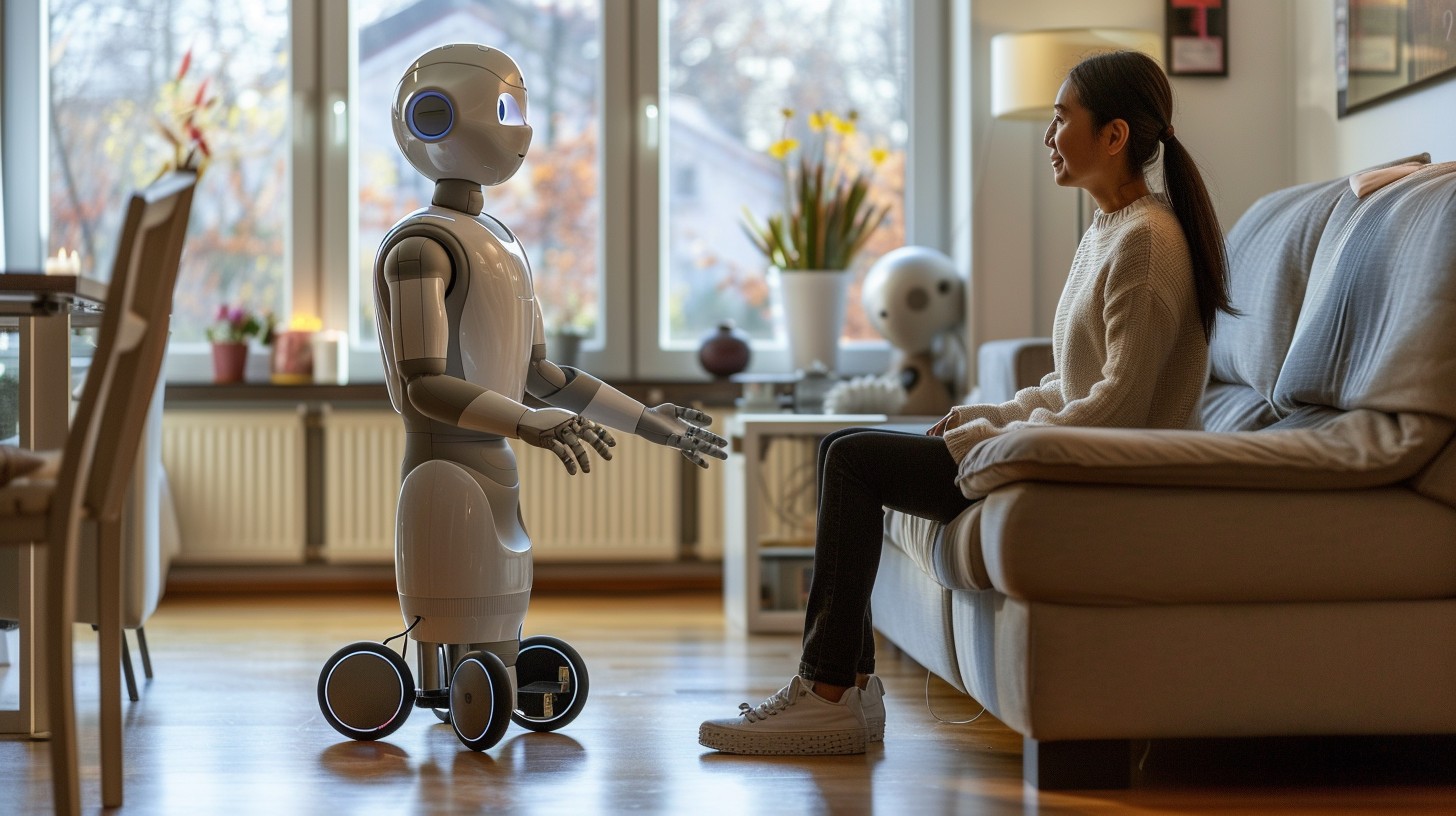
LG Electronics is building a robot. Yet on the day that machine is perfected, the fundamental question we encounter may not be about technology at all. It will likely be about how we choose to define the human experience itself.
And to that question, no one has yet found an answer.
References
- LG AI Research, EXAONE 4.5 Multimodal Foundation Model Technical Whitepaper & Visual Perception Intelligence Specification (2026)
- LG Electronics, Q1 2026 Earnings Release & Corporate Conference Call Transcript — Humanoid Robotics Business and NVIDIA Collaboration Roadmap (April 2026)
- Hana Securities Research Center, LG Electronics Equity Research: Boarding the Robotics Value Chain & Target Price Upgrade (May 2026)
- Seoul Economic TV, The Reality Behind LG Electronics' Intraday Surge: Analysis of the Strategic Physical AI Alliance with NVIDIA (May 2026)
- Newspim, LG Electronics Announces NVIDIA Humanoid Collaboration & H1 Mass Production of Initial Reducer/Actuator Batches (April 2026)
- Korea Institute of Science and Technology (KIST), K-Moonshot Flagship Project: Korean High-Function Humanoid KAPEX Platform Development Specs (2026)
- ZDNet Korea, LG Electronics' Next-Gen CDU Liquid Cooling Features & Progress on NVIDIA Certified Supply Chain Entry (2026)
- Shinhan Securities, LG Electronics Valuation Rerating and Subscription-Based Business Outlook (April 2026)
- The Korea Economic Daily, Joint Modular Cooling Solution Agreement Analysis Between LG Electronics and Flex for AI Data Centers (November 2025)
- News1, One-Team LG Strategy: Mega Paju AIDC Infrastructure & EXAONE 4.5 Agentic AI Future Roadmap (March 2026)
- SOD Tech Channel, In-Depth Coverage on Humanoid Engineering and Korean AI Robotics Platforms (October 2025)
- Sinsaimdang Channel, Jensen Huang's Master Plan & Analysis of the NVIDIA-LG Physical AI Alliance (May 2026)
- Goldman Sachs Global Investment Research, The Robot Revolution: The Economics of Humanoid Automation (2025)
- McKinsey Global Institute, Generative AI and the Physical World: From Language Models to Physical AI (2025)
- NVIDIA Corporation, Isaac Platform and Jetson AI Edge Computing for Robotics — Technical Overview (2026)