
In January 1790, the newborn United States was on the verge of bankruptcy. Paper currency printed by the Continental Congress during the war had collapsed in value and turned into virtually worthless scraps, while promissory notes distributed to soldiers in lieu of pay traded in the market at a fraction of their face value. Yet the conclusion of Treasury Secretary Alexander Hamilton’s first report to Congress was startling. Rather than reducing the debt, he proposed that the federal government assume the wartime debts of every state, effectively expanding the national obligation. A national debt, if it is not excessive, will be to us a national blessing, he wrote.
Lawmakers at the time could not comprehend how mounting debt could be considered a blessing. To Thomas Jefferson and James Madison, debt was a moral hazard and a sin. Whether for an individual or a nation, debt was something to be eliminated through repayment, not embraced and sustained. It was precisely in the chasm between this prevailing common sense and Hamilton’s radical proposal that the first chapter of the American financial system was written.
Every time you swipe a credit card or calculate interest on a loan, you rely on an implicit premise: that debt carries creditworthiness, and that well-managed debt can serve as an asset. That fundamental intuition was forged during this very period. The notion of a sovereign credit rating—which we take for granted whenever reading financial headlines today—did not even exist 236 years ago. And for this new concept to become a functioning reality, someone had to pay the price first.
Debts That Do Not Need to Be Erased
Game theory features a concept known as the repeated game. In a one-shot encounter, there is little incentive to keep a promise to someone you will never see again. However, if you are bound to deal with them continuously, the dynamic changes entirely. Breaking a promise today guarantees that no one will trade with you tomorrow. Consequently, within a repeated game, reputation—the firm belief that “this party honors its word”—transforms into a tangible asset. It becomes less about whether you have the immediate capacity to pay, and more about whether you can convince others that you will unfailingly make good on your word.
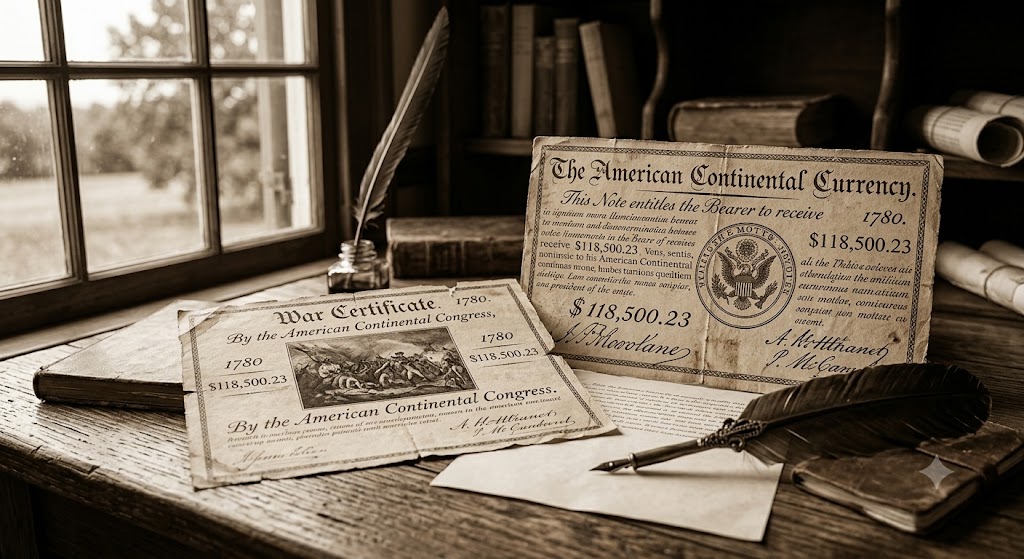
This was the exact architecture Hamilton designed. He declared that the federal government would redeem war certificates at their full nominal value. Crucially, he insisted on paying this full face value not to the original holders who had sold their certificates for pennies on the dollar, but to the speculators who had bought them up. Madison fiercely opposed this approach. He introduced a “discrimination plan” proposing that original veterans and farmers receive the face value, while subsequent speculators be paid only their actual purchase price. While morally intuitive and seemingly fair, Madison’s proposal was soundly rejected by Congress.
Hamilton operated on a different calculus. His objective was not about who held the paper right now, but about establishing the unshakable faith that future paper issued by the United States government would hold value equivalent to real money. If the government were to alter “whom it pays” based on shifting moral sympathies or convenience, no creditor would ever treat its paper as a genuine asset. The goal was not to extinguish debt once and for all, but to cultivate a stellar reputation as a sovereign power that maintains debt while servicing its interest without fail. That was the essence of the “blessing” Hamilton envisioned. An individual’s debt that ends with final payment and a nation’s debt that continually rolls over to demonstrate creditworthiness were fundamentally different games.
A Vote Decided by $30,000, and a Fateful Dinner
Looking at the numbers reveals the staggering scale of this gamble. At the time, the total outstanding debt owed by the United States—combining federal obligations and state war debts—was estimated at roughly $79 million. In that same year, annual federal revenues amounted to barely $4 million. In modern terms, the federal government had resolved to shoulder a debt nearly twenty times its annual income.
Congress remained deadlocked over the proposal throughout the summer. The measure was defeated on the floor by a narrow margin. Southern states like Virginia, which had already paid down the bulk of their debts, pushed back vehemently, asking why their taxpayers should shoulder the unpaid burdens of Northern states like Massachusetts. Madison argued that under Hamilton’s scheme, Virginia would be burdened with $5 million in new federal taxes, while the federal government would only absorb $3 million of Virginia’s debt.
The deadlock was finally broken on June 20, 1790, over dinner at Jefferson’s lodgings in New York. Hamilton, Jefferson, and Madison forged a historic bargain: in exchange for Southern support to pass the debt assumption plan, the permanent federal capital would be established along the Potomac River in the South. Fiscal policy and the capital’s geographic location—two seemingly unrelated matters—were bound together at that dinner table. Two months later, in August, the Funding Act of 1790 passed, transferring approximately $21.5 million in state debts onto the federal ledger.

What warrants attention here is not merely the political art of the deal. It is the realization that a nation is not forged solely through a written constitution, but built incrementally through the actual fulfillment of its promises to service debt. In 1789, the United States was little more than a loose confederation on paper across thirteen states. But from the moment in August 1790 when state creditors began looking to the federal government rather than individual state legislatures as their primary debtor, the United States began functioning as a single fiscal entity.
Whiskey and Taxes — Who Paid the Price of Credit?
This raises an essential question: where would the federal government find the revenue to pay the annual interest on this colossal debt? Hamilton looked to customs duties alongside internal excise taxes, chief among them an excise levied on whiskey and other distilled spirits. Enacted in 1791, this tax was systematically extracted from backcountry farmers on the Western frontier to pay interest to urban creditors in the East.
This dynamic was no accident. For farmers in rugged, mountainous border regions like Western Pennsylvania, distilling surplus grain into whiskey was not a matter of crafting a luxury good; it was an indispensable livelihood strategy, converting bulky crops that were difficult to transport into a durable, non-perishable commodity. Yet the new excise imposed a disproportionately heavy burden on small-scale rural distillers compared to large commercial distilleries. By 1794, Western farmers organized armed resistance, attacking federal tax collectors in what became known as the Whiskey Rebellion. President George Washington personally rode out at the head of a federalized militia to suppress the uprising.
The scene of sovereign credit flourishing in urban bond markets and the scene of frontier farmers tarring and feathering federal tax collectors were two sides of the very same coin. While metropolitan bondholders accumulated trust in the nation by collecting interest at full face value, the cost of manufacturing that trust was drawn directly from the pockets of disenfranchised frontier farmers. Sovereign credit was never built for free. The beneficiaries and the payers of the bill were distinct groups of people from the very beginning.
The Moment Faith Became Currency
Debt assumption was never a mere accounting maneuver. It was a structural transformation that consolidated thirteen disparate debtors into a single sovereign issuer, giving birth to a single credit system, a single market, and a unified nation. When creditors across the states ceased looking to local legislatures and turned their gaze to the federal government, they experienced, for the first time, direct commercial relations with the United States as a singular entity. While the Constitution proclaimed political union, debt assumption made that union a tangible reality on creditors’ balance sheets.
Furthermore, this newly minted credit began trading instantly. The new bonds issued by the federal government changed hands across markets, circulating effectively as currency and injecting much-needed liquidity into the commercial arteries of the young republic. It marked the precise moment when a promise on a sheet of paper transformed into a trusted, actively traded asset. Yet the price of earning that trust was paid in taxes by some and settled in armed rebellion by others.
The Same Question 236 Years Later
Even at this moment, investors purchase U.S. Treasuries, and sovereign credit downgrades send shockwaves through foreign exchange markets. The fundamental question underpinning these modern mechanisms differs little from the debate at that 1790 dinner table. It is less about whether a state possesses the immediate capacity to pay off everything, and more about whether it can consistently convince the world that it will pay. For nations and individuals alike, credit rests fundamentally on the counterparty’s conviction that the relationship will endure tomorrow.
Yet the Whiskey Rebellion left behind an enduring question of its own: the costs of maintaining credit are never divided equally. In contemporary debates over fiscal austerity and sovereign debt management, we continue to echo that very question in different words: whose confidence are we protecting, and whose pockets are being emptied first? Hamilton succeeded in manufacturing this national credit, but his success opened the doors to the next battle. Collecting taxes to service the debt required an institutional apparatus to manage the funds. What he laid before Congress next was an institution that had never before existed in America: a national bank.
References
- Wikipedia, Funding Act of 1790 https://ko.wikipedia.org/wiki/1790%EB%85%84_%EC%9E%90%EA%B8%88_%EC%A1%B0%EB%8B%AC%EB%B2%95
- Wikipedia, First Report on Public Credit https://ko.wikipedia.org/wiki/%EA%B3%B5%EA%B3%B5_%EC%8B%A0%EC%9A%A9%EC%97%90_%EB%8C%80%ED%95%9C_%EC%B2%AB_%EB%B2%88%EC%A7%B8_%EB%B3%B4%EA%B3%A0%EC%84%9C
- Wikipedia, Debt assumption https://en.wikipedia.org/wiki/Debt_assumption
- Wikipedia, Hamilton's Economic Program https://ko.wikipedia.org/wiki/%ED%95%B4%EB%B0%80%ED%84%B4_%EA%B2%BD%EC%A0%9C_%ED%94%84%EB%A1%9C%EA%B7%B8%EB%9E%A8
- IMF F&D Magazine, The History of the U.S. Financial System https://www.imf.org/en/publications/fandd/issues/2018/03/gaspar
- US House of Representatives, The First Bank of the United States https://history.house.gov/Historical-Highlights/1700s/1791_First_Bank/