
In 1780, France came to America’s aid in its war for independence. Seeking to check Britain’s power, it sent warships, troops, and vast sums of money across the Atlantic. Without that support, the American Revolutionary War might have ended very differently. Yet nine years later, the nation that received the help invented sovereign credit and laid the foundations of the world’s greatest superpower, while the nation that provided the help saw its king mount the guillotine over the exact same kind of war debt. Debt from the same war and the same era led the two nations to completely different destinies.
Yet this fork in the road had an even older precedent. The rival France confronted while helping America was Britain, and Britain had already completed this very experiment against France nearly a century earlier. The system Alexander Hamilton designed was not a brand-new invention, but rather an American adaptation of a formula Britain had already proven. France was the nation that witnessed that formula play out twice right before its eyes, yet failed to learn from it.
We usually assume that having a lot of debt is dangerous and having little debt is safe. But placing Britain, France, and the United States side by side shatters that intuition. What created the divergent paths was not the sheer size of the debt, but the structure that bore it. This applies not only to nations, but to personal credit as well. A repayment plan and trust, far more than the loan amount itself, determine the real risk.

A Script Written a Century Earlier
In 1694, embroiled in war with France, the English Crown stood on the brink of bankruptcy. Parliament granted a special charter in exchange for borrowing £1.2 million from merchants. Those who lent the money formed a single corporation to establish the Bank of England, earning the right to issue banknotes backed by government debt. It was the birth of an idea: borrowing not against the monarch’s personal credit, but against tax revenues guaranteed by parliament.
This idea immediately transformed into power. Over the following century and beyond, Britain clashed with France almost uninterruptedly—in the Nine Years’ War, the War of the Spanish Succession, the War of the Austrian Succession, the Seven Years’ War, and the American Revolutionary War. France had a larger population and a bigger economy, but the longer the wars dragged on, the more the outcome tilted in Britain’s favor. The reason was simple: backed by parliamentary credit, Britain could borrow vastly larger sums at much lower interest rates. Relying on the personal credit of its king, France always had to pay steeper interest. War ultimately came down to who could hold out longer and more cheaply, and the decisive battleground was not the battlefield, but the bond market.
Hamilton was well aware of this history. He studied the British fiscal system and mirrored its approach: building sovereign credit rather than royal credit, backed by structured tax revenues and active markets. There was only one difference. While Britain took nearly a century to transition from royal credit to sovereign credit, Hamilton compressed that entire shift into just a few years right after the founding of the United States. Meanwhile, France, having witnessed this formula twice against Britain, never managed to restructure its royal finances.
Same Pathogen, Different Immune Systems
Imagine two organisms infected with the same pathogen. One has an immune system that quickly organizes antibodies to neutralize the threat the moment it spreads, while the other lacks any such defense mechanism altogether. Even if the initial infection load is similar, the outcomes diverge completely: one survives, while the other collapses from sepsis.
The pathogen known as the American Revolutionary War infected both France and the United States. Immediately following infection, the United States possessed an immune system organized by Hamilton—a federal bond market and an integrated tax base. Even as debt grew, future tax revenues to service it were collected broadly across society rather than falling on a single group, and the bonds proved their own value as they traded freely in the market. The infection had actually strengthened the immune system.
France lacked this immune system entirely. The nobility and clergy, making up just 3% of the population, owned over 30% of the land yet paid virtually no taxes. Borrowing relied not on national credit, but on the personal reputation of the king, creating a vicious cycle where new debt had to be issued just to service existing obligations. Finance ministers like Turgot and Necker attempted several reforms to tax the privileged classes, but each effort was thwarted by resistance from the aristocracy and the parlements, leading to their dismissals. France simply could not generate the antibodies needed to defend against the pathogen.
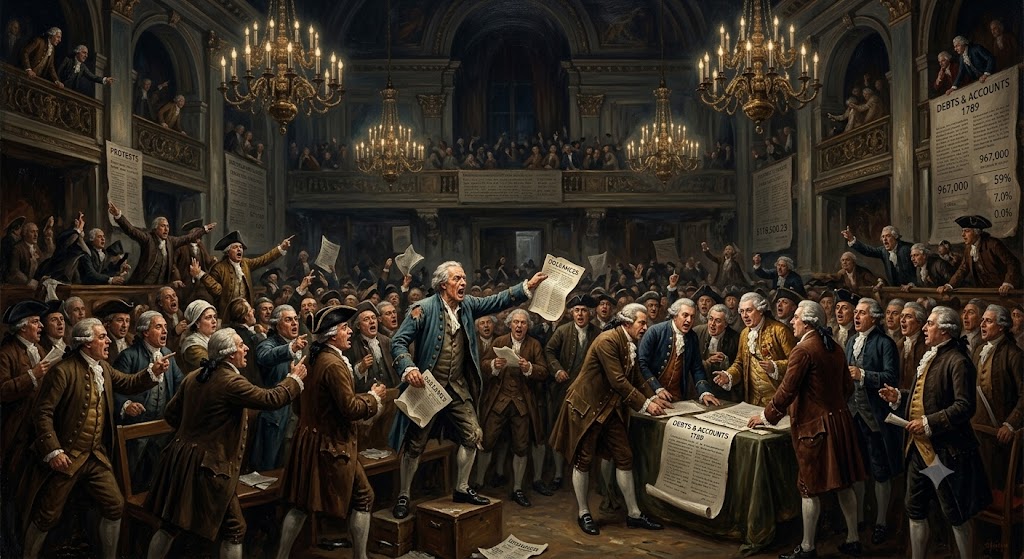
1789: Two Rooms Across the Atlantic
The numbers bring this contrast into sharper focus. The royal debt handed down from Louis XIV and accumulated through Louis XV exceeded 2 billion livres in principal alone, and supporting the American Revolutionary War added a massive burden to that pile. By the reign of Louis XVI, nearly half of national expenditures went not to new initiatives, but simply toward paying interest on debts left by past kings. When half of what a country earns vanishes into paying for its past, no room remains to build its future.
That same year, vastly different meetings were taking place on opposite sides of the Atlantic. In Philadelphia, lawmakers debated and voted on whether the federal government should assume the war debts of the individual states. A few months later, a single dinner broke the deadlock, and those debts were consolidated under the credit of the federal government. In Versailles, the controller-general’s attempts to levy taxes on the privileged classes were repeatedly blocked by the nobility and parlements, resulting in his dismissal and ultimately prompting the convocation of the Estates-General for the first time since 1614. An assembly called to solve a fiscal crisis ended up pulling the trigger on a revolution.
One side reorganized its debt into credit, while the other failed to find a way to structure its debt at all, causing the entire regime to collapse. Both nations caught the same disease, but the ability to write an effective prescription determined their fates nine years later. And that prescription was one Britain had already written a century before.
Credit Outlasts Military Might
Here, the story expands once more. Credit as an intangible asset was never a one-time tool meant only to fund a single war. During the American Civil War, the Union Treasury enlisted banker Jay Cooke to split government bonds into small denominations and sell them directly to ordinary citizens. Using newspaper advertisements and agent networks to convince farmers and shopkeepers to buy bonds was possible only because of the trust and bond market established back in the 1790s. In the two World Wars of the 20th century, the United States once again relied on the same approach—issuing war bonds anchored in public and market confidence—to finance unprecedented military efforts.
In 1944, when delegates from 44 nations gathered in Bretton Woods, New Hampshire, to design a new international monetary system, the anchor currency they chose was not gold, but the US dollar. Only the dollar was guaranteed convertibility to gold at $35 per ounce, while other currencies were pegged to the dollar. No one could create more gold, but behind the dollar stood 154 continuous years of the United States keeping its financial promises. Not weapons or territory, but a track record of repaying debt made one nation’s currency the standard of the world.
Yet even this collateral was not permanent. In 1971, the United States unilaterally broke its promise to convert dollars into gold. As the costs of the Vietnam War collided with domestic spending, the volume of dollars held abroad eclipsed America’s gold reserves, leading the government to suspend convertibility. From that moment, the dollar lost its last physical anchor. Yet it remained the most widely used currency on earth. The world realized for the first time that a currency could function without gold backing. All that remained was one thing: the belief that the United States would continue to honor its commitments.
In the end, the invention of sovereign credit proved to be a weapon that outlasts guns, warships, and even gold. Military might becomes useless once a war ends, and gold has a fixed physical limit, but a reputation for keeping promises continues to pay dividends in the next crisis, and the crisis after that.
236 Years Later, Still on the Same Testbed
Even at this very moment, some nations watch their government bond yields spike and find their borrowing limits put to the test, while individuals sit before banks drafting loan repayment plans to prove the same kind of reliability. Looking at the debt figure alone never reveals the outcome of this test. The real question is always the same: Is there a viable structure to repay this debt, or are you merely surviving until the next loan?
The £1.2 million lent by London merchants to the Crown in 1694; the compromise struck over dinner in New York in 1790; the two advisory opinions laid on Washington’s desk in 1791; the Estates-General that collapsed in Versailles that same year; and the 1971 decision to sever the final link to gold. Laying these five moments side by side converges on a single insight: a nation is not defined by territory, armies, or even gold, but by the trust that it can honor promises stretching into the next generation—and its ability to organize that trust. The single contract you sign today, the loan you commit to repay, rests on this very same foundation. On what are you—and your country—building that trust?
References
- Wikipedia, French Revolution https://ko.wikipedia.org/wiki/%ED%94%84%EB%9E%91%EC%8A%A4_%ED%98%81%EB%AA%85
- Namuwiki, French Revolution https://namu.wiki/w/%ED%94%84%EB%9E%91%EC%8A%A4%20%ED%98%81%EB%AA%85
- Woori History Net, Causes of the French Revolution https://contents.history.go.kr/mobile/ta/view.do?levelId=ta_h32_0060_0020_0040_0030
- Wikipedia, Bretton Woods System https://ko.wikipedia.org/wiki/%EB%B8%8C%EB%A0%88%ED%84%B4%EC%9A%B0%EC%A6%88_%EC%B2%B4%EC%A0%9C
- Britannica Money, Bank of England https://www.britannica.com/money/Bank-of-England
- UK Parliament, The Financial Revolution https://www.parliament.uk/about/living-heritage/evolutionofparliament/parliamentaryauthority/revolution/overview/financialrevolution/
- Market Histories, The Bank of England: How Government Debt Created the World's First Central Bank https://www.markethistories.com/en/the-bank-of-england-founding-how-government-debt-created-the-worlds-first-central-bank-1694