
Different Ways of Thinking and Their Legacies Through Two Giants of Eastern and Western Mathematics
- Fundamental differences between the Eastern ‘Guhogyeon Theorem’ and the Western ‘Pythagorean Theorem’
- A deep understanding of how mathematics reflects the worldview of each civilization
- Discovering mathematical principles applied in Korean history from the Silla Seokguram to the Joseon Angbu-ilgu
Guhogyeon Theorem: Truth Proven Through Practicality
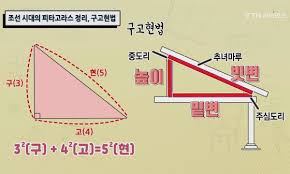
The relationship between the three sides of a right triangle ($a^2+b^2=c^2$) has been explored in different ways in the East and West. In the East, it is known as the Guhogyeon Theorem, where its principles were discovered and utilized in practical problem-solving processes. This theorem was systematized through the ancient Chinese mathematical text, “Gujangsanseul”.
“Gujangsanseul”: A Guide for Problem Solving
“Gujangsanseul (九章算術)” is a compilation of ancient Chinese mathematical knowledge, structured around thoroughly practical problem-solving rather than abstract theories.
As indicated by the chapter titles such as ‘Land Measurement’ and ‘Civil Engineering’, this book served as a guide for bureaucrats and engineers to solve realistic problems encountered in the field. Each problem presents a specific situation (“Jin Yu (今有)…”), followed by a description of the solution procedure, or algorithm (“Shu Wei (術曰)…”). This clearly illustrates the Chinese pragmatic mathematical tradition that emphasized establishing repeatable solution procedures over abstract proofs.

Liu Hui’s Proof: Wisdom Shown Through Cutting and Reassembling
The first logical explanation of the Guhogyeon Theorem appears in the annotations of the 3rd-century mathematician Liu Hui (劉徽). He visually proved the validity of this theorem through the original principle of ‘Chulip Sangbo (出入相補)’.
‘Chulip Sangbo’ involves cutting a shape into several pieces and rearranging them like a puzzle to intuitively show that the areas are equal. By cutting the squares of the base (勾, a) and height (股, b), and filling the square of the hypotenuse (弦, c) without gaps, it demonstrates that $a^2+b^2=c^2$. This is closer to an algorithmic demonstration based on the principle of area preservation rather than a logically necessary deductive proof. The goal of the proof was not to establish universal truth but to empirically demonstrate reliable rules for calculation.
Pythagorean Theorem: A Tower Built on Logic
In the West, this theorem is known as the Pythagorean Theorem, and its development took a completely different path than that of the East. Greek mathematics began with a philosophical inquiry into understanding the order of the universe through ’numbers’.
Discovery of Irrational Numbers and Philosophical Crisis
The Pythagorean school believed that “the essence of all things is number”, but they faced a crisis that shook their belief system due to their own theorem. This was the discovery of ‘incommensurability’, meaning that the length of the hypotenuse ($\sqrt{2}$) of a right isosceles triangle with a side length of 1 cannot be expressed as a ratio of integers.
This contradiction was a significant shock to those who sought to explain the world through integers. This contradiction marked a decisive turning point for Greek mathematics, leading it to move beyond observation or calculation and to derive conclusions solely through logical steps starting from self-evident truths (axioms) in a deductive reasoning approach.
Euclid’s “Elements”: The Essence of Deductive Proof
The essence of this axiomatic methodology is encapsulated in Euclid’s “Elements”. The proof of the Pythagorean Theorem, appearing as Proposition 47 in Book 1 of “Elements”, is a sophisticated logical structure qualitatively different from Liu Hui’s visual rearrangement.
Euclid weaves together auxiliary theorems about the conditions for triangle congruence and area relationships to prove that $a^2+b^2=c^2$ must necessarily follow. Instead of asking the reader to manipulate the figures, it compels them to accept the truth of the conclusion based on established axioms and theorems. The concluding “Q.E.D.” declares that this proposition has attained the status of universal truth within a closed logical system, independent of reality.

Comparison: Pragmatism vs. Idealism
The two proofs starkly illustrate the different ways of thinking about mathematical truth in these two civilizations. The Chinese approach was not a ‘failed’ attempt at Greek-style proof but a successful implementation of a different mathematical way of thinking.
| Feature | Guhogyeon Theorem (Ancient China) | Pythagorean Theorem (Ancient Greece) |
|---|---|---|
| Key Text | “Gujangsanseul (九章算術)” | Euclid’s “Elements” (Book 1, Proposition 47) |
| Proof Method | Visual division and rearrangement (Chulip Sangbo) | Axiomatic-deductive argument |
| Philosophical Basis | Pragmatism, algorithm-centered, solving real problems | Idealism, abstraction, pursuit of universal truth |
| Main Applications | Measurement, engineering, architecture, astronomy | Pure geometry, number theory, foundations of philosophy |
The Principles of Guhogyeon Embedded in Korean History
Korea adopted the pragmatic mathematical tradition of China and utilized it as a key tool for state governance.
Architecture: Implementing Divine Proportions
Have you ever thought about the mathematical principles hidden in the beautiful curves of traditional architecture? The Guhogyeon method (句股法) was essential in determining the lengths of rafters and eaves in Hanok and in establishing the right angles of buildings.
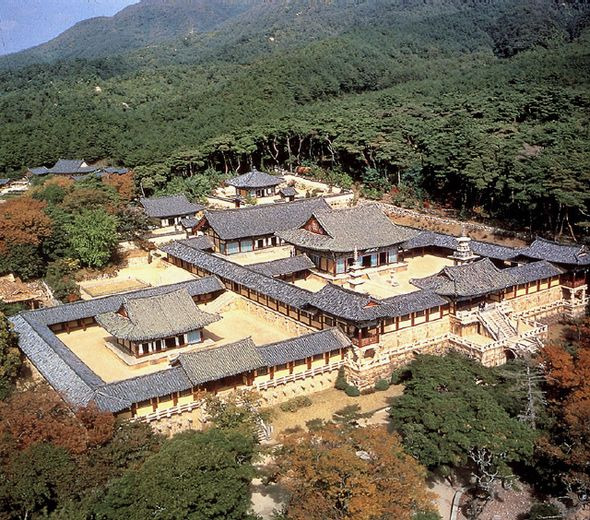
- Bulguksa and Seokguram: The masterpieces of Silla architecture, Bulguksa and Seokguram, exemplify mathematical precision. The stable proportions of the Seokgatap and Dabotap, along with the perfect geometric balance inside Seokguram, were all realized through the Guhogyeon method. Here, mathematics transcended mere technique, becoming the sacred language that actualizes the ideals of the Buddhist paradise on earth.
State Governance: The Technology of Measuring Land and Sky
The Guhogyeon method formed the core technology underpinning state governance.
- Land Measurement and Taxation: The Guhogyeon method was used to divide irregular land into right triangles for area calculation during the Joseon period’s land measurement project known as ‘Yangjeon (量田)’. This was the foundation of national financial administration that ensured fair taxation.
- Design of Astronomical Instruments: When creating precise instruments like the Angbu-ilgu (water clock) or the Honcheonui (armillary sphere), the principles of the Guhogyeon method were foundational for calculating accurate angles and designing components.
- Design of the Geojunggi: The design of the geojunggi included in the report on the construction of Suwon Hwaseong, titled “Hwaseongseongyeokui”, shows that the Guhogyeon method was part of systematic engineering technology for executing national projects.

Conclusion
The Guhogyeon Theorem and the Pythagorean Theorem clearly illustrate how a universal truth can be understood differently through the prism of culture.
-
Key Summary
- Same Truth, Different Approaches: The Guhogyeon Theorem is proven through practical and algorithmic demonstrations, while the Pythagorean Theorem is proven through abstract and deductive arguments.
- Reflection of Worldviews: This shows the fundamental differences in thinking between the East, which emphasizes solving real problems, and the West, which pursues ideal truths.
- Cornerstone of Korean History: Korea developed the practical knowledge of the Guhogyeon Theorem into core technologies for state governance in architecture, astronomy, and administration.
Next time you visit a museum or a historical site, why not look for the mathematical principles hidden within the beautiful heritage? You may discover a new joy in uncovering the wisdom and practicality of our ancestors.
References
- “Gujangsanseul (九章算術)” Dongyang Classic Comprehensive DB
- Nine Chapters on the Mathematical Art Shanghai Daily
- Illustrating The Nine Chapters on the Mathematical Art Mathematical Association of America
- Mathematics Encyclopedia of Korean Culture
- The Nine Chapters on the Mathematical Art Wikipedia
- Exemplar 21: The Ancient Chinese Proofs on Pythagoras’ Theorem Education Bureau, Hong Kong
- [Mathematics Walk] Before Pythagoras Proved It 500 Years Earlier… News Cool
-
- Pythagorean Theorem KOCW
- Pythagorean theorem Wikipedia
- [Curious S] The Science of Seokguram and Bulguksa That Surprises Even Today YTN
- Reduction of Land Area After the War Our History Net
- Angbu-ilgu Our History Net
- Hwaseongseongyeokui Wikipedia