
A Grand Journey Tracing the Birth of the Sun, Earth, and Living Planets from the Perspective of 13.8 Billion Years of Cosmic History.
- Legacy of Supernovae: Discover how the elements that make us were created and how the trigger for solar system formation was pulled.
- Birth of Earth: Examine the violent giant impacts and magma oceans that early Earth experienced, along with the backstory of the Moon’s formation.
- Secrets of Living Planets: Explore the mystery of the beginnings of plate tectonics, the key feature that distinguishes Earth from other planets.
The Great Staircase of the Universe, Big History
Look at your hand. The carbon that makes up that hand, the iron that flows through your blood, none of it was created in the Big Bang. We are, quite literally, stardust.
This grand truth becomes clear when we view ourselves through the immense lens of ‘Big History.’ Big History offers a unified narrative of the 13.8 billion-year history from the beginning of the universe to the present, highlighting significant turning points in the process, referred to as ’thresholds.’
Each threshold marks a moment when specific ‘Goldilocks conditions’—conditions that are ‘just right,’ neither too hot nor too cold—allow for the emergence of entirely new levels of complexity that did not exist before.
This article traverses the ‘Third Threshold,’ where the materials for life were created inside massive stars, and finally creates the stage for life to emerge at the ‘Fourth Threshold,’ namely the formation of the solar system and the birth of Earth.
Part 1: The Beginning of Solar System Formation - The Legacy of a Dead Star
1.1 Ghost in the Machine: The Legacy of Supernovae
The story of our solar system does not begin with a quiet primordial gas cloud, but rather in the majestic graveyard of a star. The massive molecular cloud from which our solar system was born, the ‘solar nebula,’ was not composed solely of the pure hydrogen and helium from the Big Bang. It was already enriched with ‘heavy elements’ essential for creating life and planets, such as carbon, oxygen, silicon, and iron.
Where did these crucial elements come from? They were created in the nuclear fusion furnaces of massive stars that lived long before our Sun and met a grand end. These stars exploded in a tremendous blast known as a ‘supernova,’ scattering the precious elements they had forged throughout their lifetimes into the cosmos.
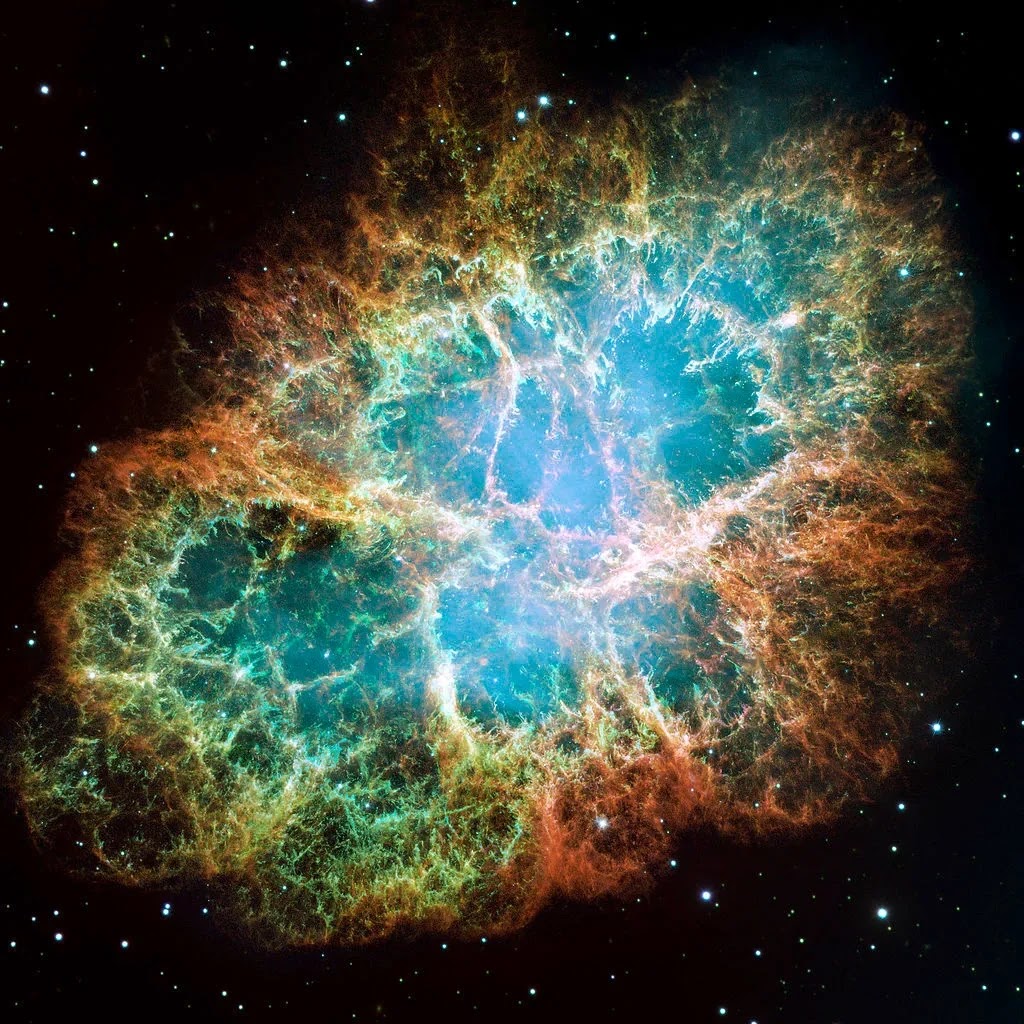
Scientists have discovered short-lived radioactive isotopes like ‘iron-60 (60Fe)’ in ancient meteorites, which serve as ‘smoking gun’ evidence. Since iron-60 is only produced during supernova explosions, this provides strong evidence that a supernova exploded right next to the cradle of our solar system.
This supernova not only supplied materials but also acted as a trigger by compressing the solar nebula with the shockwave from the explosion, causing gravitational collapse. Here, we uncover a profound truth: Our Sun had to be born from the death of another star. Creation and destruction were partners that enabled each other within the cosmic ecosystem.
1.2 The Great Spin: Igniting the Stars
The fragments of the nebula that began to collapse started to spin faster due to the conservation of angular momentum. This is similar to how a figure skater spins faster by pulling in their arms. Thanks to this rotation, not all material was drawn directly into the center; instead, it spread out flat in a direction perpendicular to the axis of rotation, forming a massive ‘protoplanetary disk.’
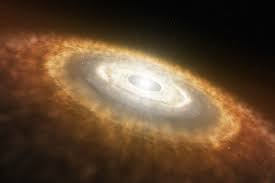
In the center of the disk, gas and dust continued to accumulate, forming a dense and hot core, the ‘protosun.’ After about 5 million years of contraction, when the temperature and pressure in the center reached 15 million Kelvin, the spark of hydrogen fusion ignited. Thus, a new light was born in the darkness of the universe: our Sun.
1.3 The Great Division: A Cradle for Two Types of Planets
The remaining 0.1~0.2% of the mass that formed the Sun became the cradle for the planets. Within this disk existed a crucial boundary known as the ‘frost line,’ located between the orbits of Mars and Jupiter. The frost line acted like a customs checkpoint in the universe.
- Inside the frost line: Temperatures were too high for water, ammonia, and methane to exist as ice, leaving only rocks and metals to remain solid, forming the ‘rocky planet zone.’
- Outside the frost line: Temperatures were low enough for volatile substances like water to freeze into massive ice grains, providing the foundation for the formation of giant gas planets.
The basic design of our solar system—small, solid inner planets and massive, cold outer planets—was determined by this simple temperature boundary. This was not a coincidence but an inevitable result of physical laws.
Part 2: The Birth of Earth - A World Forged in Fire
2.1 From Dust Bunnies to Destructive Races
Inside the solar system, rocky and metallic dust particles began to clump together to form ‘planetesimals’ several kilometers in size. In the subsequent ‘runaway accretion’ phase, the largest planetesimals vacuumed up surrounding material, growing into dozens of ‘protoplanets’ the size of Mars. This was akin to a cosmic demolition derby, and our Earth emerged as one of the final victors of this brutal competition.
2.2 The Giant Collision that Made Our World and Moon
About 4.5 billion years ago, the most significant event in Earth’s history occurred. A Mars-sized protoplanet named ‘Theia’ collided obliquely with the young Earth.
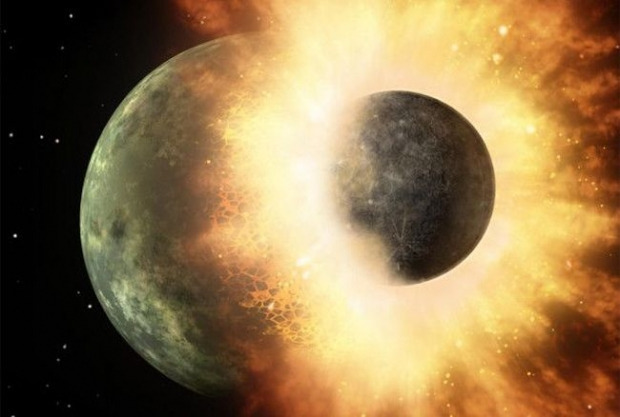
This impact melted the entire surface of the Earth, transforming the planet into a burning ‘magma ocean’ thousands of kilometers deep. Simultaneously, the massive debris ejected from the collision coalesced to form our companion, the Moon.
This ‘giant impact hypothesis’ elegantly explains several mysteries, including the Moon’s small core, the similarity of Earth’s mantle and rock composition, and the tilt of Earth’s rotational axis (the cause of seasons).
2.3 The Great Separation: Creating Earth’s Layers
Within the magma ocean, ‘planetary differentiation’ occurred, determining the future of Earth.
Just as oil and water separate, heavy elements like iron and nickel sank to form a metallic core. Meanwhile, lighter materials like silicates rose to create the mantle and primitive crust. This layered structure became the fundamental foundation that would later drive Earth’s magnetic field and plate tectonics.
2.4 Planet-Scale Rain
As the magma ocean cooled, trapped water vapor and carbon dioxide were released through volcanic activity, forming a primitive atmosphere. As Earth continued to cool, the water vapor in the atmosphere condensed and rained down for millions of years, ultimately giving birth to Earth’s first oceans.
These oceans absorbed vast amounts of carbon dioxide from the atmosphere, preventing Earth from becoming a victim of a runaway greenhouse effect like Venus. The most violent events that nearly destroyed Earth paradoxically provided the long-term stability and potential for life.
Table 1: Roadmap to a New World - Key Events of Formation
| Time (Billion Years Ago) | Major Events |
|---|---|
| About 4.6 | Beginning of gravitational collapse of the solar nebula |
| About 4.6 ~ 4.55 | Growth of the protosun and formation of the protoplanetary disk |
| About 4.55 | Ignition of the Sun (fusion begins) |
| About 4.55 ~ 4.5 | Accretion of planetesimals and protoplanets; formation of rocky planets |
| About 4.5 | Formation of the Moon from the giant impact (Theia); Earth enters magma ocean state; planetary differentiation |
| About 4.4 ~ 4.0 | Cooling of Earth, formation of primitive crust; gas release forms atmosphere; oceans form |
| About 4.1 ~ 3.8 | Late Heavy Bombardment (final asteroid and comet impacts) |
Part 3: Conditions for a Living Planet - The Mystery of Plate Tectonics
3.1 Detective and the Overlooked Theory
The story of Plate Tectonics reads like a detective novel. In 1912, German meteorologist Alfred Wegener proposed the ‘continental drift theory,’ suggesting that continents were once part of a supercontinent called ‘Pangaea’ and drifted apart. However, he could not explain what force moved the continents, leading to his theory being ignored for 50 years.
When I first encountered Wegener’s story, I was deeply impressed by how an idea ahead of its time could be overlooked. This illustrates that science is not just a matter of evidence but also about the readiness of the community to accept that evidence.
The cold case file was reopened in the mid-20th century when underwater explorations revealed massive underwater mountain ranges and magnetic stripes, leading to the ‘seafloor spreading theory,’ which was finally integrated into the great theory of plate tectonics in the 1960s.
3.2 Earth’s Engine: What Moves the Continents?
The ultimate energy source for plate tectonics is the immense heat from within the Earth. This heat causes mantle convection, which circulates the solid mantle very slowly but powerfully.
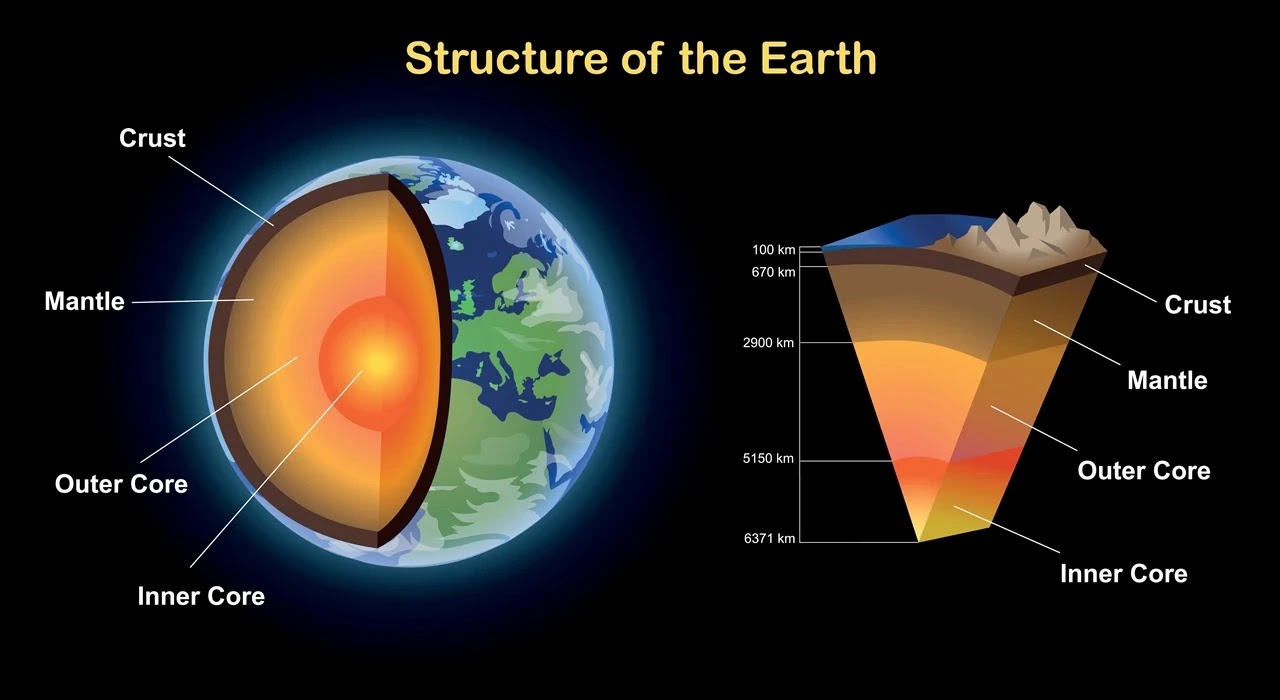
The primary force that directly moves the plates is ‘slab pull.’ As old, cold, and dense oceanic plates sink into the mantle, they exert a powerful pull on the rest of the plates.
3.3 Unresolved Mystery: When Did Earth’s Engine Start?
We know how plate tectonics works, but the question of ‘when’ it began is one of the hottest debates in Earth science.
The early Earth was likely too hot internally for solid plates to form. Instead, it may have been in a ‘stagnant lid’ regime, like Mars or Venus, where the entire planet was covered by a single shell, remaining geologically dormant. So how did Earth escape this ’trap of death’ and become a living planet?
Table 2: Unsolved Cases in Science - Who Started Plate Tectonics?
| Hypothesis/Model | Estimated Start Time | Proposed Mechanism |
|---|---|---|
| Early Start Hypothesis (Early Archean) | Over 4 billion years ago | Induced subduction by large mantle plumes |
| Gradual Transition Hypothesis (Mid Archean) | About 3.2 billion years ago | Gradual transition due to mantle cooling |
| Late Activation Hypothesis (Neoproterozoic) | About 1 billion years ago | Sufficient cooling allowing for the formation of large, solid plates |
This debate suggests that plate tectonics may not be a universal characteristic of planets but rather an emergent property that appears only under specific Goldilocks conditions, such as Earth’s mass and temperature. This implies that the very dynamism of Earth could be as rare in the universe as life itself.
Conclusion
The journey from interstellar dust to a living planet was a process of monumentally increasing complexity.
- Key Point 1: We are the descendants of stars. The heavy elements that make up our bodies and Earth are gifts from massive stars that lived and died before the Sun.
- Key Point 2: Destruction led to creation. Violent events like the giant impact with Theia paradoxically created the Moon and provided Earth with a stable environment and the materials for life.
- Key Point 3: Earth is a living planet. The unique geological engine of plate tectonics regulates Earth’s climate and creates diverse environments for life to thrive.
The stories of stars and rocks are ultimately the prologue to our own story. How could a new complexity like life emerge on this stage, where all these physical and chemical conditions were met?