
A Narrative Exploration of Comets and Social Turmoil in History
- We examine how ancient Koreans interpreted and responded to comets in the night sky.
- We explore the impact of comets on political power struggles and popular uprisings from Silla to Joseon.
- We confirm how comets, once objects of fear, transformed into subjects of systematic scientific observation.
Comets: Celestial Lions of Fear and Transformation
Imagine a star appearing unexpectedly over the capital of an ancient kingdom on a pitch-black night. Unlike familiar stars, its faint glow and long tail crossing the night sky would evoke awe and primal fear. Our ancestors referred to this ominous celestial body as ‘salbyeol (彗星)’. As the name suggests, the appearance of salbyeol was perceived as a severe warning from the heavens, foretelling war, death, the deposition of kings, and the downfall of dynasties.
I remember wishing upon shooting stars as a child; what did comets mean to our ancestors?

This article narratively explores how comets deeply entered the discourse of state governance, popular rebellion, and identity in Korean history, acting as powerful political and social catalysts. The emergence of comets was not merely a subject of curiosity; it was a significant matter concerning national security and the legitimacy of royal authority, with each movement meticulously recorded and interpreted.
From songs attempting to tame the heavens in the Silla era to the rituals of Joseon kings who humbled themselves before comets, from the political interpretations of a comet that claimed the life of a general in the 15th century to the story of a comet becoming a revolutionary banner for popular uprisings in the 19th century, and finally to the emergence of a scientific perspective that sought to transform fear into understanding, we will follow the dramatic journey of our history intertwined with comets.
The establishment of specialized astronomical institutions like Gwanseonggam (觀象監) and the substantial investments made to systematically observe the objects that the state feared reveal a core paradox inherent in the traditional governance system. This was not a contradictory act; in an era where the king’s virtue was proven by the harmony of the heavens, natural disasters like comets posed a potential challenge to royal authority.
Thus, being the first to recognize the appearance of a comet and to seize its meaning was tantamount to controlling the discourse. The king could immediately perform rituals of repentance, such as gamsun (減膳) or guyeon (求言), demonstrating to the world that he was a pious ruler who obeyed the will of heaven. Through this, the king could neutralize attacks from political rivals who might claim he had lost the Mandate of Heaven. Ultimately, systematic astronomical observation became an essential political defense mechanism to protect royal authority, and astronomy was a key tool for state governance. The vast and detailed records left in the Samguk Sagi, Goryeo Sa, and Joseon Wangjo Sillok serve as evidence of this.
Chapter 1: The Comet of Silla, a Song to Calm the Stars
The story takes us back to the 6th century during the reign of King Jinpyeong of Silla. At that time, Silla was laying the groundwork for the nation amidst the tense relations between the Three Kingdoms, and the Hwarang (花郎) were a key elite group destined to carry the future of the kingdom.
According to the Samguk Yusa, three Hwarang, Geoyeollang (居烈郎), Silcheollang (實處郎), and Bodongrang (寶動郎), were about to embark on a training trip to Mount Geumgang. At that moment, a comet appeared in the night sky, an event that was interpreted as ‘invading the heart of the star (심대성, 心大星)’. The heart of the star refers to the red star Antares located in the heart of the Scorpius constellation, which was considered a symbol of the capital Silla or royal authority at that time. Therefore, the comet’s invasion of this star was immediately interpreted as a threat to royal authority and a national disaster, particularly a terrible omen foretelling an invasion by Japanese forces. The Hwarang, engulfed in ominous energy, attempted to halt their journey to Mount Geumgang.
At that moment, a monk named Yongcheon (融天師) appeared. To overcome this crisis, he composed and sang a 10-verse song called ‘Comet Song (彗星歌)’. This song was not merely a simple prayer to calm the disaster; it was a highly symbolic act aimed at directly confronting the narrative of the ominous sign. The song demoted the comet from a harbinger of disaster to a ‘star that clears the path’ for the moon (symbolizing the king or the state). Through this, the ominous power of the comet was neutralized, and it was reinterpreted as a propitious entity.
According to legend, as Yongcheon’s song echoed, the comet vanished from the heavens, and coincidentally, the invading Japanese forces retreated. This story functioned as a powerful founding myth demonstrating the belief of the Silla people that cosmic, political order could be restored through the power of art, faith, and ritual. The ‘Comet Song’ embodies a form of ‘magical technology’ or ’narrative warfare’. It was a sophisticated attempt to seize control of the negative cosmic narrative and transform it into a positive narrative through powerful and public ritual acts. The core issue faced by Silla at that time was not the physical existence of the comet itself, but the meaning of ‘fear and paralysis’ attributed to it. Yongcheon’s song was a direct intervention in this semiotic crisis. By invoking the authority of the moon and demoting the comet to a guiding role, he performed a ritual that restructured the symbolic order of the universe in favor of the Silla royal family. This act was not passive origin but an active expression of power aimed at psychologically and politically suppressing the threat posed by celestial bodies. This event, which discerned that the power of ominous signs lay in their interpretation, left an important precedent for the political manipulation of astronomical phenomena that would appear in later generations.
Chapter 2: Humility of the King Under the Heavens
By the time of the Goryeo and Joseon dynasties, the appearance of comets was incorporated into state governance in a more systematic and institutionalized manner. At the center of this was the ideology of the Mandate of Heaven (天命思想), which connected the legitimacy of royal authority with the will of heaven. Natural disasters such as comets, eclipses, and droughts were interpreted not as random natural phenomena but as clear reprimands from heaven regarding the monarch’s ’lack of virtue (不德)’.
Therefore, when a comet appeared, the monarch was imposed with a highly formalized political obligation to respond to heaven’s warning and reflect upon himself. The Goryeo Sa and Joseon Wangjo Sillok detail the rituals of repentance that monarchs repeatedly performed.
- Gamsun (減膳): The king reduced the number of side dishes at his table, symbolically showing that he shared the suffering with the people who might be afflicted by disaster.
- Guyeon (求言): The king issued an official decree commanding his subjects to criticize his wrongdoings and point out the flaws in governance without fear. This was a political act demonstrating that the monarch was willing to listen to criticism and correct himself.
- Sahyeong (赦免令): Through a general amnesty that released unjustly imprisoned criminals, the king sought to bestow grace and appease heaven’s anger.
These rituals constituted a sophisticated crisis management system to handle the political shock brought about by the celestial event of a comet. By publicly displaying humility and attributing the responsibility for the disaster to himself, the king could absorb the legitimacy crisis posed by the ominous sign and strengthen his legitimacy as a virtuous ruler who listened to heaven’s warnings. The appearance of a comet was a moment that revealed an extreme political vulnerability, providing political rivals with a justification to question the king’s rule. Rituals like gamsun and guyeon were the king’s core defense strategies against such attacks. As Queen Jinseong declared, “This is due to my lack of virtue,” the monarch positioned himself not as a failed ruler but as a conscientious ruler correcting himself by taking ownership of the problem. This was a preemptive political propaganda strategy to stabilize public sentiment and block criticism from opposing forces.
However, even within these ritual traditions, seeds of rational thought existed. In 1456 (the second year of Sejo’s reign), when officials reported that a comet had disappeared after a certain emperor performed a repentance ritual, Sejo responded skeptically, saying, “The one who recorded this is excessive. Can heaven truly respond so quickly?”
Major Comet Appearances and Royal Responses in the Joseon Dynasty
| Period (Monarch) | Major Content and Response | Political Situation at the Time |
|---|---|---|
| 1456 (2nd year of Sejo) | Appearance of Halley’s Comet. Its long tail and bright light caused public unrest. Performed gamsun and guyeon, interpreting it as heaven’s reprimand regarding the Six Martyred Ministers incident. | Instability of royal authority immediately after the Gye-yu Jeongnan incident. |
| 1468 (Year of Yejong’s Ascension) | Appearance of a comet. Anxiety amplified coinciding with the new king’s ascension. Performed guyeon, which became a pretext for General Nam Yi’s treason incident. | Political instability due to the ascension of a young king after Sejo’s death. |
| 1664 (5th year of Hyeonjong) | A comet appeared within the constellation of Jinseong. Interpreted as a sign of trouble from the southeast. Lee Sang-jin, the Minister of Personnel, expressed concerns about the security of the borders. | Intensified factional conflicts due to the Yesong Debate. |
| 1682 (8th year of Sukjong) | Appearance of Halley’s Comet. Public unrest due to consecutive comet appearances and disasters. Performed guyeon and gamsun, with active discussions about disasters. | Severe political strife and famine following the Gyeongshin Hwan-guk incident. |
| 1811 (11th year of Sunjo) | Appearance of a great comet. Observed for several months and interpreted as a precursor to revolution. Became a justification for the outbreak of Hong Gyeong-rae’s rebellion. | Extreme corruption and devastation of people’s livelihoods under the ruling elite’s politics. |
Chapter 3: The Star that Became a Weapon: The Tragedy of General Nam Yi
This chapter reads like a historical thriller. It was 1468, the year when the powerful monarch Sejo passed away, and his young and frail son Yejong ascended the throne. The court was filled with tension between the ‘old meritorious subjects’ like Han Myeong-hoi and the ’new meritorious subjects’ like General Nam Yi, who had recently gained prominence for his achievements in the conquest of the Jurchens.
Amidst this power struggle, a comet appeared in the night sky, plunging the capital Hanyang into anxiety. At this time, the 26-year-old war hero General Nam Yi uttered a fateful remark to his colleague Yu Ja-gwang: “A comet is a sign that the old is gone and the new is coming (彗星은 舊物이 없어지고 新物이 나타날 징兆다).”
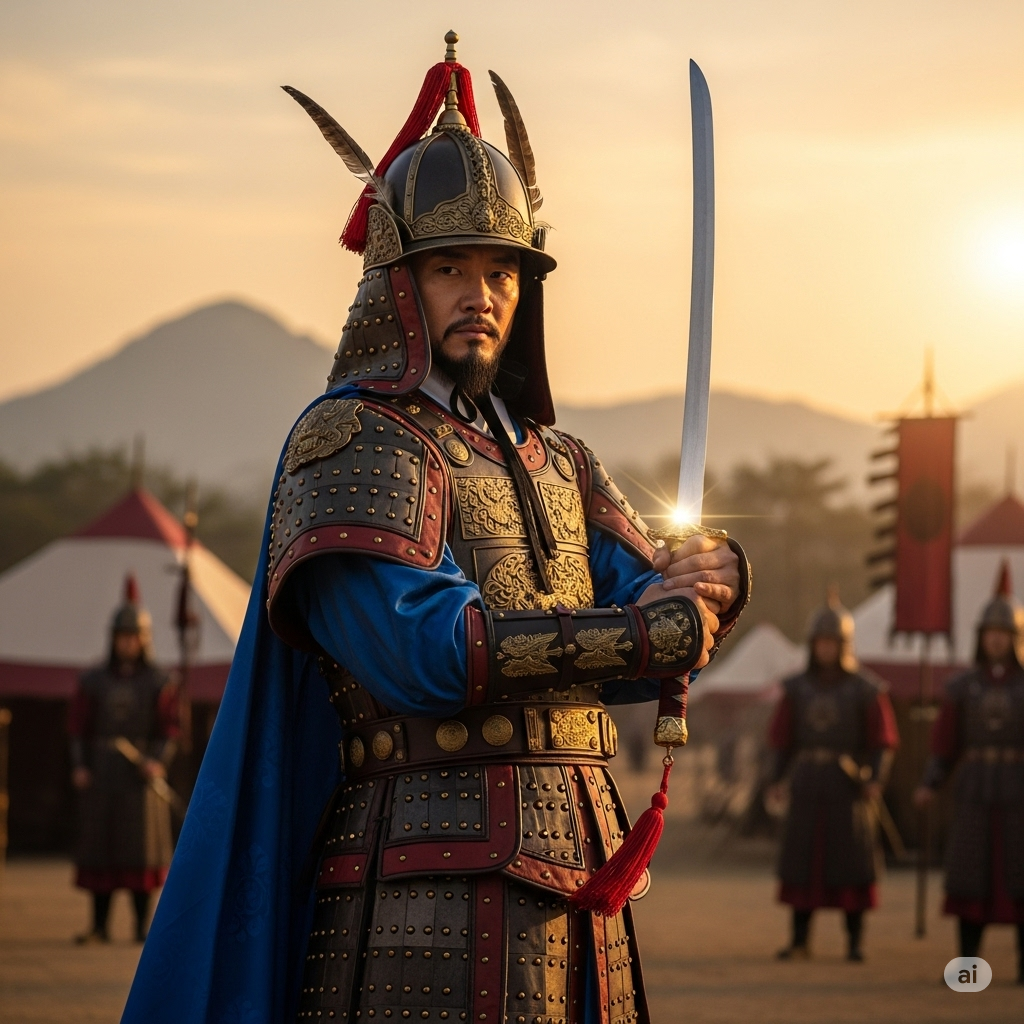
Ambitious and harboring resentment towards Nam Yi, Yu Ja-gwang seized this statement as an opportunity. He twisted Nam Yi’s ambiguous remark into evidence of treason. He rushed to Yejong, citing the Chinese historical text Zizhi Tongjian Gangmu (資治通鑑綱目), claiming that speaking about the comet in such a manner was a sign that the general was plotting rebellion.
In a situation where the fear generated by the comet and the political anxiety of the court reached their peak, Yu Ja-gwang’s accusation proved powerful. General Nam Yi was immediately arrested and subjected to harsh interrogation, and despite his protests of loyalty, he was ultimately executed for treason. It was a tragic moment where a hero who had once flourished in an era was brought to ruin, perhaps by superstitions he himself did not believe in.
The tragedy of General Nam Yi serves as ultimate evidence that the ‘interpretation’ of ominous signs can be far more powerful and dangerous than the ominous signs themselves. The comet was not the agent that caused Nam Yi’s death; it was the perfect ‘pretext’ that justified it. Nam Yi’s statement could have been interpreted as a hopeful expression blessing the new king’s era. However, Yu Ja-gwang eliminated all ambiguity. By quoting foreign classics, he layered his interpretation with scholarly objectivity and historical precedent, making his claims appear as a diagnosis of treason based on facts rather than political slander. The comet became heaven’s ‘witness’ to a crime that may not have even existed. This incident vividly illustrates how superstition can be weaponized as a tool for political assassination.
Chapter 4: The Great Comet and the Great Rebellion: The Manifesto of Hong Gyeong-rae
In the early 19th century, Joseon was suffering under the extreme corruption of the ruling elite, led by the Andong Kim clan. Bribery was rampant, the economy was in ruins due to the chaos of the three affairs, and deep-rooted discrimination against the people of Pyeongan Province stirred public anger. The soil for rebellion was already well-prepared.
At that moment, in 1811, one of the brightest and largest comets in history, known as ’the Great Comet of 1811’, appeared and dominated the night sky for several months. This was not a faint and ambiguous presence but an overwhelming and majestic celestial body that anyone could witness.
Hong Gyeong-rae, an unfortunate intellectual and charismatic leader, did not miss this once-in-a-lifetime opportunity. He cleverly utilized the appearance of the comet in his revolutionary propaganda. The manifestos he issued and the rumors spread by his followers made it clear that this rebellion was not merely a popular uprising but a grand event sanctioned by heaven. The comet was presented as a clear sign that the Joseon dynasty had already lost the Mandate of Heaven and that Hong Gyeong-rae was the one sent by heaven to ‘sweep away’ the old and corrupt regime. He combined this with popular prophetic thoughts like Jeonggamnok to provide the oppressed people with an irresistible narrative of revolution.
As countless farmers, mine workers, and small merchants came to believe in the heavenly revelation, they rallied under Hong Gyeong-rae’s banner, and his rebellion surged explosively, seizing the northern region of Pyeongan Province. Although the rebellion was ultimately brutally suppressed by government forces, the myth of ’the revolution ordained by heaven’ that he created lived on in the hearts of the people for a long time.
Hong Gyeong-rae perfectly inverted the traditional power dynamics of celestial omens. While past monarchs used rituals to absorb the threat of comets and maintain their authority, Hong Gyeong-rae seized the power of the ominous sign and transformed it into a weapon attacking the monarch. He justified the revolution in the eyes of the people through the comet. The traditional formula was ‘comet appearance → royal responsibility → royal rituals → restoration of order’. However, Hong Gyeong-rae’s revolutionary formula was ‘comet appearance → royal responsibility → therefore, the monarch must be overthrown’. He transformed the comet from a ‘warning’ for the elite into a ‘permit’ for the people. By connecting the majestic visual evidence of the Great Comet of 1811 with the real experiences of oppression and discrimination faced by the people, he endowed his uprising with powerful and undeniable legitimacy. The comet became a roar in the streets rather than a whisper within the court.
Chapter 5: From Ominous Signs to Objects: The Scientific Perspective of Joseon
Now our story shifts from superstition to science. In the 15th century, King Sejong vigorously promoted astronomical independence from China, not merely for better scientific technology but to declare cultural and political sovereignty. This effort bore fruit in the invention of original observational instruments like the Gani (簡儀) and the compilation of a unique calendar system suited to our circumstances, the Chiljeongsan (七政算).
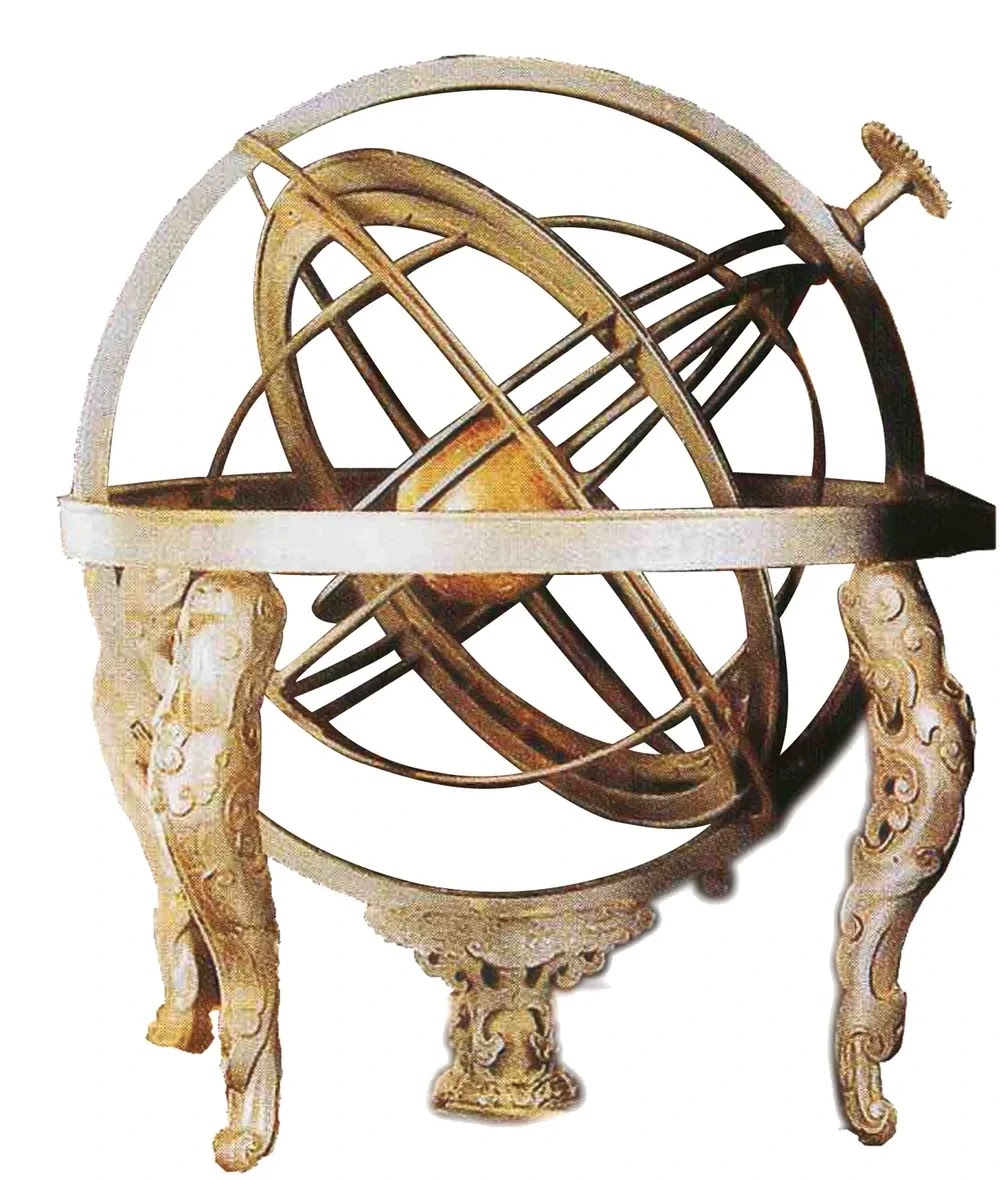
As time passed into the 17th and 18th centuries, this scientific tradition was inherited by astronomers of the Gwanseonggam (觀象監). They conducted remarkably systematic and professional observations through original materials like the Seongbyeoncheokhodanja (星變測候單子), which recorded daily astronomical phenomena.
At the center of this chapter is the observation record of Halley’s Comet in 1759 (the 35th year of Yeongjo). This record starkly illustrates the level of astronomy in Joseon at the time. The Seongbyeoncheokhodanja details which constellations the comet passed through, the angle from the North Star (declination), its brightness and color, and the length of its tail, all meticulously recorded along with the names of the observers on duty each night. These records are regarded as some of the most detailed and continuous pre-modern comet observation materials globally, and their value is recognized to the extent that efforts are underway for UNESCO World Heritage registration.
Changes in Comet Recording Methods: Silla vs. Joseon
| Era / Date | Excerpt from Records (Source) | Content Analysis |
|---|---|---|
| Silla, Reign of Jinpyeong (6th century) | “舊理東尸汀叱… 彗星也白反也人是有叱多” (Old Donghae shore… O comet! There is a person who has died) - Samguk Yusa | Narrative, metaphorical. Focused on political interpretation with terms like ‘invade’ and ‘ominous sign’. Intent to control the meaning of the event through shamanistic means. |
| Joseon, 35th year of Yeongjo (1759) | “夜五更, 彗星見於虛宿度內… 北極距一百十六度…” (At 5 o’clock at night, the comet was seen within the constellation of Husu… the distance from the North Star was 116 degrees…) - Seongbyeoncheokhodanja | Quantitative, objective. Focused on precise measurements of declination, constellations, tail length, and time. Increased reliability of records. |
The Seongbyeoncheokhodanja signifies a profound epistemological shift from interpretation to recording. While political and ritual responses to comets were still occurring in the palace, an objective and quantitative scientific tradition was blossoming within the Gwanseonggam. This serves as decisive evidence that astrology dealing with political meanings and astronomy pursuing scientific measurements began to separate. While Silla’s records remained narrative expressions like “the comet invaded the heart of the star”, the 1759 record approached data logging, stating, “At 5 o’clock at night, the comet appeared in the constellation of Husu, and the distance from the North Star was 116 degrees.” The former attempted to explain ‘why (heaven’s anger)’, while the latter aimed solely to describe ‘what, where, and when’. This qualitative narrative to quantitative data transition is a key feature of the scientific revolution. It proves that the astronomers of 18th-century Joseon, even if society as a whole was still grappling with the ominous meanings of comets, were already engaged in work that could be called modern science in its empirical aspects.
Conclusion
Through this article, we have traced the grand journey of comets, or ‘salbyeol’, in the imagination of Koreans. The long and complex relationship with comets provides a unique window into the vast evolutionary processes of Korea’s politics, society, and science.
- Comets were powerful symbols that moved politics and society beyond mere astronomical phenomena. From Silla’s Comet Song to the rituals of Joseon kings, the discourse surrounding the interpretation of comets determined the direction of power.
- The anxieties of the times changed the role of comets. What was once a warning to royal authority became a political noose for General Nam Yi and a revolutionary banner for Hong Gyeong-rae.
- Fear became a driving force for scientific advancement. The efforts to understand and predict comets elevated Joseon’s astronomy to a global level, leaving behind valuable scientific legacies like the Seongbyeoncheokhodanja.
We no longer regard comets as ominous signs to fear. Yet paradoxically, the historical records born from that very fear remain invaluable scientific and cultural treasures today. This may be the last and most intriguing echo that salbyeol has left in our history.
So, if a comet appears in the night sky again, why not recall these colorful stories left by our ancestors?