
I. ‘A Personal Voyage’ That Changed Our View of the Planets
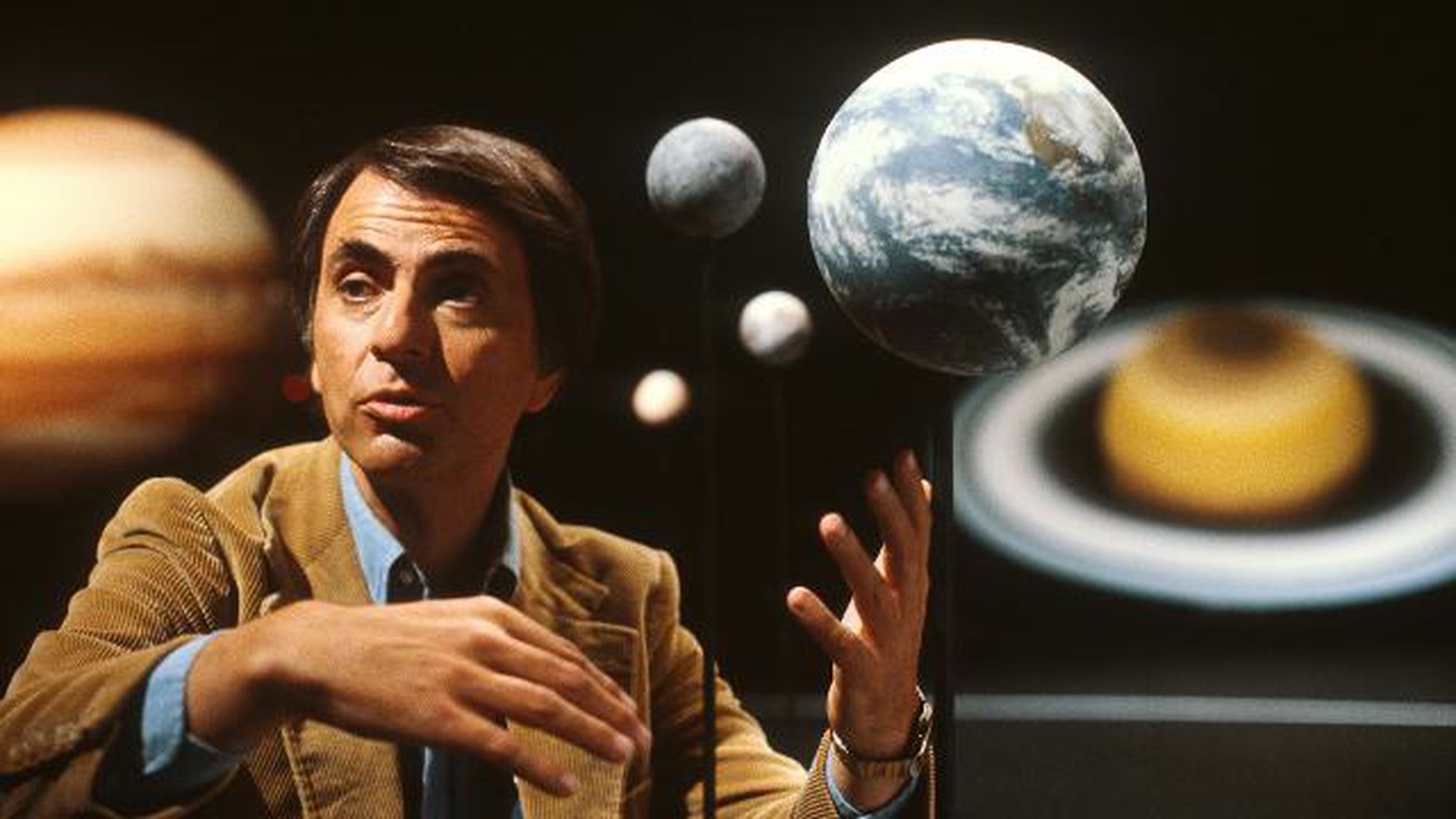
- Thinking back to that time… the world was under the uneasy shadow of the Cold War. The threat of nuclear war was, well, a daily concern. It was in this very era that an astronomer appeared on TV, inviting viewers on a ‘Personal Voyage’ into space for 13 weeks. That astronomer was Carl Sagan, and this invitation became the legendary documentary and book, ‘Cosmos’.
‘Cosmos’ wasn’t just a ‘TV program.’ In fact, to be precise, it was an ’event.’ As The New York Times praised it as “a watershed moment for science-themed television,” ‘Cosmos’ took science out of the exclusive laboratory and boldly brought it into the living rooms of hundreds of millions, the very heart of popular culture.
Its scale was beyond imagination. When it aired on American public television (PBS) in 1980, ‘Cosmos’ held the record for the highest viewership in American public TV history until Ken Burns’ ‘The Civil War’ broke it a decade later. An estimated 500 million to over 750 million people in 60 countries worldwide rode Sagan’s ‘Spaceship of the Imagination.’ The accompanying book, Cosmos, fueled by the show’s explosive popularity, remained on The New York Times bestseller list for 70 weeks and set an unprecedented record as the best-selling ‘English-language science book’ in history at the time.
But why did this book become a classic? Simply because it sold well? No, absolutely not. The key lies in its subtitle, ‘A Personal Voyage.’ ‘Cosmos’ didn’t just dryly list facts about the universe. It was an intensely philosophical and human ‘conversation’ where Carl Sagan, as an individual, looked directly into the eyes of us viewers and readers, speaking to us with poetic language full of wonder and romance. Combined with Vangelis’s dreamy music, this lyrical approach perfectly transformed science from a rigid ‘study’ into an exhilarating ’experience’ and a source of ‘wonder.’
The tremendous success of ‘Cosmos’ marked the first time in human history that ‘serious science’ proved to have such immense cultural and commercial power in the popular market. And this powerful legacy leaped over 34 years to lead to the rebooted series in 2014.
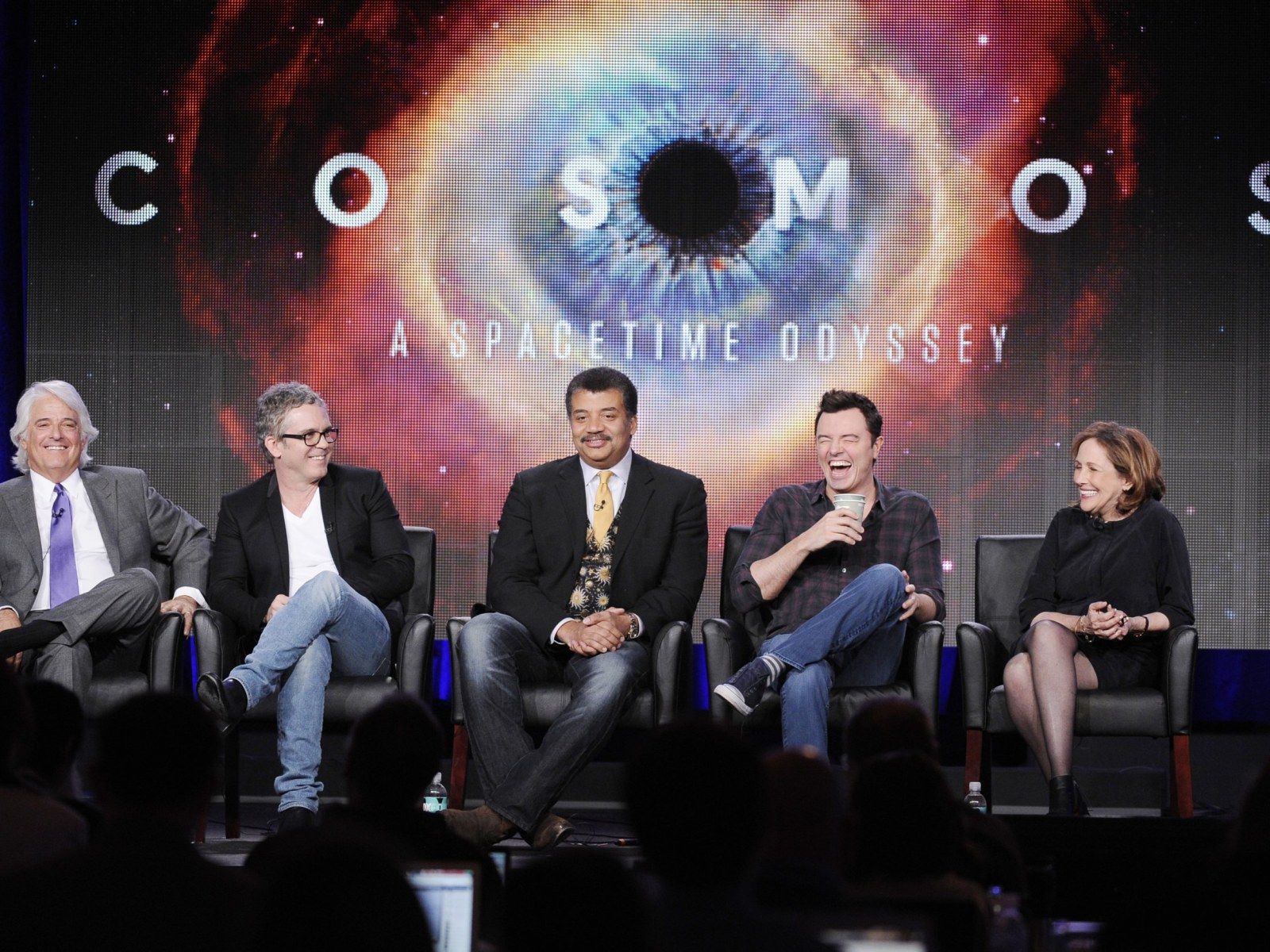
What’s truly astonishing is who produced this reboot. It was driven and championed by Seth MacFarlane, famous for comedy shows like ‘Family Guy.’ Frankly, I was surprised when I first heard it. The quiet legend of public television from 1980 was resurrected in 2014 on a grand scale, airing simultaneously across 10 commercial networks, including FOX. This is the most definitive proof of how a ‘popular market for science,’ pioneered by Sagan alone, has solidified into a robust and powerful cultural legacy over a generation.
II. The Narrative of Cosmic Citizenship: The Core Philosophy of ‘Cosmos’
If you think of this as just an ‘introduction to astronomy’… you’d be mistaken. ‘Cosmos’ is more than that. Beyond conveying knowledge, it presents three powerful philosophical narratives that help us reconsider our place in the universe and answer fundamental questions about life. These narratives form the basis of the ‘Cosmic Citizenship’ that Sagan wanted to impart to humanity.
II-A. “We are Star-stuff”: From Scientific Fact to Philosophical Identity
The phrase that immediately comes to mind with Carl Sagan. “We are star-stuff.” Does this just sound poetic? No. This is a terrifyingly accurate scientific ‘fact.’ The scientific basis for this single sentence is ‘Stellar Nucleosynthesis.’
Now… look at your hands. The carbon that makes them, the oxygen we breathe, the iron in our blood. All these heavy elements weren’t created in the Big Bang 13.8 billion years ago. With the exception of hydrogen and helium from the early universe, all other elements were ‘created’ through fusion in the fiery cores of stars dozens of times larger than our Sun.

And when those stars met their spectacular deaths in supernova explosions, they scattered these elements into space, shattering their own bodies. Billions of years later, that ‘star dust’ clumped together to form the solar system and Earth, eventually becoming the material of our bodies.
This story is the most powerful and wondrous ‘secular creation myth’ that science offers for humanity’s most fundamental question: ‘Where do I come from?’ I believe Sagan wanted to prove that scientific fact could evoke a sense of wonder and connection far more profound than any religious narrative. It’s a philosophy of ‘connection,’ that we are not physically separate from the universe. In Sagan’s words, “we are a way for the universe to know itself.” The very fact that beings made of stardust, after billions of years, are studying their origins—the stars—is a process of cosmic self-awareness, a truly sublime declaration.**
II-B. “The Cosmic Calendar”: The Art of Humility
Ah, and ‘The Cosmic Calendar.’ This is truly… truly shocking. Compressing 13.8 billion years of cosmic history into a single Earth year. This magical concept succeeded in translating the ’eons’ we only heard as numbers into the understandable, everyday timeframe of a calendar.
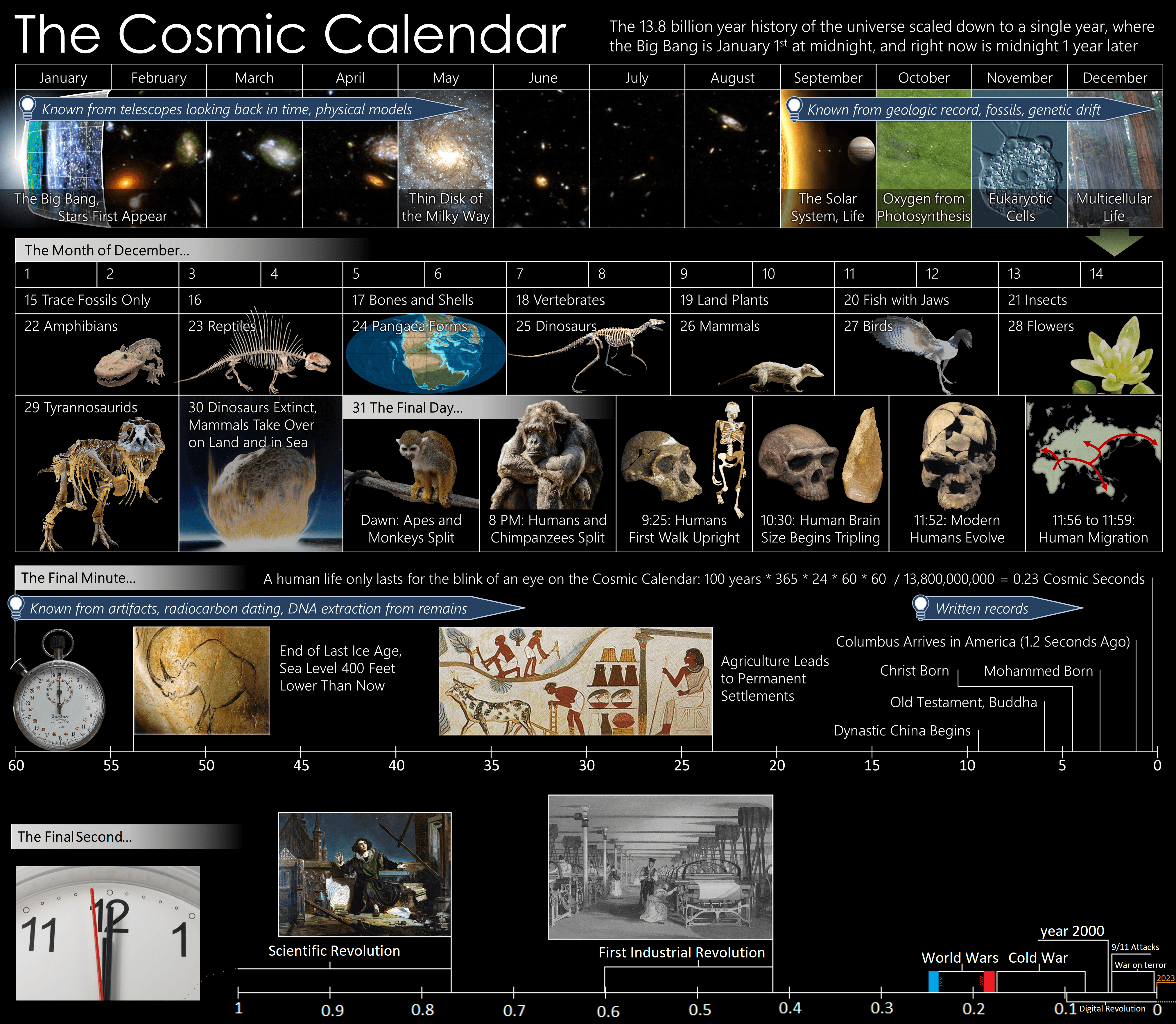
In this calendar, the Big Bang is January 1st, 00:00:00. Time flows… Our Milky Way galaxy formed in May, and the solar system settled in early September. Life appeared on Earth around the end of September. The era of dinosaurs, so long, began on Christmas Eve, December 24th, and ended on December 28th.
And ‘humanity’? The appearance of humans only happens after 10:30 PM on December 31st. The pyramids built, Alexander the Great’s conquests, the rise and fall of the Roman Empire… all the history we’ve recorded happens in the last 10 seconds of December 31st, just before the stroke of midnight. Precisely 10 seconds. Sagan likened this to the size of a football field, explaining that all of human history occupies an area no larger than his palm.
‘The Cosmic Calendar’ is the most successful data visualization in the history of popular science and the most potent antidote to human arrogance. Interestingly, recent psychological research is proving that this ‘cosmic perspective’ has a positive effect on our minds. The experience of a ‘small self,’ feeling small in the vastness of space and time, reduces personal anxiety, increases life satisfaction, and makes us more tolerant of others. In essence, reading ‘Cosmos’ goes beyond mere astronomy study; it’s a profound ‘intellectual therapy’ that makes us mentally healthy by allowing us to experience ‘self-transcendence.’
II-C. “The Ionian Awakening”: The Narrative (and Its Limits) of Science’s Origin
To lay the philosophical cornerstone of ‘Cosmos,’ Sagan takes us back to 6th-century BCE Ionia in ancient Greece. He declares that early philosophers like Thales and Anaximander gave birth to the revolutionary idea that “the universe is knowable” and that the world operates not by the whims of gods, but by predictable laws. For Sagan, this was the true beginning of the scientific spirit, when humanity escaped superstition and discovered the light of reason.
This ‘Ionian narrative’ is the core of ‘Cosmos’s’ grand philosophy. Sagan wanted to provide a majestic ‘origin myth’ for the scientific method. Just as the Genesis account declares, “In the beginning, God created the heavens and the earth,” ‘Cosmos’ presented a new ‘genesis’ for the scientific age: “In the beginning, humans began to understand the world through reason.”
However, a problem arises here that tripped up Sagan. In fact, this ‘Ionian narrative’ is pointed out as… well… the most serious historical flaw in the legacy of ‘Cosmos.’ Many historians criticize Sagan’s Ionian story for following the “conflict thesis” popular in the 19th century (the dichotomy that science and religion are inherently hostile). To make the story more dramatic, Sagan intentionally downplayed or ignored the immense contributions of the Middle Ages, often called the ‘Dark Ages,’ during which Islamic and European civilizations preserved and advanced ancient Greek science.
This shows that Sagan was more of a ‘Romantic’ aiming to maximize the enlightening value of science than a rigorous historian, which is, perhaps, a somewhat regrettable aspect.
III. The Ethics of the “Pale Blue Dot”: A Cold War Warning and Hope
When we read ‘Cosmos,’ we shouldn’t just read it. We must feel the urgency of that era. This book is not merely a cosmic exploration or a history of science lecture. It was an urgent ’ethical declaration’ made at the height of the nuclear arms race in the mid-1980s Cold War, condemning humanity’s potential for self-destruction and appealing for survival.
III-A. Historical Context: The Twin Threats (Climate Change and Nuclear Winter)
Leveraging his expertise, Sagan was among the very first and most forceful in warning about two existential threats to humanity.
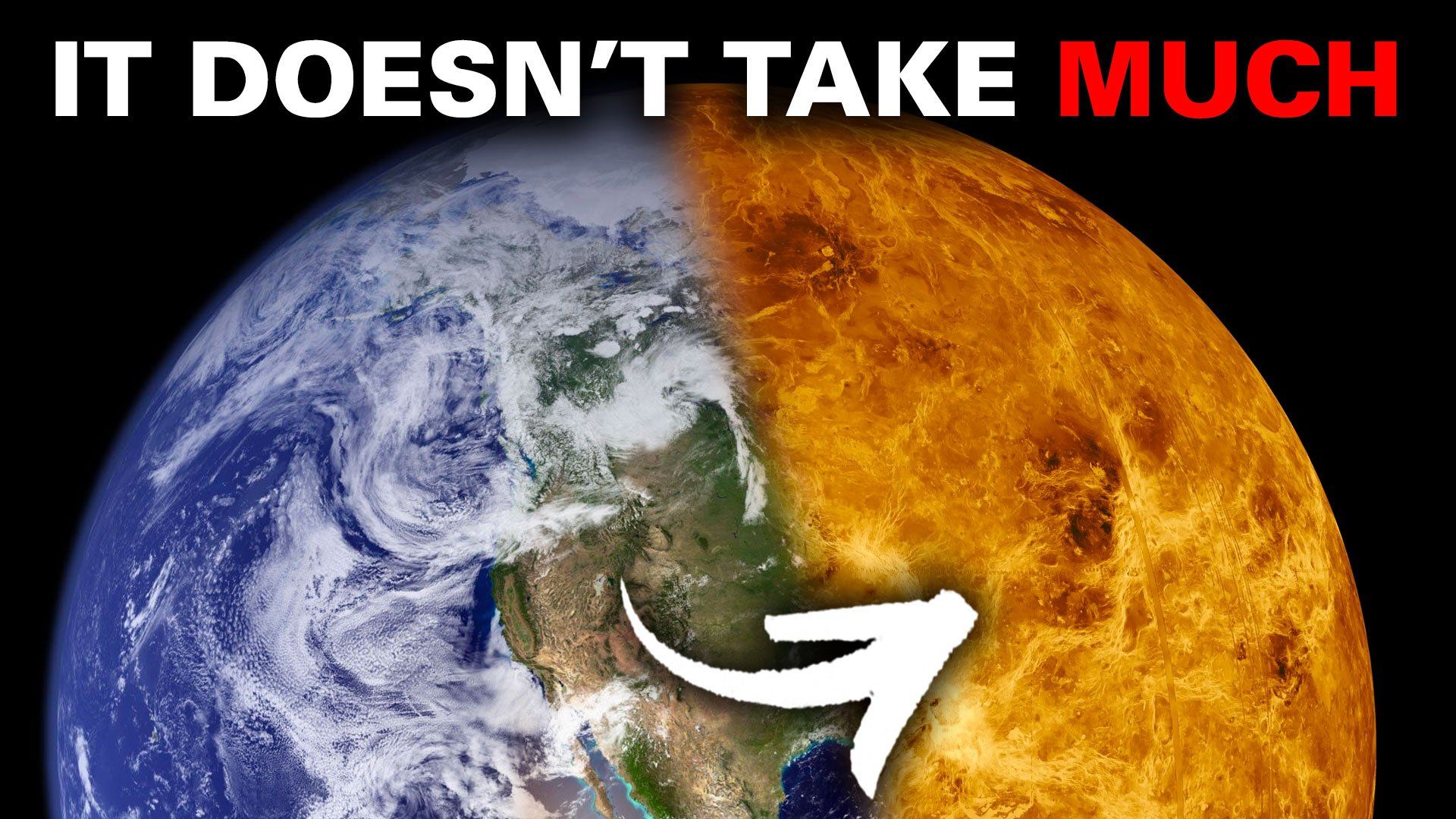
The first is climate change. While studying the atmosphere of Venus, Sagan was a pioneer in discovering that the planet’s surface was so hot it could melt lead due to an uncontrollable ‘runaway greenhouse effect.’ In ‘Cosmos,’ he explicitly mentioned the example of Venus as a “warning that catastrophe could befall a planet like Earth.” He even testified before the US Congress in 1985, presenting evidence of global warming and urging immediate action.
The second is ‘Nuclear Winter.’ ‘Cosmos’ aired in 1980, and right after, in 1983, Sagan and his colleagues published the “Nuclear Winter” theory. It presented a shocking scenario: a nuclear war would ignite cities and factories, sending vast amounts of dust and soot into the stratosphere, blocking sunlight, causing global temperatures to plummet, leading to agricultural collapse, and potentially human extinction.
Against this backdrop, ‘Cosmos’ was inherently a ‘political text.’ Sagan used the immense public trust he garnered as a scientist to actively shape public opinion on nuclear disarmament, the most pressing issue of the time. The final 13th episode of ‘Cosmos,’ “Who Speaks for Earth?” synthesized all these discussions, making an ethical appeal for viewers to go beyond knowing scientific facts and fulfill their ‘planetary responsibility.’
Sagan’s originality lies in expanding the scientific method of planetary comparative studies into planetary ethics. He studied the dust storms on Mars to create climate models for ’nuclear winter,’ and he studied the atmosphere of Venus to contemplate the catastrophe of ‘climate change.’ Thus, for Sagan, space exploration wasn’t just out of ‘curiosity.’ By observing how other planets died, he paradoxically sought ways to save ‘Earth’… Ah, it was a desperate matter of survival.
III-B. Philosophical Culmination: “Pale Blue Dot”
All the philosophy presented in ‘Cosmos’ culminated in a single photograph a decade later, in 1990. I believe it is the greatest photograph in human history. Sagan strongly urged NASA to turn the camera of Voyager 1, then leaving the solar system, back towards Earth one last time. Thus, the image of Earth, taken from approximately 6.4 billion kilometers away, was born.
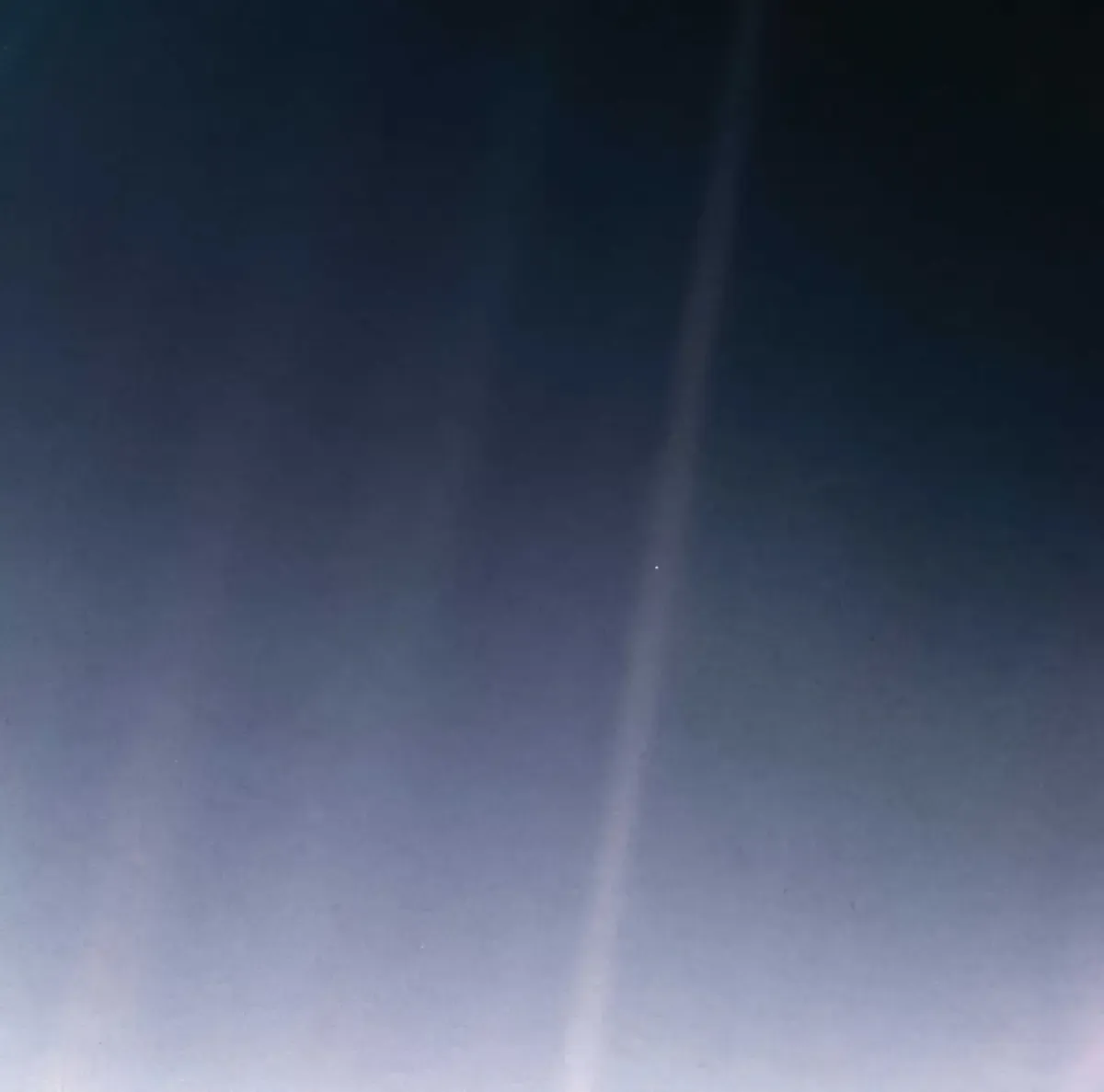
In this photo, Earth was less than 0.12 pixels, just a ‘Pale Blue Dot.’
Sagan called this image “a mote of dust suspended in a sunbeam.” His writings about this photo… wow, truly… published in the 1994 book Pale Blue Dot, are likely the most incisive and beautiful reflection on human history.
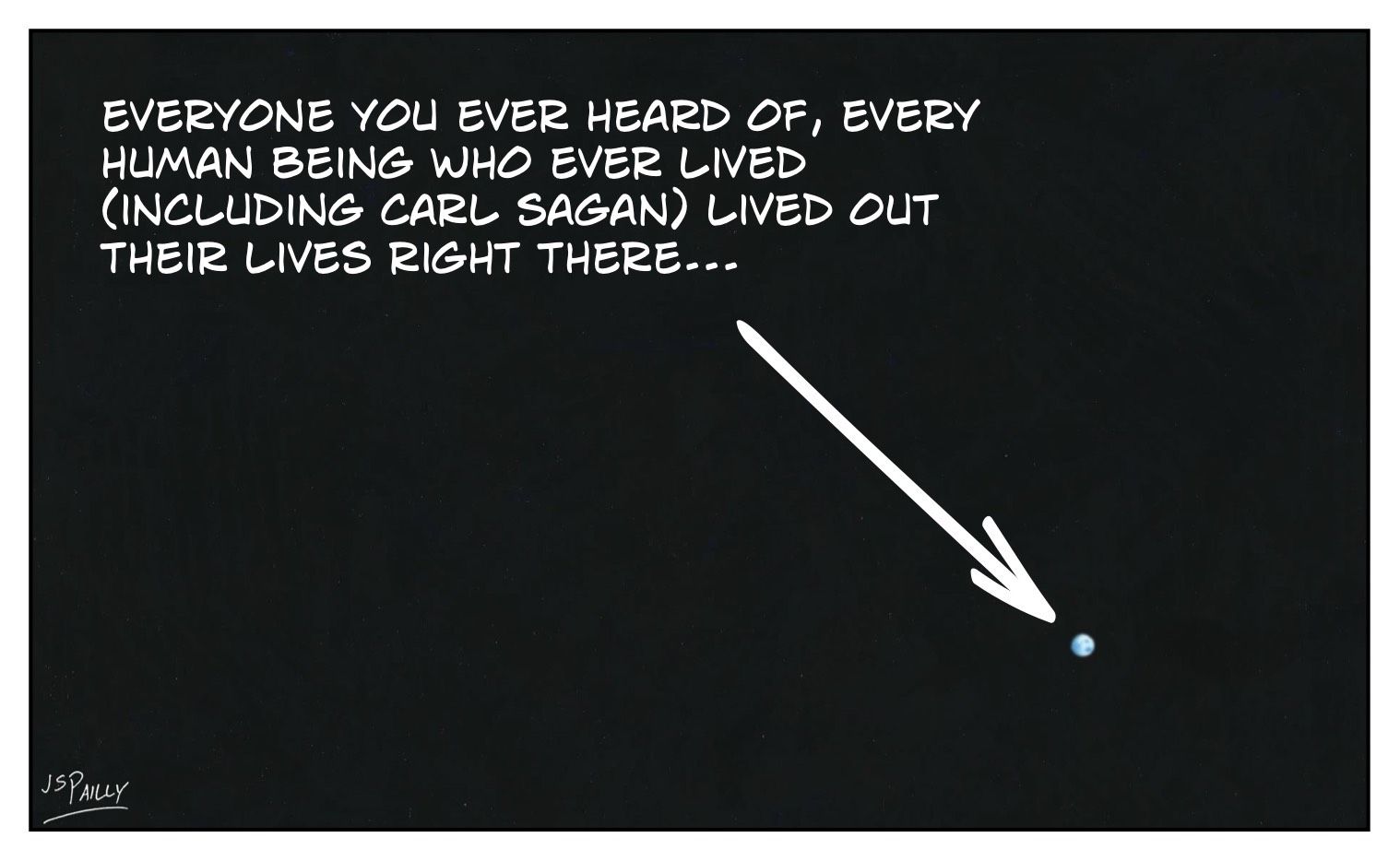
“Look again at that dot. That’s here. That’s home. That’s us…. On it everyone you love, everyone you know, everyone you ever heard of, every human being who ever was, lived out their lives. The aggregate of our joy and suffering, thousands of confident religions, ideologies, and economic doctrines, every hunter of the deer, every contender for glory, prince and peasant, every young couple in love, every mother and father, hopeful child, inventor and explorer, every teacher of morals, every corrupt politician, every ‘superstar,’ every ‘supreme leader,’ every saint and sinner in the history of our species lived there—on a mote of dust suspended in a sunbeam…. Our posturing, our imagined self-importance, the delusion that we have some privileged position in the Universe, are challenged by this point of pale light…. Consider again that dot. That’s here. That’s home. That’s us…. The Earth is a very small stage in a vast cosmic arena. Think of the rivers of blood spilled by all those generals and emperors so that, in glory and triumph, they could become the momentary masters of a fraction of a dot.”
“Pale Blue Dot” is an overwhelming visual testament that demands humility in terms of ‘space,’ just as ‘The Cosmic Calendar’ demanded it in terms of ’time.’ You know the ‘Overview Effect’—the phenomenon where astronauts feel awe and a sense of responsibility for Earth’s community upon seeing it from space? This image essentially ‘democratized’ that experience, allowing us all to feel it indirectly.
This image is the icon where all the philosophies of ‘Cosmos’ converge and a powerful ethical command. Sagan leads this extreme ‘small self’ experience not to nihilism, but to the opposite conclusion: ‘responsibility.’ The fact that our only home is so fragile and floats alone forces us to confront the harsh truth that “there is no external force coming to save us.”
The conclusion is clear. No one will save us. We must treat each other more kindly. The responsibility to protect this pale blue dot lies with us.
IV. Revolution in Science Communication and Critical Re-evaluation
‘Cosmos’ revolutionized not only the ‘content’ of science but also the ‘method’ of its delivery. However, behind this dazzling success lie the indifferent critiques from fellow scientists (the “Sagan Effect”) and limitations that are apparent from today’s perspective.
IV-A. Methodological Innovation: The “Spaceship of the Imagination” and the Aesthetics of Wonder
‘Cosmos’ utilized truly groundbreaking special effects and animation for its time in 1980. Among them, the “Spaceship of the Imagination” was the program’s central device. This spaceship not only took us to distant galaxies or planetary surfaces but also served as a time-traveling device, venturing into the past (the Library of Alexandria), the future, and even the interior of DNA molecules.
This “Spaceship of the Imagination” was a brilliant device that transformed Sagan from a mere ‘host’ into a ‘guide’ and ‘companion’ traveling with the viewers. Thanks to this device, ‘Cosmos’ transcended the structure of a chronological documentary, allowing the program’s very structure to convey its core theme: that everything in the universe—atoms and stars, life and civilizations—is ‘connected.’
IV-B. The “Sagan Effect” and Critical Re-evaluation: Romanticism vs. Rigor
In exchange for his immense public fame, he faced harsh criticism and cold reception from the scientific community. The term “Sagan Effect” came to describe the phenomenon where scientists focused on public engagement, like Sagan, were disparaged by their peers as having lower academic output or not being serious enough.
His failure to be elected to the US National Academy of Sciences (NAS), despite his numerous achievements, is a symbolic event showcasing this academic jealousy.
A more serious criticism, as mentioned earlier (II-C), is that the historical narrative in ‘Cosmos’ sacrificed historical rigor to create a ‘heroic saga’ of science. Ironically, while he represented the romanticism of science, it was this romanticism, exceeding academic ‘rigor,’ that left the biggest criticism of his legacy.
Furthermore, with science itself advancing dramatically over the past 40+ years (e.g., the discovery of dark energy, Pluto’s demotion from planet status, the discovery of exoplanets in abundance, etc.), some of the scientific information in ‘Cosmos’ is now outdated.
So, if some information is inaccurate because it’s from a 40-year-old book… is it not worth reading? No. Absolutely not. Quite the opposite. The updating of scientific information is a natural result of science’s inherent ‘self-correction’ process and does not undermine the core philosophy of ‘Cosmos.’ On the contrary, the essence that ‘Cosmos’ conveys—the ‘scientific way of thinking’ and the ‘cosmic perspective’—is more desperately needed and important than ever in today’s world, flooded with fake news and polarization.
V. The Inheritance of Legacy: ‘Cosmos’ Passed Down to the Next Generation
The most powerful and enduring legacy left by ‘Cosmos’ is not the data or special effects within the program, but the ‘people’ who grew up watching it. If you understand how the generation that grew up reading this book changed the world, you’ll know why you should read it, even with just two anecdotes I particularly love.
V-A. Personal Succession: Neil deGrasse Tyson’s Saturday
The most perfect anecdote illustrating how Sagan’s legacy was passed down is the story of Neil deGrasse Tyson, who became the host of the 2014 ‘Cosmos’ reboot.
In 1975, Tyson, a 17-year-old Black high school student aspiring to be an astronomer, wrote to Sagan about his college 고민 (concerns/deliberations) regarding Cornell University. Sagan, already a superstar scientist appearing on ‘The Tonight Show,’ personally invited the unknown high school student to Cornell University in Ithaca, New York.
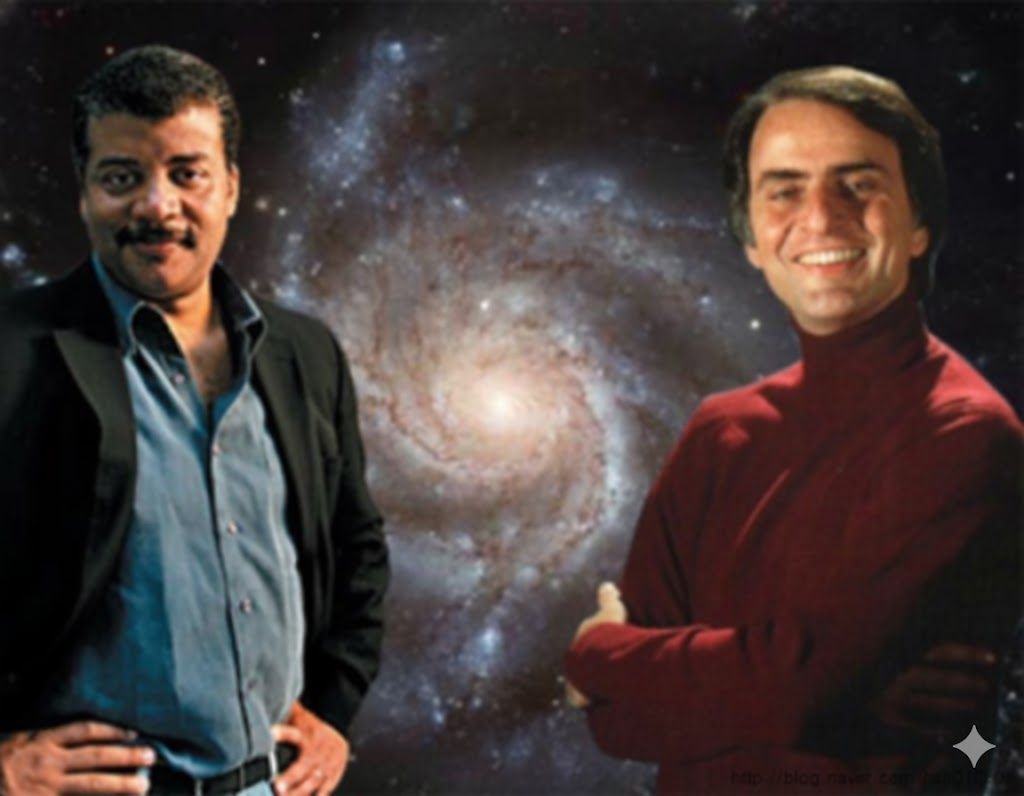
According to Tyson’s recollections… can you imagine? The top star scientist of the era took time out of his busy Saturday to personally show a high school student his lab and gifted him a copy of his book with an inscription: “To Neil, future astronomer.”
That day, there was a heavy snowfall in Ithaca, but as Tyson was walking to the bus stop, Sagan gave him a slip of paper with his home phone number, saying, “If the bus gets canceled due to snow, feel free to stay in our guest room. Call me.”
Although he eventually chose Harvard over Cornell, he recalled, “I realized then what kind of ‘scientist’ I wanted to be. I wanted to be a scientist like Carl Sagan.”
Over 30 years later, in 2014, in the final scene of the first episode of the ‘Cosmos’ reboot, Tyson, as the host, recounted this anecdote, paying homage to his mentor Sagan. This wasn’t just sharing a story; it was a tribute to his mentor and a moving ‘coronation’ declaring the official passing of a generational legacy. What does this show? Sagan’s legacy was not the transmission of ‘knowledge,’ but the transmission of ‘kindness’ and ‘inspiration.’ Isn’t that truly wonderful?
V-B. Official Succession: Ann Druyan and the ‘Cosmos’ Franchise
Ann Druyan, Carl Sagan’s wife and lifelong collaborator, played a… truly indispensable role in the official continuation of the ‘Cosmos’ legacy. She was a co-author of the original 1980 ‘Cosmos’ and, after Sagan’s passing, served as the executive producer, screenwriter, and director for all the rebooted series in 2014 and 2020. Ann Druyan’s presence is the “living link” that guarantees the ‘Cosmos’ reboots are not mere remakes but a ‘succession’ that carries forward the original philosophy.
VI. Conclusion: A Message in a Bottle and Love Sent into the Cosmos
The title of this article, “A Letter Written with Star Dust,” is not just a metaphor. Carl Sagan genuinely wrote a letter with ‘star material’ and sent it into space.
The physical embodiment of that letter is the ‘Voyager Golden Record.’
Sagan chaired the committee for this Golden Record to be carried on Voyager 1 and 2, departing the solar system. This record, created to convey Earth’s story to extraterrestrial intelligence, is literally a gold-plated copper disc – both elements forged from supernova explosions. Sagan called it “a bottle cast into the cosmic ocean.”
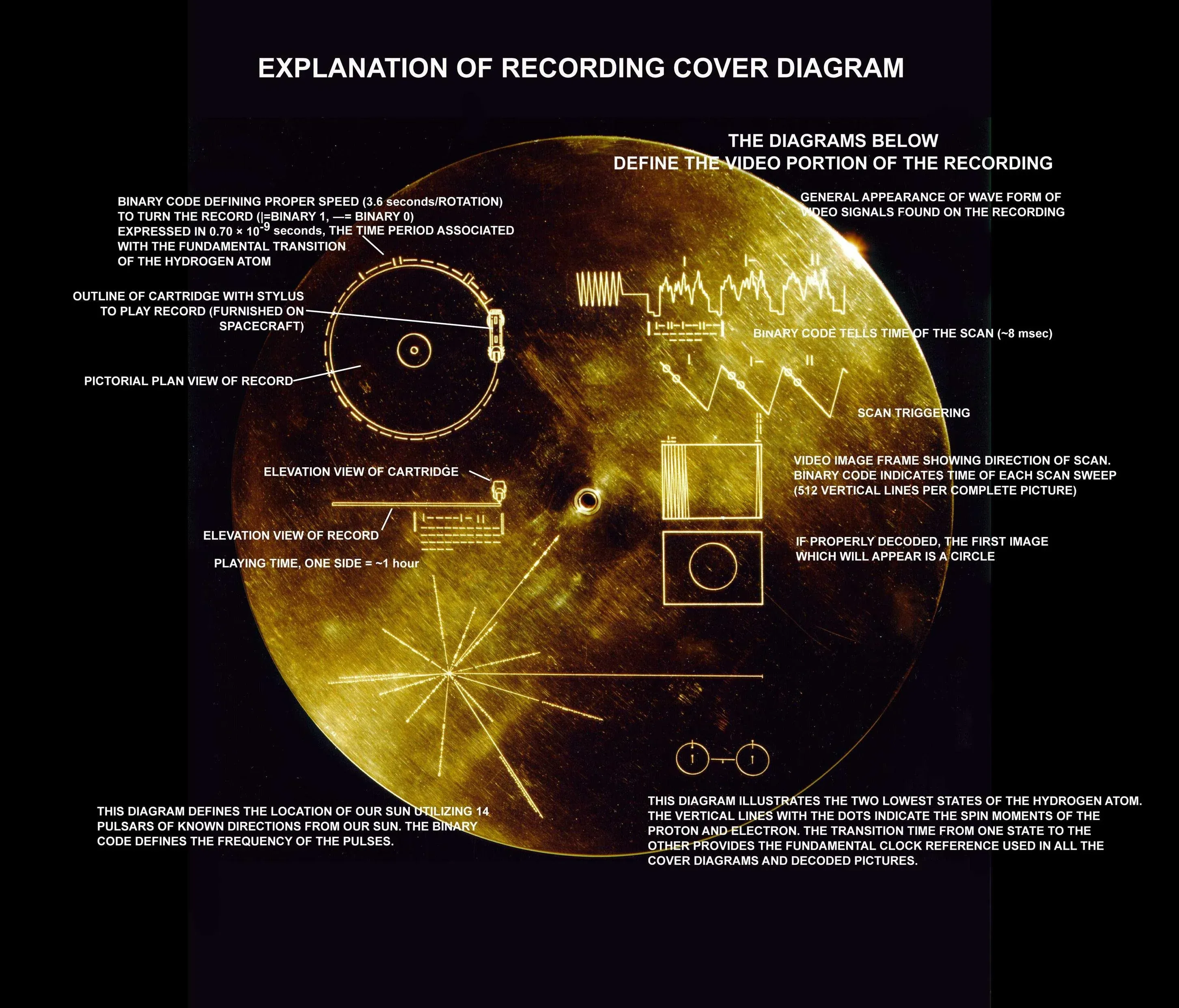
This ’letter’ contains sounds of Earth, 116 images, music from Bach to Chuck Berry, and greetings of peace in 55 languages. It was the answer to Sagan’s question, “Who Speaks for Earth?” – the answer was, “Ourselves.”
But… this ’letter written with star dust’ contains a truly personal and profound message beyond the official list.
The creative director of this project was Ann Druyan, and the two fell in love during its creation. On the day they recorded human brainwaves (EEG) to be included on the record, she meditated intensely for an hour on the history and civilization of Earth, and simultaneously on the feeling of love for Sagan that she had just realized – “what it is like to fall in love.” Her brainwave recording was compressed and placed on the Golden Record, and it continues its journey beyond the solar system, spanning billions of years, even at this moment.
That brainwave, still traveling beyond the solar system… spanning billions of years. Isn’t it chilling just to think about?
I believe this is the ultimate legacy ‘Cosmos’ left for our generation and posterity: the meeting of the ‘Cosmic Perspective’ and ‘Human Connection.’ These two are inseparable.
‘Cosmos’ and ‘Pale Blue Dot’ taught us the vastness of the universe and how small humans are within it. So, what is the strength that sustains us through that overwhelming vastness and loneliness?
Sagan himself clearly provided the answer in his later novel, Contact:
“For small creatures such as we the vastness is bearable only through love.”
Isn’t Ann Druyan’s act of embedding her brainwaves of love for Sagan into the ’letter written with star dust’ (the Voyager Golden Record) and sending it into eternal space, the most powerful… and most truthful… evidence of this philosophy?
Therefore, reading ‘Cosmos’ is not just about acquiring knowledge. It’s about participating in a truly wondrous and moving intellectual journey where the ‘cosmic awareness’ of realizing we are made of stardust ultimately leads to ‘human ethics’ – treating the people around us with deeper love and greater kindness.