
Welcome to the Greatest Origin Story in the World.
- Understand the 13.8 billion years of cosmic history divided into 8 critical turning points (thresholds).
- Learn how fragmented knowledge from physics, biology, history, and more connects into one.
- Gain insights into modern challenges like climate change from a macro perspective.
What is Big History? A Modern Origin Story
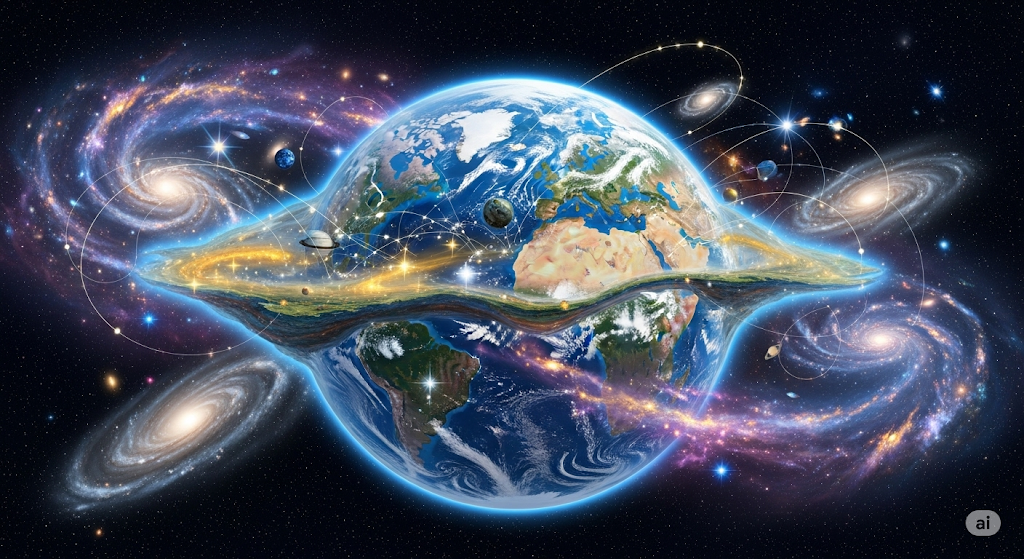
Humanity has always asked the fundamental question, “Where do we come from?” In response to this question, which was once answered by myths, science today offers a new origin story based on evidence: Big History. Big History is a grand narrative that connects all history from the Big Bang 13.8 billion years ago to the present and future within a single vast context.
This is not merely a listing of past facts; it provides a powerful ‘framework of thought’ that breaks down the boundaries of individual disciplines, from cosmology to history, and integrates knowledge. This perspective, first proposed by historian David Christian in 1989, has inspired figures like Bill Gates and evolved into the ‘Big History Project.’ Big History serves as a ‘cognitive map’ for modern individuals, helping them navigate through the fragments of scattered information.
8 Thresholds: A Giant Leap Towards Complexity
Big History explains the 13.8 billion years of history through 8 decisive turning points, known as ‘Thresholds.’ Each threshold requires the ‘just right’ conditions, or ‘Goldilocks Conditions,’ that are neither too hot nor too cold.
| Threshold (Threshold) | Approx. Date | Key Features (Key Features) |
|---|---|---|
| 1. Big Bang | 13.8 billion years ago | Conditions: Unknown Result: Universe (time, space, energy, matter) |
| 2. Emergence of Stars | 13.6 billion years ago | Conditions: Gravity, slight density differences in matter Result: Stars, galaxies, cosmic structures |
| 3. New Elements | 13.6 billion years ago | Conditions: Extreme heat/pressure in massive stars, supernova explosions Result: Various elements of the periodic table |
| 4. Solar System and Earth | 4.6 billion years ago | Conditions: New elements, gravity, accretion Result: Stellar systems, planets, moons |
| 5. Origin of Life | 3.8 billion years ago | Conditions: Complex chemistry, appropriate energy, liquid water Result: Life on Earth |
| 6. Collective Learning | 200,000-300,000 years ago | Conditions: Powerful brains, symbolic language Result: Humanity, cumulative knowledge |
| 7. Agriculture | 11,000 years ago | Conditions: Warming, population growth Result: Settlements, civilizations |
| 8. Modern Revolution | 250 years ago | Conditions: Global networks, fossil fuels Result: Industrialization, Anthropocene |
Thresholds 1-3: The Birth of the Universe, Stars, and New Elements
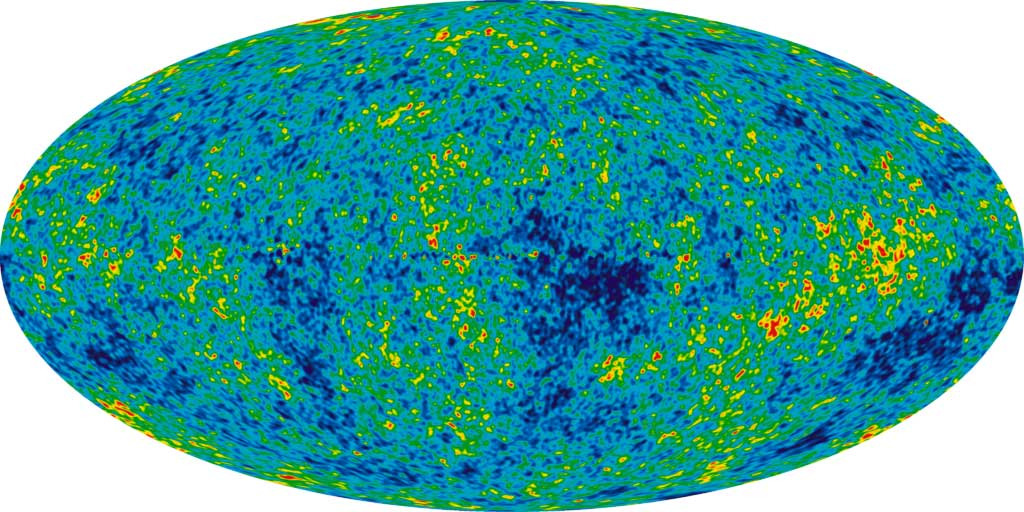
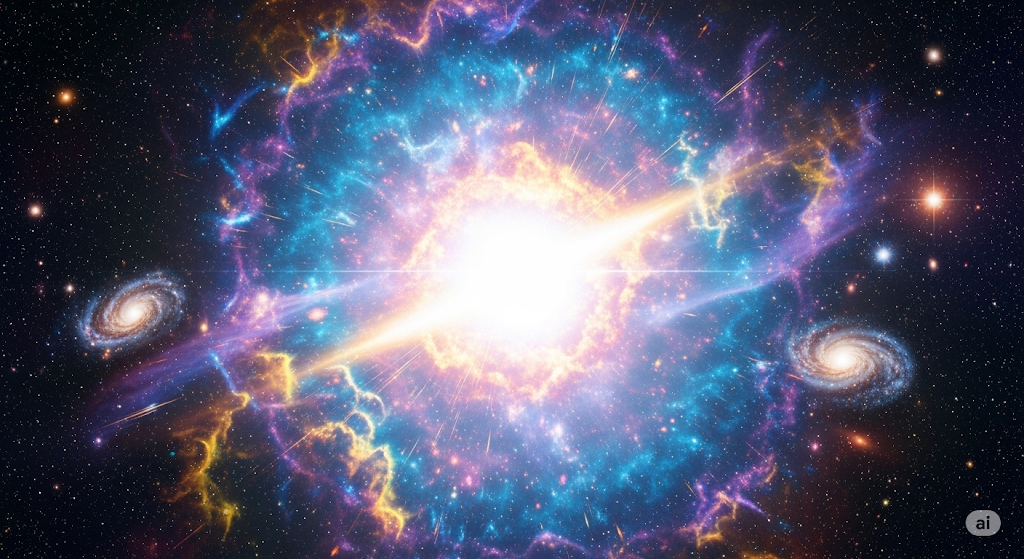
Everything began about 13.8 billion years ago with the ‘Big Bang,’ where space and time, matter and energy emerged from a single point and rapidly expanded. Scientists prove this through evidence of the universe’s ongoing expansion (redshift) and the residual heat of the Big Bang (cosmic microwave background radiation). The slight density differences in primordial matter became the seeds of gravity, leading to the birth of the first stars millions of years later.
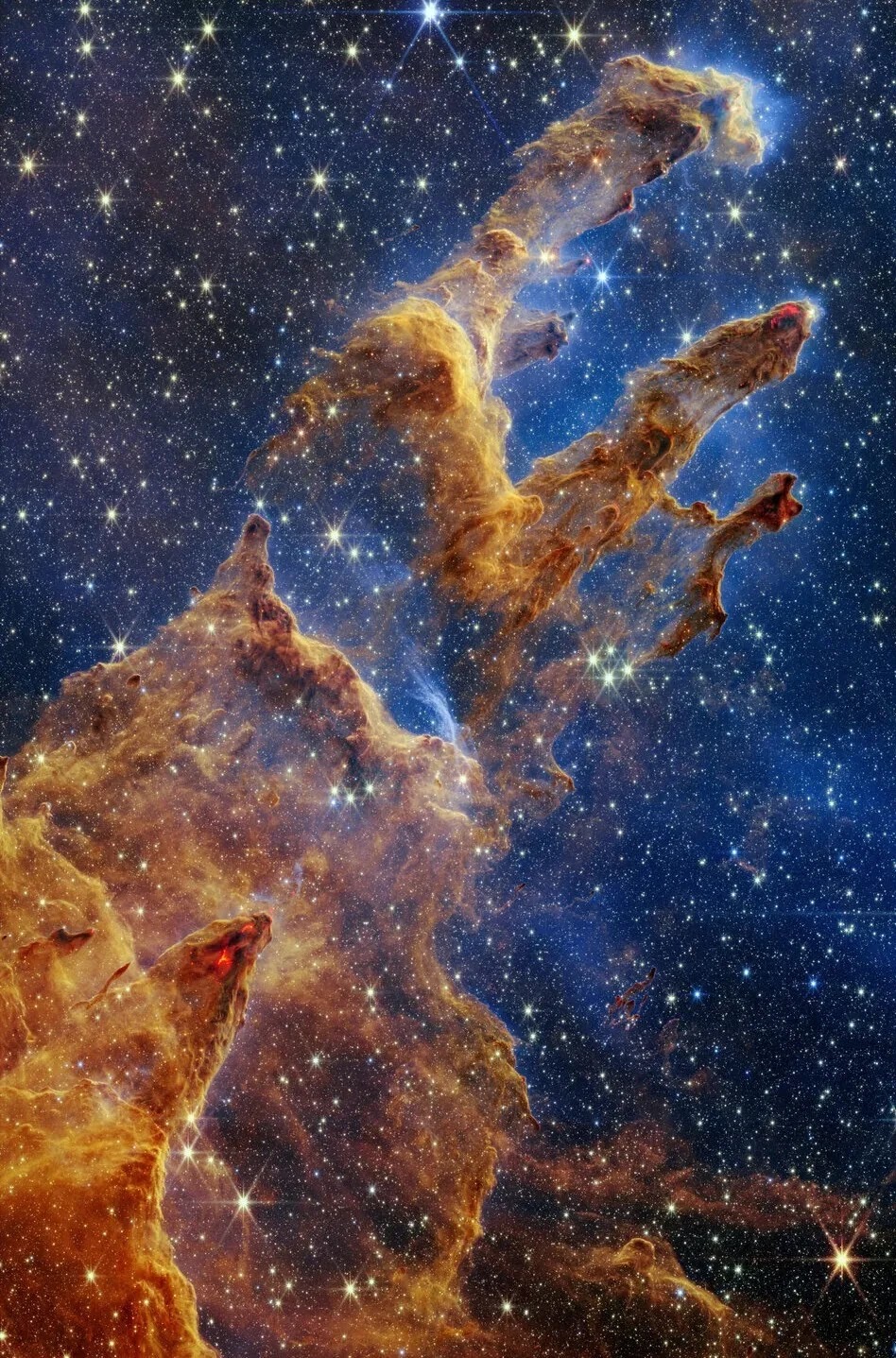
The Big Bang produced only hydrogen and helium. Heavier elements like carbon, oxygen, and iron that make up our bodies were created in the ‘cosmic furnace’ of stars and spread throughout the universe via supernova explosions. Indeed, the saying ‘we are made of star dust’ is not just poetic but a scientific fact.
Thresholds 4-5: The Solar System, Earth, and the Emergence of Life
About 4.6 billion years ago, the Sun and Earth formed from the remnants of previous generations of stars. Notably, the ‘giant impact hypothesis’ suggests that a planet the size of Mars, named ‘Theia,’ collided with early Earth, leading to the formation of the Moon, which provided essential conditions for seasonal changes and the birth of life.
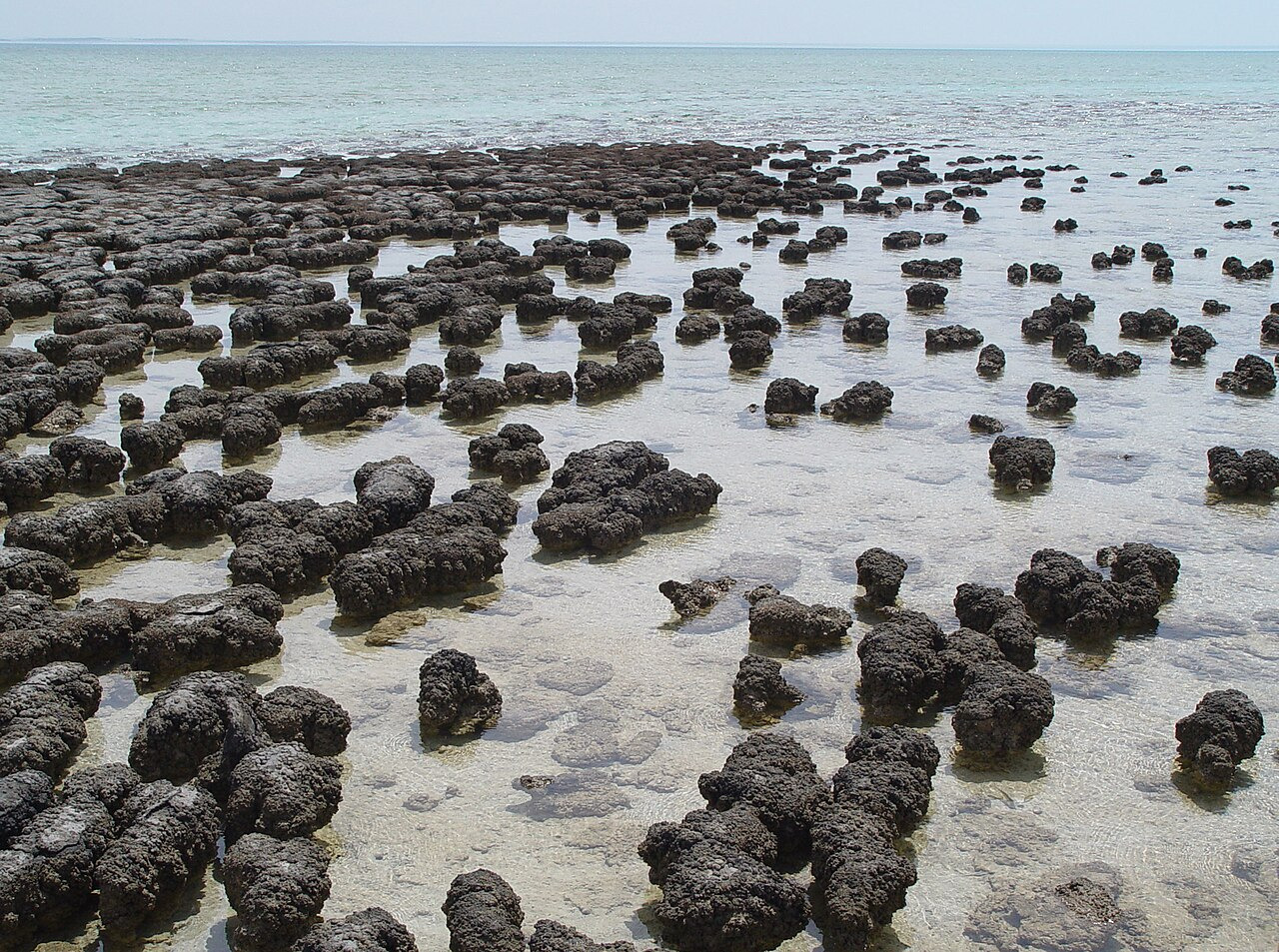
Finally, about 3.8 billion years ago, a miraculous event occurred on Earth, where inorganic materials transitioned into organic materials and then into self-replicating life. Early life forms produced oxygen through photosynthesis, completely transforming the Earth’s atmosphere and paving the way for the evolution of breathing organisms like us.
Threshold 6: Collective Learning, Humanity’s Superpower
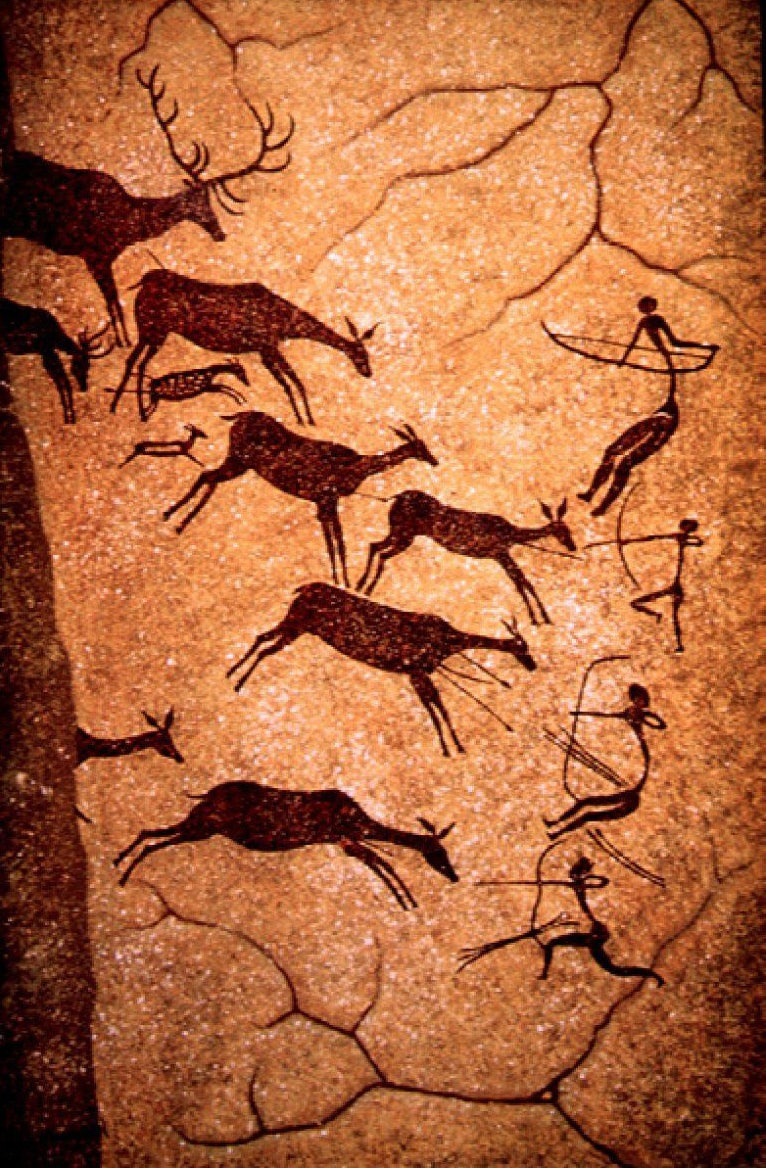
Homo sapiens, emerging around 200,000-300,000 years ago, sparked a revolution of ‘collective learning’ through sophisticated symbolic language. This ability to accurately share and accumulate knowledge across generations became a ‘superpower’ that allowed humanity to break free from the shackles of slow genetic evolution and embark on a path of explosive cultural evolution.
When I first encountered this concept, I was thrilled by the thought that principles akin to modern open-source software or Wikipedia have driven human advancement for thousands of years. Knowledge is not an individual possession; it only gains immense power when shared and improved upon.
Thresholds 7-8: The Agricultural and Modern Revolutions, and the Anthropocene
About 11,000 years ago, humanity began a Agricultural Revolution and settled down. Although individual lives may have become more arduous, agriculture supported larger populations, and surplus food enabled the birth of civilizations like cities, nations, and empires.
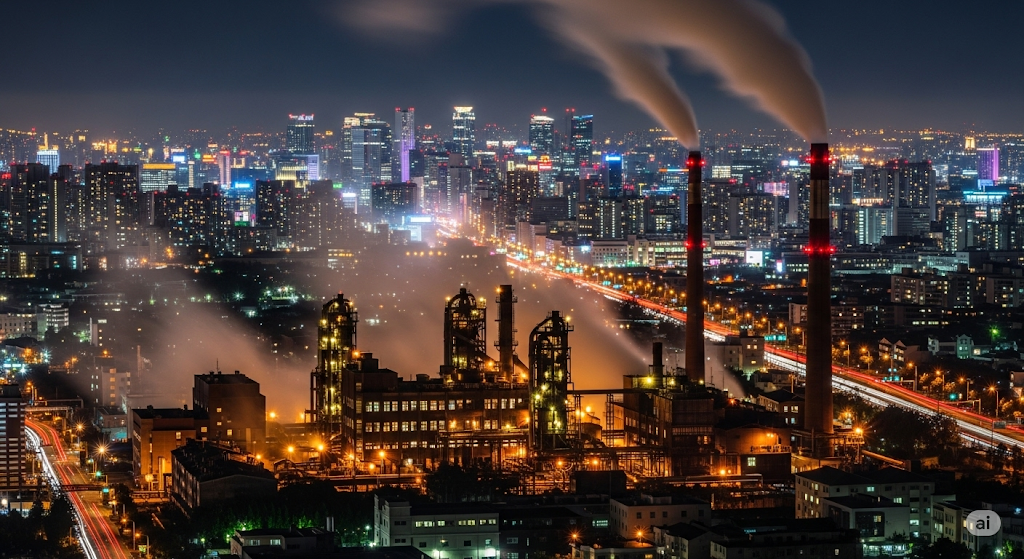
Then, just 250 years ago, humanity discovered fossil fuels and began the Modern Revolution. This immense energy granted humanity unprecedented power to change the entire Earth’s environment, and scientists say we have entered a new geological epoch called the ‘Anthropocene.’ This means that for the first time since the Earth’s formation, a single species has become the dominant factor in planetary change. Do you think we are using this power wisely?
Conclusion
Big History provides us with important insights through its 13.8 billion-year journey.
- Everything is connected: The atoms that make up our bodies came from the hearts of stars that died long ago. We are part of the universe.
- Collective learning accelerates change: The ability to share and accumulate information has been the driving force behind human advancement.
- Humanity has become a planetary being: We possess the power to change the Earth, and with it, we also bear responsibility.
Big History reminds us that we are one species facing a shared fate on a single planet. Now, it is up to all of us to write the next chapter of this story. Today, what part of this grand narrative will you contribute to from your position?
References
- Where do we come from, where are we, and where are we going? … All answers lie in Big History! Link
- Do you know ‘Big History’? Link
- Big History - Wikipedia Link
- Big History - Namu Wiki Link
- Thoughts on Big History - Sungkyunkwan University Newspaper Link
- The Fusion of Natural Sciences and Humanities, Big History: Seohyung Kim at TEDxBusan - YouTube Link
- From the Big Bang to Humans: What is Big History? - KIAS HORIZON Link
- [Choi Byung-kwan’s A·Sa·Gwa 23] Big History - HelloDD Link