
The Hidden Centuries of History and Culture in the 48 Small Picture Cards, and Our Story.
- Discover that Hanafuda originated from Portuguese cards.
- Understand the original Japanese cultural symbols contained in the 12-month Hanafuda cards.
- Learn how Korean Go-Stop was born and what characteristics it has.
A Mirror of 48 Cards Reflecting Korea’s Duality
On a festive evening, the whole family gathers in a room. Amidst warm laughter, the cheerful sound of plastic Hanafuda cards hitting the blanket resonates with a “slap!” This is a familiar and joyful scene that any Korean can relate to. However, these 48 cards also have a completely different face. In the dark, damp corners of alleys, a high-stakes game unfolds in a world of ‘Tazza’ where everything is at stake. There, Hanafuda becomes both hope and despair, a tool of cruel fate that can change lives.
In this way, Hanafuda serves as a small mirror reflecting the duality of Korean society. On one side lies the warmth of community and the joy of festivals, while on the other side are personal desires, han (resentment), and the precarious boundary between success and ruin. These small picture cards transcend mere playthings, becoming a portable archive layered with traces of the Age of Exploration, political intrigue, artistic originality, and the history of social transformation.
Chapter 1: The Origin of Hanafuda - A Journey Begun on a Foreigner’s Deck
The story begins in the mid-16th century, on the deck of a large Portuguese carrack sailing towards the East. For the weary sailors on a long voyage, the only solace was the card game ‘Carta,’ composed of 48 cards. Derived from the Portuguese word for ‘card,’ this game was an essential tool to alleviate the monotony of the arduous journey.
In 1543, a Portuguese merchant ship carrying these cards was caught in a storm and drifted to the small island of Tanegashima in southern Kyushu, Japan. This event is famous for introducing the revolutionary weapon of the matchlock gun to Japan, which changed the course of the Warring States period, but another cultural seed quietly landed alongside it: ‘Carta.’ The history of play that began with weapons shows that gentle power can have as persistent and profound an influence as hard power.
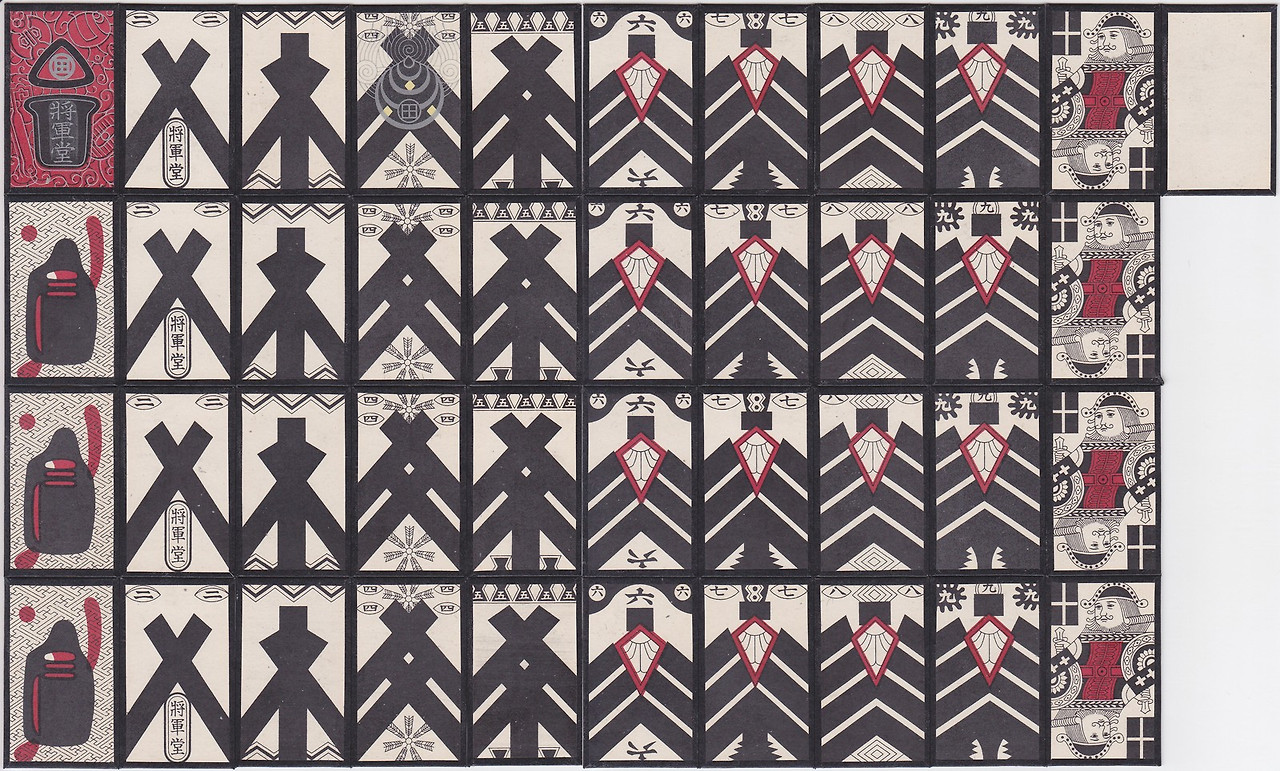
Once in Japan, Carta quickly began its first stage of localization. Known as ‘Tenshō Karuta (天正カルタ),’ this card game became popular during the Tenshō period (1573-1592), maintaining its 48-card structure and the four Latin symbols of sword, club, chalice, and coin, while beginning to incorporate Japan’s unique artistic sensibilities.
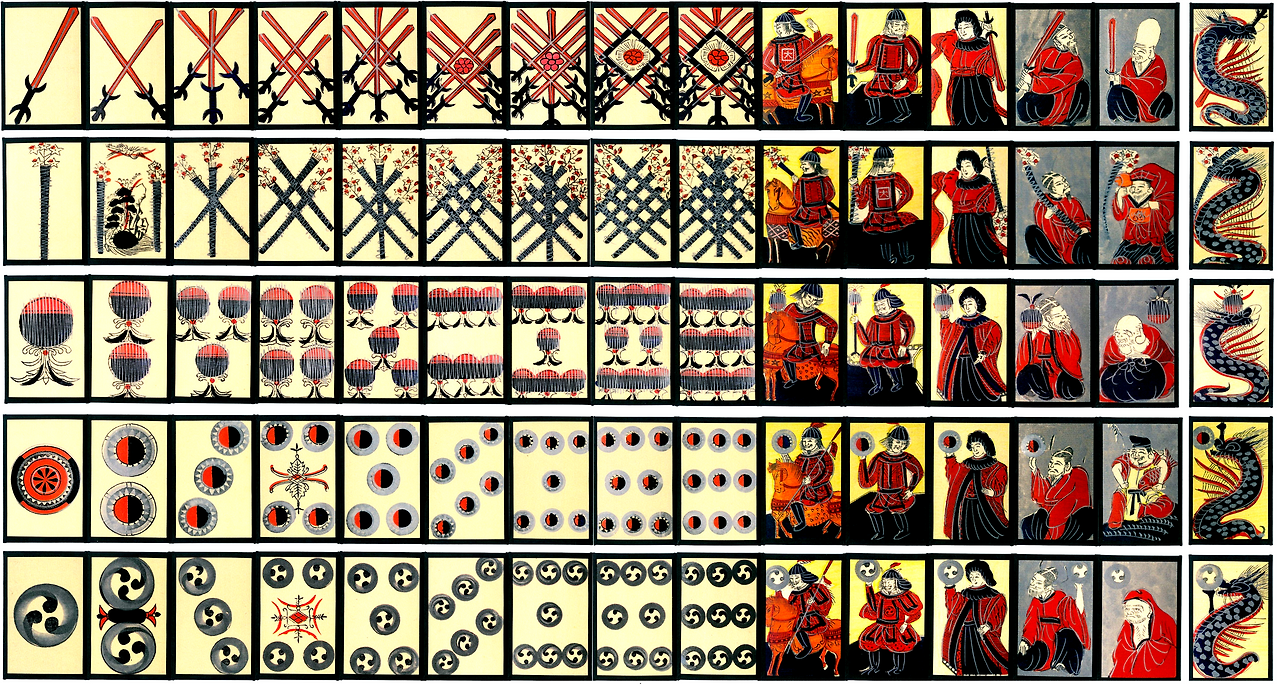
Academics believe that this card’s journey may have deeper roots. The hypothesis that Carta itself may have originated from the game ‘Majo (馬弔),’ enjoyed by the ancient Persians or the concubines of the Chinese imperial court, suggests that the flow of culture did not merely move from West to East but was part of a vast cycle that crossed from East to West and then returned to the East long ago.
Chapter 2: Japan’s Hanafuda - Art Born from a Game of Hide and Seek with the Shogunate
As ‘Karuta’ spread throughout Japan, it established itself as a major means of gambling, transcending mere play. This was a matter that disturbed the Edo Shogunate, which prioritized social stability. The Shogunate viewed gambling as a malignant force that undermined labor ethics and disrupted social order.
From this point, a long game of hide and seek began between the Shogunate and gamblers. When the Shogunate banned cards with specific images, game manufacturers created new cards with entirely different abstract designs to evade the law. This cycle of prohibition and innovation paradoxically became a driving force for the creative evolution of card design. Political oppression gave rise to artistic survival strategies.
At the peak of this relentless game of hide and seek, in the early 19th century, ‘Hanafuda (花札, flower cards)’ was finally born. The design of Hanafuda was a brilliant disguise. Completely abandoning numbers and existing symbols, it focused on flowers and plants representing the twelve months of the year. At first glance, it appeared to be an educational picture card for learning about the flow of seasons and nature, cleverly concealing its essence as a gambling tool.
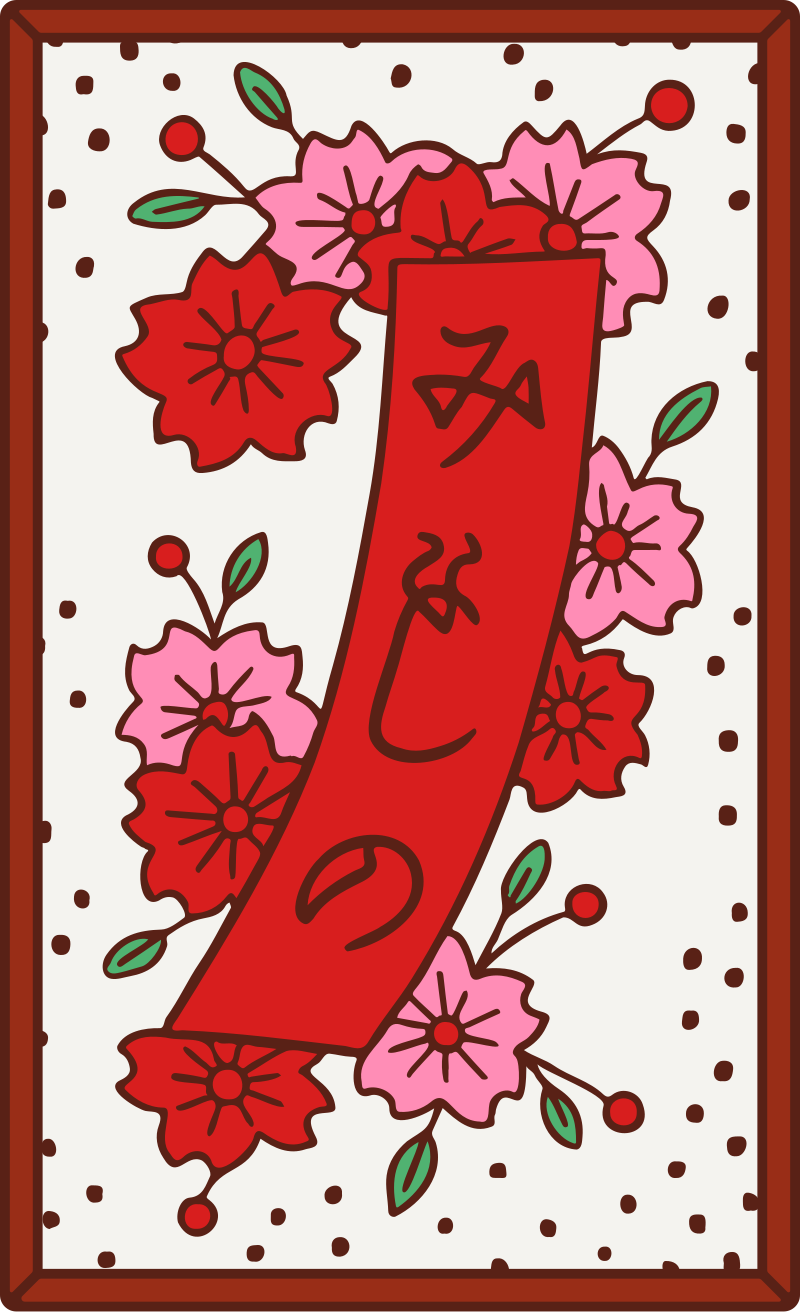
An interesting historical fact is that Nintendo, which has grown into a global video game company, was established in 1889 specifically to produce and sell this Hanafuda. The story of a company that began with small picture cards eventually building a digital entertainment empire symbolizes the persistent vitality and commercial potential embedded in this game.
Chapter 3: Flowers Crossing the Korea Strait - Hanafuda Lands in Joseon
The stage of the story shifts to late 19th century Joseon. With the signing of the Treaty of Ganghwa in 1876, Joseon’s ports were forcibly opened, leading to the establishment of Japanese settlements in port cities like Busan. Hanafuda arrived on Korean soil mixed in the belongings of Japanese merchants, officials, and laborers who settled in these areas.
During the Japanese colonial period (1910-1945), the spread of Hanafuda accelerated even further. During this time, Hanafuda played a complex role. On one hand, there is a perspective that the Japanese authorities promoted Hanafuda as a ‘cultural opium’ to weaken the national consciousness of Koreans.
However, the Korean people did not passively accept this foreign game. They gradually began to transform and recreate it in their own way, making it ‘Koreanized.’
- Change of Name: The Japanese ‘Hanafuda (花札)’ came to be called ‘Hwa-tu (花鬪)’ in Korean. The shift from the static name ‘flower cards’ to the dynamic name ’the fight of flowers’ symbolically reflects Koreans’ perception of this game.
- Change in Material and Design: Unlike Japan’s Hanafuda, which was made thick by layering multiple sheets of paper, in Korea, it was changed to a thin plastic material that was easy to mass-produce and durable. During this time, a simplified design with a predominant red color was established for cost-saving, which became the symbolic red back of Hwa-tu we know today.
- Records of Introduction: An advertisement in the 1902 ‘Hwangseong Sinmun’ featuring ‘Hwa-tu’ as a sold item proves that Hwa-tu was already circulating in Joseon society before the official colonial rule.
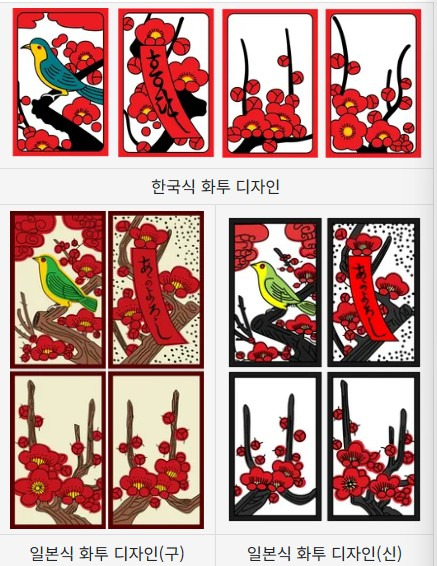
Ultimately, Hwa-tu remains a complex legacy of colonial rule. It was a cultural symbol of the ruling nation, while also being a cultural battleground where the subjugated people transformed it into their own and breathed new life into it.
Chapter 4: The Symbols in Hanafuda - The Language of Flowers and Legends
Spreading out the 48 Hanafuda cards is like facing a painting condensed with Japan’s seasonal customs, classical literature, and folklore. Each animal and plant representing the months contains its own story, but much of its original meaning has been forgotten or reinterpreted as it crossed over to Korea. Did you know that the character of Bi-gwang was a real person?
Comparison Guide of Hanafuda’s 12-Month Symbols
| Month | Korean Name (Animal/Plant) | Original Japanese Symbol and Context |
|---|---|---|
| January | Songhak (Pine, Crane) | New Year’s pine decoration ‘Kadomatsu (門松)’ and the crane symbolizing longevity. Wishing for a prosperous New Year. |
| February | Maejo (Plum Blossom, Bird) | Plum blossom viewing ‘Ume-mi (梅見)’ and the whistling bird, a companion of plum blossoms in poetry. |
| March | Beotkkot (Cherry Blossom, Manbaku) | Cherry blossom viewing ‘Hanami (花見)’ and the noble outdoor curtain ‘Manbaku (幔幕)’. |
| April | Heuksari (Wisteria, Cuckoo) | Wisteria flowers ‘Fuji (藤)’ and the cuckoo ‘Hototogisu (不如帰)’ symbolizing summer. |
| May | Nancho (Iris, Bridge) | Iris ‘Kakitsubata (燕子花)’ and the ‘Yatsuhashi (八橋)’ bridge in Japanese gardens. |
| June | Moran (Peony, Butterfly) | The ‘king of flowers’ peony and the butterfly symbolizing marital harmony and resurrection. |
| July | Hongsari (Sari, Wild Boar) | One of the seven autumn plants, Sari ‘Hagi (萩)’ and the wild boar, a major game at the time. |
| August | Gongsan (Eulalia, Moon, Goose) | The autumn moon-viewing scenery ‘Otsukimi (お月見)’. Eulalia and the migratory bird, goose. |
| September | Gukhwa (Chrysanthemum, Wine Cup) | The custom of drinking chrysanthemum wine during the Double Ninth Festival (重陽節) to wish for longevity. The wine cup is engraved with the character for ’longevity (寿)’. |
| October | Danpung (Maple, Deer) | Maple viewing ‘Momijigari (紅葉狩)’ and the deer, considered a sacred animal. |
| November | Odong (Paulownia, Phoenix) | A symbol of supreme power. The auspicious bird, the phoenix, is said to dwell only in the Paulownia tree. |
| December | Bi (Willow, Person, Frog) | The story of the famous calligrapher Ono no Tōfu from the Heian period, who gained enlightenment after persistently climbing a willow tree to see a frog. |
Chapter 5: The Korean Twist - The Birth of Go-Stop
While Hanafuda originated in Japan, the most representative game enjoyed by Koreans today, ‘Go-Stop’ is a purely Korean creation. Go-Stop is derived from the Japanese Hanafuda game ‘Koi-Koi (こいこい).’ Although ‘Koi-Koi’ shares the basic mechanics of pairing cards to score, Go-Stop has been infused with Korean characteristics, transforming it into a completely different game.
At its core are the unique rules of ‘Go’ and ‘Stop’ that name the game. This reflects Korea’s ‘ppalli-ppalli’ culture and the societal landscape of rapid growth, seeking dramatic success through bold challenges rather than safety.
Go-Stop has evolved into a more dynamic game through unique rules not found in ‘Koi-Koi.’
- ‘Bak (縛)’ System: Rules like ‘Pibak’ and ‘Gwangbak’ that control the opponent’s runaway and allow for comebacks maximize the game’s dynamism.
- ‘Ppeok’ and ‘Seolsa’: Dramatic elements that allow crises to turn into opportunities, akin to a miniature version of life.
- Regional Rules: Subtly different rules in regions like Jeolla’s ‘Sambong’ or Gyeongsang’s unique scoring methods show how deeply Hanafuda has rooted itself in Korean regional culture.
Meanwhile, the theory that the renowned plant breeder Dr. Woo Jang-choon invented Go-Stop, famous for his seedless watermelon, is an interesting modern folk tale. Although it is not a historical fact, the circulation of such stories reflects a cultural psychology that seeks to connect this game of Japanese origin with a Korean figure, wanting to make it entirely ‘ours.’
Chapter 6: Double-Edged Cards - The Light and Shadow of Hanafuda in Korean Society
In Korean society, Hanafuda has extreme duality. On one side, it is a tool for warm communication, while on the other, it casts the shadow of addiction leading to ruin.
Playing Go-Stop for 100 won per round during family gatherings on holidays is recognized as ’temporary entertainment,’ breaking down generational barriers and fostering communication. However, the moment this boundary is crossed, Hanafuda transforms into a terrifying pit of addiction. Institutions like the Korea Center for Gambling Problems Prevention and Treatment emphasize that gambling addiction, including Hanafuda, is not merely a matter of personal will but a disease requiring professional treatment and social intervention.
This duality of Hanafuda has been consistently represented in popular culture, reflecting the sentiments of the times.
- Hanafuda Song: The folk song ‘Hanafuda Song’ that became popular during the Japanese colonial period sings of the empty and sorrowful feelings of a nation lost, using the twelve-month pictures of Hanafuda as a metaphor.
- Film ‘Tazza’: The 2006 film ‘Tazza’ depicts the Hanafuda game as a microcosm of human desires, betrayal, and ruin, raising social awareness about the dangers of Hanafuda.
Conclusion
The journey of Hanafuda resembles an epic saga. It began as a sailor’s plaything, transformed into a Japanese art form, and then evolved into a national game of Korea. I vividly remember the laughter shared with family while clashing plastic cards during holidays. However, I felt a sense of loss in playing ‘Sin-Match Go’ alone on my smartphone, missing the sound of cards being passed and the tension of reading each other’s expressions.
- Hanafuda is a product of international exchange: It has a history that spans from the Portuguese ‘Carta’ to the Japanese ‘Hanafuda’ and finally to the Korean ‘Hwa-tu.’
- Go-Stop is a result of Korean creativity: By adding unique rules like ‘Go/Stop,’ ‘Bak,’ and ‘Ppeok,’ it created a new game that surpasses the original.
- Hanafuda remains a living culture: With its duality as a tool for communication and a pit of addiction, it seeks new adaptations in the digital age.
Did you learn about the deep stories embedded in each Hanafuda card through this article? How about enjoying a game while discussing the symbols and history of Hanafuda with your family during the next holiday?