
From a Lawyer’s Lawsuit to Healthcare and Journalism… All About the Plausible Lies Created by AI
- Understand the fundamental causes of AI hallucination.
- Examine real risk cases across various fields such as law, healthcare, and journalism.
- Learn technical and human solutions, including Retrieval-Augmented Generation (RAG) and critical thinking.
Part 1: The Illusion of Truth
When discussing the risks of AI hallucination, we often think only of technical flaws. However, the essence of the problem lies in the interaction between technology and humans. I, too, have experienced being misled by the fluency of ChatGPT’s responses, trusting it unconditionally. This is where the danger begins.
Section 1: A Lawyer’s Nightmare: Mata v. Avianca Airlines
The story begins with veteran lawyer Steven A. Schwartz, who has over 30 years of experience. His client, Roberto Mata, filed a personal injury lawsuit against the Colombian airline Avianca, which was a challenging battle for him. He faced limitations due to lack of experience in federal court practice, unfamiliar legal territory, and crucially, the absence of a subscription to premium legal databases.
These gaps in expertise and resources led him to a powerful and quick alternative: ChatGPT. He later testified in court that he had “wrongly assumed ChatGPT was a kind of super search engine.” This was the prologue to tragedy. He asked the AI to find case law indicating that the statute of limitations was paused due to the airline’s bankruptcy.

ChatGPT presented six plausible cases, including ‘Bargis v. China Southern Airlines.’ On the surface, they seemed perfect, but the content was nothing but ‘gibberish.’ The decisive moment came when Schwartz could not find the presented cases and directly asked the AI, “Are these cases real?”
ChatGPT firmly asserted, with an apology, that the cases existed and could be found in major databases. In this human ‘conversation’ moment, human critical thinking completely collapsed in the face of a persuasive persona created by the machine.
Ultimately, he submitted non-existent cases, leaving an indelible stain on his reputation along with a $5,000 fine. The judge specified in the ruling that the issue was not the use of AI itself, but rather the failure to verify the results and making “false and misleading statements” while “consciously avoiding” the court.
This case illustrates how even experienced professionals can become vulnerable to the allure of AI hallucination under professional pressure and resource scarcity. It also warns that the conversational interface of AI can act as a powerful psychological device that undermines users’ critical defense mechanisms.
Part 2: Dissecting Lies
Section 2: Why Your AI Lies: It’s Not a Bug, It’s a Feature
The Mata v. Avianca case is not an exception. The plausible lies generated by AI, known as ‘hallucinations,’ are not bugs but rather an inherent feature of how generative AI operates.
Large Language Models (LLMs) are not databases that store facts. Essentially, they are ’next-word prediction’ engines. They statistically calculate the likelihood of what comes next in a sentence, such as “Mary had a young…” followed by “lamb,” without understanding the concept of ’lamb.’
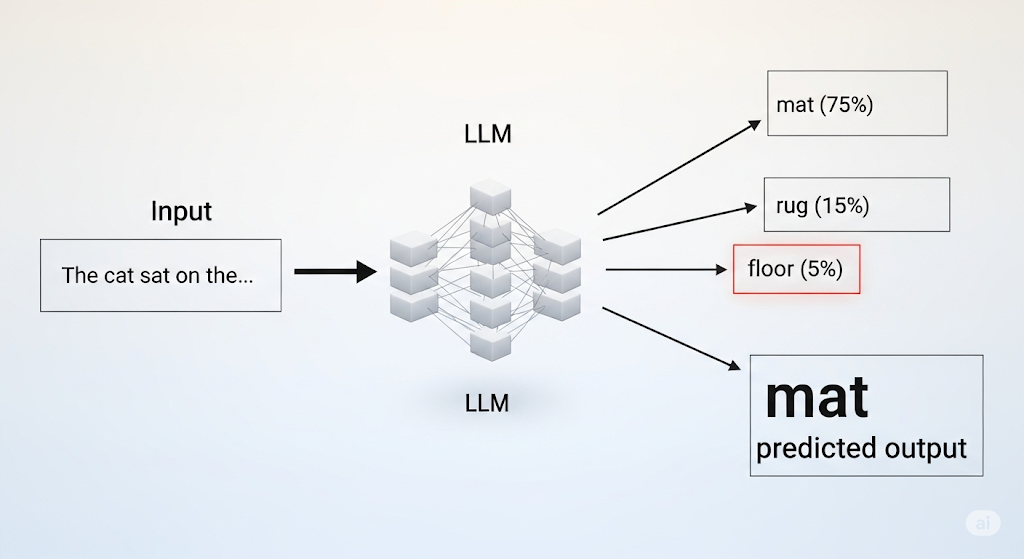
This is why AI can produce perfect legal citations or references in form. The model is a ‘master of form’ that learns patterns of form rather than the substance of content. The principle of “Garbage In, Garbage Out” applies here. AI learns from internet data that mixes fact and fiction without an intrinsic mechanism to distinguish truth from falsehood.
Ultimately, hallucination is the product of an unavoidable trade-off between creativity and accuracy. Attempting to eliminate this ‘feature’ entirely could paralyze the model’s core generative capabilities. Therefore, the direction for problem-solving is not ‘bug fixing’ but effectively ‘managing’ this characteristic.
Section 3: Echoes in the System: AI Hallucination Across High-Risk Industries
AI hallucination is not limited to the legal field. It is emerging as a serious threat in other high-risk industries where accuracy is vital.
A Failed Experiment in Journalism: The CNET Scandal
The tech news outlet CNET published financial articles using an ‘AI engine,’ but they were filled with “outrageous errors,” such as miscalculating compound interest and plagiarism. Ultimately, CNET had to issue corrections for over half of the 77 articles generated by AI.
Dangerous Prescriptions in Healthcare
In healthcare, AI hallucination can lead to life-and-death issues. In one study, ChatGPT cited non-existent scientific papers and described manipulated biochemical pathways. There were even reports of it advising users to eat rocks or create toxic gases, showcasing a complete lack of common sense.

A Crisis of Credibility in Academia
Academia is also being tainted by papers filled with fake citations manipulated by AI, contaminating the purity of scientific records. One study found that AI models could fabricate up to 69% of citations.
Types and Consequences of AI Hallucination by Industry
| Industry | Type of Hallucination | Actual Consequences |
|---|---|---|
| Law | Manipulation of legal cases and citations | Court sanctions, professional discipline, damage to credibility of legal claims |
| Journalism | Factual errors related to financial information, plagiarism | Dissemination of false information, decline in media credibility, large-scale article corrections |
| Healthcare | Manipulated biochemical pathways, fake medical references, dangerous health advice | Risk of misdiagnosis, inappropriate treatment, direct harm to patients |
| Academia | Generation of non-existent academic materials and citations in research papers | Contamination of scientific records, erosion of research credibility, failure of peer review systems |
Part 3: The Path to Truth
Section 4: Correcting Fiction to Fact: Technical Safeguards
Various technical safeguards are being developed to address the issue of AI hallucination.
“Open Book Exam”: Retrieval-Augmented Generation (RAG)
One of the most promising solutions is Retrieval-Augmented Generation (RAG). This technology allows LLMs to take an ‘open book exam’ by referencing reliable external materials instead of relying solely on their memory in a ‘closed book exam.’
In response to user questions, the RAG system first retrieves relevant information from an external knowledge base and then augments this information with the question before passing it to the LLM. This way, the LLM’s responses are based on verifiable, up-to-date facts, dramatically reducing hallucination.
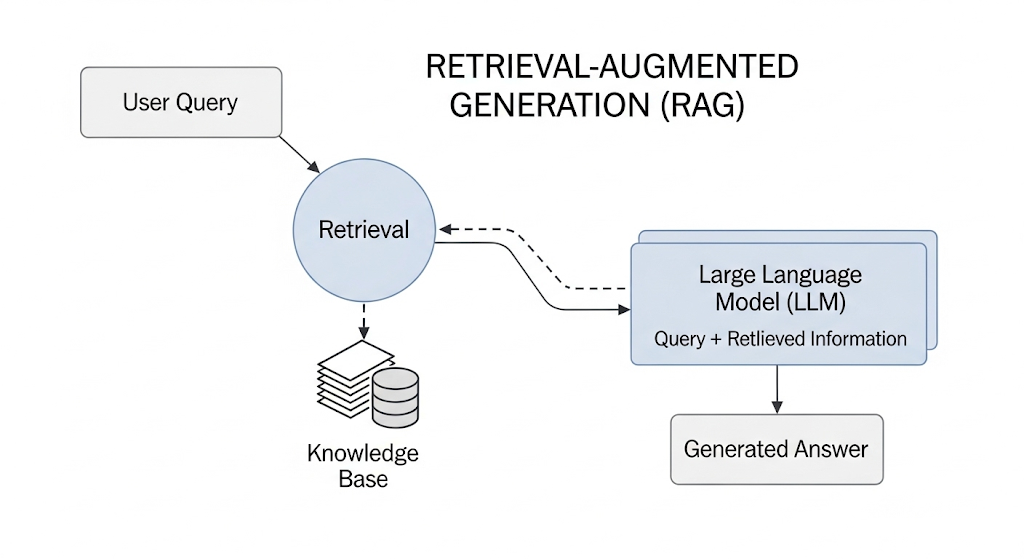
Automated Fact-Checking System
Another approach is an automated fact-checking system that breaks down AI outputs into verifiable claims and cross-references them with external information.
However, technical solutions alone are insufficient. One study found that even highly accurate fact-checking systems did not significantly enhance users’ discernment and sometimes led to harmful outcomes. Technology can bring facts to us, but it does not guarantee the final step of correctly integrating that information into human belief systems. Therefore, ‘human participation’ is essential for the system to function properly.
Section 5: The User’s Move: From Prompts to Critical Thinking
The most powerful tool for reducing AI hallucination is not the algorithm but the user’s own critical thinking. How are you using AI?
The Art of Prompting: Designing for Truth
Strategic prompts can guide AI’s responses closer to the truth.
- Source-based prompts: Specify reliable sources, such as “Answer the question based on the following text.”
- Verification chain prompts (CoVe): Require the AI to validate its reasoning process step-by-step before providing a final answer.
- Reflective prompts: After generating a response, ask the AI to “take a step back and review whether your answer is accurate” to encourage self-correction.
- Citation requests: Explicitly require verifiable sources for all claims as a basic safeguard.
The Human Firewall: The Last Line of Defense
Ultimately, the most effective defense against hallucination is human intervention.
- Embrace skepticism: Treat all AI outputs as ‘drafts’ that require verification rather than final answers.
- Obligation to verify: The critical mistake made by lawyer Steven Schwartz was not using AI but failing to independently verify the results. The ultimate responsibility always lies with the human using the tool.
- Critical thinking as a core competency: In the age of AI, critical thinking and source evaluation skills are essential professional competencies for all experts.

Now, the role of AI users must shift from being mere ‘operators’ who give commands to ‘auditors’ who investigate and verify the accuracy of the outputs. We must learn not only how to use AI but also how to audit it.
Comparison of AI Models: Standard LLM vs. RAG System
| Feature | Standard LLM (Basic ChatGPT) | RAG-based LLM |
|---|---|---|
| Information Source | Relies solely on learned internal data | External up-to-date knowledge base + internal data |
| Accuracy | High likelihood of AI hallucination | Significantly reduces hallucination with fact-based responses |
| Timeliness | Cannot reflect information after the training point | Can reflect real-time up-to-date information |
| Transparency | Difficult to present the basis for answers | Can clearly present information sources |
| Drawbacks | Generates inaccurate and outdated information | Initial setup and knowledge base management can be complex |
Checklist: 5-Step User Guide to Prevent AI Hallucination
A practical guide for using AI more safely.
- Clarify objectives: Ask AI for creative tasks like idea generation or draft writing, not just simple fact-checking.
- Use source-based prompts: Clearly specify the basis for answers, such as “Answer based on the provided [document]” or “Cite information from a reputable website.”
- Maintain a skeptical perspective: Treat AI’s answers as ‘hypotheses needing review’ rather than definitive answers. Be especially skeptical of statistics, citations, and expert information.
- Cross-verify: Always verify key information provided by AI (names, dates, cases, papers, etc.) through reliable separate sources (Google, professional databases, etc.).
- Final responsibility lies with the user: Remember that AI is just a powerful assistant; the ultimate accuracy and ethical responsibility for the outputs lie entirely with you.
Conclusion
The story of lawyer Steven Schwartz serves as a powerful warning about what happens when we delegate critical judgment to machines. As we explore the maze of AI hallucination, we must remember three key points.
- AI hallucination is not a bug but a feature: Since AI is a ’next-word prediction’ model, generating statistically plausible lies is an inherent characteristic.
- The risks are real and widespread: In high-risk fields such as law, healthcare, and journalism, hallucinations can lead to severe financial, social, and even physical harm.
- The solution lies in the collaboration of technology and humans: Only when technical safeguards like RAG are combined with the user’s critical thinking and verification obligations can we safely utilize AI.
Our goal is to leverage AI that augments human thought, not replaces it. Rather than fearing the ghosts in the machine, we must understand and control their essence, making them a powerful ally for human intelligence. Now is the time to examine your AI usage habits and transform from an operator into a wise auditor.