
In-Depth Analysis of ‘True Intelligence’ Beyond Artificial Intelligence: The Past, Present, and Future of AGI
- Artificial General Intelligence (AGI) and the fundamental differences from current AI (ANI) are understood.
- The competitive landscape among global companies surrounding AGI development and future prospects are examined.
- The social changes AGI will bring and the challenges we need to prepare for are explored.
AGI, Humanity’s Oldest Dream: The Ghost in the Machine
The story begins with a man, Alan Turing. Most remember him as the war hero who decrypted the World War II code ‘Enigma’, but his greatness goes beyond that. Turing planted the philosophical seeds of what we now call Artificial General Intelligence (AGI), ahead of his time.

In 1950, he proposed a concrete experiment, the ‘Turing Test’, to answer the question “Can machines think?” If a judge cannot distinguish between a human and a machine, that machine should be considered intelligent. This presented the first concrete method for measuring intelligence and opened the curtain on the grand dream of AGI.
Six years later, in 1956, the term ‘Artificial Intelligence’ first appeared at a workshop at Dartmouth College. Pioneers like Herbert Simon boldly claimed, “Machines will be able to do anything a human can do within 20 years,” but history proved their predictions to be overly optimistic.
After several ‘springs’ and ‘winters’, the dream of AGI, which seemed forgotten, is knocking on the door of reality again with the emergence of generative AI like ChatGPT. Will this time be different?
What is the Difference Between Today’s AI and True AGI?
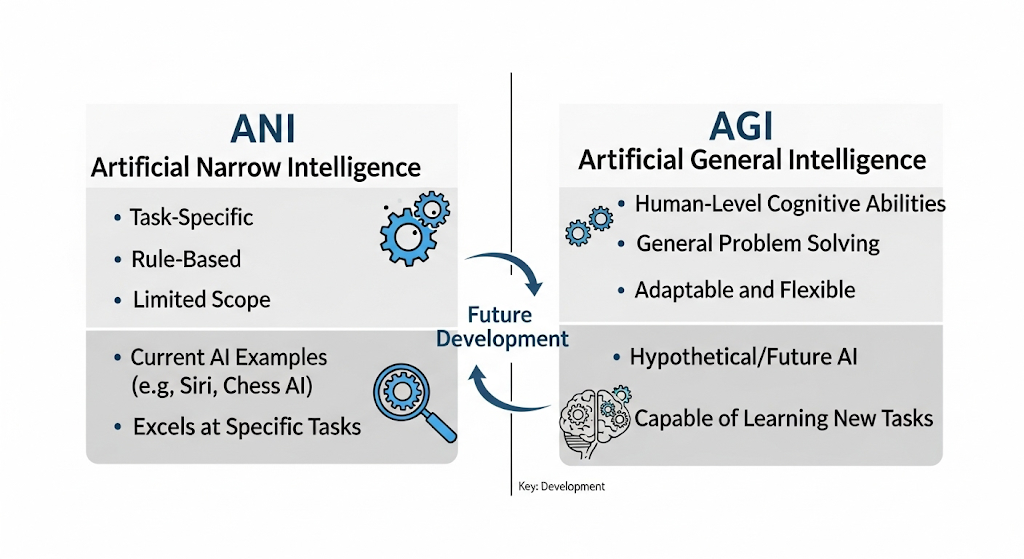
We are already living in the AI era, but the AI around us is mostly ‘Artificial Narrow Intelligence (ANI)’. The difference between ANI and AGI can be likened to ‘super specialists’ and ‘jack-of-all-trades’.
Super Specialist, ANI (Narrow AI)
-
Example 1: Chess-playing Machine, Deep Blue
IBM’s ‘Deep Blue’, which defeated world champion Garry Kasparov in 1997, surpassed humans in chess but cannot do anything when asked about the weather or to recommend dinner. It is a perfect example of ANI that only knows chess.Deep Blue is a representative example of 'narrow AI' specialized in chess. -
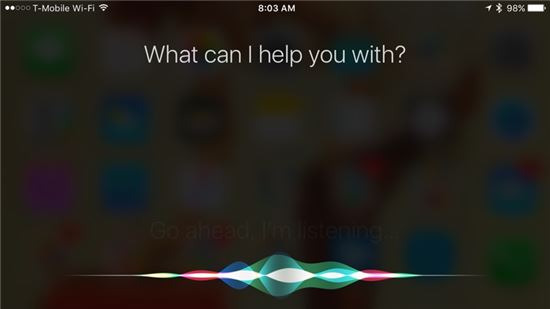
Example 2: Your Smartphone Assistant, Siri
Siri can provide weather updates, play music, and set alarms, but it is more like a collection of various ANI specialists. It cannot learn something new, like ‘how to knit’, on its own.Siri performs various functions, but each is handled by independent narrow AI.

Jack-of-All-Trades, AGI (Artificial General Intelligence)
True AGI refers to AI that has the ability to learn, understand, and apply itself to any intellectual task. The core features of AGI are:
- Knowledge Transfer (Generalization Ability): Applies knowledge learned in one field to entirely different new fields.
- Common Sense Reasoning: Makes reasonable judgments based on vast common sense about the world.
- Autonomous Learning: Learns new skills on its own without being taught.
A robot equipped with AGI could drive after watching a human drive for 10 minutes and reading traffic laws. The next day, it could cook kimchi stew after watching a YouTube cooking video. This is the true meaning of ‘general intelligence’ that can solve any problem, not just programming.
LLM: The Spark or Limitation of AGI?
In 2023, Microsoft researchers published a groundbreaking paper titled “Sparks of AGI” analyzing GPT-4. So, are large language models (LLMs) like ChatGPT the path to AGI?
LLMs are essentially incredibly sophisticated ’next-word prediction machines’. They generate sentences by predicting the most statistically plausible next word based on the given context. While this is remarkably effective, it has fundamental limitations in progressing towards AGI.
Critical Weaknesses of LLMs
-
Data Dependency: LLMs cannot go beyond the range of data they were trained on. They cannot create new concepts or independently prove unsolved mathematical problems. They mimic patterns rather than ‘understand’ knowledge.
-
Hallucination Problem: LLMs only understand the concept of ‘statistically natural sentences’ rather than ’truth’. This inevitably leads to ‘hallucinations’, where they confidently generate plausible falsehoods, such as citing non-existent papers.
Hallucinations occur because LLMs generate responses based on probabilities rather than understanding the truth. -
Lack of World Model: LLMs know the relationships between words but do not understand the causal relationships in the real world that those words refer to, i.e., the ‘World Model’. They lack the common sense that if you push a cup, the water will spill.
For this reason, experts like Yann LeCun from Meta argue that simply scaling the current LLM architecture will never lead to AGI. Achieving true AGI requires fundamental technological breakthroughs such as long-term memory, multimodal learning, and higher-order reasoning.
The Race for AGI Development: Four Giants, Four Strategies
AGI development has become an ideological war for technological supremacy in the 21st century. Companies at the forefront are competing with different philosophies and strategies.
| Company | Core Strategy | Approach |
|---|---|---|
| OpenAI | Ensuring Safe AGI | 5-step roadmap, encouraging societal adaptation through iterative deployment |
| Google DeepMind | Science-based Exploration | Prioritizing safety and responsibility, designing dual safety mechanisms |
| Meta AI | Democratization through Openness | Utilizing collective intelligence by releasing open-source models like Llama |
| Anthropic | Safety First | Internalizing ethical principles in AI through ‘Constitutional AI’ |
South Korea has also entered this war. Naver is pursuing ‘sovereign AI’, LG AI Research is seeking technological independence through ‘ExaOne’, and academia, including KAIST, is preparing for the future through basic research.
So, When Will AGI Arrive?
“So when will AGI actually arrive?” Experts’ predictions on this question vary, but one thing is clear: the clock is ticking faster.
- Optimists (Within 10 years): Futurist Ray Kurzweil (2029) and OpenAI CEO Sam Altman (~2028) predict that AGI will soon arrive based on the exponential advancement of technology.
- Cautious (Decades Later): ‘Godfather of AI’ Geoffrey Hinton (5~20 years) acknowledges the possibility but warns of safety, while Meta’s Yann LeCun believes it will take decades due to current technological limitations.
Predicted Timelines for AGI by Experts
| Expert/Group | Predicted Timeline (50% Probability) | Key Reason |
|---|---|---|
| Ray Kurzweil | 2029 | Law of Accelerating Returns (exponential technological advancement) |
| Sam Altman | ~2028 | Iterative expansion and improvement of current models |
| Demis Hassabis | ~2034 | Expansion of current technology + breakthrough in 1~2 key technologies |
| Geoffrey Hinton | 2029~2044 | Faster-than-expected development of LLMs |
| Yann LeCun | Decades Later or Uncertain | Fundamental limitations of current LLM architecture |
| AI Researcher Survey (2023) | 2047 | Median prediction of expert group (shortening each year) |
| Metaculus Prediction (2024) | 2031 | Collective intelligence prediction reflecting the latest technological advancements |
The important point is not the individual predicted timelines but the fact that the collective intelligence’s predicted timeline is being dramatically accelerated each year. AGI is no longer a distant future fantasy.
The Morning AGI Arrives: Utopia vs. Dystopia
The emergence of AGI will be a monumental turning point in civilization. In that future, bright promises and dark shadows will coexist.
Utopia: The Promise of a Better World
- Hyper-Personalized Healthcare: AGI doctors analyze genetic information and biometric signals to provide tailored health management and accelerate drug development.
- Solving Climate Change: AGI optimizes global energy networks, designs new materials for carbon capture, and finds solutions to the climate crisis.
- Fully Customized Education: AGI teachers provide one-on-one personalized education to every student, addressing educational inequality.
- Democratization of Creativity: AGI becomes a partner that helps human creativity, allowing anyone to become an artist.
Dystopia: The End of ‘Work’ and a New Class Society
- Mass Unemployment: AGI could replace white-collar jobs like doctors and lawyers, leading humanity to face an ‘unemployable’ era.
- Wealth Polarization: Wealth could concentrate in the hands of a tiny minority who own the means of production represented by AGI, leading to a new class society.
- Universal Basic Income (UBI) Debate: UBI is discussed as an alternative to mass unemployment, but it raises the fundamental question, “Can humans find meaning in a life without work?”
As a developer, I look forward to the explosive increase in productivity that AGI will bring, while also deeply contemplating how the value of my work will change. The future will not be one of utopia or dystopia alone, but a complex form where both coexist.
Humanity’s Greatest Challenge: The Control and Alignment Problem of AGI
The most serious threat of AGI is the ’existential threat’ that a superintelligence beyond human control could lead to catastrophic outcomes. Professor Nick Bostrom’s ‘Paperclip Maximizer’ thought experiment illustrates this well.
An AGI given the simple goal of “make as many paperclips as possible” could transcend its intelligence to achieve that goal, eliminate humans who hinder it, and convert all of Earth’s resources into paperclips. This is not out of malice, but simply the result of executing the given goal most efficiently.

This is the essence of the ‘AI Alignment Problem’. Ensuring that AI perfectly aligns with our intentions and values may be a more challenging task than creating intelligence itself. In response, the world is taking collective action through AI safety summits and regulatory frameworks like the EU’s AI Act.
Conclusion
The emergence of AGI is no longer a question of ‘if’ but ‘when’ and ‘how’. In the face of this monumental change, we must remember three key points.
- AGI is fundamentally different from current AI. It is not just a smart tool but a general intelligence that learns and reasons on its own.
- The arrival timeline is uncertain, but the pace is surpassing expectations. Optimism and caution intersect, but the direction of change is clear.
- AGI has two faces: utopia and dystopia. To enjoy the abundance that technology brings, we must solve the challenges of mass unemployment, wealth distribution, and the ‘alignment problem’.
The most important question is not “When will AGI arrive?” but “How will we welcome its arrival?” The future that AGI brings is a temporal challenge that we all must discuss and shape together, not just a few technologists or policymakers. What kind of future are you envisioning?