
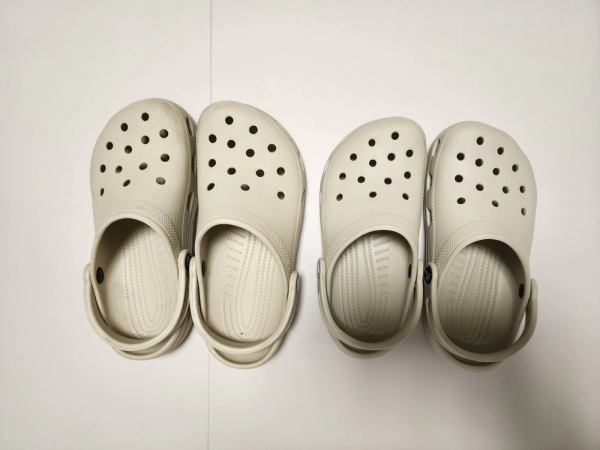
Every summer when I tidy up my shoe rack, there’s always one thing that catches my eye. Next to my Crocs are ‘fake’ clogs that are almost identical in color and shape. These are sold much cheaper at supermarkets or online, but strangely, my feet hurt when I wear them, and the soles sag after a few days. The material label says EVA for both, so I was curious to find out what the difference was.
However, while digging through information, I stumbled upon an unexpected fact. Crocs’ material, ‘Croslite’, is not patented. This was admitted by Crocs in a lawsuit against their competitor, Double Diamond/USA Doggs. The opposing side even argued that Croslite is just a common EVA copolymer, similar to rubber, used by many shoe companies.
This means that a substance I thought was a secret recipe protected by a patent was, in fact, a common material with a different name. So, where does the actual difference we feel between the fakes and the originals come from?
This strange situation of the same material, different shoes isn’t just happening to me. Many people who bought replicas after seeing the phrase “EVA identical to Crocs material” online leave similar reviews. They feel similar at first, but the gap with the original widens the more they wear them. People with wide feet or those in professions that require standing for long periods are more sensitive to this difference. From a consumer’s perspective, making purchasing decisions based solely on the material list, we are all essentially opening our wallets under this illusion.
Why the Material Label Tells Us Nothing
Looking deeper into the court records reveals an interesting statement. In internal Crocs documents, someone is quoted as saying that Croslite is just one of several olefin foams, and since people don’t really know what EVA foam is yet, they should just teach them the name “Croslite” instead of “EVA.” The intention was that the name itself was a marketing strategy.
A polymer materials scientist from Penn State University makes a precise point here. The real magic of Crocs lies not in the material, but in the process.
Hearing this only amplified my curiosity. If the material is the same, what about the process makes it feel so different when worn?
It’s Easier to Understand with a Cooking Analogy
Thinking about cooking makes it easier to understand. Anyone can buy the same ingredients for kimchi stew: pork, kimchi, tofu, and chili powder. However, when cooked with the same ingredients, some stews have a deep flavor, while others are bland. The difference comes not from the ingredients, but from controlling the heat, cooking time, the order in which ingredients are added, and the subtle nuances known only to someone who has cooked it dozens of times.
Shoe sole molding is the same. When expandable EVA is mixed with polyolefin elastomer and pigment, and then heated in a mold, the material expands up to 2.5 times its volume. It then shrinks back to about 0.6 times its original volume as it cools. The precision with which this expansion and contraction is predicted and controlled completely changes the density, cell structure, and how the sole conforms to the foot.
There are more detailed aspects. Different pigment colors expand to different degrees. Therefore, to make a green shoe and a khaki shoe of the same size, the dimensions of the mold itself must be designed differently for each color. Accurately determining these adjustment values requires countless trial and error and accumulated data, and that data is not published in papers or patent documents. It’s simply a sensory value accumulated within the production floor of a company.
Sealed Cells, Invisible Differences
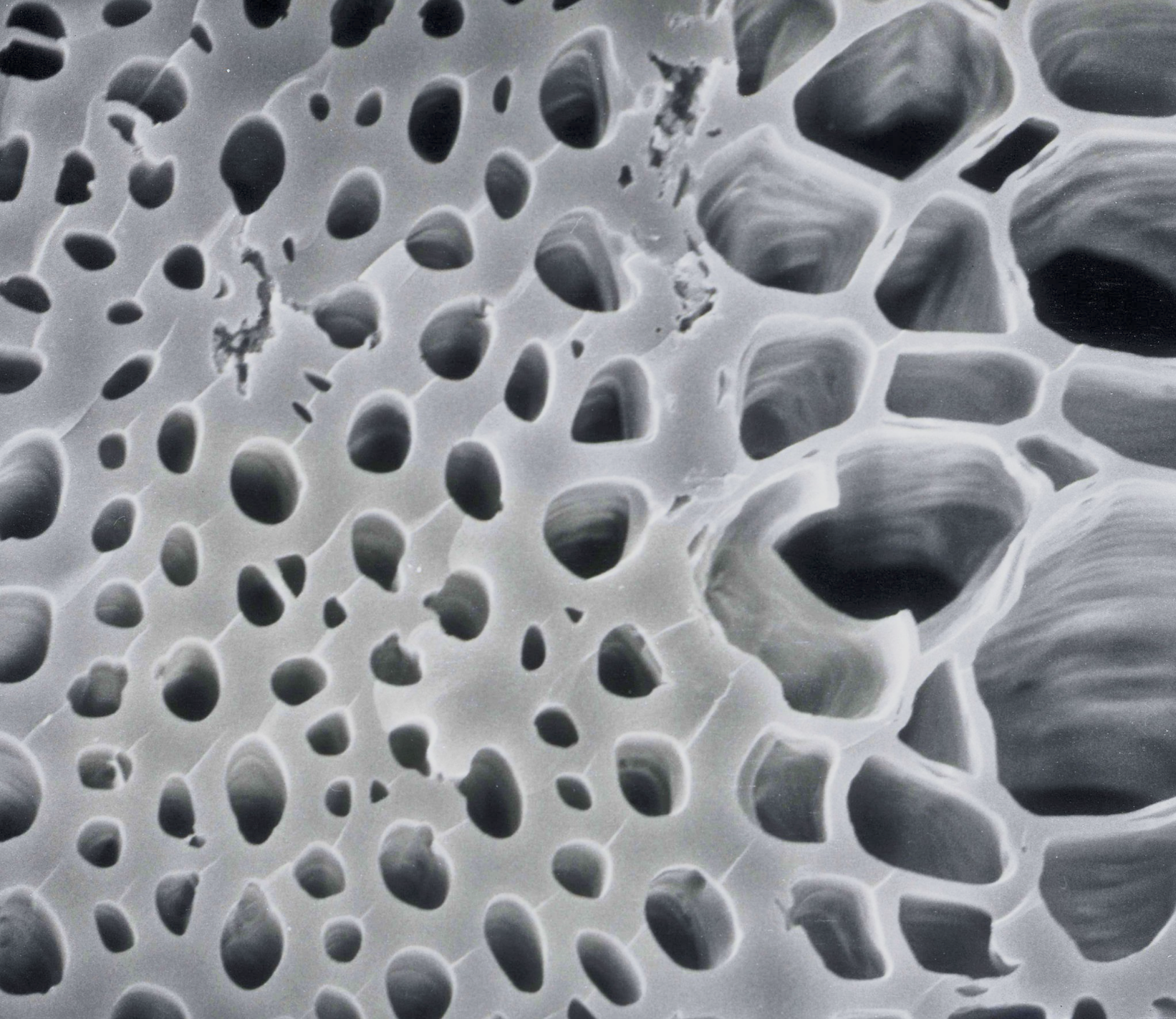
Croslite is classified as a ‘closed-cell’ resin foam. As the name suggests, each cell is separated by an independent wall. Open-cell foam has interconnected cells, making it easy for water or pressure to pass through, whereas closed-cell structures have sealed cells, making them more resistant to liquids and denser and firmer.
The problem is that even a slight deviation in the foaming ratio or cooling rate used to create this closed-cell structure can result in thinner or uneven cell walls. While they may look like equally soft foam on the outside, the internal cell structure is completely different. This is why many replicas receive reviews stating, “They feel similar when worn, but the soles flatten after a few days.” If the cell walls are not formed uniformly, they begin to collapse at certain points under repeated load.
What we discover here is not the chemical formula of the material, but the brief physical event that occurs during its creation.
In the End, It Wasn’t the Material But Time That Couldn’t Be Copied
At first, I thought the difference between Crocs and replicas was a material issue. But as I followed the information, my perspective shifted. The material is essentially public without a patent, and competitors can obtain the same EVA copolymer.
What’s truly difficult to replicate is the accumulated know-how in the molding process. The relationship between expansion and shrinkage rates, mold correction values for different pigments, and the correlation between cooling speed and cell uniformity. These are not published in academic papers, nor are they registered as patents. They exist only within the data accumulated by a company that has produced the material tens of thousands of times with its machines.
This isn’t just about shoes. When we feel that “this brand is somehow different,” we often mistake the cause of that difference for material or design issues. In reality, it’s far more common for the difference to be created by the precision of the invisible manufacturing process, knowledge that is not documented and only accumulates through repeated execution.
Rethinking Things in Front of the Shoe Rack
Now, when I pass by a Crocs store, I see it differently. I’ve learned that the reason these shoes are special is not because they use a material that doesn’t exist in the world, but because they handle common materials in a way that no one has documented.
So, the next time I encounter an object that feels comfortable, I think I’ll ask myself again: does this comfort truly come from the material, or from the touch honed through years of repetition by someone’s hands?
This article is not intended to recommend the purchase of specific products or to assert the superiority of any particular brand. Its purpose is to convey information based on publicly available patent documents and material science data. Product selection may vary based on individual needs and fit.
References
- Crocs, Inc. v. Effervescent, Inc. et al., U.S. Court of Appeals for the Federal Circuit, Docket No. 2022-2160, Appellant's Opening Brief
- "Patent check: What's in a Croc?," PlasticsToday
- "What Crocs are made of — and how they're changing," Scienceline, 2022
- "How the EVA sandal became everyone's favorite shoe," Fast Company, 2024
- "FAQ: What is Croslite?," bestwalkingfeet.com
- "Crocs," Design Life-Cycle Project (designlife-cycle.com)
- U.S. Patent No. 9,414,639 — Dance shoes with improved heel and arch sections (EVA foam density specifications)
- U.S. Patent No. 11,439,198 — Two part sole structures and uses thereof (compression molding process)
- U.S. Patent No. 11,529,783 / 12,053,948 — Cushioning member for article of footwear and related methods
- Yao, H., Pang, Y., Liu, X., Qu, J., "Experimental Study of the Dynamic and Static Compression Mechanical Properties of Closed-Cell PVC Foams," Polymers, 2022, DOI: 10.3390/polym14173522
- "Dynamic Crushing Behavior of Ethylene Vinyl Acetate Copolymer Foam Based on Energy Method," NCBI/PMC
- "3D Printed Shoes vs Crocs: Comfort, Durability & Materials," Nexbie
- "How Is Crocs Made? The Complete Guide To Crocs Manufacturing," myshoesreview.com
- "What Are Crocs Footwear Made Out Of? A Detailed Guide," myshoesreview.com
- "Guide to Crocs Technologies," sportspirit.md