
AI Stops Gambling on Probability and Starts Designing with Logic: The Semantic Renaissance
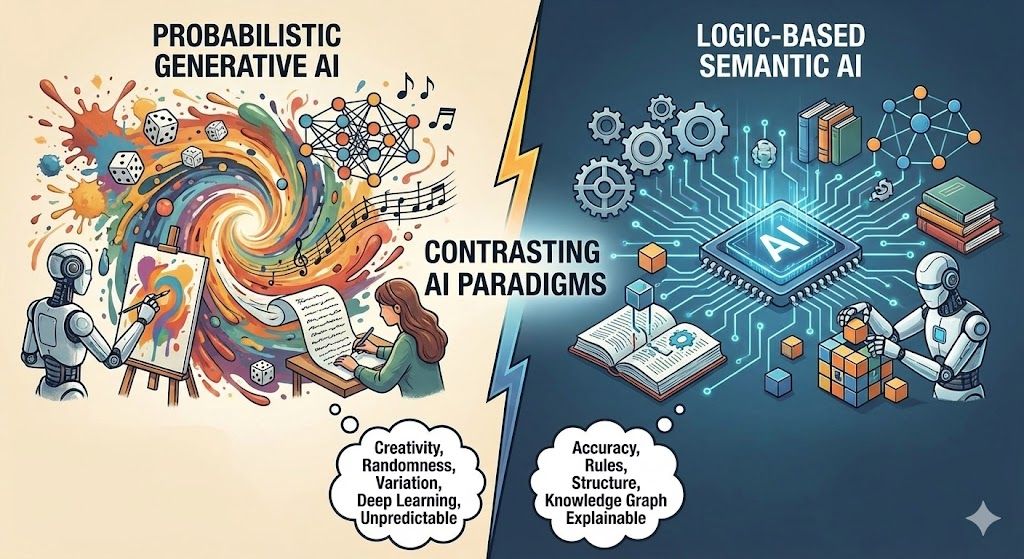
1. Goodbye, Eloquent Liar
Let’s be honest.
For the past few years, we’ve been captivated by the grand, dazzling ‘probability game’ of Generative AI.
The magic of AI, spewing eloquent sentences as if possessed by Shakespeare’s spirit and mimicking Van Gogh’s brushstrokes, was undoubtedly thrilling.
I, too, can’t forget the shock of encountering ChatGPT for the first time.
But now, as the festive lights dim and the cold invoice arrives, the expressions in corporate settings are markedly different.
“It sounds plausible, but I can’t rely on it.” This is the most painful problem AI faces today.
No CEO would trust an assistant who gives a different flight time every time they ask for it before an important business meeting tomorrow morning.
In 2025, the AI market is navigating the ‘valley of disillusionment’.
In ‘mission-critical’ domains like financial transactions, semiconductor micro-fabrication, and battlefield command and control, simply predicting the next word probabilistically is no longer sufficient.
Even if it performs perfectly 99 times, a single, fatal ‘hallucination’ can threaten a company’s survival.

The market now demands a clear answer:
A transition from ‘AI that talks the talk’ to ‘AI that truly gets the job done.’
And at the heart of this are ‘Semantic Technology’ and ‘Knowledge Graphs’ – technologies long forgotten but now powerfully revived.
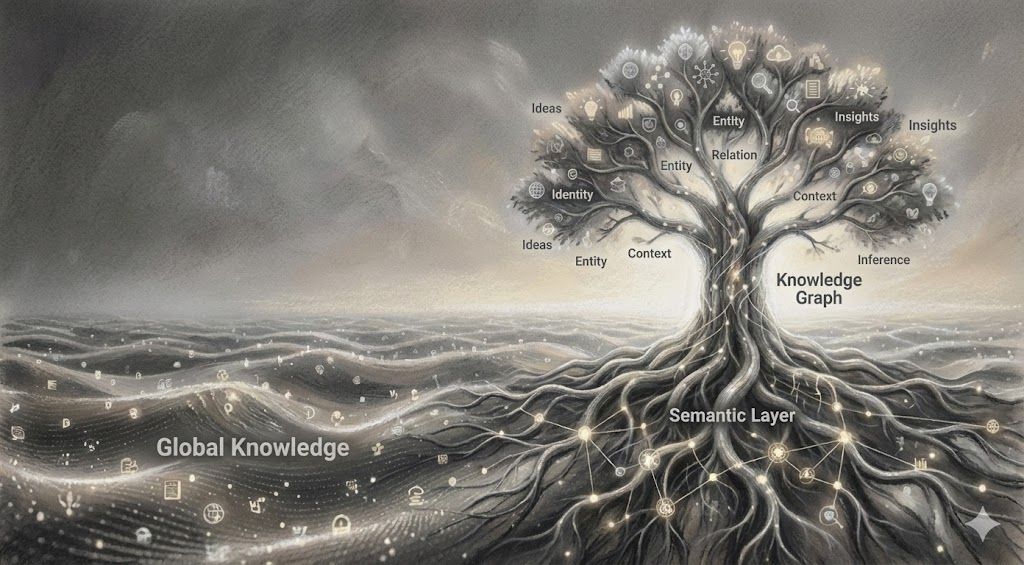
Giving **meaning** to data and teaching machines **logic** is _the final puzzle piece for true artificial intelligence_.
2. The Return of Meaning: Why ‘Semantic’ Now?
2.1. Revival of a Forgotten Dream, and the Paradox
In the early 2000s, Tim Berners-Lee, the inventor of the web, championed the ‘Semantic Web’.
A world where machines could understand and communicate the meaning of information themselves. It was a perfect dream, but it failed spectacularly at the time.
The reason was simple: _humans had to manually define the relationships between data._
_Connecting the vast data of the web manually was a near-impossible, insane task_.
But it’s quite ironic.
It’s the very LLMs (Large Language Models), once called ‘probabilistic parrots,’ that have resurrected semantic technology from its grave.
As LLMs can read vast amounts of text and automatically extract data relationships (Ontology), the barriers to building knowledge graphs, which were so difficult, have crumbled down.
2.2. The Era of Neuro-Symbolic AI
‘Diagram of an AI model combining intuitive neural networks (Neuro) and logical symbols (Symbolic), similar to the human brain structure’
We are now entering the ‘Neuro-Symbolic’ era.
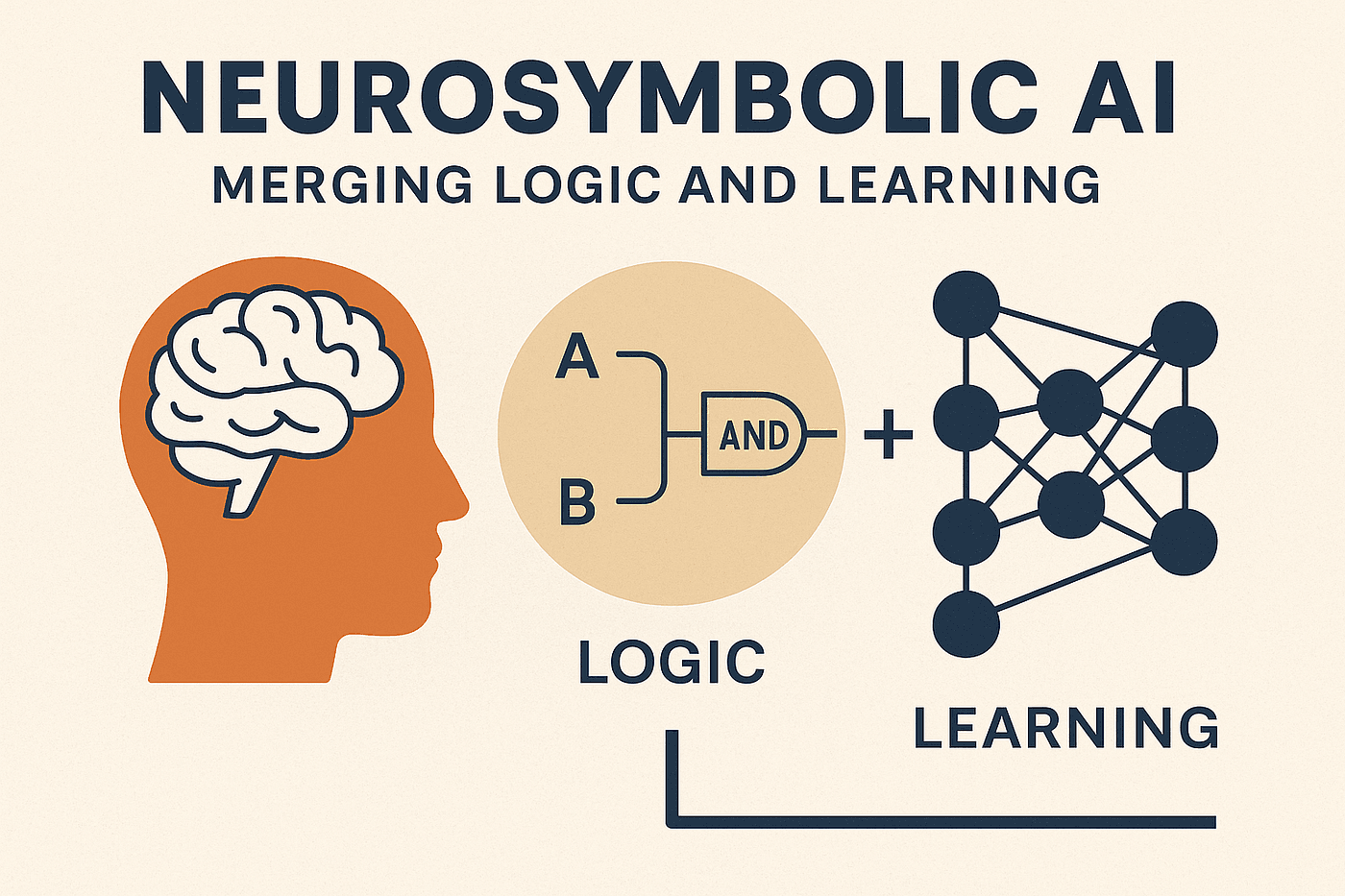
This perfectly mimics how the human brain works.
Neuro (Neural Networks/Right Brain): Handled by deep learning and LLMs. It’s intuitive, creative, and excels at understanding context.
Symbolic (Symbols/Left Brain): Handled by knowledge graphs and logical reasoning. It follows clear rules and possesses explainable and verifiable capabilities.
Quickly grasping a situation through intuition and verifying that judgment with logic.
The destructive power created by the combination of these two is chillingly evident in the recent actions of two giants, Samsung Electronics and Palantir.
3. Samsung Electronics: A ‘Personalized Brain’ in Your Hand
Samsung Electronics’ AI strategy differs slightly from its competitors.
While everyone else is clamoring for bigger servers and more powerful clouds, Samsung has delved deep into the smallest place: ‘On-Device’ within the device itself.
The acquisition of ‘Oxford Semantic Technologies (OST)’ in the UK in July 2024 was not just a tech shopping spree. It was a bold move to completely flip the script on mobile AI.
3.1. RDFox: The Supercomputer in Your Pocket
OST’s core weapon, acquired by Samsung Electronics, is ‘RDFox’.

This is the world’s fastest knowledge graph engine, with truly impressive specifications.
100% In-Memory: It doesn’t scratch slow hard drives. All calculations happen lightning-fast on RAM.
Incremental Reasoning: It’s not the foolish method of recalculating everything just because one piece of data changed.
It precisely pinpoints and updates only the parts affected by the changed data.
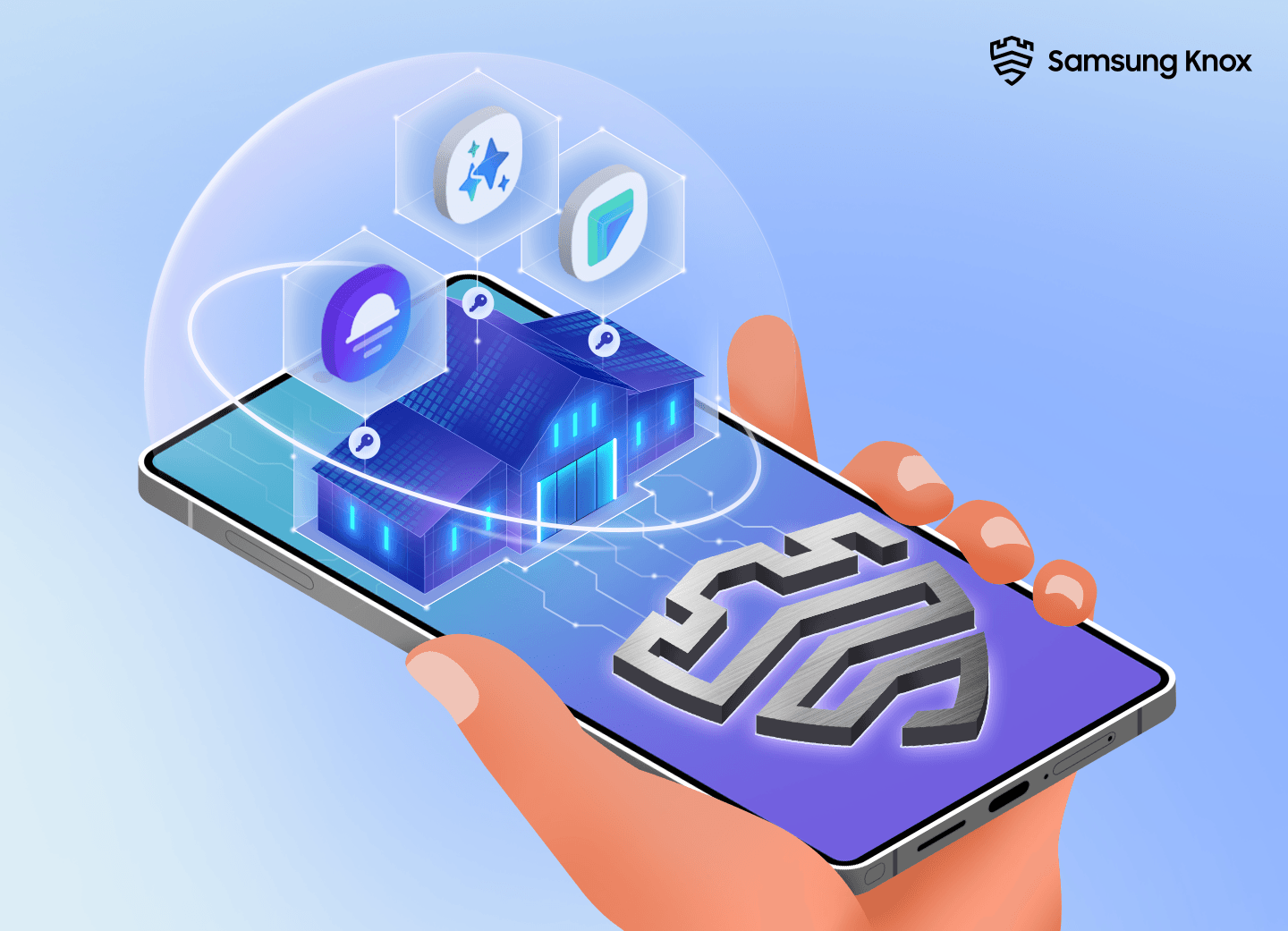
This technology, when embedded in Galaxy devices, led to its creation.
Simply put, it’s like having a ‘digital brain’ inside my smartphone that understands me more logically than I do.
3.2. Solving the Privacy Paradox
“I want it to know me very well. But please, keep my secrets safe.”
Samsung has addressed this contradictory and selfish consumer demand with an on-device knowledge graph.
My location data, credit card transactions, and sensitive health information never leave the device. RDFox connects and reasons with this fragmented information internally.
For example, when an AI suggests, “You have a meeting at the airport tomorrow morning, shall I wake you 30 minutes earlier than usual?”, my schedule data is not sent to a cloud server.
It’s a secretary who understands me better than a server but is incredibly discreet. This is the essence of ‘hyper-personalization’ that Samsung envisions.
4. Palantir: The Neural Network Powering Corporate Giants

While Samsung revolutionizes individual (B2C) lives, Palantir is rewriting the operating systems for enterprises and nations (B2B/B2G).
Palantir’s AIP (Artificial Intelligence Platform) is not just a data analysis tool.
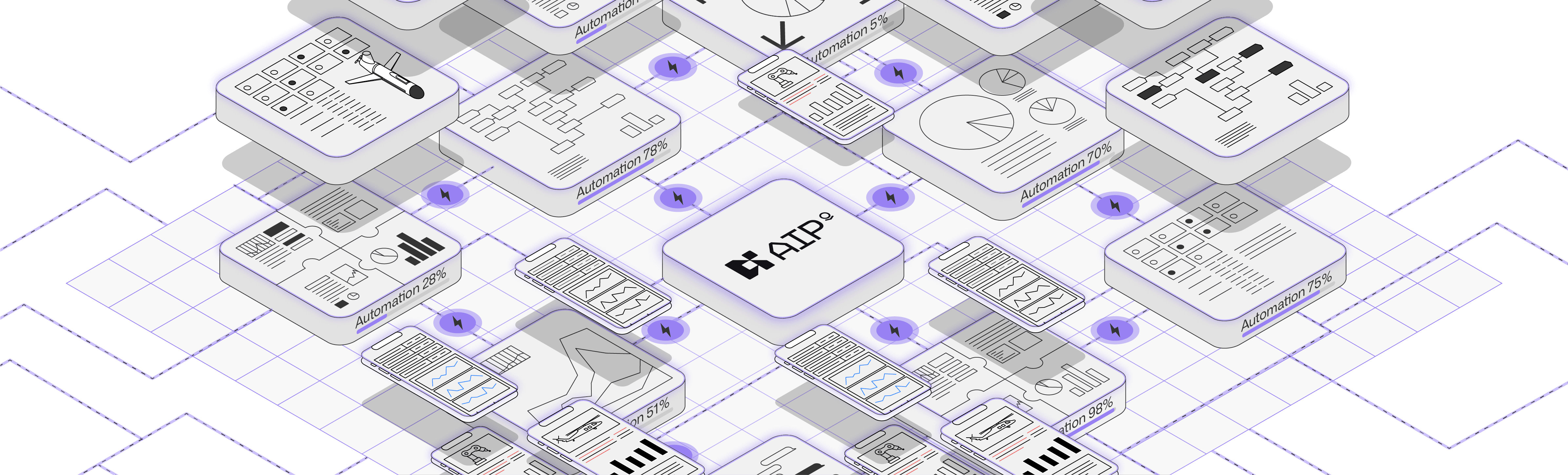
It’s closer to a massive ‘operating system’ that replicates and controls an entire organization in the digital world.
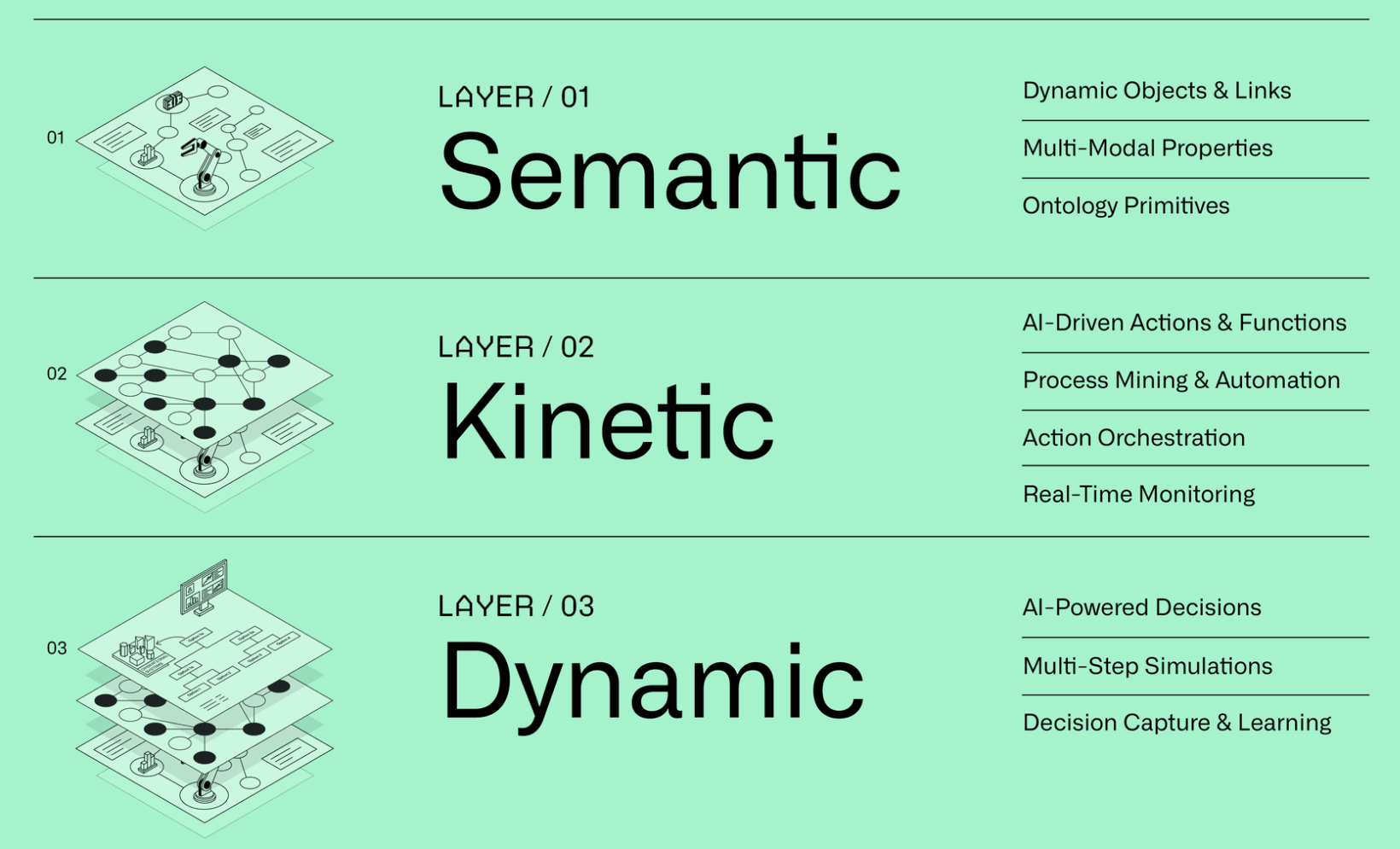
4.1. Ontology: Business as Code
Palantir’s core weapon is ‘Ontology’.
This is the process of defining and connecting an enterprise’s physical assets (factories, trucks, inventory) and logical assets (contracts, processes, customers) as software objects.
Here, a very important conceptual distinction emerges:
Semantic: Defines what the data is. (Noun-based approach)
Kinetic: Defines what can be done with that data. (Verb-based approach)
4.2. It’s About Action, Not Chat
Existing chatbots might say, “There is a shortage of inventory at Plant A currently,” and stop there.
So what are we supposed to do?
But Palantir AIP is different.
Detect: Through the ontology, it detects the shortage of raw materials at Plant A in real-time.
Reason: The LLM searches the ontology and identifies the fact that “there is available surplus at nearby Warehouse B.”
Act: With user approval, it directly accesses the ERP system and issues ‘material transfer orders.’
With this system, the UK oil company BP increased its oil field production by 30,000 barrels per day, and Airbus optimized its complex aircraft manufacturing process.
For Palantir, AI is not mere wordplay; it’s a machine that delivers a tangible ROI (Return on Investment).
5. The Forefront of Technology: GraphRAG and Hybrid Intelligence to Erase Hallucinations
Now, let’s dive deeper into topics that will excite technology enthusiasts.
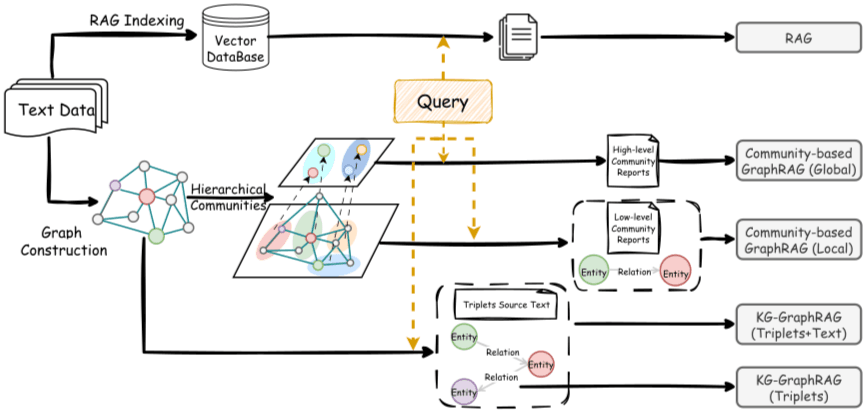
Microsoft Research’s GraphRAG is systematically breaking through the limitations of existing Retrieval-Augmented Generation (RAG).
5.1. The Limits of Vectors and the Connectivity of Graphs
Traditional RAG converts sentences into vectors (numerical coordinates) to find similar ones.
But when asked complex questions like, “Who is the current CEO of the company founded by Steve Jobs’ competitor?”, the AI is stumped.
This is because it requires reasoning that skips multiple steps.
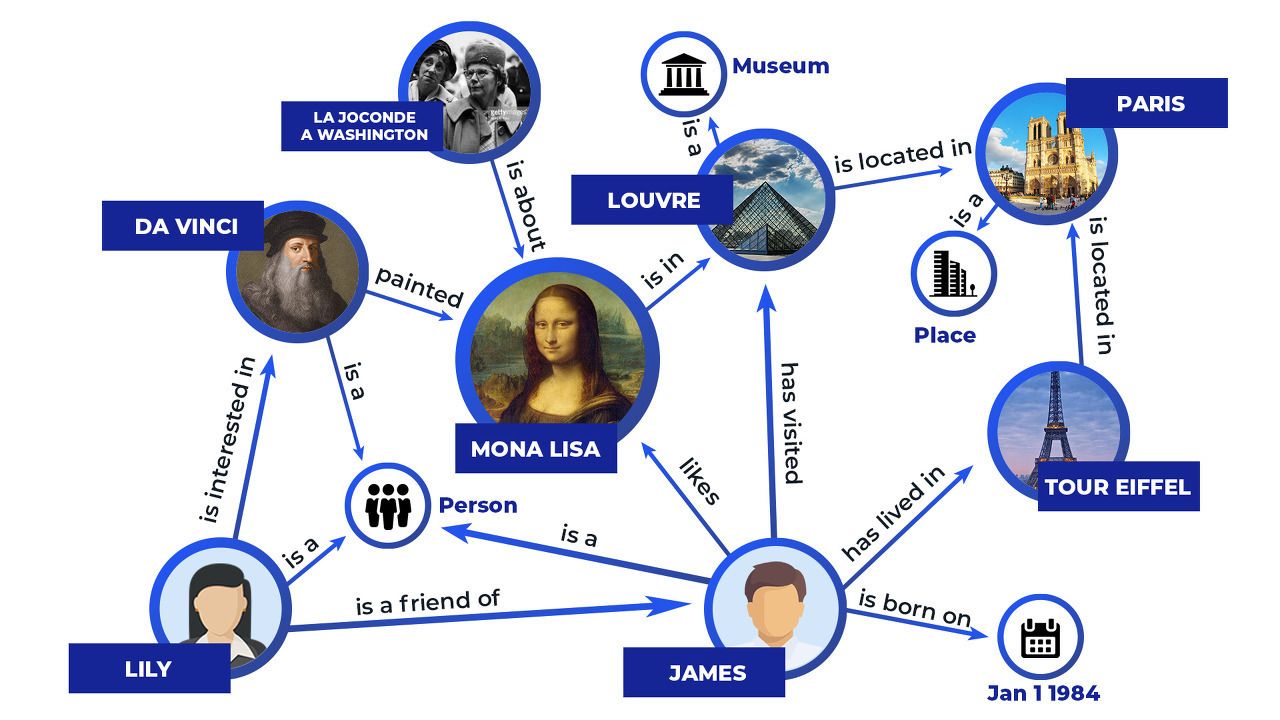
GraphRAG extracts knowledge graphs from text and forms ‘communities’ between data points.
When a question comes in, instead of simple word matching, it traverses the graph’s connections to gather and synthesize information.
5.2. Challenging Zero Hallucination
Benchmark results show that GraphRAG has dramatically reduced AI’s persistent problem of hallucinations.
Notably, ‘HybridRAG’ mixes the flexibility of vector search with the logical accuracy of graph traversal.
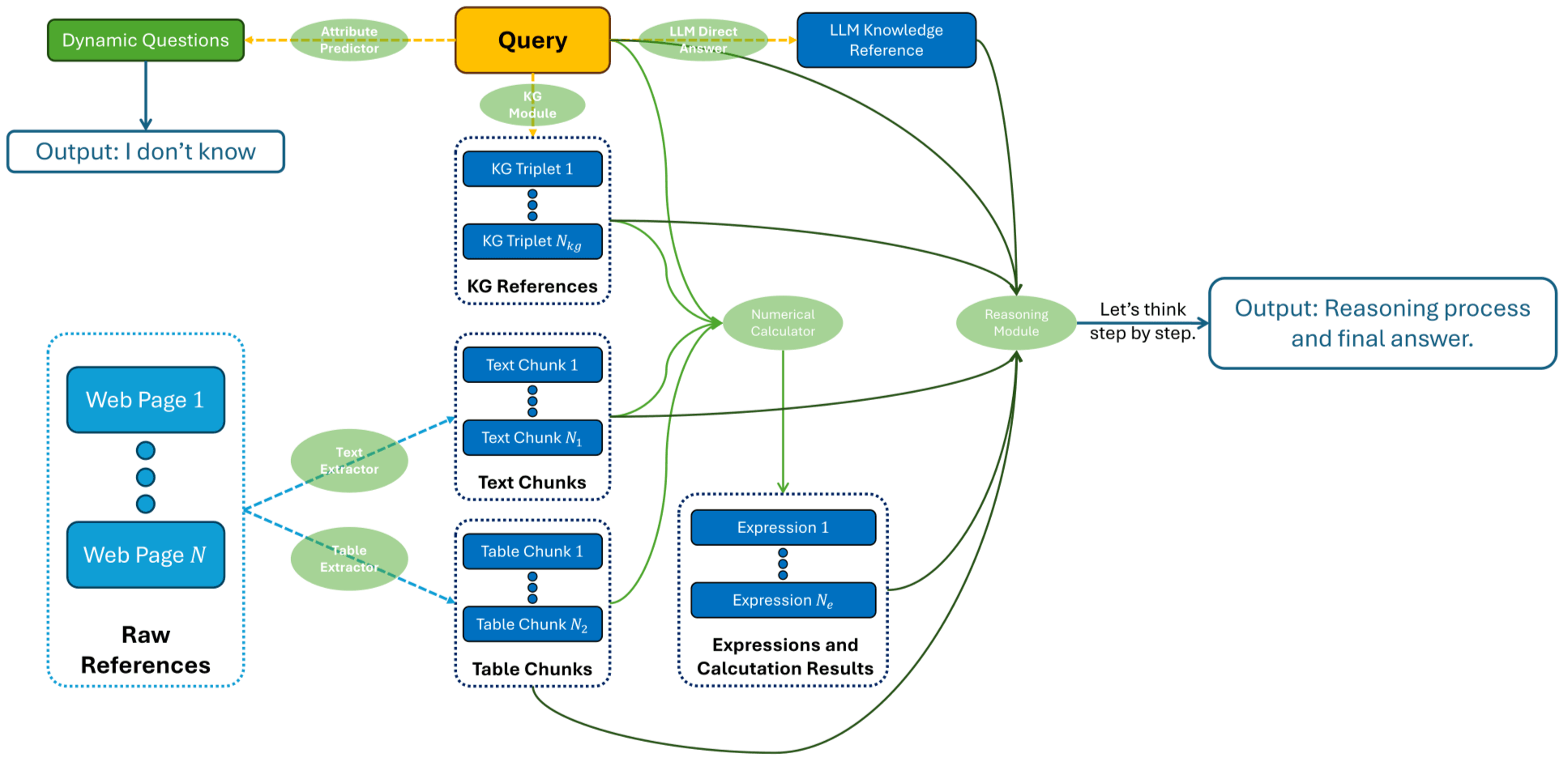
This demonstrates accuracy comparable to human experts in fields where errors can be catastrophic, such as financial report analysis or legal review.
6. The Future of Infrastructure: 6G and Semantic Communication
The semantic revolution is extending beyond software to network hardware infrastructure.
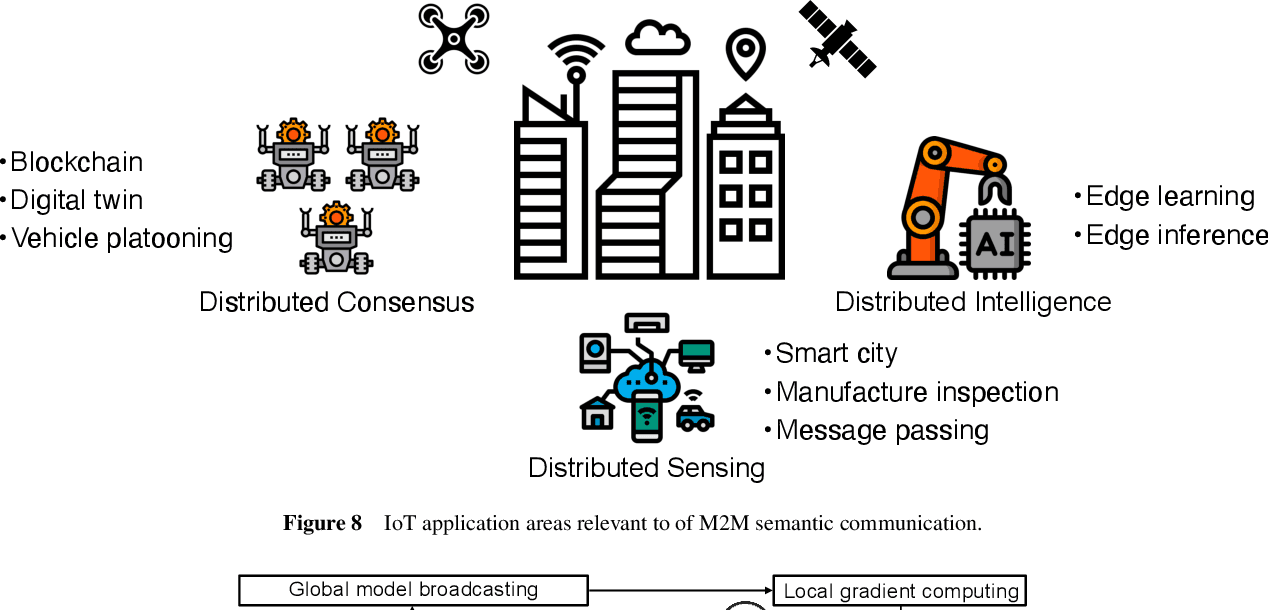
The core of the 6G network, slated for commercialization in 2030, isn’t just speed but the transmission of ‘Meaning’.
6.1. Beyond Shannon’s Limits
Claude Shannon, the father of information theory, defined the physical limits of communication capacity.
But that was for transmitting ‘bits’.
Semantic communication transmits ‘meaning’, not bits.
Conventional Communication: Transmits a 4K video of a cat jumping, compressed pixel by pixel, struggling to get through. This is a significant waste of bandwidth.
Semantic Communication: The AI at the transmitter extracts only the **meaning code and skeleton** (e.g., “Cat (object) + Jump (action) + Living Room (background)”). The AI at the receiver uses this code to reconstruct a high-definition video.
This magic, reducing data transmission volume by 1000 times while perfectly conveying the essence of information, is the future semantic communication paints.
7. Conclusion: He Who Designs Logic Will Win
In 2025, we stand at a major inflection point in AI technology.
The competition to boast about ‘how much data was fed’ is over.
It’s an era where ‘how logically the data is structured and connected’ determines victory.
Samsung Electronics is drawing a massive ‘map of meaning’ in devices in our hands, Palantir in enterprise servers, and 6G across global communication networks.
This is not just a fad.
It is the process of ‘wisdom automation,’ where data becomes information, information becomes knowledge, and finally, knowledge becomes action.
I dare to advise corporate leaders:
Do not be content with ‘Data Lakes’ that merely accumulate data.
You must pump that water out, connect and structure it to build ‘Knowledge Graphs.’
Only companies with the compass of logic, not adrift in the sea of probability, can become the true masters of the coming agent AI era.

References
1. Gartner Research \[Hype Cycle for Artificial Intelligence, 2024\]-
Oxford Semantic Technologies Whitepaper
\[RDFox: The World’s Most Advanced Knowledge Graph and Reasoning Engine\] -
Samsung Newsroom
\[Samsung Electronics Acquires Oxford Semantic Technologies to Strengthen On-Device AI Capabilities\](July 17, 2024)
-
Palantir Foundry Documentation
\[Ontology: The Operating System for the Modern Enterprise\] -
Microsoft Research Blog & GitHub
\[GraphRAG: Unlocking LLM Discovery on Narrative Private Data\] -
arXiv preprint
\[From Local to Global: A Graph RAG Approach to Query-Focused Summarization\](Edge, D., et al., 2024)
-
arXiv preprint
\[6G Networks: Beyond Shannon Towards Semantic and Goal-Oriented Communications\](Strinati, E. C., & Barbarossa, S., 2024)
-
International Data Corporation (IDC)
\[Worldwide Artificial Intelligence Spending Guide 2025\]