
A few days ago, I stood in a grocery store for ten minutes just trying to buy a jar of jam. There were eight different types of strawberry jam alone: low-sugar, organic, imported, domestic, with seeds, seedless. As I eventually grabbed one and headed out, I couldn’t help but wonder: Did I just make a rational choice, or was I just exhausted and gave up?
If you open an economics textbook, the answer is simple. Humans are rational. We make a Rational Choice that maximizes our utility within the given information. But that qualifier, “within the given information,” kept bothering me. Surely, choosing between eight options and choosing between eighty cannot carry the same weight.
What Rational Choice Theory Was Originally About
First, I think we need to clear up a misunderstanding. Rational Choice Theory does not claim that people always pick the “correct” answer. It is a theory designed to predict outcomes and patterns of choice, not to explain the actual decision-making process. In other words, it doesn’t aim to peer inside our brains to see “why” we chose something; it’s a premise that as long as there is a consistent preference system, a somewhat predictable pattern emerges.
Its premises are simpler than you might think. Individuals hold preferences among alternatives, and those preferences are complete (you must be able to choose between two or say you are indifferent) and transitive (if you like A over B, and B over C, you must also like A over C). Looking at it this way, it sounds like a fairly reasonable requirement. The problem is that real-life choices don’t just happen within these neat conditions.
While looking through KDI materials, I found an interesting sentence: The choices we actually face are not all-or-nothing scenarios, like deciding between starving or eating until we burst, but rather marginal choices, like deciding whether or not to take one more spoonful of rice. Therefore, rationality is not something exerted between two extreme options, but something that must be re-activated with every tiny adjustment. When these tiny adjustments pile up, there comes a point where the brain simply gets exhausted first.

*## 24 Jams vs. 6 Jams: Why Do More Choices Lead to Fewer Sales?
I can’t skip the famous experiment here. Stanford’s Mark Lepper and Columbia’s Sheena Iyengar set up two tasting booths at a grocery store. They displayed six types of jam at one booth and twenty-four at the other.
As expected, people were more drawn to the variety. 60% of passing customers stopped at the twenty-four-jam booth, while only 40% stopped at the six-jam booth. Up to this point, it aligns with common sense. People are more attracted to more choices.
However, when it came to actual purchases, the story flipped completely. At the twenty-four-jam booth, only 3% of visitors bought jam, while 30% of those at the six-jam booth made a purchase. In numbers, that’s a tenfold difference. Increasing the number of choices increased interest but actually decreased real action.
Comparison of Interest and Purchase Rates at Jam Tasting Booths by Number of Options
| Category | 6-Jam Booth | 24-Jam Booth |
|—|—|—|
| Stopped at booth | 40% | 60% |
| Actual purchase rate | 30% | 3% |
The two researchers confirmed this result again with chocolate. After having people taste two types of chocolate from a selection of either six or thirty and rate them out of 10, the average satisfaction at the six-chocolate booth was 6.25, while the thirty-chocolate booth was 5.5. This means that the group with more choices was actually less satisfied. At this point, I think we should question the intuition that “more choices are always better.”
Why Does Having More Choices Make Things Worse?
Psychologist Barry Schwartz is the one who properly named this phenomenon. In his 2004 book, he argued that as choices increase, people don’t necessarily make better decisions; instead, they either struggle to decide at all or experience greater regret after the decision.
There are two main mechanisms. One is when there are so many choices that the brain experiences overload, leading to an inability to make any decision at all. The other is that the more choices there are, the greater the regret that you might have made a better choice elsewhere. The former is a problem of failing to decide, and the latter is a problem where the decision is made, but it continues to gnaw at you. The causes are different, but the results are similar: satisfaction decreases.
If you push this to the extreme, you reach a point where you give up on the decision itself. In psychology, this is called Analysis Paralysis. It is described as a phenomenon where the fear of missing out on a better solution overwhelms the expected value, and the decision itself is repressed in an unconscious effort to preserve the status quo. In short, it’s not that we can’t decide because we lack information, but rather that we can’t decide because we have too much information and too many choices. The very effort to be rational creates the paradox that hinders rational choice.
Personally, this part hit home. I’ve always believed that when choosing something, “if I look into it more, I can make a better choice,” but the idea that this belief itself could be a trap felt unfamiliar.
Satisficers vs. Maximizers: Which One Am I?
Schwartz categorized how people choose into two types: Maximizers, who want to find the best possible option by reviewing all alternatives, and Satisficers, who set clear criteria and wrap up their choice the moment those criteria are met.
What’s interesting is that Maximizers do not actually perform better in reality. In fact, investment cases show that Satisficers, who set criteria, achieve better long-term results than Maximizers, who try to find the absolute best stock. The moment you change your question from “What is the best?” to “What conditions need to be met?”, you actually start choosing better.
I think this is worth reconsidering. We often understand “choosing rationally” as “comparing every possible option to find the optimal point.” But if that perfectionist rationality actually delays decisions, increases regret, and lowers satisfaction—is that really rational, or is it something else disguised under the name of rationality?
The Ultimatum Game: Why We Accept Losses to Reject Unfairness
If the paradox of choice is a problem of “too many options,” there is another case with a different nuance: the Ultimatum Game, which has been studied in game theory for a long time. The rules are simple. One person proposes how to split money, and the other can accept or reject it. If they reject, neither person gets anything.
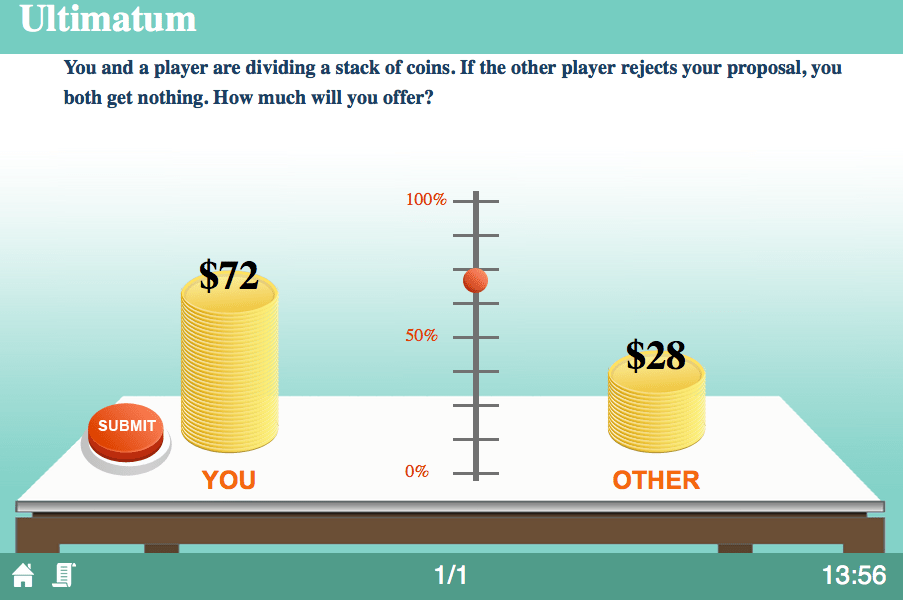
If you look at it from a purely rational standpoint, the answer is fixed. Any amount is better than zero, so it is correct to accept. The equilibrium point calculated in game theory is the same. Even if the proposer takes a share favorable to themselves, it is theoretically the correct choice not to reject, as rejecting means getting nothing.
However, in real experiments, this prediction is consistently off the mark. When presented with “Take $10 out of $100, or reject and both get $0," traditional economics says it’s rational to accept because $10 is greater than $0. But decades of experimental results repeatedly show that people don’t just calculate money. Instead of accepting a low offer, people often give up their own share just to tell the person who undervalued them that the deal is unacceptable.
From a calculator’s perspective, this is completely irrational behavior. But if you look at it differently, these people simply aren’t optimizing for the single axis of money. They are including another axis in their calculation: fairness. This experiment is treated as a microcosm of reality where the distribution of money—such as wage negotiations, bonuses, platform fees, inheritance disputes, and performance reviews—is not just about numbers, but is intertwined with respect, status, and power dynamics.
This leads to a question: If the word “rational” yields completely different answers depending on what is being optimized, by whose standards should we judge rationality?
So, Is Being Rational Always the Best?
If we’ve come this far, we return to the original question. If you ask whether a rational choice is always the best choice, I think we can say that the equation breaks down in at least three ways.
First, the increase in choices itself erodes judgment. Gathering more information and reviewing more alternatives does not always lead to a better decision. This is exactly what the jam experiment showed.
Second, what to optimize is ambiguous. As seen in the Ultimatum Game, people weigh not just money, but fairness, pride, and relationships. This means the word “rational” itself implies that there isn’t just one item to calculate.
Third, the attitude of chasing perfection comes at a cost. The fact that Maximizers don’t perform better than Satisficers shows that the effort to push rationality to the extreme also has a cost.
This doesn’t mean rationality is useless. However, it reaffirms that Rational Choice Theory was originally aimed at “making the results of choices predictable,” not “guaranteeing the optimal answer every time.” Even I, who wasted ten minutes in front of eight jars of jam today, was actually just exhausted and chose a random jam like a Satisficer in the end. I’m still not sure if that was the best choice.
References
- Wikipedia - Rational Choice Theory
- Wikipedia - Behavioral Economics
- Wikipedia - Ultimatum Game
- Wikipedia - Analysis Paralysis
- KDI Economic Education - Rational Choice
- Barry Schwartz, The Paradox of Choice
- Iyengar & Lepper, Jam Experiment Study