

Birth of Financial Giants: The Beginning of Everything
The news of Naver and Dunamu joining forces is not just another M&A announcement. It is a monumental event that will carve a significant mark in the history of South Korea’s digital economy. Imagine two giants, each having built formidable empires in their own domains, now joining hands.
On one side, we have Naver, the embodiment of the platform economy that dominates our daily lives, a “Big Tech model.” On the other, Dunamu, a disruptive innovator shaking the foundations of traditional finance, a “Web3 model.” Two entirely different rivers are finally merging to create an unstoppable, colossal current. This merger goes beyond mere expansion; it holds the potential to redefine South Korea’s financial infrastructure from the ground up.
While the paperwork might suggest Naver acquiring Dunamu, a closer look reveals it’s more akin to Dunamu effectively acquiring the financial heart of Naver. In essence, this union is an “inevitable encounter” born out of mutual desperation. Naver was desperately seeking a new breakthrough as its traditional business growth plateaued, while Dunamu was yearning for legitimacy beyond the confines of virtual assets to enter the mainstream market.
The future these two foresee is clear: the birth of a “Super App” with unprecedented market dominance, capable of handling everything from search, shopping, and payments to digital asset trading in one place. This is a powerful declaration of war against traditional financial institutions and a daunting challenge for regulators. More broadly, it will prompt society to fundamentally question what data concentration and economic power in the digital age truly mean. We will now delve into every aspect of this colossal transformation.
Anatomy of Two Giants: What Makes Them Special?
To understand why the union of Naver and Dunamu is so disruptive, we must first examine the unique strengths and strategic positions each company holds. While their differences promise powerful synergy, they also sow the seeds of potential conflict during integration.
Naver: The Digital Commonwealth Ruling Daily Life
Naver is the sovereign of a vast empire whose territory is the very digital life of the South Korean people. Its business portfolio, which began with search and expanded into commerce, fintech, content, and cloud, is deeply embedded in every aspect of our daily lives. 
Blueprint of a Business Empire
Naver’s empire is built on five interlocking pillars:
- Search Platform: The undisputed leader in the South Korean search market. Advertising revenue from this platform serves as Naver’s strong treasury, its cash cow.
- Commerce: With Smart Store and Shopping Live, it’s engaged in fierce competition with the giant Coupang, establishing itself as a key player in the e-commerce market.
- Fintech: Led by Naver Pay, it’s aggressively encroaching on the financial territory, offering not just payments and remittances but also loans and insurance.
- Content: Webtoons, web novels, and SNOW are gaining strong global fandoms, becoming future growth engines.
- Cloud: By offering enterprise solutions and AI and robotics technologies, it’s targeting the B2B market, solidifying its identity as a technology company beyond a mere internet firm.
Financial Prowess
The strength supporting this vast empire comes from its robust financial health. In 2024, Naver made history by becoming the first domestic internet company to surpass 10 trillion won in annual revenue. With 10.7377 trillion won in annual revenue and 1.9793 trillion won in operating profit, it demonstrated its continued vitality with year-on-year growth of 11.0% and 32.9%, respectively. This financial stability provides the ammunition for a mega-M&A and the market’s trust.
The Crown Jewel: Naver Financial
Among Naver’s numerous businesses, Naver Financial stands at the very center of this merger. Represented by Naver Pay, this company is the undisputed number one player in South Korea’s simple payment market. It ranked first in brand reputation surveys in April and July 2025, boasting an overwhelming market share with half of mobile payment users considering it their primary choice. However, Naver Financial’s ambition extends beyond mere payment methods. Its evolution into a comprehensive financial platform, encompassing loan brokerage, insurance comparison, and securities services, clearly demonstrates Naver’s grand ambition to encompass the entire financial industry.
Dunamu: The Tycoon of the Cryptocurrency World
Dunamu is an emerging powerhouse that has built an overwhelmingly dominant empire in the uncharted territory of virtual assets in an astonishingly short period. Fueled by the massive profits generated from South Korea’s largest virtual asset exchange, “Upbit,” it now dreams of becoming a next-generation financial infrastructure company. 
Upbit’s Overwhelming Market Dominance
Upbit is the heart of Dunamu. As of July 2025, Upbit’s monthly active users (MAU) were 4.53 million, nearly double that of its closest competitor, Bithumb (2.42 million). It also significantly outpaced competitors in user time and session counts. Its market share stands at a remarkable 64%, solidifying a de facto “1-strong” system where competition is nearly meaningless. During Bitcoin price surges, daily trading volume has exceeded 4.3 billion dollars. Dunamu is not just a market leader; it is the very infrastructure of South Korea’s virtual asset market.
Astonishing Profitability
Dunamu’s financial statements are breathtaking. In 2024, it reported 1.7316 trillion won in revenue and an operating profit of a staggering 1.1863 trillion won. An operating profit margin of 69% is far beyond what Naver achieves with its consolidated operating profit margin of approximately 18.8%, starkly illustrating how efficiently Dunamu operates as a cash-generating machine. This immense cash flow is the source of Dunamu’s ability to invest boldly in future technologies and exert strong influence in the M&A market.
Beyond the Exchange: Designing the Future
Dunamu shows no intention of resting on its current success. Its vision is to grow into a future financial infrastructure company, transcending its role as an exchange.
- Directly Building Web3 Infrastructure: The unveiling of its own blockchain, “GIWA Chain,” and wallet service, “GIWA Wallet,” signals its ambition to create core technologies for the next-generation internet environment. It aims to be a designer of the game’s rules, not just a service provider.
- BaaS (Blockchain-as-a-Service): Through its subsidiary Lambda256, it operates “Luniverse,” a platform that helps companies easily adopt blockchain technology. By providing technical solutions in various fields like security tokens (STO) and NFTs, it’s building the technological foundation of the blockchain ecosystem.
- Investing in Future Technologies: Through Dunamu & Partners, it’s aggressively investing in promising startups in fields like AI, fintech, and healthcare. As of May 2025, it has invested 194 billion won in 70 startups, preemptively securing positions in the future technology ecosystem. This is not merely financial investment but a strategic move to secure potential partners who could synergize with the Upbit ecosystem in the future.
Comparing the profiles of these two companies clarifies the essence of this merger. Naver possesses vast “scale (users, data),” while Dunamu has overwhelming “efficiency (profitability).” If Naver has “what (customers),” Dunamu has “how (high-profit engine).” Therefore, this merger is more like a giant, facing growth stagnation despite its size, acquiring a small but sharp, strong enterprise to change its financial structure and growth trajectory.
Furthermore, the two companies have fundamentally different DNA. Naver is a giant of Web2, grown on centralized data, while Dunamu is a Web3-native company based on decentralized technology. These cultural and technological differences will undoubtedly present immense challenges during the integration process, but they will also be the greatest driving force for innovation that disrupts the existing order.
| Metric | Naver (Consolidated) | Dunamu (Consolidated) | Naver Financial | Key Comparison |
|---|---|---|---|---|
| 2024 Annual Revenue | 10.7377 trillion won | 1.7316 trillion won | 1.65 trillion won | Naver’s overwhelming scale advantage |
| 2024 Operating Profit | 1.9793 trillion won | 1.1863 trillion won | 103.5 billion won | Dunamu’s astonishing profit generation capability |
| Operating Margin | Approx. 18.4% | Approx. 68.5% | Approx. 6.3% | Dunamu’s absolute superiority in efficiency |
| Total Assets (2024) | - | 15.3205 trillion won | 3.8979 trillion won | Dunamu’s substantial asset size |
| Core Business Area | Search, Commerce, Fintech, Content, Cloud | Virtual Assets Trading, Web3 Infrastructure, Venture Investment | Simple Payment, Financial Platform | Complementary business portfolio |
| Market Share (Primary) | Search (Dominant), Simple Payment (1st) | Virtual Asset Trading (Over 64%) | Simple Payment (1st) | Exclusive positions secured in respective domains |
| User Base | Nationwide (Approx. 40 million+) | 4.53 million (MAU) | - | Naver’s vast user base is the core asset |
Deconstructing the ‘Big Deal’: Structure, Value, and Hidden Ambitions
The merger between Naver and Dunamu is not merely a transaction of buying and selling companies. Behind it lies complex valuation and restructuring of governance, embedded with sophisticated financial engineering. In this section, we will delve deeply into the structural characteristics of this deal and the strategic reasons that compelled each company to undertake such intricate maneuvers.
The Architecture of the Merger: A David Swallowing a Giant, a Veiled Reverse Takeover
This transaction will proceed through a “comprehensive stock swap” where Dunamu becomes a 100% subsidiary of Naver Financial. On the surface, it appears Naver’s financial subsidiary is acquiring Dunamu, but in reality, it’s quite the opposite.
The key lies in the enterprise value of the two companies. The market values Dunamu at approximately 14-15 trillion won, and Naver Financial at around 4.7-5.1 trillion won. This is roughly a 3:1 difference. Stocks will be exchanged based on this ratio.
Here, the “1 to 3” ratio signifies more than just an exchange ratio; it’s the key that triggers a seismic shift in the governance structure of the merged entity. Song Chi-hyung, Chairman of Dunamu, who holds about 25% of Dunamu’s shares, will secure approximately 20% of the merged Naver Financial’s shares post-exchange, instantly becoming the single largest shareholder. Conversely, Naver, which previously held 69% of the shares, will likely see its stake diluted, becoming the second-largest shareholder. In essence, under the grand banner of “Naver,” the actual management control will be held by Dunamu’s side, signifying a “Reverse Takeover.” 
Strategic Rationale: When Necessity Meets Ambition
The reason both companies are pursuing this complex and sensitive governance restructuring lies in their desperate need for survival and growth.
Naver: In Need of a New Growth Engine
Despite its impressive outward appearance, Naver is experiencing severe growing pains.
- Stagnation of Core Businesses: Its mainstay search advertising is already in its mature phase, and commerce faces fierce competition with Coupang, making profitability challenging. Its AI business is struggling against global tech giants with immense financial power. This is why a sense of crisis prevails within Naver, with the sentiment that “there are no more safe businesses.”
- Thirst for Global Expansion: After experiencing management disputes with LINE, Naver urgently needs a new momentum for global expansion. Borderless digital assets and Web3 can open up a new global stage for Naver.
- The Final Puzzle Piece of Fintech: Naver knows well that simple payments alone cannot secure dominance in the future financial market. It needs to embrace next-generation financial infrastructure and digital assets to become a true “financial super app,” and Dunamu is the only partner capable of instantly providing this final puzzle piece.
Dunamu: Towards Institutionalization and Territorial Expansion
Despite its dazzling profitability, Dunamu also faces distinct limitations and threats.
- Resolving Regulatory Risks: Dunamu has operated under constant regulatory uncertainty. Issues like lawsuits with the Financial Intelligence Unit (FIU) have been major obstacles to business expansion. Joining forces with Naver, a “national company,” serves as a powerful shield in its relationship with regulators and lends legitimacy to its operations.
- Securing a User Base of 40 Million: Upbit’s users are limited to those interested in virtual asset investment. Naver is like an express highway connecting Dunamu to the entire South Korean population. Utilizing Naver IDs can streamline complex Know Your Customer (KYC) procedures, leading to explosive user growth.
- Diversifying Revenue Structure: Dunamu’s revenue relies almost entirely on the volatile virtual asset trading fees. By being integrated into the Naver ecosystem, it can secure more stable revenue streams such as payments, loans, and asset management, diversifying its business portfolio.
In conclusion, this merger is a strategic decision by Naver to acknowledge that the future paradigm of finance is being created in Web3 beyond the framework of Web2, and to choose to “purchase” it rather than build it directly. Meanwhile, the valuation of this deal reflects the market’s perspective, which places a higher value on future potential (Dunamu’s Web3 ecosystem) than on current scale (Naver Pay). This indicates that investors are betting on the higher growth potential and profitability of Web3 finance compared to Web2 fintech. 
However, despite these strategic justifications, a significant hurdle remains: convincing shareholders. Naver shareholders may protest that their core subsidiary is being sold too cheaply, and other shareholders of Dunamu might express dissatisfaction with the valuation. Therefore, the ultimate success of the merger hinges not only on regulatory approval but also on convincing shareholders that the long-term synergistic effects will more than offset short-term losses.
| Synergy Area | Naver’s Benefit | Dunamu’s Benefit | Integrated Entity’s Competitive Advantage | Key Risks/Challenges |
|---|---|---|---|---|
| User Base & KYC | New inflow of virtual asset investors | Immediate access to Naver’s 40 million user base | Formation of the largest financial user pool in Korea via simplified KYC through Naver ID | Privacy and security issues related to integrated personal information |
| Payment Infrastructure | Reduced fees via stablecoin-based next-gen payment network | Linking virtual assets in Upbit to Naver Pay payments | Establishment of a complete closed-loop ecosystem connecting search-shopping-payment-investment | Intensified conflict with existing credit card companies and VAN companies |
| Stablecoin Issuance | Securing core infrastructure for Web3 finance | Dominance in the issuance and circulation of stablecoins | Mastering market standards through first-ever large-scale KRW stablecoin issuance and circulation | Strong regulation from the central bank and financial authorities regarding financial stability |
| Web3 Service Integration | Applying Dunamu’s blockchain tech to Naver services | Securing a large-scale commercialization testbed for its Web3 tech | Creating innovative services merging Web2 and Web3 like NFT webtoons and game item trading | Technical integration complexity and clashes between different corporate cultures |
| Data Analysis | Acquiring user investment/asset data for hyper-personalized financial services | Developing sophisticated investment products using Naver’s search/consumption data | Overwhelming data competitiveness based on the most comprehensive consumer finance profile in Korea | Social criticism and intensified regulation regarding data monopolies |
| Regulatory Relations | Resolving virtual asset regulatory uncertainty | Mitigating regulatory risks using Naver’s lobbying capabilities | Maximizing negotiation power by combining a “national platform” with a “1st-place virtual asset operator” | Potential focus of intense scrutiny from regulators due to “Too Big to Fail” concerns |
| Global Expansion | Establishing new bridgeheads for overseas expansion through borderless Web3 services | Entering overseas markets leveraging Naver’s global network | Targeting global markets beyond Asia by combining the “K-Fintech” model with Web3 | Differences in regulatory environments across countries and competition with USD-based stablecoins |

Reshaping the Digital Finance Landscape: Everything Changes
The meeting of Naver and Dunamu will not just alter the destinies of these two companies. It will trigger a seismic shift that will shake the very foundations of South Korea’s financial and industrial landscape. This union will birth a new form of “financial super app,” blur industry boundaries, and pose an existential threat to existing financial powerhouses, forcing them to worry about their survival.
The Emergence of a “Financial Super App,” and the Power of Data
The merged entity will offer an integrated ecosystem where users can seamlessly handle all their financial activities—search (Naver), shopping (Naver Commerce), payments (Naver Pay), and investments in traditional and digital assets (Upbit)—within a single app. This will create an extreme level of user convenience, establishing a powerful “lock-in effect” that binds users to the platform.
However, the truly formidable power stems from data integration. Imagine combining your search history, purchasing patterns, and interests data held by Naver with your financial asset, investment propensity, and transaction history data held by Dunamu. This will result in the creation of the most sophisticated and comprehensive personal financial profile in South Korea. Analyzing this data with AI will enable personalized financial product recommendations, refined credit scoring, and ultra-precise targeted advertising. For instance, someone searching for “newlywed home interior” on Naver could be recommended a tailored mortgage loan through Naver Pay, or if they show a propensity for investing in a particular coin on Upbit, they could be presented with related NFT products for cross-selling. This offers an overwhelming competitive advantage based on data that traditional banks or securities firms cannot possibly replicate.
Acceleration of “Big Blur”: Industry Boundaries Vanish

An Existential Threat to Traditional Financial Institutions
The emergence of the merged entity poses a direct threat that shakes the very foundation of the traditional financial industry.
- Traditional Banks: Users will rapidly gravitate towards more convenient and intuitive super apps. Especially with the proliferation of stablecoins, deposits, a core source of funds for banks, could flow in large volumes into the digital wallets of super apps. This means the weakening of banks’ core profit model—net interest margin—and a potential contraction of their fund intermediation function.
- Securities Firms: If users can trade stocks and virtual assets with a single click within the Naver app they use daily, how many will bother opening a separate Mobile Trading System (MTS)? Particularly, younger generations of investors will inevitably prefer easier and more integrated platforms.
- Credit Card Companies: If the merged entity establishes its own payment network based on stablecoins, the credit card industry’s core revenue source—merchant fees—could be rendered powerless. Blockchain-based payments can significantly reduce fees by minimizing intermediaries, making them an attractive alternative for both merchants and consumers.
These changes present a survival challenge for traditional financial institutions. They can no longer afford to focus solely on interest rate or fee competition. To counter the “ecosystem vs. ecosystem” competitive landscape that the merged entity will build, financial companies will have to undertake a comprehensive strategic overhaul, such as creating their own platforms or joining forces with other big techs. This will inevitably act as a catalyst for widespread M&A and alliances across the entire financial industry.
The Stablecoin Gambit: The Dawn of a New Currency?
Among the many ripple effects of the Naver-Dunamu merger, the most innovative and controversial aspect is the potential birth of a private stablecoin pegged to the South Korean Won (KRW), tentatively named “KRW-Coin.” This is not merely about adding another payment method; it will be a massive social experiment that fundamentally questions the nation’s currency system and financial stability. 
The Blueprint of “KRW-Coin”: How It Works
The vision for the won-denominated stablecoin envisioned by the merged entity is clear.
- Issuance and Circulation: Dunamu will be responsible for the issuance and circulation of the stablecoin through its own blockchain technology, like “GIWA Chain,” and Upbit’s infrastructure. Naver will provide a wide distribution channel where this coin can be used in real life through its powerful digital wallet, Naver Pay, and its network of millions of merchants.
- Economic Model: It’s very simple. When a user tops up 1,000 won on Naver Pay, the merged entity issues exactly 1,000 KRW-Coins and holds the received cash as reserves in safe assets like bank deposits or government bonds. The stablecoin itself does not have direct profit-generating value as its value remains stable. The real profit comes from the interest earned by managing the massive reserves, expected to be trillions of won. Furthermore, significant cost savings will be achieved by replacing existing credit card fees with its own network. The market anticipates substantial annual profits if this business is successfully established.
The Regulatory Gateway and the Bank of Korea’s Intentions
However, this grand vision must overcome formidable regulatory hurdles to become a reality.
- Legal Vacuum: South Korea’s “Virtual Asset User Protection Act” currently focuses on investor protection, lacking clear provisions on the qualifications of stablecoin issuers or reserve regulations. Legal grounds will only be established with the passage of the “Digital Asset Basic Act” being discussed in the National Assembly, but its content and timeline remain uncertain.
- Concerns about Financial Stability: Financial authorities and the Bank of Korea (BOK) have expressed deep concerns about private stablecoins. The biggest worry is the possibility of a large-scale withdrawal event, a “coin run,” if reserves become distressed or market confidence collapses. This is a nightmare we clearly witnessed in the Terra-Luna incident in 2022. Furthermore, if substantial funds move from bank deposits to stablecoin reserves, market liquidity could decrease, potentially weakening banks’ lending capabilities and opening avenues for money laundering.
- Bank of Korea’s CBDC Response Strategy: The Bank of Korea’s pursuit of Central Bank Digital Currency (CBDC) research is not merely a technological experiment. It’s a direct strategic response to the situation where private stablecoins effectively encroach upon the nation’s currency-issuing authority. The merger of Naver and Dunamu and their stablecoin issuance plans will dramatically heighten the urgency of the CBDC project. Ultimately, a fierce competition for future monetary dominance will emerge between the private-led “Naver-Coin” and the state-issued “Digital Won.”
Geopolitical Currency: Global Stablecoin Competition
The emergence of “KRW-Coin” holds significant meaning not only within domestic issues but also in the context of global currency competition. Currently, the global stablecoin market is dominated by USD-pegged USDT and USDC. In response, the European Union (EU) has established legal grounds for issuing Euro-based stablecoins through its MiCA legislation, and the United States, since the Trump administration’s launch, has been actively promoting policies to foster stablecoins. 
In this scenario, the successful launch of a KRW-denominated stablecoin could serve as an important precedent for countries outside the dollar bloc. While it will initially be used primarily in the domestic market due to the Won not being a reserve currency, it could pose new challenges to the existing foreign exchange management system in the long term.
In conclusion, the emergence of a widely used private stablecoin is akin to entrusting some of the state’s inherent function of currency issuance to the private sector. This is a direct challenge to the central bank’s monetary sovereignty. The central bank adjusts interest rates to manage market liquidity and influence the economy. However, if a significant portion of the public’s transaction funds shifts from bank deposits to private stablecoins, the traditional monetary policy effectiveness of the central bank will inevitably diminish. This is why the financial stability concerns raised by the Financial Services Commission and the Bank of Korea will be the most decisive factors in the approval of this merger. Whether the merged entity can present a perfect and transparent reserve management system that allays the nightmare of Terra-Luna will be the most crucial key in determining the success of the stablecoin business and, consequently, the fate of the merger.
Navigating the Labyrinth of Power: Regulation and Politics on the Chessboard
For the colossal plan of the Naver-Dunamu merger to become a reality, it must pass through a complex and arduous regulatory labyrinth involving various government ministries. This is not merely a legal review but a high-stakes political negotiation process with regulatory bodies holding diverse interests.
The Fair Trade Commission’s Trial: The Dilemma of Monopoly
The first hurdle for the merger is the Fair Trade Commission’s (FTC) review of business combinations. The FTC must determine if this merger will substantially harm market competition, and here, several contentious issues arise.
- Defining Relevant Markets: The starting point of the review is how to define the “relevant market.” The merged entity will likely argue that simple payments, virtual asset trading, and securities trading are separate markets. However, the FTC is likely to view them as a broader market of “comprehensive digital financial services.” If so, the merged entity’s market share would be significant enough to raise concerns of a monopoly.
- Analysis of Competitive Restraint: The FTC will examine potential competitive harms from various angles.
- Bundling (Tying): The possibility of coercing users to utilize their own financial services to access dominant services like Naver Search or Shopping.
- Exclusionary Practices: The potential for blocking access or imposing unfavorable terms on competing fintech apps or other virtual asset exchanges on the Naver platform.
- Impairment of Potential Competition: The concern that by preemptively acquiring Dunamu, a powerful future competitor, the merger could stifle innovative competition and make it extremely difficult for new startups to emerge.
Historically, the FTC has tended to impose corrective measures rather than outright rejection for big tech mergers. However, with the recent rise in public criticism of platform monopolies, they have shown a stricter stance, making the outcome difficult to predict. As in the case of SK Telecom’s acquisition of CJ HelloVision, which was rejected due to clear competitive restraints, a rejection decision could be made if significant competitive harm is identified.
Financial Authorities’ Scrutiny: The Scale of Systemic Risk
While the FTC focuses on “competition,” the Financial Services Commission (FSC) and the Financial Supervisory Service (FSS) will examine this merger through the lens of “financial system stability.”
- Duality of Big Tech’s Financial Entry: Financial authorities welcome the innovation brought by big tech’s entry into finance but have always been wary of the “Too Big to Fail” risk. There are fundamental concerns about giant platforms, not subject to the same regulations as banks, entering the very heart of the financial system.
- Systemic Risk Assessment: The FSC must assess whether the merged entity’s potential bankruptcy could cause cascading shocks to the entire financial system, i.e., assess systemic risk. This will be a complex process involving comprehensive analysis of the interconnectedness between the merged entity and commercial banks, its role in the payment market, and the ripple effects of a potential stablecoin run.
Political Winds and National Interest Logic
Ultimately, the final decision will heavily depend on political dynamics beyond legal judgments.
- The “National Champion” Argument: The merged entity will actively promote the narrative that a “national champion” is needed to compete against global tech giants like Google and Apple in the Web3 era. This could hold considerable persuasive power with the government and public opinion.
- The “Digital Goliath” Criticism: Conversely, civil society groups and small and medium-sized fintech companies will counter that this merger will harm consumer and small business interests and create a monopolistic giant that stifles innovation. Politicians will face the difficult task of balancing national interest and fairness amidst these opposing public sentiments.
Ultimately, this merger exposes the blind spots in the existing regulatory framework. Naver is supervised by the FTC as a platform operator, and Dunamu by the FSC as a virtual asset operator. There is currently no single regulatory body capable of comprehensively overseeing all activities of such a massive, combined conglomerate. A crucial variable in this situation is the global regulatory environment, especially policy changes in the United States. If the Trump administration enacts pro-virtual asset legislation as foreshadowed, it will exert significant pressure on South Korean regulators. Amidst the sense of urgency not to fall behind the “global standard,” the argument for approving the merger to foster domestic industry could gain traction. 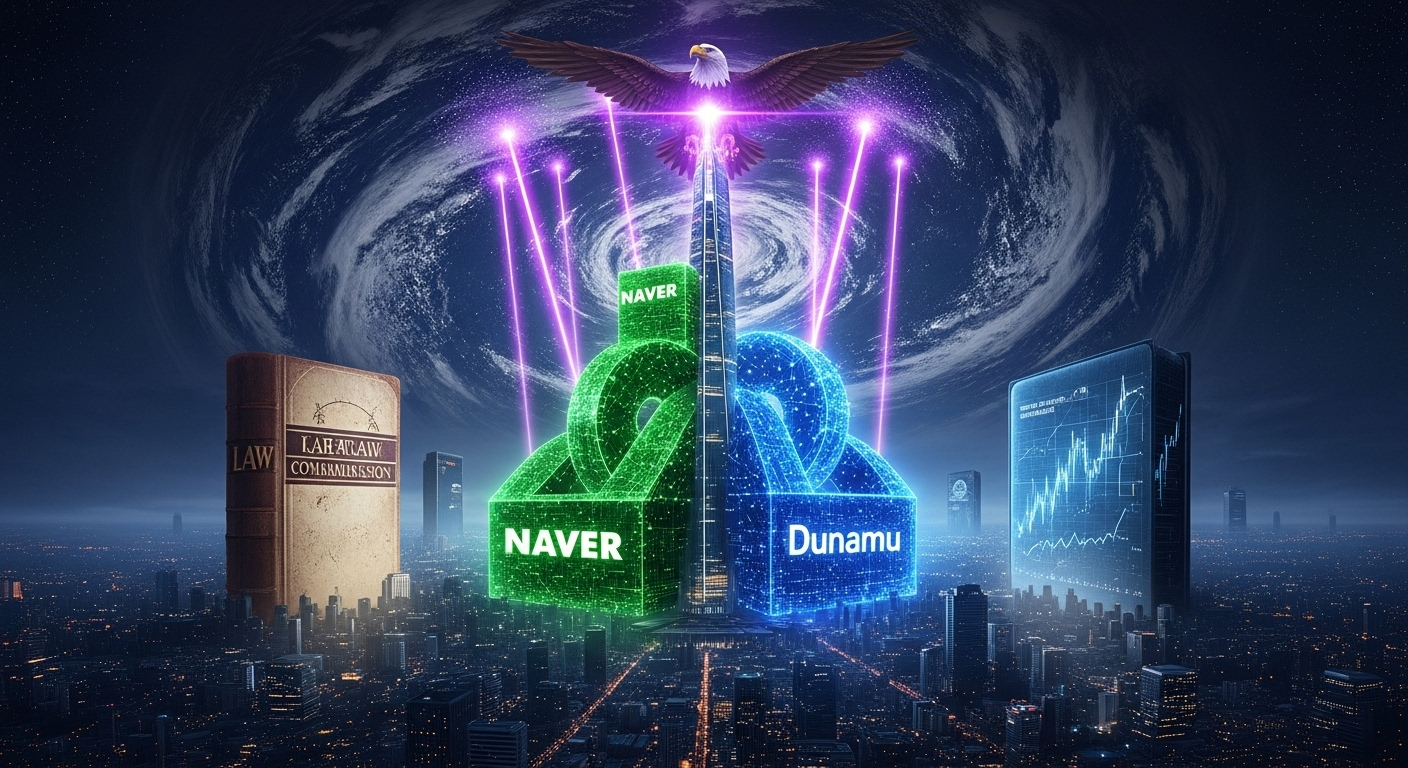
| Regulatory Body | Key Concerns | Anticipated Negative Outcomes | Merged Entity’s Expected Response Strategy |
|---|---|---|---|
| FTC | Abuse of market dominance, impairment of potential competition and innovation | Merger rejection or strong structural remedies like divestiture of core business units | - Emphasize business areas with low competition concerns - Promise platform openness to competing fintechs - Commit to R&D investment and startup support funds |
| FSC / FSS | Systemic risk transfer, inadequate financial consumer protection, “Too Big to Fail” | Stablecoin issuance rejection, imposition of stringent prudential regulations comparable to banks | - Present transparent reserve management systems - Establish consumer damage compensation fund - Install strict firewalls between financial and non-financial sectors |
| BOK | Weakened monetary policy effectiveness, infringement of monetary sovereignty, payment instability | Restrictions on stablecoin issuance volume/scope, demand for strengthened central bank oversight | - Deposit reserves with the BOK / Focus on government bonds - Propose interoperability with CBDC systems - Present a phased business model |
| Political Circle / Public Opinion | Data monopoly, exploitation of small businesses, unfair algorithms | Introduction of stricter platform regulations, negative public opinion formation | - Emphasize the “national interest” frame of securing “global competitiveness” - Promise contributions to small business win-win funds and fee reductions - Propose an external committee for algorithm review |
The Strategic Problem of Back-door Listing: Another Path to the Stock Market
The Naver-Dunamu merger is not just a business combination; it holds significant financial strategic meaning as it provides a gateway for the unlisted major player, Dunamu, to enter the stock market. This choice, opting for a “Back-door Listing” instead of a traditional Initial Public Offering (IPO), carries distinct opportunities and risks.
The Gateway to KOSPI: What is a Back-door Listing?
A back-door listing is when an unlisted company (Dunamu) gains listing effects through a merger or other means with an already listed company (Naver Financial). It’s like entering the stock market through the “back door” of an existing listed company, rather than passing through the front gate of an IPO. While it historically carried negative connotations as a route for struggling companies to get listed, this is no longer the case. The Korea Exchange (KRX) applies very stringent review standards to back-door listings. Particularly in cases like this, where the value of the unlisted company is greater than the listed company, or when management control changes due to the merger, it must undergo a rigorous review equivalent to a new listing. Therefore, Dunamu will not be completely exempt from listing procedures but will undergo a severe listing review different from a traditional IPO.
A Double-Edged Sword: What Back-door Listing Means for Dunamu
For Dunamu, choosing a back-door listing over an IPO is a strategic decision with the following pros and cons:
Advantages (Opportunities)
- Speed and Certainty: An IPO is a long and uncertain process that takes at least several months. Especially in the volatile virtual asset market, there’s a significant risk of the IPO being canceled if market conditions worsen. In contrast, a back-door listing through a merger can be completed relatively quickly according to a set schedule.
- Valuation Stability: An IPO’s public offering price can be set much lower than expected depending on market conditions. However, a back-door listing confirms the enterprise value agreed upon by both parties during the merger negotiation, allowing them to secure their desired valuation relatively free from market volatility.
- Immediate Trust Acquisition: Listing as an affiliate of “Naver,” a national company, provides much higher trust and stability to institutional investors and the general public than “Dunamu,” a virtual asset company, listing independently.
Disadvantages (Risks)
- Intense Scrutiny: The Korea Exchange conducts a microscopic review of companies undergoing back-door listings. Dunamu’s financial status, internal controls, governance structure, and business sustainability will be thoroughly examined.
- Negative Market Perception: Some investors still tend to view back-door listings as a method adopted by companies that find it difficult to follow normal procedures. This could negatively impact the stock price in the early stages of listing.
The fundamental reason Dunamu chooses a back-door listing is a strategic hedge against the inherent volatility of the virtual asset market and the adversarial stance of regulatory authorities. If Dunamu were to pursue an IPO on its own, its enterprise value could swing wildly from heaven to hell depending on the Bitcoin price at the time of listing. By diversifying its business portfolio and enhancing stability through a merger with Naver Financial, it can significantly mitigate such volatility and regulatory risks. This is, in essence, the most realistic and clever option to achieve its listing goals.
This choice also fundamentally changes the nature of Naver’s stock. After the merger, Naver will no longer be just an internet platform company but a crucial “proxy” for the growth and risks of the entire South Korean digital asset ecosystem. While institutional investors wanting to invest in the virtual asset market may flock to Naver stock, it will also transform into a highly volatile stock where sharp rises and falls in Bitcoin prices directly impact Naver’s stock price. 
| Evaluation Factor | Back-door Listing via Naver Merger | Traditional IPO |
|---|---|---|
| Time Required | Relatively fast and predictable | Long duration, delays/cancellations possible depending on market conditions |
| Cost | Relatively lower than IPO | Significant costs including lead underwriter fees |
| Valuation Certainty | Enterprise value fixed at negotiation time, less impacted by market volatility | Public offering price varies based on demand forecast, high uncertainty |
| Regulatory Review | Strict qualitative review equivalent to a new listing | Strict preliminary listing review and securities registration statement review |
| Market Perception/Trust | Potential for high trust acquisition due to “Naver” halo effect | Positive assessment of passing formal market verification |
| Fundraising | Limited direct large-scale fundraising through new share issuance | Large-scale new fundraising possible |
| Shareholder Liquidity | Provides immediate liquidity (listed shares) to existing shareholders | Provides opportunities for existing shareholders to recoup investment through secondary offerings |
Beyond the Financial Statements: Questions for Our Society
The Naver-Dunamu merger goes beyond economics and industry; it will have profound and lasting impacts on South Korea’s societal structure and our individual daily lives. The birth of this colossal corporation poses serious socio-cultural questions about data power concentration, algorithmic social control, and the deepening of digital inequality—questions that cannot be taken lightly.
The Data Leviathan: Power Concentrates in One Place
The merged entity will become a single entity controlling personal data on an unprecedented scale in South Korean history. All information about what an individual is curious about (search), what they desire (shopping), how they spend money (payments), where they place their future (investments), and who they communicate with will be consolidated into one massive database. 
This brings the globally debated issue of “super app” data monopolies directly into Korean society. Super apps offer convenience, but in return, they can use their vast data as a weapon to raise market entry barriers, stifle innovation, and impose unfavorable conditions on platform merchants. If a hacking incident or internal data leak occurs, it could lead to a national disaster. A fundamental societal consensus is needed on whether it is truly desirable for a single private company to monopolize control over data, which has become such crucial social infrastructure.
The Algorithm Gatekeeper: Designing Your Thoughts and Actions
A more serious problem lies in the influence of algorithms that operate based on this vast data. The merged entity’s algorithms will become deeply embedded in our daily choices, customizing recommendations for products, financial services, investment information, and even news. 
- Filter Bubbles and Confirmation Bias: Algorithms continuously show you information you’re likely to prefer. This traps you in your own “filter bubble” of thoughts and tastes, preventing exposure to diverse perspectives and reinforcing existing biases. This could potentially exacerbate societal polarization.
- Algorithmic Discrimination: When the merged entity’s AI makes crucial decisions like loan assessments or insurance premium calculations, there’s a risk it may perpetuate or even amplify existing social biases in the training data. Digital discrimination could occur, where individuals face disadvantages in loans simply for residing in a particular area.
- The Black Box Problem: The decision-making process of the latest AI algorithms is so complex that even developers can sometimes struggle to explain it perfectly—like a “black box.” Consumers will be unable to know why their loan was rejected or why a particular product appears more expensive to them. This is a serious issue that infringes upon individual autonomy and fairness.
These issues demonstrate that discussions about the merger must extend beyond economic regulations like market share to encompass societal regulations concerning data governance, algorithmic accountability, and digital citizenship. Who will control our data? How will algorithmic fairness be ensured? Finding answers to these questions might be a more critical task than determining the merger’s approval.
Ripple Effects: Competitive Landscape and Survival Strategies
The emergence of the colossal Naver-Dunamu behemoth will fundamentally shake up the competitive landscape of South Korea’s fintech market. Kakao and Toss, in particular, which have been rivals with Naver for a long time and have maintained a subtle relationship with Dunamu, will be forced into a complete strategic overhaul for survival.
Kakao’s Dilemma: Betrayal by a Trusted Partner
For Kakao, this merger is more than just the emergence of a powerful competitor. It’s akin to a strategic disaster, a betrayal by a trusted partner. 
- Deep Historical Relationship: In many ways, Dunamu grew under Kakao’s umbrella. Kakao provided investment, and former CEO Lee Seok-woo is also from Kakao. Upbit’s predecessor, “Securities Plus,” also grew based on KakaoTalk. For such a long-standing ally like Dunamu to join forces with its greatest rival, Naver, is an undeniable blow to Kakao’s blockchain and financial strategies.
- Inevitable Strategic Revision: Kakao must now prepare for a head-on confrontation.
- Strengthening Its Own Ecosystem: It will likely try to solidify its blockchain ecosystem “Kaia,” integrated with Naver LINE’s blockchain, and connect it closely with Kakao’s services.
- Maximizing Synergy Among Financial Affiliates: By connecting Kakao Bank, Kakao Pay, and Kaia’s virtual assets, it will accelerate the development of a competitive super app where all financial activities are completed within the “Kakao Universe.”
- Seeking New Partners: It may consider finding a new virtual asset exchange partner to replace Upbit or even investing massive funds to create its own exchange. However, competing against the combined force of Naver and Upbit, which already dominate the market, will be an extremely difficult challenge.
Toss’s Choice: The Agile Challenger’s Crossroads
Toss, which grew by breaking the conventional wisdom that “finance is difficult,” has successfully established itself in the banking, securities, and payment markets with user-centric services. While it has maintained a relatively cautious stance on virtual asset business, this merger has created a situation where Toss can no longer postpone its decisions.
- Strategic Crossroads: Toss must now define a clear direction for virtual assets.
- Forming an Anti-Naver Alliance: It could consider a strategy of forming a second alliance, uniting with second-tier exchanges like Bithumb and Coinone, to counter the Naver-Upbit alliance.
- Differentiating Strategy: It could leverage the volatility and regulatory risks of the virtual asset market as an opportunity to strengthen its identity as a “stable and trustworthy comprehensive financial platform” and pursue differentiation.
- Direct Confrontation: It could make a bold choice to enter the fray directly by acquiring a leading exchange with massive investment or launching its own business, challenging the dominance of the top three players.
Ultimately, this grand merger is likely to reshape South Korea’s fintech market into a “2-strong, 1-medium” structure. An overwhelming giant like Naver-Dunamu, the Kakao ecosystem challenging it, and Toss, the challenger seeking opportunities between them, will divide the market into three. In this process, small and medium-sized fintech companies will have to either integrate into one of these three giant ecosystems or focus on highly specialized niche markets to survive. 
The very nature of competition will also change. The battle will no longer be about the superiority of individual products but about who can build stronger partnerships to lock users within their ecosystem. In the coming years, South Korea’s fintech market will enter an era of fierce “ecosystem warfare,” where giant capital entities will fortify their walls and form alliances.
Shaping the Future: Scenario Analysis and Strategic Recommendations
The Naver-Dunamu merger is not a finalized future in itself. It is merely one of several possibilities to be determined through the interaction of numerous variables and stakeholders. In this final section, we will analyze three core scenarios based on the merger’s trajectory and conclude this lengthy report by offering strategic directions that each stakeholder should pursue.
Scenario Analysis
- Scenario A: “Roar of the Hydra” (Unconditional Approval)
- Development: Regulatory authorities accept the “strengthening global competitiveness” rationale and approve the merger with minimal conditions. The merged entity swiftly completes integration, successfully launches the KRW stablecoin, and dominates the market.
- Outcome: Traditional financial industries rapidly shrink, and Kakao and Toss are put on the defensive. The merged entity builds overwhelming market dominance spanning search, commerce, payments, and finance, while societal debates intensify regarding data monopolies and algorithmic influence.
- Scenario B: “Giant Bound by Chains” (Conditional Approval)
- Development: The FTC and FSC approve the merger but impose strong corrective measures. For example, they might demand platform openness to competing fintech apps, strict firewalls between financial and non-financial data, or limitations on stablecoin issuance volume.
- Outcome: The disruptive power of the merged entity is significantly controlled. Synergies from integration will appear more slowly, and competitors like Kakao and Toss will gain breathing room and seek opportunities for counterattacks. The market will be gradually reshaped, but the merged entity’s innovation speed might slow down due to regulatory compliance costs.
- Scenario C: “Big Deal Capsizes” (Rejection)
- Development: Regulatory authorities deem the concerns about monopoly and financial system stability too significant and ultimately reject the merger.
- Outcome: Naver and Dunamu go their separate ways. Naver will seek alternative solutions, and Dunamu may re-pursue an independent IPO or seek other partners. The market status quo will likely continue for the time being, but underground competition and strategic alliances to capture digital financial dominance will become even more intense.
Strategic Recommendations
- To Naver/Dunamu Management: Before regulatory authorities raise issues, proactively present concrete and sincere solutions regarding data privacy, algorithmic fairness, and market openness. While maintaining a positive frame of “innovation” and “consumer benefit,” actively propose voluntary win-win measures to alleviate monopoly concerns.
- To Competitors (Kakao, Toss, Traditional Financial Institutions): Prepare contingency plans for all scenarios. In anticipation of the merger’s potential success, secure a pool of potential partnership candidates executable swiftly and focus resources on strengthening your core competitive advantages. A giant behemoth cannot excel at everything. You must secure competitive advantages by offering differentiated value, such as trust, security, and a deep understanding of specific customer segments.
- To Regulatory Authorities and Policymakers: Use this merger not as a single isolated event but as an opportunity to establish an integrated regulatory philosophy for the digital economy era. Break down inter-departmental silos and consider enacting a “Digital Economy Basic Act” that encompasses new agendas like data governance, algorithmic accountability, and private digital currencies. The goal should be to find a delicate balance that protects financial system stability while ensuring fair competition without hindering innovation.
The Naver-Dunamu merger is not merely a business transaction. It is a massive “stress test” for South Korea’s entire economy and regulatory system. The final outcome of this deal will not only determine the future of these two companies but also set a significant precedent for how technology and finance will interact in the coming generations and how our society will control digital power. The prelude to a great change has begun.
References
- Various media reports and securities firm reports (2024 - 2025)
- Naver and Dunamu official announcements and IR materials
- Fair Trade Commission business combination review standards and related press releases
- Bank of Korea research reports and press releases
- Publications from research institutions such as the Korea Capital Market Institute and the Korea Insurance Research Institute
- Newsletters and legal analysis materials published by domestic and international law firms
- Publications from policy research institutes such as KDI and the Jeongui Policy Research Institute