

The Smart AI: Why It Can Be Frustrating at Times
Have you ever had the experience of talking to an artificial intelligence (AI) and felt frustrated? Perhaps the AI completely forgot something you discussed in a previous conversation or provided irrelevant answers without considering your specific situation. It feels like starting a new conversation with someone you just met every time. Why does this happen?
The reason is that AI lacks a crucial piece of the puzzle called ‘Context’. Just as we naturally consider past memories, surrounding circumstances, and the emotions of others when we converse, AI also needs the ability to understand this ‘context’.
To solve this problem and lead conversations with AI toward true ‘communication’, a new concept called ‘Context Engineering’ has emerged. However, to fully grasp this concept, we first need to look back at the history of how we have communicated with AI.
Chapter 1: The Long Journey of Talking to AI
The effort to communicate with machines and AI has been ongoing for a long time. The methods have dramatically changed with technological advancements, much like the process of teaching a newborn to speak.
Stage 1: The Era of Talking Through Holes (1950s-60s - Batch Processing)
The first conversations with computers were hardly deserving of the term ‘conversation’. Programmers would punch holes in punch cards to create commands in combinations of 0s and 1s, and after submitting a batch, they would receive results long after. It was a very one-sided and rigid ‘command’ that would spit out errors mercilessly if even slightly deviated from the set rules.

Stage 2: The Era of Speaking in Their Language (1970s-80s - Command Line)
With the advent of personal computers, we could finally converse with computers in real-time through the Command Line Interface (CLI). By typing predefined commands (their language) like dir, cd, and copy, we received immediate responses. We still had to learn the machine’s language, but at least it marked the beginning of a ’tiki-taka’ style conversation.
Stage 3: The Era of Speaking in Pictures (1980s-Present - Graphic User Interface)
The introduction of the mouse and icons brought about a revolution. We no longer needed to memorize difficult commands; we could communicate with computers simply by clicking visible icons. The GUI (Graphic User Interface) made computers a friend to everyone, providing a very intuitive and easy way to converse.
Stage 4: The Era of Speaking Our Language (2010s-Present - Natural Language Processing)
With the emergence of voice assistants and chatbots, we could finally talk to machines in ‘our language’. However, AI during this period was mostly limited to responding within predefined scenarios. It could answer questions like, “What’s the weather today?” but would struggle with context, failing to understand follow-up questions like, “Is it hotter than yesterday?”.
Finally, with the advent of large language models (LLMs), the new concept of Context Engineering emerged, allowing us to dream of true ‘communication’ with AI.
Chapter 2: Context Engineering - The Technology Filling AI’s Brain
So, how does Context Engineering enable AI to communicate like humans? Let’s delve deeper. It goes beyond simply asking good questions through ‘prompt engineering’; it systematically designs an ‘information environment’ that allows AI to think and act intelligently.
Just as we mobilize our knowledge, internet searches, and advice from those around us when solving a problem, we create such an environment for AI as well.
Core Technology 1: Gift AI an External Library (RAG)
AI has a critical flaw: it only knows what it has learned. It doesn’t know about events that happened yesterday or internal company regulations. Retrieval-Augmented Generation (RAG) is the key technology to solve this problem.
- Easy Analogy: It’s like giving a ‘huge digital library access card’ to a smart but naive genius. When asked a question, AI first goes to this library (external databases, internal company documents, etc.) to find the latest information or expert materials related to the question. It then references this material to generate the most accurate and reliable answer.
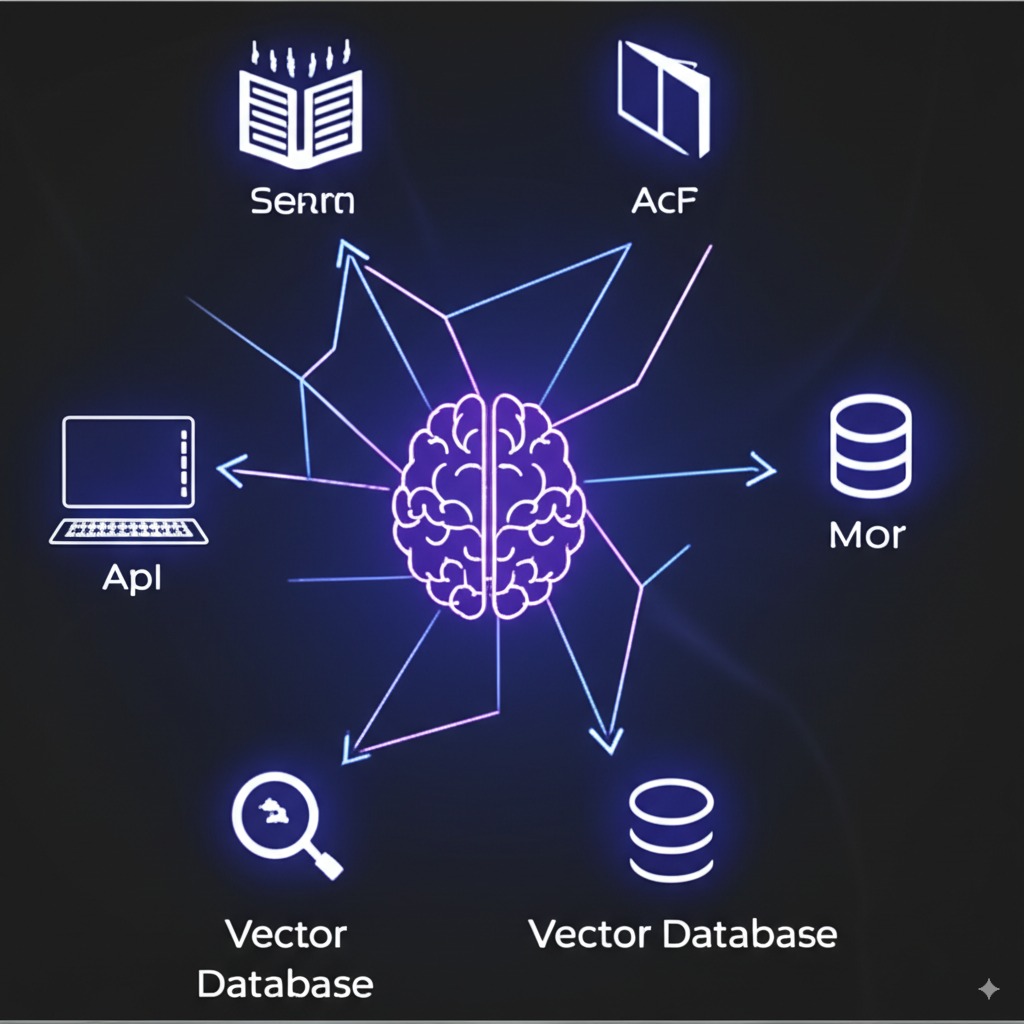
Retrieval-Augmented Generation (RAG)

Core Technology 2: The Magical Map That Tells AI ‘Meaning’ (Vector Database)
For RAG to work effectively, AI must be able to quickly find the necessary information among countless books in the library. This is where the Vector Database comes into play.
- Easy Analogy: A regular library organizes books alphabetically or by genre, but a vector database is a magical library that organizes by ‘meaning’. Words like ’love’ are clustered with ‘partner’, ’excitement’, and ‘breakup’, while ‘car’ is grouped with ’engine’, ‘wheel’, and ‘driving’. When AI receives a question, it teleports to the location closest to the ‘meaning’ of that question to find relevant information. This allows us to get accurate information about ‘cars’ even if we vaguely ask about ‘vehicles with wheels’.
Vector Database

Core Technology 3: The Ability to Remember, Learn, and Execute
Context Engineering also endows AI with communication abilities akin to humans.
- 🧠 Memory: It remembers previous conversations, allowing it to understand phrases like “the thing we talked about earlier.”
- 🛠️ Tools: It equips AI with ‘hands and feet’ to execute external programs like real-time flight bookings and hotel reservations.
- 📜 System Instructions: It assigns specific roles (e.g., a friendly financial expert) and communication styles and rules of behavior to AI, giving it a consistent identity.
When all these elements combine organically, AI can finally transcend being a rigid machine and become a true ‘communication’ partner with us.
Chapter 3: The Future with AI and the Role of Context Engineering
The advancement of Context Engineering will completely change how we collaborate with AI. We will no longer be ‘supervisors’ who give commands and corrections to AI; instead, we will become designers and conductors who create an environment where AI can perform at its best.
Anecdote: 2030, My AI Project Manager ‘Jupiter’
In 2030, I am working on a new product development project. My AI project manager ‘Jupiter’ is not just a simple assistant.
- [Automatic Learning of Project Context] As the project begins, Jupiter accesses the company cloud to learn from planning documents, meeting notes, and final reports of past similar projects. It analyzes success and failure factors and predicts risks for this project, reporting them to me in advance.
- [Customized Communication with Team Members] Jupiter remembers the previous work styles and performance data of project team members. It gives clear and concise instructions to Developer A using technical terms and communicates with Designer B using visual references and emotional language, maximizing each team member’s capabilities.
- [Autonomous Problem Solving] When real-time logistics data indicates a disruption in overseas parts supply, Jupiter immediately searches for alternative suppliers worldwide and presents me with a report comparing quotes, quality, and delivery dates along with three alternatives. When I choose option 2, it promptly sends a draft contract to that supplier and schedules a video conference in my calendar.
Throughout this process, I simply asked, “Jupiter, how is the project progressing?” or “What’s the best solution for the parts issue?” With the information environment perfectly designed, Jupiter understood the context and executed the optimal solution on its own.

Opening the Era of True Communication
From the days of punching holes in punch cards to convey our intentions to machines, we have come a long way to an era where AI understands not only our words but also the intentions and situations behind them.
Context Engineering is the pinnacle of that journey and a new beginning. It poses philosophical questions about how AI and humans can understand, trust, and grow together more deeply, beyond technology. As ‘context engineers’, we create the beautiful scores and stages for the excellent orchestra that is AI to perform at its best. Isn’t this a new role that all of us need as we live alongside AI?