
The Strange Ensemble of Trumpet and Contrabass
Imagine for a moment that you are in a grand concert hall, surrounded by a massive orchestra. In this orchestra called the global economy, two of the most important instruments begin to play. One is the fierce and high-pitched ’trumpet’ of U.S. tariff policy, wielded by the president, shaking the foundations of global trade. The other is the ‘contrabass’, playing a deep and heavy tune that reflects the health of the economy and future expectations, which is the U.S. Treasury bond yield.
Originally, these two instruments were expected to harmoniously play from the same sheet music titled ‘inflation’. When the trumpet blares, “I will raise tariffs to increase import prices!”, the contrabass would respond with a heavy note, “I need to raise interest rates due to concerns about rising prices!”.
However, in 2025, we are witnessing the strangest duet in history. The trumpet from the White House is blasting tariff bombs of 10%, 60%, and even over 100% in a frenzied march, while the contrabass on Wall Street maintains a low pitch, quietly playing the dirge of economic recession.
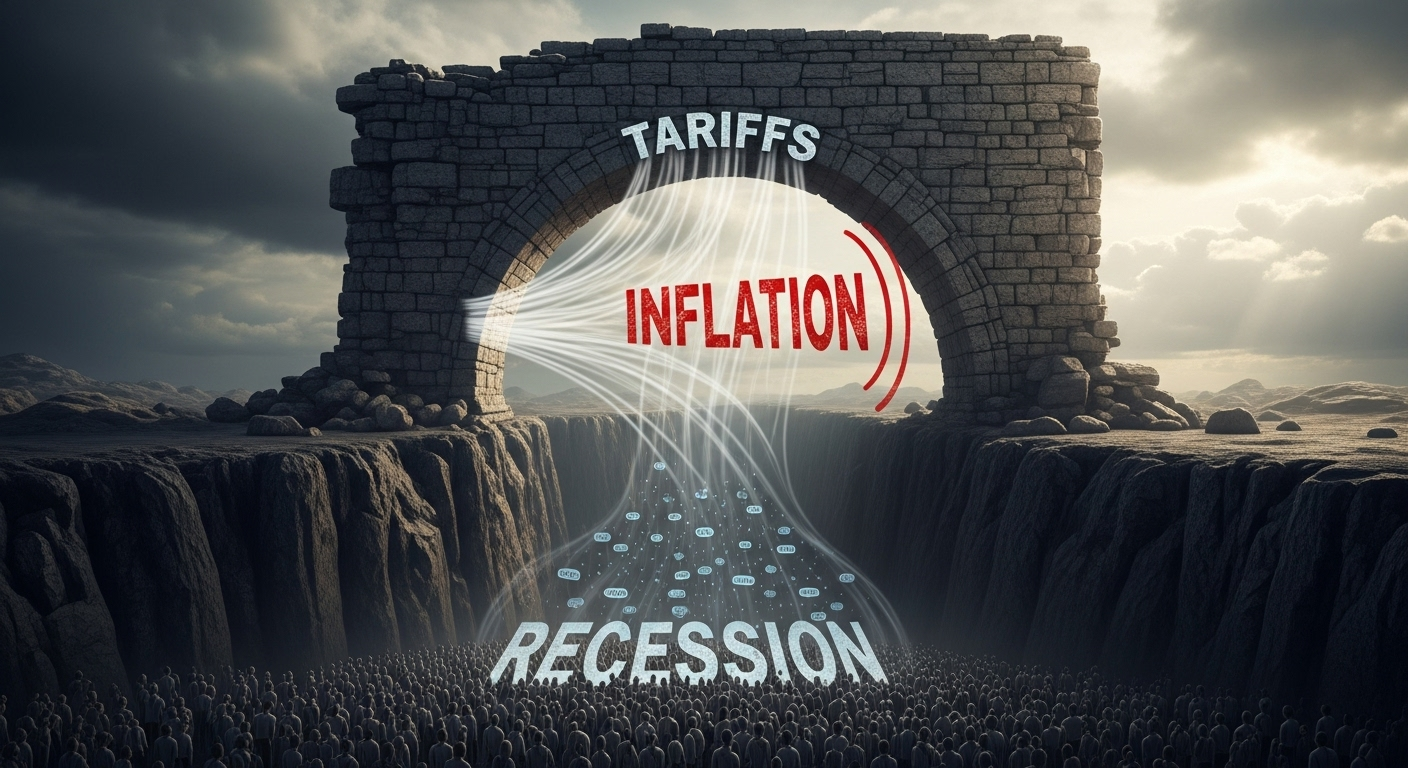
The Return of the ‘Tariff Bomb’: What Has Changed?
The tariff policy of the Trump administration’s second term is on a different level than before. Previously, it was a ‘precision strike’ targeting specific items from specific countries, like Chinese steel products. Now, it resembles an ‘indiscriminate carpet bombing’ that encompasses the entire globe.
Imposing ‘American Tax’ on Everything
The most significant feature is the ‘universal basic tariff’. It’s like declaring, “Want to sell goods in America? Then pay a 10% entry fee first.” This basic tariff applies universally, regardless of the country or the product, sending a clear bill for ‘America First’ to all trading partners worldwide.
Retaliation in the Spirit of ‘An Eye for an Eye’
Additionally, there is the fearsome rule of ‘reciprocal tariffs’. “If you impose a 25% tariff on American cars, we will impose the same 25% on your cars.” This simple, power-based logic breaks the long-standing promise of free trade that ‘all trade partners are treated equally’, transforming the global trade order into a jungle governed by the logic of power.
These policies do more than just raise the prices of imports; they are halting the massive conveyor belt of the global supply chain, which has been structured around efficiency for decades. Companies now face a new era where they must first consider, ‘Where is safe from tariff bombs?’ rather than ‘Where can I produce the cheapest?’.
The Silent Warning of the Market: The Paradox of Interest Rates
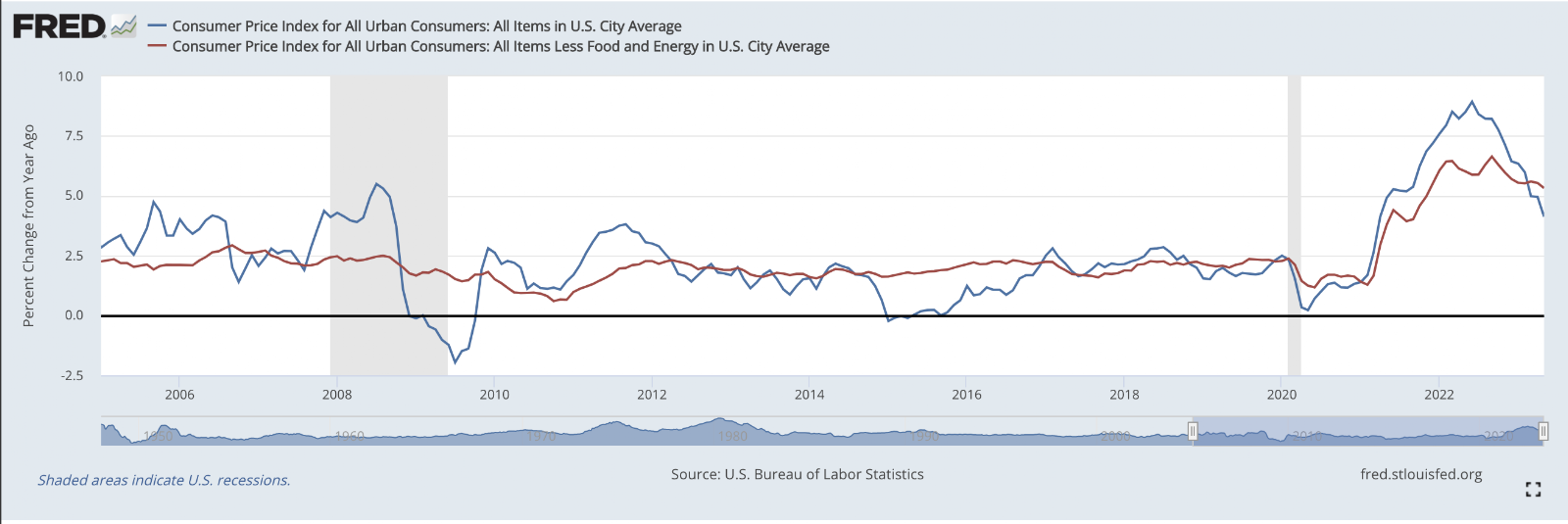
An economics textbook would say this: “When tariffs rise, import prices rise, leading to increased overall price pressure (inflation). Then the central bank (the Fed) will consider raising interest rates, and the market’s long-term Treasury bond yields will naturally rise.”
But reality is mocking the textbooks. Despite the White House detonating tariff bombs daily and igniting inflation, the U.S. 10-year Treasury yield, the most important price in the world, remains surprisingly calm or even falls.
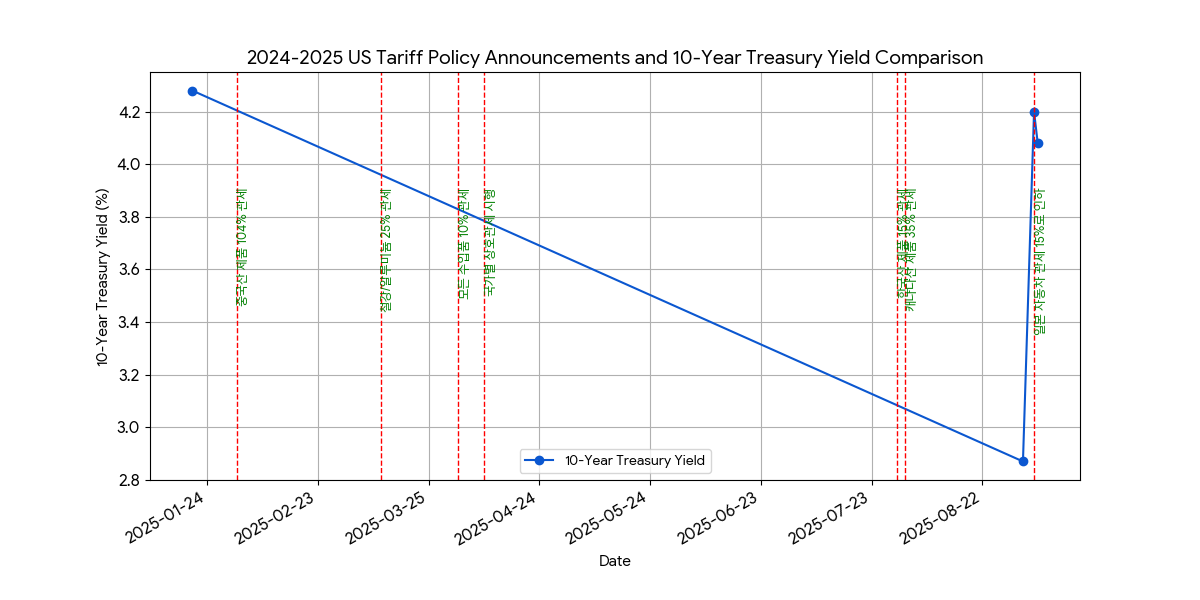
This graph reveals a shocking fact. While yields may fluctuate briefly after tariff announcements, the larger trend shows that rather than reflecting fears of rising prices, the increasing uncertainty in the global economy is causing people to flee to safe havens (U.S. Treasuries). (When more people want to buy Treasuries, their prices rise, and yields fall.)
What is the market telling us?
- “Recession is scarier than inflation”: The market worries that tariffs will ultimately close people’s wallets and freeze corporate investments, plunging the global economy into a deep recession.
- “Let’s go to the safest place first!”: As trade wars escalate, the world becomes more unstable. In such times, large sums of money flock to the safest refuge, U.S. Treasuries, leaving risky stock markets or emerging markets behind, which drives down yields.
- “The Fed won’t be able to raise rates freely”: The market may calculate that the Fed will be unable to raise rates hastily due to political pressure or the worst-case scenario of stagflation, where recession and rising prices occur simultaneously.
In conclusion, the Treasury market either ignores the White House’s loud trumpet sound as “This too shall pass” or warns that “That sound will ultimately ruin everything”.
Two Families Under One Roof: The Diverging Dreams of the White House and the Fed
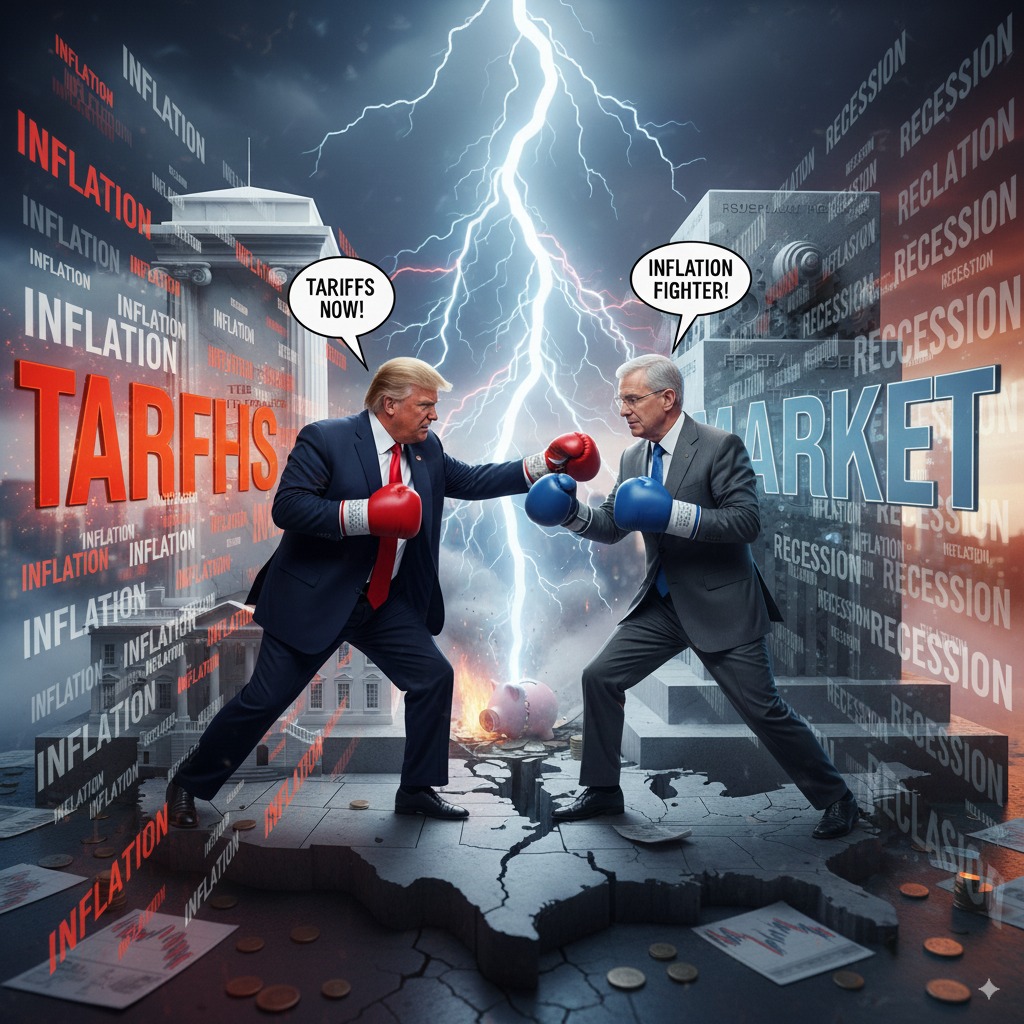
At the heart of this strange dissonance lies a deepening conflict between two giants that drive the U.S. economy: the White House (government) and the Fed (central bank).
- The White House’s Dream: Shouting for a “strong America!”, focusing on immediate economic growth rates, reviving manufacturing, and achieving visible political results to rally support. Their weapons are ’tariffs’, ’tax cuts’, and pressure on the Fed to “lower rates!”.
- The Fed’s Dream: Concentrating on achieving the two legally mandated goals of ‘price stability’ and ‘maximum employment’. Independent from politics, it seeks long-term economic stability, using ‘interest rate adjustments’ as its main tool.
However, tariff policy is worsening this relationship. Tariffs raise import prices, stimulating inflation while simultaneously freezing the economy due to trade war anxieties. This presents the Fed with the worst dilemma of stagflation, where inflation rises amidst recession.
If it raises rates to control inflation, the economy could collapse entirely. Conversely, if it lowers rates to stimulate the economy, inflation could spiral out of control. Perhaps the White House is deliberately aiming for this point, cornering the Fed with tariffs to pressure it into lowering rates to revive the economy.
What Is Trump’s True Intention?
The White House claims it is to “protect American workers and resolve the trade deficit”, but there may be a much more complex ulterior motive.
- Hypothesis 1: Pressing the Reset Button on Global Order: The big picture could be, “Let’s discard all the free trade rules we’ve established so far and redefine everything based on power dynamics between the U.S. and others from now on!” Tariffs serve as a powerful ’entry fee’ to bring all countries to the negotiation table.
- Hypothesis 2: Taming the Fed to Seize Control of Interest Rates: As mentioned earlier, creating a stagflation dilemma with tariffs forces the Fed to lower rates. The White House disrupts the economy while shifting the responsibility for stabilization to the Fed.
- Hypothesis 3: Winning the Technological Hegemony War with China: Imposing high tariffs on advanced technologies like semiconductors and AI could be part of a ’technological cold war’ over future industry leadership. Beyond monetary issues, it aims to fundamentally block China’s technological advancement.
- Hypothesis 4: A Strategic Move to Win Domestic Politics: This may be the most realistic reason. The image of a “strong America” is highly effective in rallying support. Even if there are adverse effects on the economy, the political burden is low since the blame can be shifted to China or the Fed.
These four hypotheses likely interact in complex ways. The important thing is that the tariff war we are witnessing is not merely an economic policy but part of a grand game aimed at changing politics, technology, and the global order.
The Butterfly Effect of Tariffs: How Will the World Change?
The stone of tariffs thrown by the U.S. is creating massive ripples in the lake of the global economy.
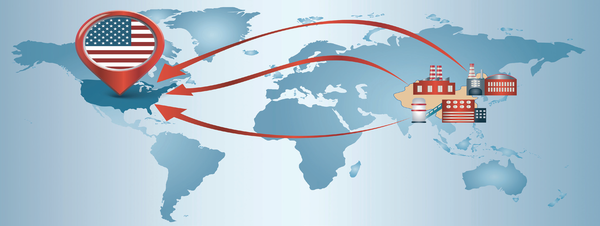
- China: The biggest victim, undergoing the most dramatic changes. With U.S. export routes blocked, it is expanding its domestic market, strengthening relationships with other countries (‘Belt and Road Initiative’), and desperately trying to develop its own technology. Ironically, U.S. pressure is accelerating improvements in China’s economic structure.
- Europe: Yesterday’s friend has become today’s competitor. Facing the U.S. is daunting, but yielding could mean a loss of pride and industry. Ultimately, they are trying to carve their own path by creating independent supply chains and trade rules, forming a third bloc.
- Emerging Markets: Caught in the crossfire of a whale fight. As global economic instability rises, the value of the dollar increases, causing the currencies of emerging markets to plummet, and foreign investment capital to flow out like a tide. While some countries like Mexico or Vietnam may gain from this, most are at risk of being swept away by the massive wave.
- Allied Countries like South Korea: They face the most complex balancing act. While relying on the U.S. for security, their economy is deeply intertwined with China. They stand at a critical crossroads for their national future between the U.S.’s demand for ‘decoupling from China’ and the vast Chinese market.
For Whose Victory? The Side Effects Already in Motion
Contrary to the White House’s claims, tariff policies are leaving deep scars on the U.S. economy.
- The Bill Passed to American Consumers: Tariffs are ultimately reflected in the prices of imported goods. From Walmart’s household items to European cars, everything is becoming more expensive, thinning the wallets of Americans.

- Deepening Sighs from Businesses: Companies that rely on overseas parts face rising production costs, while those selling goods abroad lose price competitiveness due to retaliatory tariffs. Most importantly, due to ‘uncertainty’, companies hesitate to make new investments or hire, which erodes the engine of economic growth.
- Cracks in the Dollar Kingdom: The most frightening side effect is the potential shaking of ‘dollar hegemony’. As the U.S. weaponizes the dollar payment network, other countries are beginning to seek ways to trade without the dollar, fearing they might be next. Countries like China and Russia are settling transactions in other currencies, or central banks are buying gold or euros instead of dollars. While it won’t collapse overnight, cracks are beginning to form in the absolute ring of the dollar.
A New Era: Our Survival Strategies
We are living in an era of ‘New Abnormal’ where economic textbooks no longer apply. Now, a single tweet from the president can shake the market more than economic indicators, marking an era of ‘political risk’. How should we survive in this chaos?
- Redraw the Map (Geopolitical Diversification): Beyond dividing assets into stocks and bonds as before, we must consider ‘which country’ and ‘which political block’ the assets belong to. Moving away from a U.S.-centric view, it is wise to diversify investments into countries like India or ASEAN, which are relatively free from tariff wars, or Europe, which is pursuing an independent path.
- Find ‘Tariff-Immune’ Companies: Focus on companies with low dependence on other countries and strong domestic markets, or those with unique technological capabilities that can overcome tariff barriers. Now, we must scrutinize ‘supply chain maps’ as carefully as financial statements.
- Reconsider the Meaning of ‘Safe Assets’: Even U.S. Treasuries, which seemed absolutely safe, are not free from political uncertainty. We need to reassess the value of traditional safe assets like gold and remain open to the role of new assets that are free from the control of specific countries in the long term.
In conclusion, the dissonance between U.S. tariffs and interest rates is not merely a mismatch of two indicators. It marks the prelude to a ‘great transformation’ where the era of globalization is fading and protectionism for survival begins. In this massive dissonance, we can no longer rely on old sheet music. It is time to listen to the fierce trumpet sound and the anxious whisper of the contrabass, preparing our own sturdy ark for the approaching storm.