The Crisis of Food Systems: The Paradox of Empty Plates
phoue
•13 min read•--
An Exploration of the Invisible Forces Surrounding Our Dining Tables Starting from a Bundle of Green Onions
The structure of invisible power dominating the global food system
The impact of climate change and financialization on our dining tables
Exploring alternatives like local food and food tech for a sustainable future
The Crisis of Dining Tables Begins with a Bundle of Green Onions
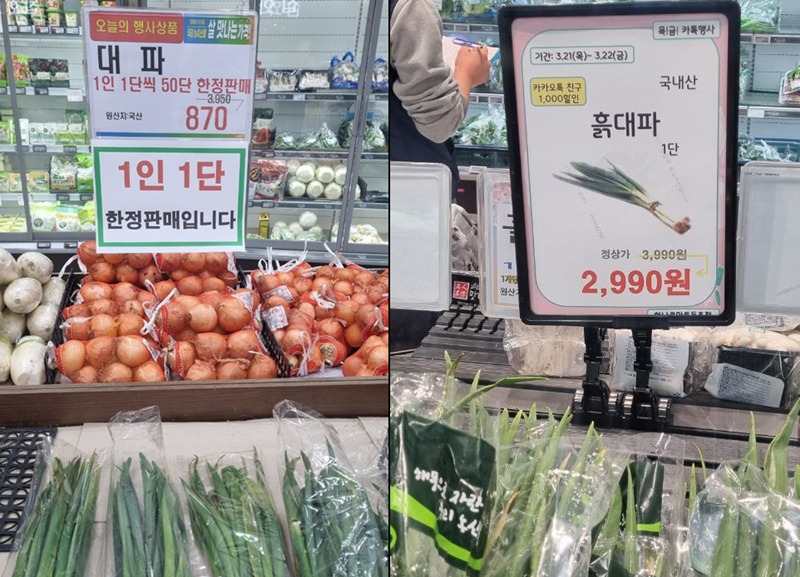
In the spring of 2021, many people stopped in front of the price tag for a bundle of green onions at the supermarket. The staggering increase of 341.8% compared to the previous year revealed structural problems in our food system beyond just a price hike. The emergence of the term ‘patech’ symbolically illustrated the pain caused by soaring grocery prices for households.
The problem did not stop with green onions. Prices for apples and eggs rose by 91.3%, and chicken by 33.3%. This suggested that the issues surrounding our dining tables were not just due to poor harvests of specific items but were indicative of deeper structural problems.
The surge in green onion prices was a signal of rising grocery costs.
While the media discusses global economic growth, the reality we experience is poverty at the dining table. This paradox is also evidenced by statistics. When the average price index of OECD member countries is set at 100, South Korea’s food price index stands at 151, the second highest after Switzerland. This is overwhelming compared to the United States (94), Germany (107), and Japan (126).
The Bank of Korea pointed out that high living costs are a major factor hindering consumption recovery, suggesting solutions such as “deregulation and reducing market entry barriers” and “diversifying raw material import sources.” This acknowledges the structural vulnerabilities of the current food system, which is monopolistic and overly dependent on specific supply chains.
This article follows the questions raised by a bundle of green onions, tracing the identity of the invisible forces that make our dining tables shabby and exploring innovative alternatives to reclaim sovereignty over our dining tables.
Who Rules Our Dining Tables: The Architects of the Giant Food System
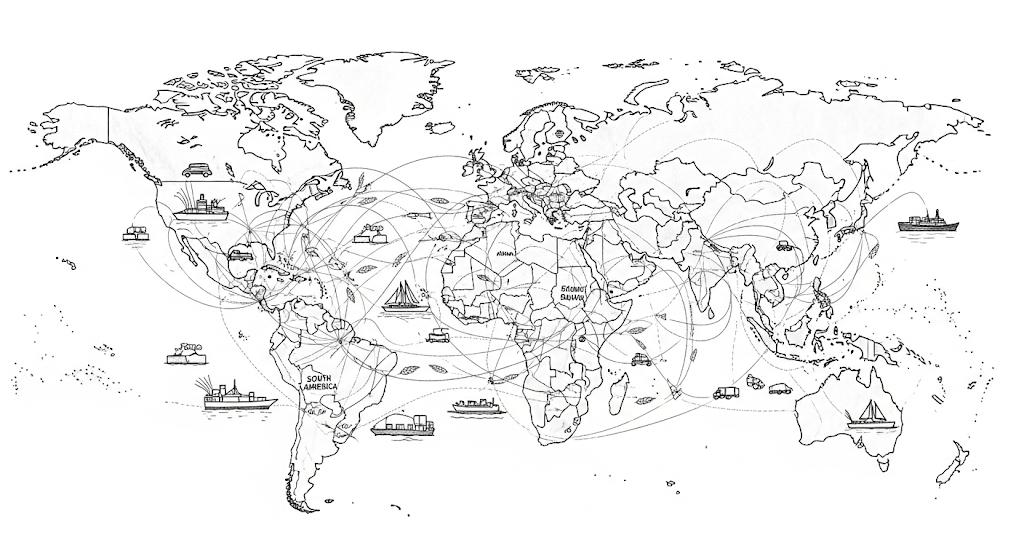
The global food supply is largely governed by two corporate empires. One is the invisible foundation controlling grain flows, while the other is the visible superstructure of brands dominating supermarket shelves. Together, they support each other and form the power structure of the modern food system.
The Invisible Grain Empire: ABCD
Almost every stage of the journey of wheat and corn, the raw materials for bread and noodles on our dining tables, is controlled by four giant companies: Archer Daniels Midland (ADM), Bunge, Cargill, and Louis Dreyfus Company (LDC). These are collectively referred to as the ‘ABCD’ companies, which dominate 70-90% of global grain trade, establishing an oligopolistic structure. Just as ‘Big Tech’ dominates the IT industry, these ‘Big Ag’ companies hold the reins of global food flows.
Recently, they have been pursuing distinctly differentiated strategies based on their respective strengths.
ADM: Value-Centric StrategistADM Logo Image
ADM is shifting its portfolio from traditional grain trading to high-value products such as nutrition and bio-solutions. Through ADM Ventures, it is aggressively investing in food tech startups to seize future technologies.
Bunge: Scale-Centric PuristBunge Logo Image
Bunge has opted for a straightforward approach by merging with Viterra to secure overwhelming scale in its core agricultural business. It aims to dominate the market through control over its core areas rather than expanding its scope.
Cargill: Diversified GiantCargill Logo Image
As the largest privately-held company in the U.S., Cargill creates synergies by integrating digital technologies and sustainability into its vast business portfolio. It is turning sustainability into a new business opportunity through investments in regenerative agriculture and supply chain decarbonization.
Louis Dreyfus Company (LDC): The Modernizing TraderLDC Logo Image
LDC is expanding its investments in processing areas such as juice and plant-based proteins, leveraging capital secured through partnerships with the Abu Dhabi sovereign fund ADQ, aiming to transform into a comprehensive food company.
Company Name
Archer Daniels Midland (ADM)
Bunge
Cargill
Louis Dreyfus Company (LDC)
Core Strategy
Value-Centric (Value-over-Volume)
Scale-Centric (Scale-over-Scope)
Diversification and Digital Integration
Downstream and High-Value
Key Trends
Investment in Nutrition/Bio Solutions, Food Tech Ventures
Maximizing Scale through Viterra Merger
Digital Platforms, Sustainability Investments, Food Tech Partnerships
Partnership with ADQ, Expanding Processing Investments
Implications
Still reliant on traditional business, facing challenges in new business transitions
Pursuing overwhelming dominance in core business
Synergy across all business areas and integration of future technologies
Transitioning from traditional trader to comprehensive food company
The New Leviathan: The Bunge-Viterra Merger and the Era of Mega Consolidation
The merger between Bunge and Viterra, completed in July 2025, illustrates the deepening of oligopolistic structures. This approximately $18 billion deal created ‘Bunge-Viterra’, fundamentally altering the landscape of the global grain market.
In particular, Canadian competitors warned that this merger is likely to “hinder competition in the grain and canola markets.” The merged entity will control about 40% of the Canadian grain market, forcing farmers to accept unfavorable prices due to reduced buyer options. One study estimated that this could lead to an annual income loss of approximately CAD 770 million for Canadian grain producers.
This is not merely a matter of market share; it signifies a transition to a logistics-based power structure that controls physical infrastructure, securing structural pricing power over both farmers and buyers.
The Brand Empire: How Big Food Conquered Supermarkets
If the grain empire is the invisible foundation, ‘Big Food’ is the glamorous superstructure built on top of it. A handful of multinational companies, such as Nestlé, PepsiCo, and Coca-Cola, dominate over 50% of the global food and beverage market.
Their success is attributed to technological innovations like canning and pasteurization, as well as conceptual innovations like the ‘brand’. Henry J. Heinz opened the door to mass consumption by instilling trust in anonymous industrial products with transparent glass jars and the slogan “57 varieties”.
Today, supermarket shelves display an ‘illusion of diversity’. Hundreds of brands are actually owned by a very small number of parent companies. This structure reveals the symbiotic relationship between Big Food and the ABCD grain empire. Big Food creates ultra-processed foods using cheap raw materials (like high-fructose corn syrup) supplied by ABCD, adding branding and marketing to generate enormous added value. This system is the key engine that produces the ‘paradox of empty plates’.
Shaky Supply Chains: Cracks in the Global Food System
The modern food system, built on ultra-efficiency and globalization, contains vulnerabilities in its very design. Financial, geopolitical, climate, and ethical issues are exposing cracks in the system, threatening our dining tables.
The Giant Food Casino: Financialization and Geopolitical Weaponization
Food has become a financial asset rather than a survival necessity. In the early 2000s, deregulation allowed large financial capital to enter the food futures market, triggering the global food price crisis of 2007-2008.
In addition to physical economic factors, speculation by financial capital skyrocketed food prices, leading to ‘food riots’ in over 30 countries worldwide. In Haiti, the government collapsed due to soaring international rice prices.
Food has also become a geopolitical weapon. In July 2023, when India, the world’s largest rice exporter, imposed an export ban, the global rice supply chain was paralyzed, and prices soared to their highest in 15 years. This poses a direct threat to South Korea, where the grain self-sufficiency rate is only about 20.9%. The long supply chains and just-in-time production’s ’efficiency’ have effectively stripped away resilience.
A Boiling Earth, A Sick Dining Table
Climate change is altering the price and quality of our food. The IPCC warns that, in the worst-case scenario, global agricultural productivity could plummet by 50% within a decade.
The End of Mediterranean ‘Liquid Gold’?: Severe drought has led to a more than 55% drop in production in Spain, the world’s largest olive oil producer, causing prices to triple.
The Disappearance of a National Side Dish, East Sea Squid: Rising sea temperatures in the East Sea have caused squid catches to plummet by over 93% compared to the 2000s, turning them into ‘golden squid’.
Threatened Global Delicacies: By 2050, suitable areas for coffee cultivation are projected to decrease by 50%, and if temperatures rise by 2°C, 70% of major wine regions may become unsuitable for grape cultivation.
Food
Olive Oil
East Sea Squid
Coffee
Cocoa
Wine
Major Impact
Production plummets due to Mediterranean drought, prices soar
Catch drops 93% due to rising sea temperatures
Projected 50% decrease in suitable cultivation areas by 2050
Production drops due to drought/disease in West Africa
70% of major production areas at risk of extinction if temperatures rise by 2°C
The True Cost of Superfoods: Violence, Exploitation, Environmental Destruction
The cracks in the global food system are also severe on an ethical level.
‘Blood Avocado’: In Michoacán, Mexico, the world’s largest avocado producer, drug cartels have intervened, extorting farmers and plunging the region into a state of civil war.
The Scars Left by Palm Oil: Massive deforestation for palm oil plantations is destroying indigenous livelihoods and rampant labor exploitation.
Slavery at Sea: The demand for cheap seafood has led to serious human rights violations, including forced labor and violence against migrant workers, alongside overfishing.
These hidden costs, which are never reflected in price tags, demonstrate how a system that pursues efficiency and profit leaves deep scars on both humanity and nature.
Poverty Amidst Abundance: The Betrayal of Taste and Nutrition
The crisis of our dining tables manifests not only in rising prices but also in the degradation of the essential ‘quality’ of food, alongside the paradox of unimaginable quantities of food being wasted.
The Tragedy of Tasteless Tomatoes: Hidden Nutrient Reduction
The blandness of supermarket tomatoes is due to prioritizing firmness for yield and long-distance transport over taste and nutrition in breeding. ‘Gas tomatoes’, harvested while green and artificially ripened with ethylene gas, skip the natural flavor development process.
A more serious issue is the nutrient reduction caused by the ‘genetic dilution effect’. Focusing solely on yield increases has resulted in fruits and vegetables appearing larger but diluted in vitamin and mineral density. From 1950 to 1999, six key nutrients significantly decreased in 43 types of vegetables and fruits, with vitamin B2 (riboflavin) dropping by 38%.
Nutrient
Protein
Calcium
Phosphorus
Iron
Riboflavin (Vitamin B2)
Ascorbic Acid (Vitamin C)
Average Reduction Rate
-6%
-16%
-9%
-15%
-38%
-20%
The Lie of Perfect Shapes: Mountains of Wasted Food
Behind the food crisis lies shocking waste. In 2022, one-third of the food produced globally, approximately 1.05 billion tons, was wasted. This is equivalent to wasting 1 billion meals every day.
A significant portion is discarded simply for not being visually appealing, known as ‘ugly produce’. Challenging this paradox is the concept of ‘food upcycling’. The South Korean startup ‘ReHarvest’ creates alternative flour from barley husks, a byproduct of beer, generating both environmental value and economic benefits. This circular model, transforming waste into a source of new value, is a hopeful attempt to break the cycle of waste.
Planting the Future: Efforts to Reclaim Dining Table Sovereignty
Amidst these enormous challenges, hope is sprouting. Meaningful attempts to heal the broken food system and reclaim sovereignty over our dining tables are emerging worldwide.
The Power of Proximity: The Local Food Revolution
The antidote to the global food system is ‘proximity’, or local food.
Local Food Direct Sales: The Yongjin Agricultural Cooperative in Wanju, Jeollabuk-do, known as the ‘Mecca of Korean Local Food’, earns hundreds of billions of won annually by branding producers’ names and faces to gain trust.
Community Supported Agriculture (CSA): Consumers pre-purchase a portion of a farm’s annual production, providing farmers with stable funding while ensuring consumers receive healthy food. The ‘Nonsan Young Farmers Cooperative’ in Chungcheongnam-do is making agriculture a joyful community experience through CSA.
I also visit local direct sales markets every weekend to buy seasonal produce, and the ingredients purchased after seeing the faces of the producers have a unique taste and trust. What about you? These local food models play a role beyond mere changes in distribution structures; they help restore social relationships through trust and solidarity.
Farms in Tunnels and Towers: The Promise of AgriTech
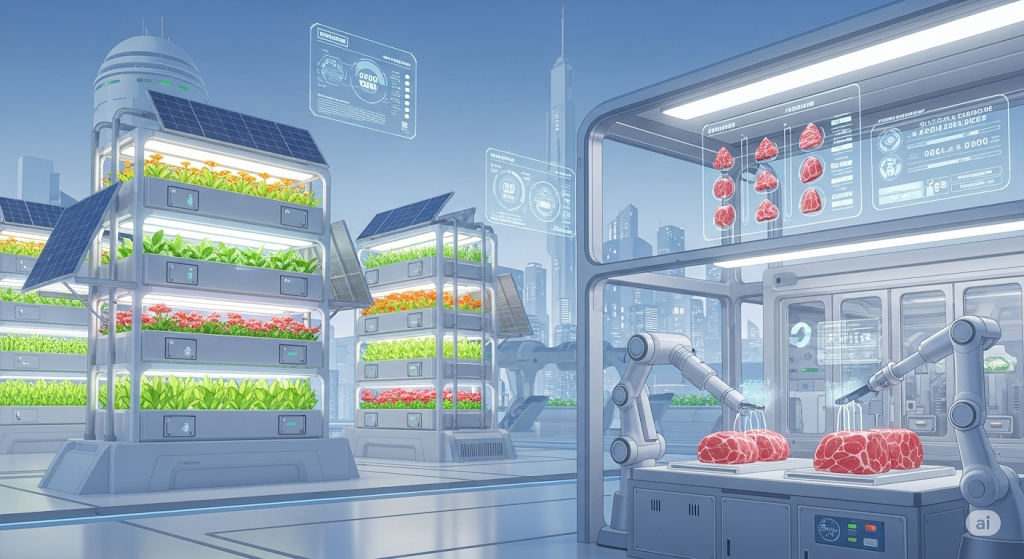
Smart farms, combined with advanced technology, are sparking a new agricultural revolution in forgotten urban spaces. South Korea’s ‘NextOn’ has transformed a decommissioned highway tunnel in Okcheon, Chungbuk, into one of the world’s largest indoor vertical farms.
The natural insulation effect of the abandoned tunnel drastically reduces energy costs, a major challenge for smart farms.
The stable internal temperature of the tunnel significantly reduces heating and cooling energy costs, cutting electricity usage by one-third. NextOn is further evolving into a technology solution company that ‘sells the farm itself’, exporting its technology to regions with desert climates like the Middle East or cold areas like Canada, turning South Korea’s weaknesses into global competitiveness.
The Empire’s Adaptation: Big Ag’s Food Tech Strategy
Large corporations are also seeking to secure dominance in future food systems through strategic investments in food tech. ADM and Cargill are investing in innovative technology startups focused on alternative proteins and cultured meat through venture capital, integrating them into their vast supply chains.
This strategy aims to control the pace of change by acquiring disruptors rather than allowing the empire to be destroyed. Therefore, future food policies must include fair trade policies to prevent technology from being monopolized by a few large corporations, in addition to fostering innovative technologies.
Comparison/Alternatives: New Food System Models
Model
Core Values
Advantages
Disadvantages/Challenges
Local Food
Trust, Community, Transparency
Shortened distribution distance, improved freshness, revitalization of local economies
Limits of mass production, seasonal constraints, high initial costs
Food Upcycling
Resource Circulation, Value Creation
Reduction of food waste, creation of new added value, cost competitiveness
Instability in raw material supply, need for improved consumer awareness
High initial investment, massive energy consumption, dependency on technology
Conclusion
Starting from the question, ‘Why is my dining table becoming shabby while the world is getting richer?’, we have confirmed that the root of the problem lies not in food scarcity but in the ‘broken food system’ designed for profit.
Key Summary 1: The Problem is the System. The monopoly of a few large corporations, financialization, and geopolitical vulnerabilities are structural problems threatening our dining tables.
Key Summary 2: Invisible Threats. Climate change and industrial agriculture undermine not only food prices but also nutritional value, leading to massive waste.
Key Summary 3: Alternatives are Close. Local food, food upcycling, and agri-tech offer hope in local communities and innovative technologies.
Every choice we make is a vote. When we use local food, open our wallets for ugly produce, and support innovative companies, we can collectively change the flow of this massive system.
Ultimately, a fork is not just a tool for eating but the most powerful and everyday tool for choosing the future we want. What future will you choose with your fork tonight?
References
“Bunge-Viterra merger approval highlights myth of competition and need for effective regulation, says NFU.” National Farmers Union