
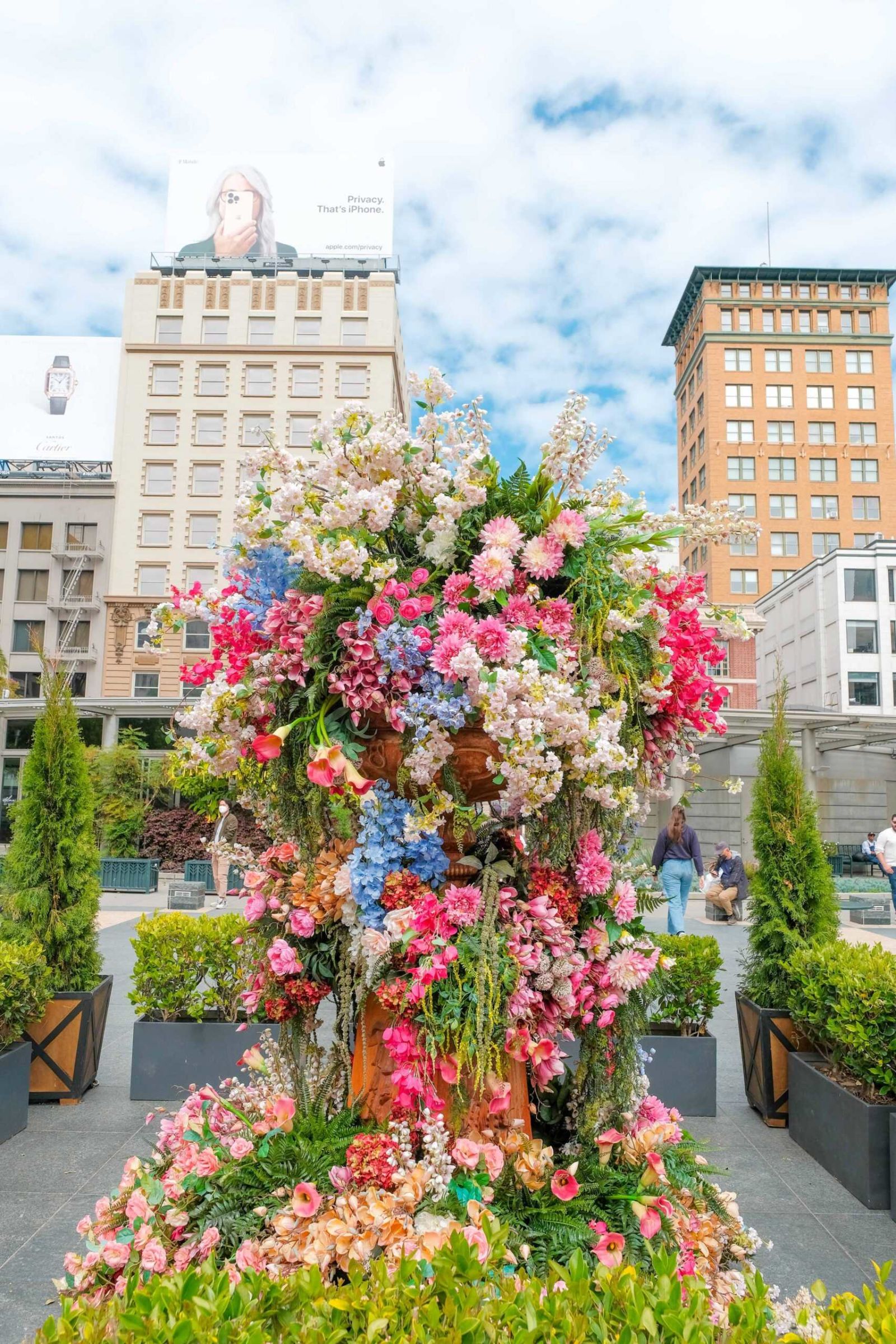
A few days ago, I happened to see a photo of San Francisco’s Union Square, and the entire plaza was a field of tulips. Behind it stood old department store buildings, and in front, colorful flowers were spread out like a carpet. People weren’t just walking by; they were crouching down and picking up armfuls of flowers. Curious, I looked it up and found out this campaign has been running for five years. It wasn’t just some local neighborhood festival, either—this year, even Amazon was listed as a sponsor.
The sentence “Amazon is paying for flowers” sounded a bit strange. Why would a company that lives off logistics and cloud computing attach its name to tulips planted in a city square?
What is ‘Union Square in Bloom’?
The campaign is called ‘Union Square in Bloom.’ It is a five-month floral campaign run by the Union Square Alliance, taking place from spring through summer every year. Its beginnings were much more modest. In 2021, when downtown offices and stores were empty due to the pandemic, the San Francisco Flower Mart proposed an idea to the city: let’s make recovery visible through large-scale floral installations.
Looking back, it’s a romantic, if not naive, idea. Solving the problem of empty offices and closed shops with flowers? Yet, the interesting part is that this idea was officially adopted as a flagship program in the downtown recovery plan under then-Mayor London Breed in 2022. A temporary measure had become official policy.
80,000 Tulips: Why are they planted every March?
The event that serves as the face of the campaign is ‘American Tulip Day.’ Held at the start of each season, this representative event transforms the entire plaza into a flower field, allowing visitors to take home a free bouquet without a ticket. This is the source of the photos that appear in international media every March.
While it looks like a marketing event by the numbers, the floral industry sees it differently. There is a long tradition in this industry of linking ‘cities and parks’—a concept famously associated with Frederick Law Olmsted, the designer of New York’s Central Park—and this campaign is considered part of that lineage. While it’s hard to judge how persuasive that lineage is, the floral industry itself seems to be taking this seriously as a new business territory beyond weddings and funerals.
This campaign doesn’t end with Tulip Day. Throughout the summer, floral arrangements are woven into storefronts and hotel awnings. Programs continue all summer long, including an outdoor fashion show featuring Academy of Art University students, a ‘Blooms and Bubbles’ bar crawl, and the ‘Bloomy Awards,’ which recognize the stores that best embraced the campaign. The 2026 season concluded in August with an Art & Culture Week (August 17–23), a second Bloom Music Series (August 20), and a public vote for the best ‘bloomed’ store.
What do flowers have to do with downtown vacancy rates?
To be honest, I didn’t quite believe the connection at first. The vacancy problem in downtown San Francisco wasn’t something that could be fixed with a few bouquets of flowers. By early 2020, office vacancy rates were at a 20-year low, only to flip to record highs within a year of the pandemic. Union Square, SoMa, Yerba Buena, and the Financial District were reportedly covered in empty buildings and shuttered stores. As late as 2023, seven large storefronts sat empty on a single block of Powell Street, leading many to believe that finding new tenants for those spaces was nearly impossible.
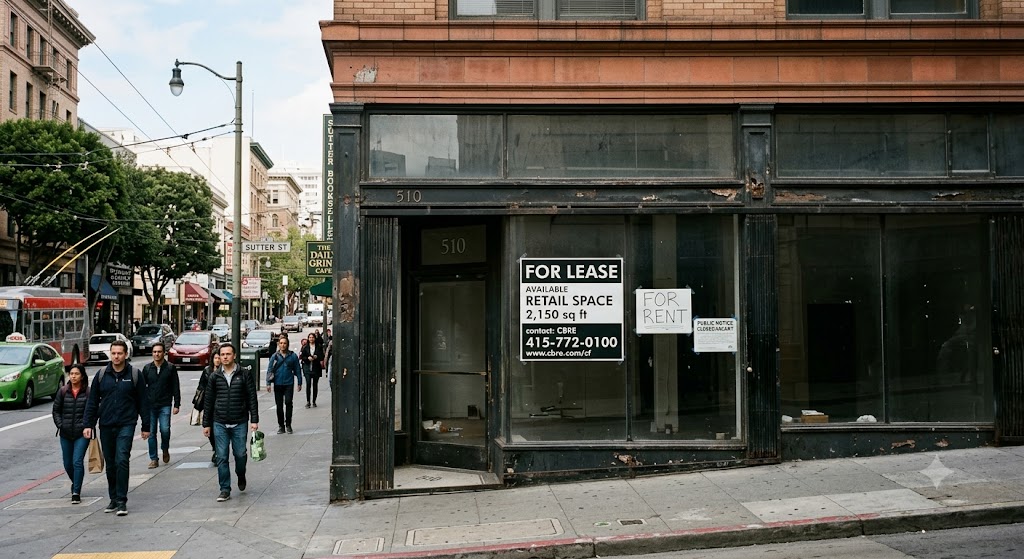
Therefore, it would be an exaggeration to say the flower campaign ‘solved’ the issue. Even the representative of the flower market who wrote about this acknowledges that downtown vacancy remains a real and chronic problem and that one season of flowers cannot fix the commercial real estate cycle. However, there was a shift. When the Filipino fast-food chain Jollibee opened its Market Street location this year, the line wrapped around the block, and there is talk that the streetwear brand Kith is considering a flagship store in the area. It’s hard to call it direct causality, but at least these things happened during the same period.
What makes me really curious is why it had to be ‘flowers.’ Policy tools like pop-up shop support, rent subsidies, and tax breaks were already being implemented by the city. The London Breed administration was already running a program called ‘Vacant to Vibrant,’ which placed ice cream shops, bakeries, cafes, art organizations, and flower shops into vacant storefronts rent-free. There must be a reason why the flower campaign survived and grew independently of those policy-driven supports.
Perhaps it’s because while pop-up support policies create ’tenancy,’ the flower campaign makes people ‘want to walk the streets.’ People need to pass by for stores to survive, and stores need to survive for properties to be leased. In fact, other articles covering the city’s vacancy problem point out that a TikTok video of empty storefronts in San Francisco went viral with over 2.8 million views, citing online shopping, petty crime, high rent, and a lack of support for small businesses as reasons. The city’s image itself was as much a variable as the vacancy rate. Flowers were the cheapest and fastest way to flip that image.
Why is the list of sponsors a significant signal?
2026 Union Square in Bloom Sponsorship and Background Summary
| Category | Details |
| — | — |
| Campaign Name | Union Square in Bloom |
| Organizer | Union Square Alliance |
| 2026 New Sponsor | Amazon (Announced Aug 5, 2026) |
| Existing Sponsors | JPMorgan Chase, Levi Strauss |
| 2026 Local Garden Sponsor | Amazon, JPMorgan Chase, San Francisco Downtown Development Corp, United Airlines, Union Square Foundation |
| City Government Support | Office of Mayor Daniel Lurie, Office of Economic and Workforce Development |
| Start Year | 2020 (Idea proposed), 2022 (Official program) |
On August 5, 2026, Amazon announced a formal partnership with the Union Square Alliance to support neighborhood beautification and placemaking. This year’s Local Garden program is sponsored by JPMorgan Chase, Amazon, the San Francisco Downtown Development Corp, United Airlines, and the Union Square Foundation, with additional support from the Office of Mayor Daniel Lurie and the Office of Economic and Workforce Development.
According to the author, this lineup is significantly different from the list of sponsors that witnessed the half-empty, anxious plaza in 2022. Since it is rare for Fortune 500 companies to attach their names to a flowerbed beautification project, this itself acts as a signal that “this neighborhood is now worth investing in.” It’s more of a calculated bet than charity.
Will this model work in other cities?
What’s interesting about this case for the floral industry isn’t just the photogenic tulip field, but the replicable partnership structure: a wholesale flower market providing floral expertise and city connections, a downtown commercial alliance providing location and permitting power, and corporate sponsors beginning to view beautification as a measurable economic strategy rather than charity.
I’m not sure if this is a formula that can be transplanted to other cities. The San Francisco Flower Market already had the unique infrastructure of being one of the few remaining wholesale flower markets in the US, having connected Northern California growers and wholesalers to the city’s florists, hotels, and event spaces since the late 1800s. It is questionable whether the same method would work in a city without such long-standing wholesale infrastructure.
Still, at least one thing is clear: if you approach the problem of downtown vacancy only by asking ‘how do we fill it,’ you end up with rigid solutions like rent subsidies or deregulation. But if you change the question to ‘how do we make these streets walkable again,’ you might find answers like flowers. Of course, I couldn’t find exact figures in this data to show how much the vacancy rate dropped or the precise causal relationship. We’ll have to wait and see on that part.
References
- Thursd, 'San Francisco's Flower-Powered Downtown Comeback', 2026-08-17
- San Francisco Chronicle, 'What comes next for S.F.'s emptying downtown?', 2023-05-06
- SPUR, 'Downtown on a Precipice: Why San Francisco Must Recover', 2021
- San Francisco Chronicle, 'Can pop-ups save downtown San Francisco?', 2022-07-05
- San Francisco Chronicle - Sunday Edition, '8 pop-ups coming to empty downtown S.F. storefronts'
- SFGate, 'Video of vacant storefronts in downtown SF goes viral', 2023-10-18
- Union Square Alliance official announcement (Union Square in Bloom campaign overview)