
Hello! Today, I would like to share a somewhat special story. It is about the new captain, President Lee Jae-myung, who is leading the massive ship called ‘South Korea.’ It has been 100 days since he took the helm, and the captain called all the crew (the citizens) to the deck to reflect on the past voyage and to unfold the navigation chart for the vast sea ahead. This report is a record of that passionate conversation and a valuable compass to gauge the direction our ship will take.
Part 1: 100 Days of Voyage, Correcting the Course After the Storm
The First 100 Days: A Time of ‘Recovery and Normalization’
Captain Lee defined the past 100 days as a time of ‘recovery and normalization’ spent with the mindset of “rebuilding a broken ship from the ground up.” His metaphor of needing to perform emergency CPR on our ship, which had become weary and weak from the rough storms of the previous voyage, conveys the urgency of the past.
But we did it wonderfully. We quickly released emergency funds to revitalize the stagnant economy on board, and as a result, the consumption sentiment of the crew reached its highest level in 7 years and 7 months. The KOSPI index, which shows the value of our ship, planted its flag at 3,300 for the first time in history. In the vast ocean of diplomacy, we visited various ports, including the G7 summit, to interact with other ships and elevate South Korea’s status. In short, it was a time of correcting the ship’s balance and normalizing the course after breaking through the storm.
Now, to the New Continent of ‘Leap and Growth’
The captain now declares that the arduous task of ‘recovery’ has come to an end. He emphasized that the remaining 4 years and 9 months will be a time of ’leap and growth.’ His statement that “the ship, which set sail without a transition committee, has finally reached the starting line” serves as a declaration that the real voyage, colored by Captain Lee’s unique style, is about to begin.
The core of the navigation chart he presented consists of four key points:
- Innovative Economy: Achieving ‘growth that leads the world’ with cutting-edge technologies like semiconductors and artificial intelligence.
- Growth for All: His long-held dream of sharing the fruits of growth equitably among everyone.
- Dignified Practical Diplomacy: Breaking free from the shackles of ideology and sailing the world with the sail of national interest.
- Politics of Integration: Promising to become ’the president of all’ and unite the divided hearts of the crew.
Dividing the past into a time of ‘recovery’ and the future into a time of ’leap’ is a very clever rhetorical strategy. The difficult issues of the previous government can be framed as ’the legacy of the past that must be overcome,’ while the current positive signals can be fully attributed to the current administration. Furthermore, the bold policies to be implemented, such as expansionary fiscal measures and institutional reforms, can be naturally packaged as ’the next step that must be taken after overcoming the crisis.’
Part 2: Economic Doctrine, Raising the Huge Sail in the Sea of Growth
The most time during this conversation was undoubtedly spent discussing how to operate the engine called ’economy’ more powerfully.
100 Trillion Won Wind: Investment for the Future
In response to the worried question, “Are you saying you will incur another 100 trillion won in debt?” the captain replied with a very interesting metaphor. “If you need to sow seeds in the field but have no seeds, you must borrow to sow them to reap a larger harvest in the fall, right?” In other words, the current 100 trillion won is not debt but a ‘future investment’ for greater growth.
He emphasized that the ratio of debt to GDP is more important than the absolute amount of debt. Even if this investment is made, our debt ratio will remain just above 50%, which is still very strong compared to other advanced countries with ratios exceeding 100%.
Breaking the Shackles of ‘Korea Discount’
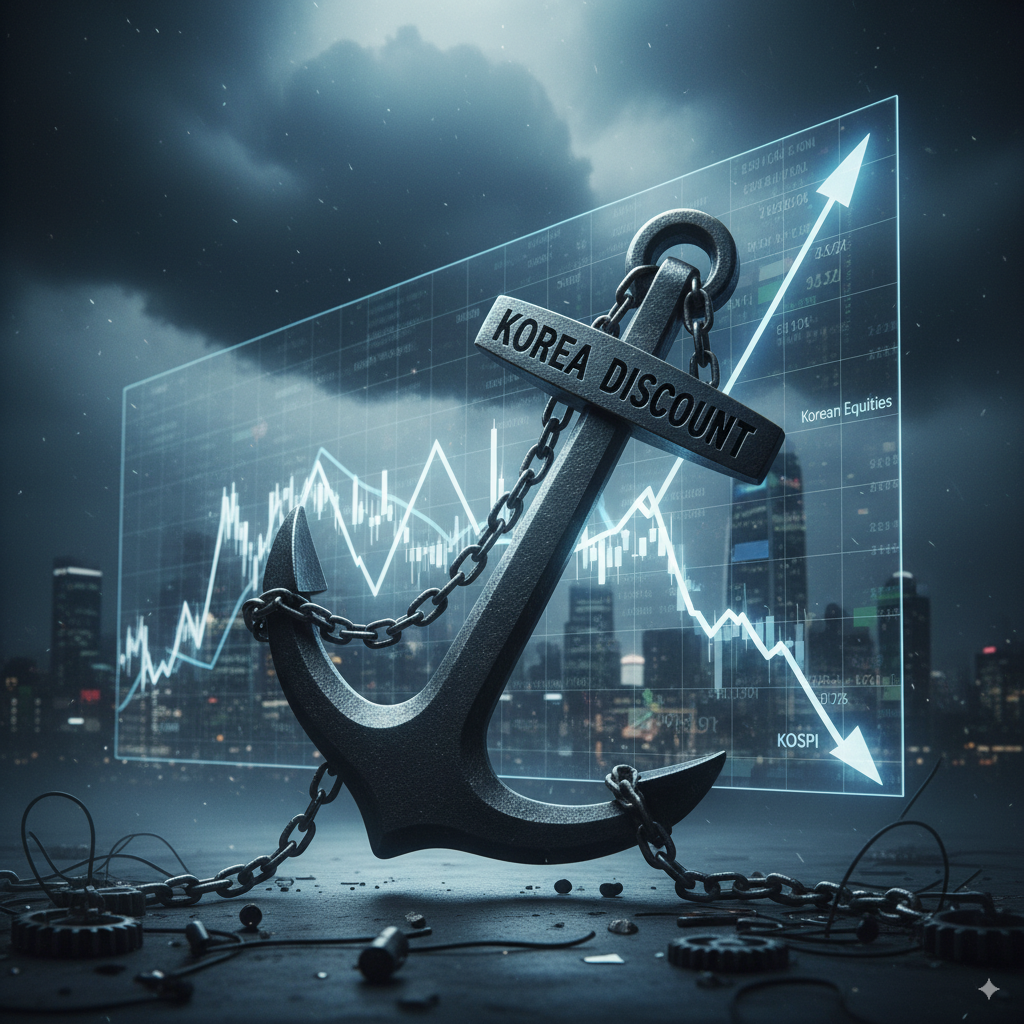
Why is our ship (the South Korean stock market) always undervalued compared to its true worth? The captain identified the cause as ‘distrust.’ It is not due to geopolitical risks, but rather a sharp diagnosis that it stems from outdated practices and a system that fails to protect minority shareholders, as in, “You never know when someone might siphon off company funds.”
The solution was simple and powerful. “If there is stock manipulation, I will confiscate the principal and make them bankrupt.” This is a strong warning to the pirates of the market and a firm promise to protect honest investors. His grand vision is to establish market rules through strong law enforcement, allowing money tied up in unproductive areas like real estate to flow into the productive engine of the stock market.
Part 3: Diplomacy and Security, Navigating the Capricious Sea
The captain also presented a clear compass of ‘practicality’ on how to navigate the unpredictable sea of diplomacy.
North Korean Straits: The Tenacity of ‘Strategic Patience’
He stated that it is perhaps natural for North Korea to be cold towards us right now. Therefore, he expressed the belief that “rather than unnecessarily provoking North Korea, if we continue our efforts toward peace, there will be a moment when a small opening will appear.” He made it clear that this is not due to ideology, but rather the most realistic choice for the safety and economy of our ship.
Japanese Route: The Wisdom of ‘Two-Track’
The tricky relationship with Japan reaffirmed the principle of ’two-track.’ Sensitive issues like historical grievances will be addressed firmly while keeping the door wide open for cooperation in areas like economic and cultural exchanges.
U.S. Alliance: A Partnership Without ‘Behind-the-Scenes Agreements’
Regarding the relationship with the U.S., he firmly stated, “We will never make decisions that go against South Korea’s national interest.” This is an expression of confidence that we will negotiate as an equal and horizontal partner without sacrificing our interests under the name of alliance.
Part 4: Domestic Reforms, Cutting Out the Long-Standing Maladies on Board
The captain drew his sword for reform against the chronic issues on board, particularly the two massive institutions of the prosecution and the media.

Prosecution Reform: With the Voice of the Victim
He introduced himself as “the biggest victim of the prosecution” to start the conversation. This elevates the necessity of reform to a moral dimension of ‘realizing justice’ beyond legal arguments. Just as he said, “You cannot break the jar just because you dislike the maggots,” he promised to take his time and gather opinions from various sectors over the course of a year to conduct the most precise and complete surgery.
Media Reform: The Scalpel of ‘Punitive Damages’
He began discussing media issues by sharing personal pain related to his son. His solution is clear: “For those who deliberately create ‘fake news’ with ‘malice’ and destroy a person’s life, I will impose hefty punitive damages regardless of the source.” He emphasized that this is not media suppression but rather the act of cutting out malignant tumors that poison the community with false information.
Using personal experiences as the driving force for public reform is his unique strategy. While it has the power to strongly rally his support base, it is also a double-edged sword that can provoke fierce resistance.
Part 5: Communication, The Captain’s Voice Reaches All Crew Members
This press conference itself was a powerful message.

Sitting just 1.5 meters away from reporters without a podium, and answering 22 questions smoothly for over 150 minutes, far exceeding the scheduled 90 minutes, demonstrated his willingness to communicate directly by lowering authority. His candid and straightforward language, such as “Let’s talk openly” and “It’s chaos whether we change or not,” reflects his style of rejecting the grammar of established politics and approaching the public in their language.
This is a sophisticated strategy to establish a direct and emotional bond with all crew members without intermediaries like the media or political parties. The president himself becomes the strongest ‘speaker’ of this ship.
Part 6: Comprehensive Analysis, Where is the Fate of This Voyage Heading?
Through the record of the 100-day voyage, we have identified the enormous challenges facing the identity of ‘Lee Jae-myung’s ship.’
The Core of ‘Lee Jae-myungism’: Active State Interventionism

His governing philosophy can be summarized as ‘active state interventionism.’ Rather than leaving it to the market or existing order, he holds a strong belief that the powerful subject of the state must directly intervene to open the economic floodgates and cleanse the social grime.
Three Great Waves Ahead
In the future, this ship must overcome three great waves.
- Economic Gamble: Will the massive wind of 100 trillion won lead us to a new continent, or will it become a storm that tears the sails? The battle against time to create tangible results that the citizens can feel has begun.
- Quagmire of Reform: While prosecution and media reforms are necessary surgeries, there is a risk of exhausting all governance momentum by bleeding too much in the process.
- From Declaration to Execution: The splendid navigation chart has now been unfolded. However, what matters is not the picture on the map but actually reaching that destination.
The 100-day mark is like the sound of a ship’s horn signaling the end of a festival and the beginning of a serious test. Now, Captain Lee and the ship of South Korea are moving from the era of declarations into the long sea of proof.