
How the World’s Largest Dam is Transforming Asia’s Geopolitical Landscape Beyond a Simple Energy Source
Introduction
The Medog (Motuo) Hydropower Station is not just an infrastructure project. It represents a paradigm-shifting development at the intersection of global energy transition, Asian geopolitics, and extreme environmental risks. Regarded as China’s most ambitious engineering feat since the Three Gorges Dam, its strategic implications are far deeper and more complex than any previous project.
This report argues that while the Medog Dam is ostensibly promoted under the banner of ‘clean energy’, at its core, it functions as a powerful tool for national governance. The project is located on a transboundary river, adjacent to the disputed border with strategic competitor India, and sits at the pinnacle of a cascade dam system that holds tremendous geopolitical significance. The project’s massive scale and the extreme geological and ecological vulnerabilities of the site create risks that extend far beyond its immediate impact, threatening regional stability and the livelihoods of over 130 million downstream residents.
The analysis is divided into five parts. First, we will examine the technical and engineering specifications of the project, followed by an analysis of China’s strategic calculations behind the dam’s construction. Next, we will assess the impacts on downstream countries, India and Bangladesh, and illuminate why the Medog Dam poses a new level of risk compared to the Three Gorges Dam. Finally, we will present comprehensive conclusions and strategic recommendations for downstream nations.
Part 1: Dissecting the Project and Engineering Ambitions
1.1. Technical Specifications and Project Overview
The Medog Project is the world’s largest and most expensive hydropower station, with its sheer scale being overwhelming.
- Installed Capacity: The planned installed capacity is 60,000 MW (60 GW), nearly three times that of the Three Gorges Dam’s 22,500 MW.
- Annual Power Generation: An annual power generation of 300 billion kilowatt-hours (300 TWh) is expected, which is three times the output of the Three Gorges Dam and equivalent to the total annual electricity consumption of the UK.
- Project Cost: The estimated investment exceeds 1 trillion yuan, ranging from $137 billion to $168 billion. This amount is more than four times the official cost of the Three Gorges Dam (approximately $32 billion).
- Construction Timeline: Official approval was granted in December 2024, with the groundbreaking ceremony held on July 19, 2025. The project is planned to be installed in a single phase, with commercial operation expected to begin in 2033.
- Corporate Structure: The newly established state-owned enterprise China Yajiang Group manages the project, while PowerChina is responsible for ownership and development. This integration under a dedicated state-owned enterprise suggests strong central government control and prioritization.
1.2. Blueprint: Geographical and Engineering Design
The project’s location and design are highly unique and challenging.
- Geographical Location: The dam is located in Medog County, Nyingchi Prefecture, Tibet Autonomous Region. A key feature is its position at the “Great Bend” of the Yarlung Tsangpo River, where the river sharply bends in a horseshoe shape just before flowing into India, dropping steeply in elevation. Analysis of open-source information confirms that the groundbreaking site is just upstream of this bend, in Mainling, Nyingchi City.
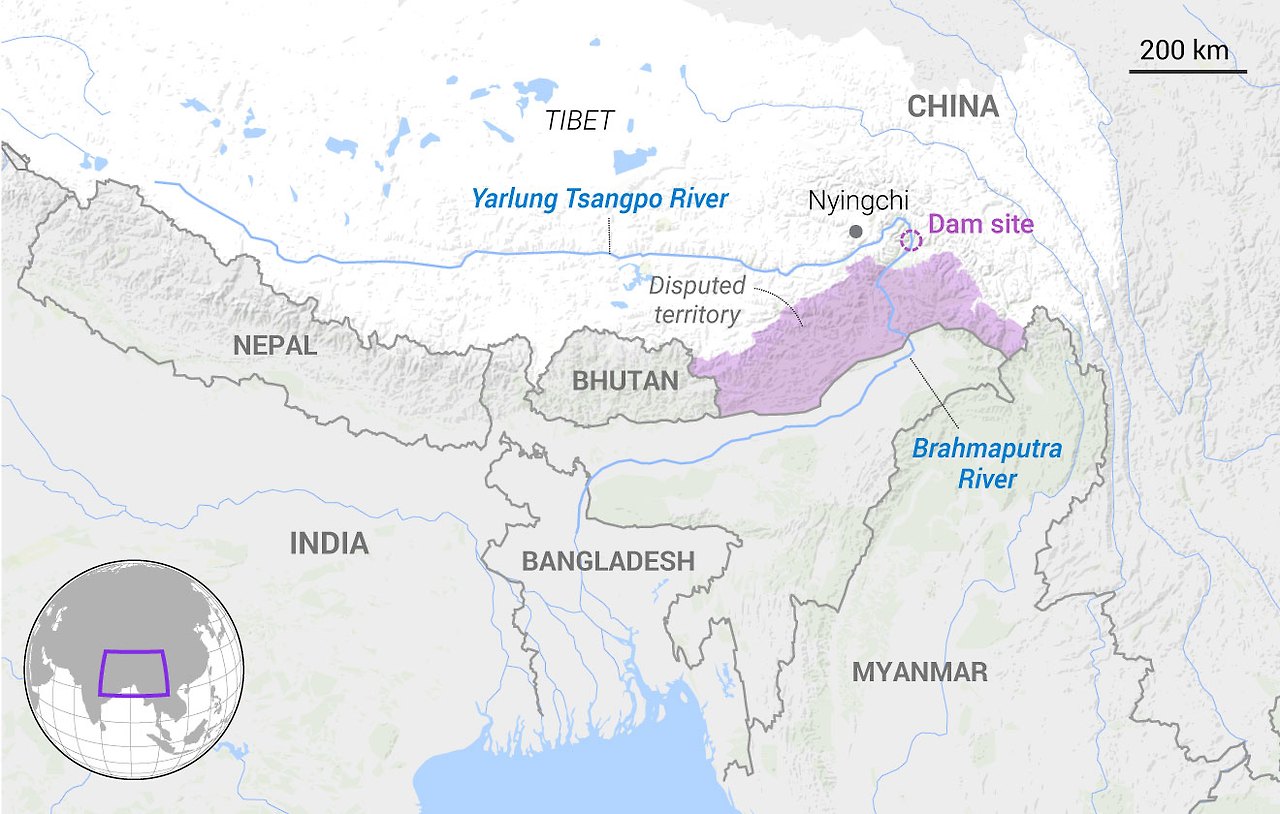
- Engineering Concept: The project’s design is unprecedented. It is not a traditional reservoir dam but a massive run-of-the-river hydropower station. It will utilize a 2,000-meter drop over a 50 km stretch of the world’s deepest Yarlung Tsangpo Grand Canyon. This will be achieved by excavating four 20 km long tunnels through Namcha Barwa Mountain to divert the river flow and create significant hydraulic head.
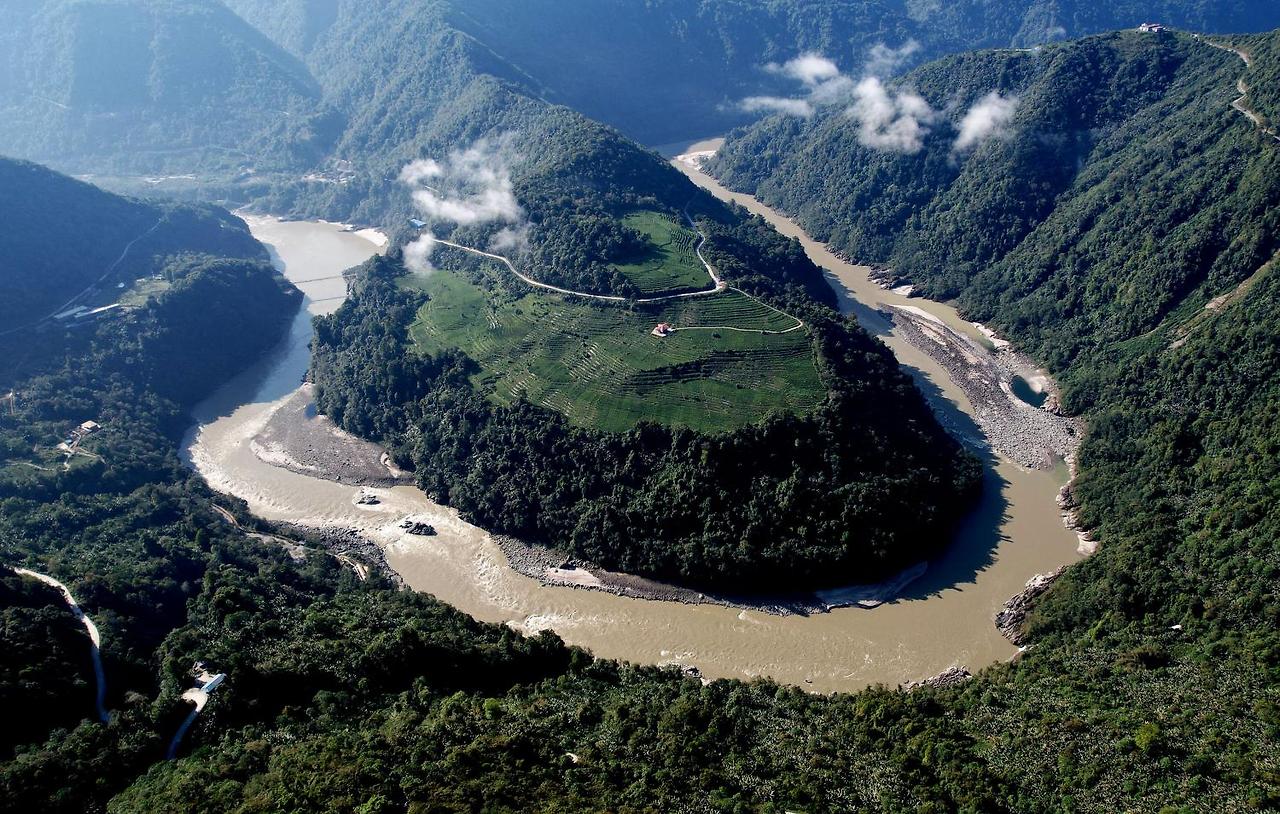
The project’s vast power generation potential stems from the unique terrain of the “Great Bend”, but this very geographical feature is also linked to the project’s greatest risks. The 2,000-meter drop is a result of the collision between the Indian and Eurasian tectonic plates. Thus, the geographical characteristics that make the dam so powerful are also the source of the greatest geological risks, including earthquake activity and landslides. This is not an incidental risk but a fundamental paradox inherent in the project design.
Table 1: Medog Hydropower Station - Key Specifications
| Parameter | Value | Source |
|---|---|---|
| Installed Capacity | 60 GW | |
| Annual Power Generation | 300 TWh | |
| Estimated Cost (USD) | $137 billion ~ $168 billion | |
| Dam Type / Power Station Type | Gravity Dam / Run-of-the-River | |
| Key Engineering Features | Utilization of 2,000m drop, 4 tunnels | |
| Expected Commercial Operation | 2033 |
Part 2: Strategic Calculations: China’s Control of the “Water Tower of Asia”
2.1. Domestic Drivers and Strategic Necessity
China’s reasons for constructing the Medog Dam are multifaceted.
- Green Energy Narrative: Officially, the dam is framed as a key project for achieving President Xi Jinping’s 2060 carbon neutrality goal. It is justified as a means to supply a massive amount of renewable energy to replace coal.
- Geopolitical and Security Narrative: Beyond energy issues, the dam is a central element in Beijing’s strategy to develop the Tibetan region and solidify control over the disputed border with India, thereby enhancing border security. Such large-scale infrastructure projects function as a means of projecting hard power to reinforce de facto control over sensitive territories.
2.2. Yarlung Tsangpo Cascade System: Control Network
The Medog Dam should be understood not as an isolated project but as part of a larger system.
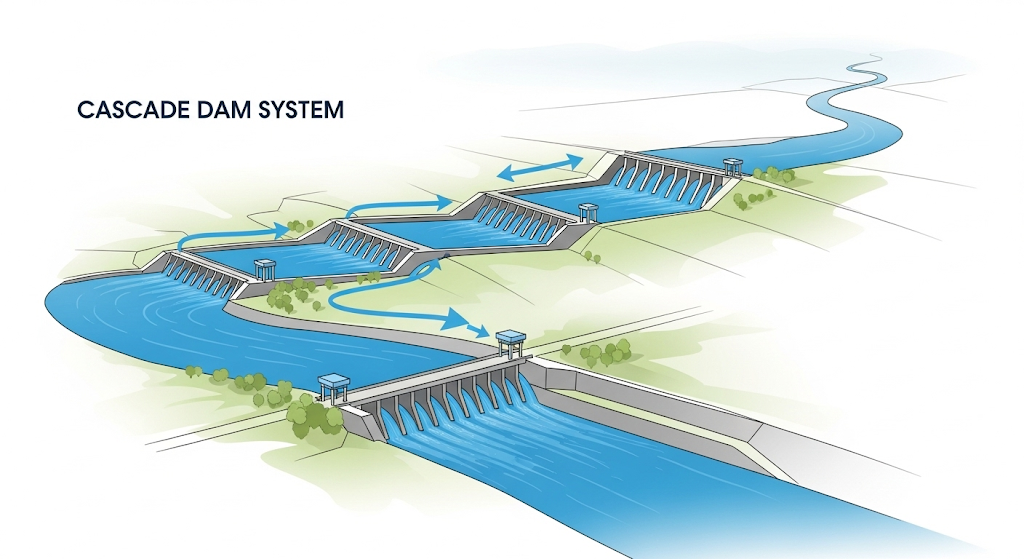
- Concept of Cascade Dams: The cascade system involves constructing a series of dams along the river so that the discharge from upstream power stations flows into the next downstream power station. This allows for the repeated use of water to generate energy and provides a more integrated control over the flow and generation of the entire river system.
- Yarlung Tsangpo Cascade Dams: The Medog Dam is not an isolated project. It is the “crown jewel” and final component of a comprehensive upstream infrastructure network. China is already operating several dams on the Yarlung Tsangpo River (such as Zhangmu, Zacha, and Jiachao) and has plans for additional dams. The Medog project itself is expected to consist of five cascade hydropower stations.
2.3. The Politics of Water and the Mekong River Precedent
The theory of “weaponization of water” can be concretely analyzed through the case of the Mekong River.
- “Weaponization of Water” Theory: A country controlling the upstream of a transboundary river can restrict water flow during dry seasons and release excessive water during wet seasons, creating hydrological stress for downstream countries, which can be used as a strong bargaining chip in diplomatic or military disputes.
- Evidence from Mekong Dam Monitor: The Stimson Center’s ‘Mekong Dam Monitor’ provides empirical evidence of this phenomenon. Analysis shows that China’s 12 dams on the upper Mekong (Lancang River) have significantly stored wet season flows, exacerbating drought conditions downstream. In 2019, despite sufficient rainfall, the dams blocked nearly all flow from the upper Mekong, contributing to the worst drought in history for Thailand, Cambodia, and Vietnam. This pattern provides a reliable model for potential impacts on the Brahmaputra River.
Beyond the simple function of a single dam holding or releasing water, the cascade system provides much more sophisticated control. It transforms the river from a natural system into a centrally planned utility. China is not merely installing gates on the river; it is building a complex “exchange station” that can precisely and strategically regulate the river’s movements, granting it far greater geopolitical influence than a single dam could possess. At the same time, the “green energy” narrative serves as a geopolitical shield. By framing this project as part of global climate commitments, China avoids international criticism and complicates diplomatic responses.
Part 3: The Reality Downstream: Perspectives from India and Bangladesh
3.1. India’s Strategic Dilemma: “Water Bomb” and Economic Disruption
- Threat of a “Water Bomb”: Indian officials, particularly the Chief Minister of Arunachal Pradesh, have expressed fears that the dam could be used as a “water bomb”. This implies the potential for sudden and massive water releases during conflicts, causing devastating floods downstream. There is also the risk of dam failure due to earthquakes or landslides.
- Manipulated Drought and Agricultural Shock: Conversely, the dam could trap water, causing severe drought during dry seasons. This could severely impact India’s approximately 130 million people and 6 million hectares of farmland that rely on the Brahmaputra River.
- Ecosystem Disruption: One of the key concerns is the blocking of sediment flow. The Great Bend area generates a significant portion of Brahmaputra sediment, which is essential for soil fertility across the Assam plains and northeastern region.
- Divided Internal Perspectives: There are differing views within India. The Chief Minister of Arunachal Pradesh sees it as an “existential threat”, while the Chief Minister of Assam suggests that reduced flow could help alleviate chronic flooding in Assam. These differing perspectives complicate a unified national response.
3.2. Bangladesh’s Existential Vulnerability
- Extreme Dependence: As the most downstream country, Bangladesh is extremely vulnerable. The river, known as the Jamuna, is crucial for over 160 million people, supporting 55% of irrigation demand, drinking water, and a massive fishing industry.
- Delta Subsidence: The most severe long-term threat is sediment depletion. The Ganges-Brahmaputra Delta is maintained by natural sediment accumulation, which helps counteract rising sea levels. Blocking this sediment upstream threatens the very existence of the low-lying delta where millions reside.
- Worsening Floods and Droughts: Altered flow patterns could exacerbate both flood risks during the monsoon season and water shortages during dry periods in Bangladesh, which is already facing extreme water stress and climate change issues.
Table 2: Dependence on Brahmaputra/Jamuna River
| Country | Key Indicators | Value/Statistics |
|---|---|---|
| India | Population Dependent on Basin | Approximately 130 million |
| Irrigated Land | 6 million hectares | |
| Major Economic Activities | Agriculture, Fisheries, Hydropower | |
| Bangladesh | Population Dependent on Basin | Over 160 million |
| Irrigation Dependence | 55% of national irrigation demand | |
| Water Resource Dependence | Most of total renewable water resources |
3.3. Counterarguments and Responses from Downstream Countries
China claims that this project is entirely within its sovereignty and will not negatively impact downstream areas. It also argues that being a run-of-the-river project, it lacks large-scale storage capacity, making it difficult to weaponize water. However, this contradicts the precedent set by the Mekong River.
In response, India is actively monitoring the project and has proposed the construction of a 11,000 MW response dam in Arunachal Pradesh to offset impacts. Additionally, it continues to demand transparency and data sharing through diplomatic channels. China’s strategy presents India with a “dam dilemma”. To counter the threat, India finds itself in a position where it must also construct massive dams at great cost and domestic opposition.
Part 4: The Tale of Two Mega Dams: Medog vs. Three Gorges
A direct comparison of the two projects makes it clear that Medog is fundamentally different from merely being a larger version of the Three Gorges.
Table 3: Comparative Analysis - Medog vs. Three Gorges Dam
| Feature | Three Gorges Dam | Medog Hydropower Station |
|---|---|---|
| River System | Yangtze River (Domestic River) | Yarlung Tsangpo-Brahmaputra (International River) |
| Geopolitical Context | Domestic Energy/Flood Control | Cross-Border, Adjacent to Disputed Border |
| Installed Capacity | 22.5 GW | 60 GW |
| Official Cost (USD) | Approximately $32 billion | Approximately $137 billion - $168 billion |
| Population Displacement | Approximately 1.4 million (realized) | ? more |
| Major Geological Risks | Earthquakes/Landslides from Stable Reservoir | Seismic/Landslide Risks from Tectonic Plate Boundary |
| Major Ecological Risks | Downstream Sediment/Flow Changes | Critical to Fragile Himalayan Ecosystem and Downstream Delta |
4.2. Lessons Not Learned from the Yangtze River
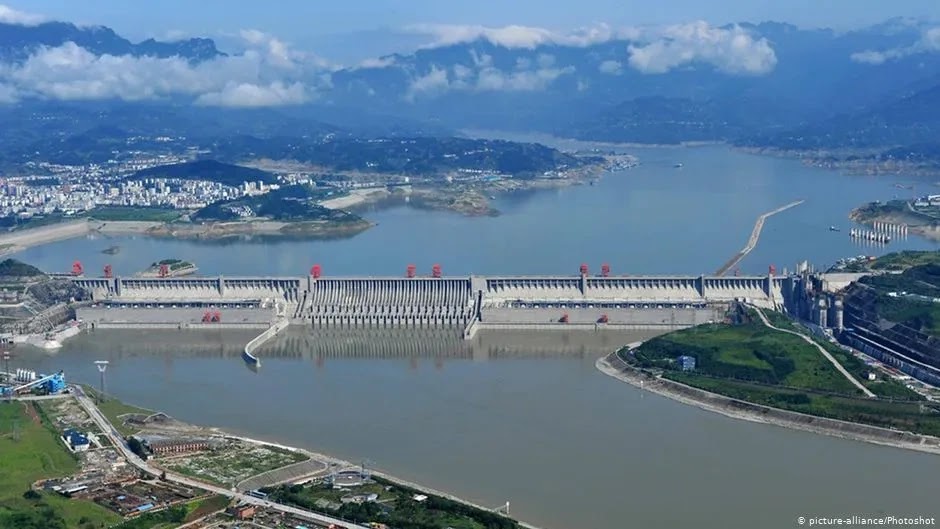
The severe side effects of the Three Gorges Dam serve as a clear case demonstrating the risks of mega dam projects. Issues such as the large-scale displacement of at least 1.3 million people, social unrest, increased risks of earthquakes and landslides due to the reservoir, and irreversible ecological destruction like the extinction of the Baiji dolphin have already materialized.
4.3. Why Medog is a More Dangerous Gamble
The known issues of the Three Gorges Dam could be amplified to catastrophic levels in Medog.
- Risk Amplifier 1: Extreme Geology: The Medog site is located at the point where the world’s deepest canyon’s tectonic plates directly collide, akin to the criticism of “building on tofu”. The geological risks are inherently higher than those of the Three Gorges Dam.
- Risk Amplifier 2: Cross-Border Conflicts: A catastrophic failure, such as dam collapse, would not only be a disaster for China but would also send walls of water and debris to India and Bangladesh, resulting in an international catastrophe.
- Risk Amplifier 3: Heightened Geopolitical Competition: Unlike the Three Gorges Dam, the Medog Dam is being constructed during a time of escalating US-China tensions and border clashes with India. This context makes the threat of “water weaponization” much more realistic and increases the potential for miscalculation.
From Beijing’s perspective, the Three Gorges Dam may be viewed as a successful project. This experience of “success” may lead planners to underestimate known risks and embark on much more ambitious and dangerous projects like Medog.
Part 5: Summary and Strategic Recommendations
5.1. Comprehensive Risk Assessment
The risks of this project do not simply add up; they operate in multiplication. Extreme engineering complexity, extreme geological instability, and acute geopolitical competition combine. A failure in one area could trigger catastrophic failures in others. Experts question not only whether China should build this dam but also whether it can be safely constructed in such an environment. The lack of transparency from the Chinese government regarding detailed environmental and engineering plans further fuels this skepticism.
5.2. Pathways for Downstream Countries
Viable policy recommendations for India, Bangladesh, and the international community include:
- Recommendation 1: Establish a “Brahmaputra Dam Monitor”: Modeled after the Stimson Center’s ‘Mekong Dam Monitor’, downstream countries should collaborate to operate an independent monitoring platform using satellite imagery, remote sensing, etc. This would provide an independent evidence base to counter China’s data opacity.
- Recommendation 2: Strengthen Legal and Diplomatic Frameworks: India and Bangladesh should intensify efforts to create a legally binding tripartite water-sharing treaty. They should also continuously urge China to join the 1997 UN Water Convention for equitable use and dispute resolution.
- Recommendation 3: Invest in Resilient Domestic Infrastructure: Given the low likelihood of China halting the project, downstream countries should invest in mitigating its impacts. This includes building response dams, improving flood management systems, developing drought-resistant agriculture, and protecting and restoring delta ecosystems.
- Recommendation 4: Form a Coalition of Downstream Coastal States: India should collaborate with other downstream coastal states, including Bhutan and Bangladesh, to develop joint protocols for early flood warning and disaster preparedness, and to present a more unified voice to China.
Sources
- [China's Medog county mega-dam is bad news for India and ...](https://www.lowyinstitute.org/the-interpreter/china-s-medog-county-mega-dam-bad-news-india-bangladesh)
- (PDF) Modeling the water-energy-food-environment nexus and transboundary cooperation opportunity in the Brahmaputra River Basin - ResearchGate
- Medog Hydropower Station - Wikipedia
- Three Gorges Dam - Wikipedia
- World’s Largest Hydropower Dam Begins Construction
- Satellite Photos Show Where China Is Building World’s Biggest …
- Not immediately worried: Himanta on China’s Medog Dam construction
- www.scmp.com
- China Authorizes Controversial Hydropower Project in Landslide …
- China’s Brahmaputra Gambit: A strategic assessment of Motuo dam | India Sentinels
- Building the largest dam on Brahmaputra river’s Great Bend in China | Climate Conflicts
- India’s Water Security Strong Despite China’s Brahmaputra Dam - IndiaWest Journal News
- ‘Building on Tofu’: Medog Another Project Damming Tibet’s environment - Institute for Security and Development Policy
- China’s Mega Dam on Brahmaputra: Implications for India-China Relations - Vision IAS
- China’s Gigantic Hydropower Dam in Tibet: Green Energy or the “Weaponization” Of Water?
- Design concept of Hydro cascade control system - INIS-IAEA
- DESIGN CONCEPT OF HYDRO CASCADE CONTROL SYSTEM - INIS-IAEA
- Management Models for Hydropower Cascade Reservoirs
- Modeling of Cascade Dams and Reservoirs Operation for Hydropower Energy Generation - HENRY
- Hydro power plants operating modes in a cascade system depending on the needs of the power system - ResearchGate
- China’s mega dam on Brahmaputra & concerns in India | Explained …
- The Mekong Dam Monitor Tracks a River Under Pressure | New Security Beat
- The Mekong Dam Monitor Tracks a River Under Pressure - Circle of Blue
- New Evidence: How China Turned Off the Tap on the Mekong River - Stimson Center
- Country profile – Bangladesh - FAO Knowledge Repository
- Water Resource Competition in the Brahmaputra River Basin: - CNA.org.
- Dam on upper reaches Brahmaputra will not impact India, Bangladesh: China - The Hindu
- China To Build The World’s Largest Hydroelectric Dam On The Yarlung Tsangpo River - PPI
- China’s Brahmaputra Dam Plan: An Ecological Gamble in the Himalayas with Geopolitical Consequences - Outlook Business
- Three Gorges Dam Facts for Kids
- China’s three gorges Dam - Rivers Resource Hub
- Three Gorges Dam | Facts, Construction, Benefits, & Problems …
- Mekong Dam Monitor - Stimson Center