
The Physical AI Revolution and LG’s Bet
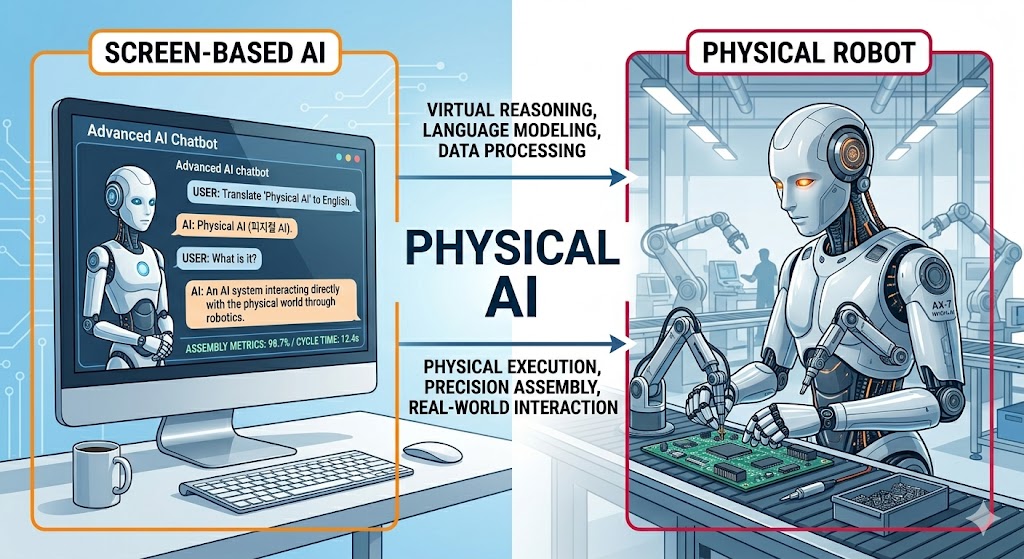
When ChatGPT first appeared, the world said, “Writing is over.” A year later, they said, “Image generation is over.” But the most important question was never asked.
What happens when these intelligent brains step out of the screen?
Doing chores like washing dishes, picking up parts on a factory line, or carrying meal trays for patients in hospital corridors – those ordinary tasks. Until now, AI has been confined to screens. In 2026, that boundary is breaking down.
I. The Limits of a Genius Without Hands
Everyone knows how capable LLMs (Large Language Models) are. They can solve college entrance exam math problems, pass the bar exam, and write complex code.
But this genius has a critical weakness.
It cannot pick up a cup.
Consider how much information the human hand processes when performing such an action, and you’ll grasp the scale of this problem.
Is it a glass cup or a paper cup?
How full is it?
Is it hot? Is it slippery?
How much should I tilt my wrist?
Humans process all these judgments unconsciously in 0.3 seconds.
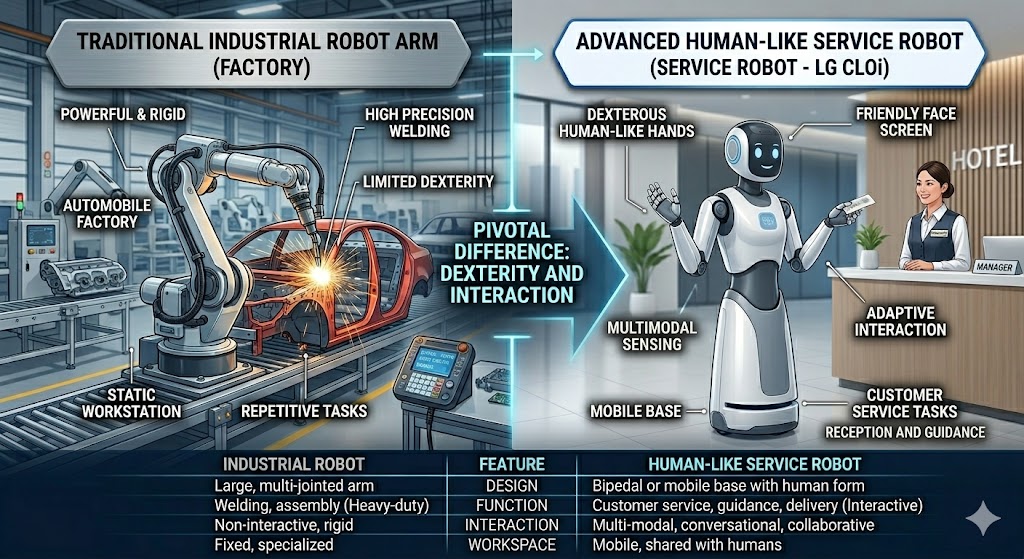
Traditional industrial robots solved this problem differently.
They didn’t judge.
Instead, they placed the same object in the same spot every time and mechanically repeated actions by pre-programming tens of thousands of trajectory codes.
-> This was factory automation for the past 40 years.
That method is fast and accurate, but it fails at one crucial thing: adapting to change.
If a part is off by 2 centimeters, it stops. If an unexpected object appears, it stops. If the lighting changes, it stops.
-> These robots were not geniuses; they were memorizers.
Physical AI is an attempt to change this equation.
It combines a powerful AI brain with actual hardware to create a system that sees, judges, and acts.
And at this moment, a company that has been manufacturing home appliances for decades has stepped into the center of the game from a completely unexpected direction.
II. Why the Name LG Doesn’t Fit, and Why It Does
To be honest, the phrase “LG is leading the robot revolution” sounds awkward at first.
LG is a refrigerator company. It makes washing machines, air conditioners, and OLED TVs.
When you think of robot companies, names like Boston Dynamics, Tesla, or Figure AI come to mind first. LG wasn’t on that list.
However, this awkwardness arises from looking only at the surface.
To make a washing machine, you need a motor. Specifically, a precision motor that won’t fail even after millions of rotations. LG’s developed DD (Direct Drive) motor, which drives the washing drum directly without belts or gears, requires world-class precision torque control. The inverter technology that controls air conditioner compressors is similar.
This capability to control rotational speed in tens of microseconds is structurally identical to the servo motor technology used to control robot joints.
For 60 years, LG has been creating robot component technology. It was just embedded within refrigerators and washing machines.
Now, that technology is shedding its shell.
III. EXAONE: Teaching Robots to Speak
The traditional way robots recognize objects is as follows:
They store the shape of an apple as a 3D point cloud and match patterns with the input image. This method works reasonably well but has a critical limitation: it stops in front of objects it hasn’t seen before.
There are too many objects in the world. An apple can be a whole apple, a half-eaten apple, a peeled apple, or a wrinkled old apple. You can’t put all of them into a database.
The latest version of EXAONE (EXAONE), developed by LG AI Research, approaches this problem differently.
It trains on language and vision simultaneously.
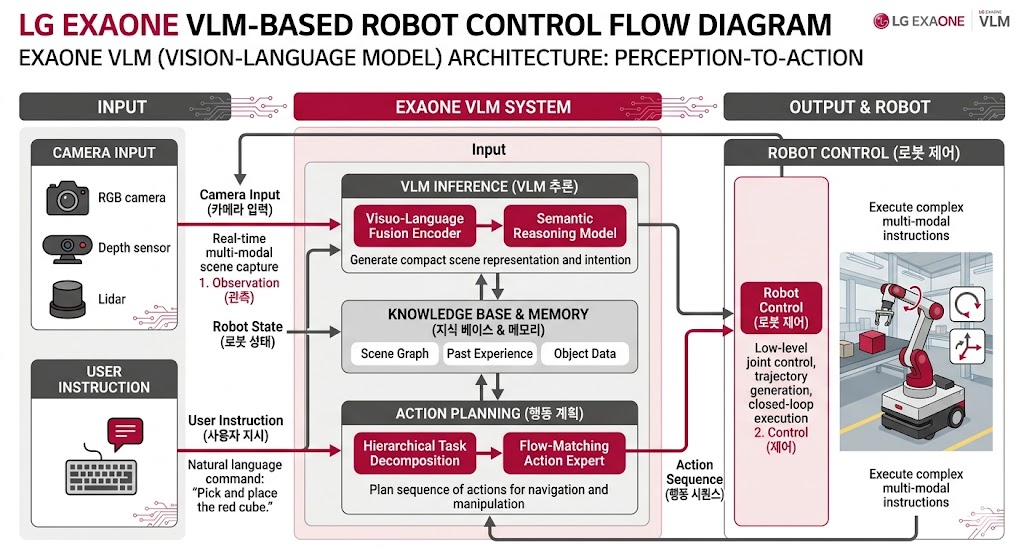
EXAONE 4.5 is a Vision-Language Model (VLM). This structure, which processes text and images together, connects sentences like “a half-eaten brown apple” with the corresponding image. Because it understands concepts through language, it can infer, for an object it sees for the first time, “This is a type of apple, and since the inside is exposed, it needs to be handled carefully.”
This is not a mere technological improvement. It’s a paradigm shift in how robots understand the world.
EXAONE Deep goes a step further.
This model, the first “reasoning AI” developed in Korea by LG, goes beyond simply answering “What is this?” and plans “In what order should I do what?”
When given the command, “Clean the room,” EXAONE Deep independently breaks down the task.
First, it scans the space with its camera and maps the locations of obstacles. Then, it determines the order of processing based on size and material. If pets or children are detected, it slows down or stops. Once all tasks are complete, it returns to the charging station.
This AI plans and executes the ordinary daily tasks that humans perform every morning.
Long-Horizon Tasks: The Truly Difficult Problems
However, robot engineers have a separate category of truly difficult problems. These are called ‘Long-horizon Tasks.’
“Pick up the cup” is easy. It’s a single action, and the result is immediately verifiable. But real life looks like this:
“Clear the table, put the dishes in the dishwasher, start it, and after it’s done, check for dryness and put them in the cupboard.”
This command hides dozens of judgments.
How many dishes are there?
Is there space in the dishwasher?
How do you confirm it’s finished drying?
Where in the cupboard does which dish go?
What makes the problem more complex is the existence of ‘waiting’ periods between each step.
What should the robot do during the 40 minutes the dishwasher is running?
And can it return at the precise timing after doing other tasks in the meantime?
EXAONE 4.5 is designed to maximize this ability to infer sequential causal relationships.
Logically calculating the relationships between objects in the physical world over a time axis – this was the final barrier to commercializing household chore robots, and LG is aiming to overcome it.
IV. Building the Body: Joints, Muscles, and Bones
Software development can start with a few servers and engineers. Hardware is different. Manufacturing precision parts in large quantities requires decades of process know-how and hundreds of billions of won in facilities.
This is why LG Electronics is a truly formidable player in the robot market.
Actuators: The Heart of Robot Joints
Consider the human elbow joint. This joint doesn’t just bend.
It adjusts the force, changes direction, responds to sudden impacts, and repeats tens of thousands of times without fatigue.
In robots, this role is performed by actuators.
These are joint modules that integrate motors, drivers, and reducers, accounting for 20-30% or more of the manufacturing cost of a single humanoid robot.
Historically, these core components have been virtually monopolized by Japanese and Swiss companies.
Global robot companies paid high prices for imports, and their production had to halt whenever lead times (the period from order to delivery) became too long.
LG Electronics directly targeted this supply chain weakness.
Starting from its washing machine DD motor technology, LG’s servo motor design capabilities have evolved into actuators that significantly increase instantaneous torque while reducing power consumption by 30%.
In the first half of 2026, LG began mass production of its initial batch of robot actuators. Now, a Korean company is directly manufacturing robot joints.
Reducers: Gears That Distribute Force Precisely
While motors generate fast rotation, reducers convert that rotation into slow, strong, and precise motion.
For example, they change the output of a motor rotating at 3,000 revolutions per minute into a strong force at 30 revolutions per minute, allowing a robot arm to precisely grasp an object.
The precision with which the gear teeth of these reducers are machined determines whether a robot can pick up an egg without breaking it.
LG Electronics is pursuing independence in this area by internalizing precision mechanical engineering design and special surface treatment processes.
KAPEX: Korea’s Humanoid Robot
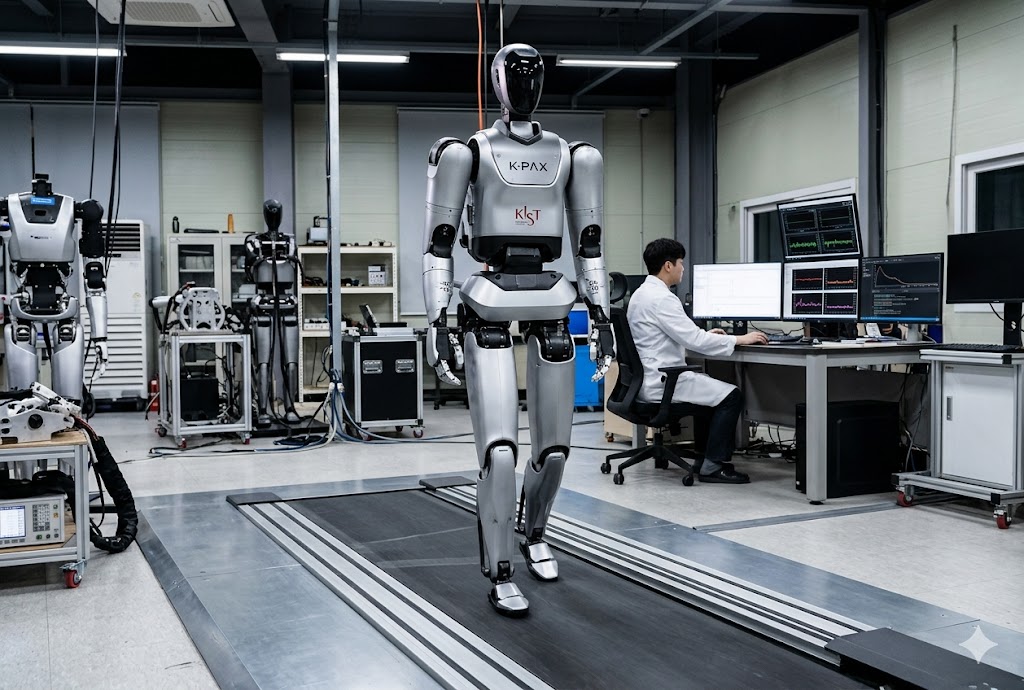
The humanoid robot platform ‘KAPEX’ designed by the Korea Institute of Science and Technology (KIST) is central to the government-led robot R&D efforts.
LG Electronics is leading the work of integrating its mass production know-how and modular design into this platform.
Modular design, simply put, allows complex robots to be assembled like LEGOs.
If a single joint fails, only that module needs to be replaced. There’s no need to disassemble the entire unit.
Manufacturing costs decrease, maintenance becomes easier, and mass production becomes feasible.
This is LG’s true strength, built over 60 years in appliance manufacturing.
Not how intelligently it’s made, but how much, and how cheaply.
V. Batteries: For Robots Not to Fall
The biggest psychological barrier to robots entering homes is safety.
Among these, the risk of fire is critical.
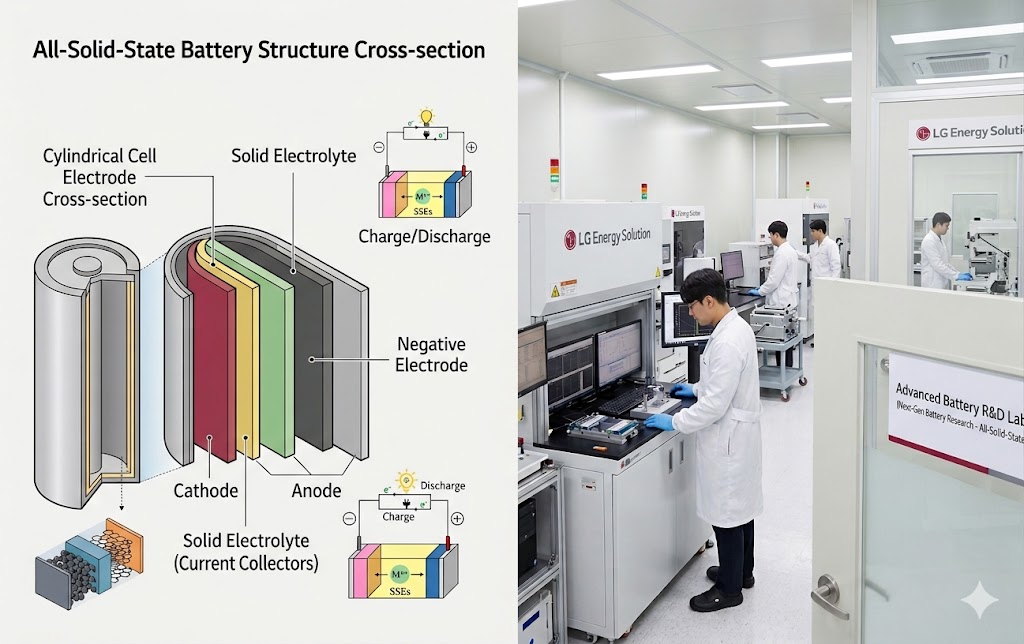
Traditional lithium-ion liquid batteries can cause fires if their internal electrolyte leaks upon impact.
While this risk can be managed to some extent in factories or warehouses, it’s different inside a home. There are children, the elderly, and pets. A fire must not occur if a robot falls or bumps into something.
LG Energy Solution has played a decisive card here.
High-safety all-solid-state batteries.
These batteries, which use solid electrolytes, do not cause fires even when impacted.
Their energy density is higher than existing batteries, allowing them to operate longer on a single charge.
LG’s figures indicate an extension from the current 1.5-2 hours to 4-5 hours.
This is not just a number because this difference is the line that separates a ‘usable robot’ from an ‘unusable robot.’
Preparing a single meal takes 45 minutes. With a 1.5-hour battery, you’d have to charge the robot while using it. With 4-5 hours, you can complete a day’s work.
VI. The NVIDIA Alliance: What’s Given and What’s Received
In May 2026, the collaboration between LG Electronics and NVIDIA garnered market attention. However, reading this relationship as a mere “big corporate partnership” misses the essence.
This alliance has structural complementarity.
What NVIDIA Gives LG
NVIDIA’s Isaac platform is the core operating system for robot software.
It includes algorithms for robots to recognize objects and plan actions, pipelines for real-time fusion of data from multiple sensors, and an inference engine optimized for GPUs.
Jetson is the edge computer that runs this software within the robot at low power.
-> By equipping this, LG can increase the robot’s brain processing speed and significantly reduce power consumption compared to existing PC-based control systems.
What LG Gives NVIDIA
NVIDIA has smart software, but it needs hardware manufacturing partners to apply it to the real world.
Factories capable of producing robots in the thousands or tens of thousands, mass-produced precision actuators, and channels to deliver robots to homes through appliance distribution networks – this is something a semiconductor company cannot build alone.
This is exactly what LG Electronics possesses and NVIDIA lacks.
Omniverse: Learning First in the Virtual World
There’s a crucial element often overlooked in this partnership: NVIDIA’s Omniverse platform.
Training robots solely on actual hardware is astronomically expensive.
Machines break, objects get damaged, and accidents happen. It’s impossible to go through tens of millions of trial-and-error iterations in physical space.
Omniverse is a 3D virtual environment that accurately simulates the real world.
It implements physical laws such as gravity, friction, object elasticity, and light reflection.
LG Electronics trains tens of thousands of virtual robots simultaneously in this virtual space and then transfers that learned knowledge to actual hardware.
This is a method to discover physical design errors in advance and dramatically improve the precision of robot arm control.
A robot that has already completed tens of thousands of training sessions without a single trial-and-error in the real world. This is the competitiveness in the age of Physical AI.
VII. The One Who Cools Data Centers Will Dominate the AI Era
The collaboration between LG and NVIDIA is not limited to robots.
A completely unexpected revenue structure emerges here.
AI data centers packed with NVIDIA’s H100 and B200 GPUs generate immense heat.
By simple calculation, a single high-performance GPU consumes up to 700W of power. When tens of thousands are gathered, it’s comparable to the power consumption of a small to medium-sized city.
If this heat is not managed, the GPUs will reduce their performance (thermal throttling) or stop altogether.
Here, LG Electronics’ air conditioning technology becomes a core infrastructure in a completely different context.
Chillers: Technology to Cool Entire Buildings
Large chillers are cooling systems that maintain a constant temperature throughout the entire data center space where hundreds of server racks are densely packed.
LG Electronics is one of the world’s largest manufacturers in this field.
Microsoft has already agreed to receive LG Electronics’ ultra-large chiller equipment for its Azure data centers.
CDU (Cooling Distribution Unit): Directly Cooling the Chip Surface
Liquid cooling has emerged to overcome the limitations of air cooling.
A CDU directly removes heat by circulating coolant through a cooling plate attached directly above the GPU chip.
Its efficiency is tens of times higher than air cooling, allowing GPUs to achieve higher performance stably.
LG Electronics is pursuing official hardware certification from NVIDIA in the CDU sector.
It is proving its stability by applying high-precision virtual sensor technology and inverter pump technology – also technologies originating from home appliances.
As long as AI computing demand explodes, the demand for data center cooling will also increase.
While robots are still a growing market, data center cooling is already a market with exploding demand.
LG is betting on both directions of the AI revolution: the future of robots and the present of cooling.
VIII. Paju Data Center: The Robot’s External Brain
When robots perform complex reasoning, they don’t need to process all calculations internally. In fact, it’s difficult to do so.
Running large language models on-device requires immense computing resources.
LG Uplus’s AI data center under construction in Paju will solve this problem.
This facility, with a scale of 200 megawatts (MW) and capable of housing up to 120,000 GPUs, will be the largest in the Seoul metropolitan area.
Robots will offload complex reasoning tasks that are difficult to perform on-site to this server farm in real-time and act immediately upon receiving the results.
This is the ‘Cloud Brain Robot’ architecture.
The key is latency. If it takes 100 milliseconds (0.1 seconds) for a robot to request a judgment and receive the result, it’s impractical. It needs to be 10 milliseconds or less.
To achieve this, LG Uplus’s 5G/6G high-speed dedicated lines and edge computing nodes are combined.
Within the LG Group, the telecommunications company was on the periphery.
But with the advent of the robot era, ultra-low latency networks will become the robot’s nervous system.

IX. ‘One LG’: The Completion of Vertical Integration
When all these pieces are viewed together, one picture emerges.
LG AI Research develops the brain (EXAONE).
LG Electronics builds the body (KAPEX, CLOi) and joints (actuators).
LG Energy Solution provides the heart (all-solid-state battery).
LG Uplus provides the nervous system (5G/6G + AIDC).
LG CNS integrates these systems into factories and warehouses.
This is the ‘One LG’ strategy.
What would competitors need to build this ecosystem?
They would need to find, contract, and coordinate one AI model development company, one robot manufacturer, one battery company, one telecommunications company, and one system integration firm.
Friction would arise at each interface, bottlenecks would occur, and accountability would become ambiguous.
-> LG does all of this under one roof.
Vertical integration is not a matter of efficiency. It’s a matter of speed.
When a robot AI model is upgraded, the battery management system and network protocols can be optimized on the same day.
Without waiting for third-party components or reviewing contracts.
Few companies in the world can do this.
X. The Path CLOi Has Walked
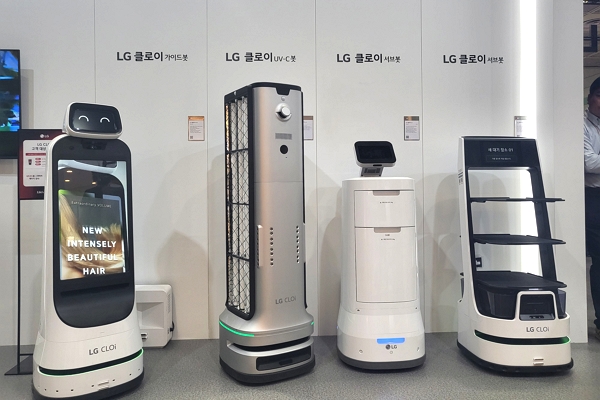
LG Electronics’ service robot brand, ‘CLOi,’ is already operating in reality.
When first unveiled in 2019, CLOi was a modest robot guiding visitors in hotel lobbies. Since then, it has expanded its scope to restaurant serving, hospital guidance, and item transportation within logistics warehouses. What LG gained through this process was not just revenue.
It was field data.
Data collected as robots operate in real environments – how people move, what exceptional situations occur, how commands should be interpreted – goes into training EXAONE.
CLOi was simultaneously a product and a data collection infrastructure.
Without this data, even the best AI models would falter in reality.
LG’s goal is the full commercialization of home robots by 2028. A smart home hub and assistant robot that coordinates home appliances and manages the household. A robot that turns on the washing machine, adjusts the air conditioner, tracks refrigerator inventory, and orders necessary groceries – that robot is already training in the field under the CLOi name.
XI. The Market in Numbers: The Scale of the Robot Industry
Global consulting firms predict that the physical AI and humanoid robot market will grow to trillions of won by 2030. If these numbers are hard to grasp, consider another comparison.
When the first iPhone was released in 2007, the smartphone market didn’t exist. A decade later, smartphones were owned by more than half the world’s population. The market created by smartphone-related components, apps, and services exceeded trillions of won.
This is why the robot industry is called the “second smartphone revolution.” It’s not a matter of scale, but of structure.
Just as smartphones personalized computing from the PC era, robots are physicalizing labor in the AI era.
The leverage held by companies controlling the component supply chain in this transition is immense.
Just as Samsung profited from Apple’s success by selling components in the smartphone era,
LG Electronics is aiming to supply actuators, batteries, and cooling solutions to whichever robot company wins.
XII. The Stock Story: Why the Market is Looking at LG Electronics Again
For a long time, LG Electronics was a prime example of an undervalued company on the Korean stock market.
The reason was simple. Appliance companies are subject to economic cycles. When people buy a house, they buy a refrigerator; when housing prices rise, they replace their TVs. In a recession, they buy neither. Within these predictable limits, the price-to-earnings ratio (PER) remained at 6-8 times. The price-to-book ratio (PBR) was below 1. This means the company was cheaper than its asset value.
However, this frame is now breaking.
AI data center cooling solutions are not subject to economic cycles. AI computing demand increases regardless of whether the economy is good or bad. The revenue generated from this is predictable without seasonal fluctuations.
Robot actuator supply contracts are similar. Once entered into the supply chain, it’s a B2B business that leads to long-term contracts.
Subscription-based Robot-as-a-Service (RaaS) is even more powerful. Instead of selling robots, they are leased, and monthly fees are charged. When packaged with software updates, maintenance, and energy optimization services, once a company becomes a customer, they are unlikely to leave easily.
Companies with such revenue structures are valued at PERs of 15-20 times. If the classification changes from a traditional appliance stock to an AI infrastructure company, the stock price can double or triple for the same profit.
The fact that major securities firms, including Hana Securities, have raised LG Electronics’ target stock price by over 45% from the previous 160,000 won range to over 230,000 won reflects this logic.
Of course, these are numbers that include expectations for the future. The robot market may not open as expected, technology development may be delayed, or strong competitors may emerge. Stock prices reflect expectations, but reality is always more complex.
However, one thing is certain: LG Electronics will no longer be evaluated solely within the frame of a “home appliance stock.”
XIII. Competitive Landscape: The Challenges LG Faces
Despite all these advantages, LG faces formidable competition.
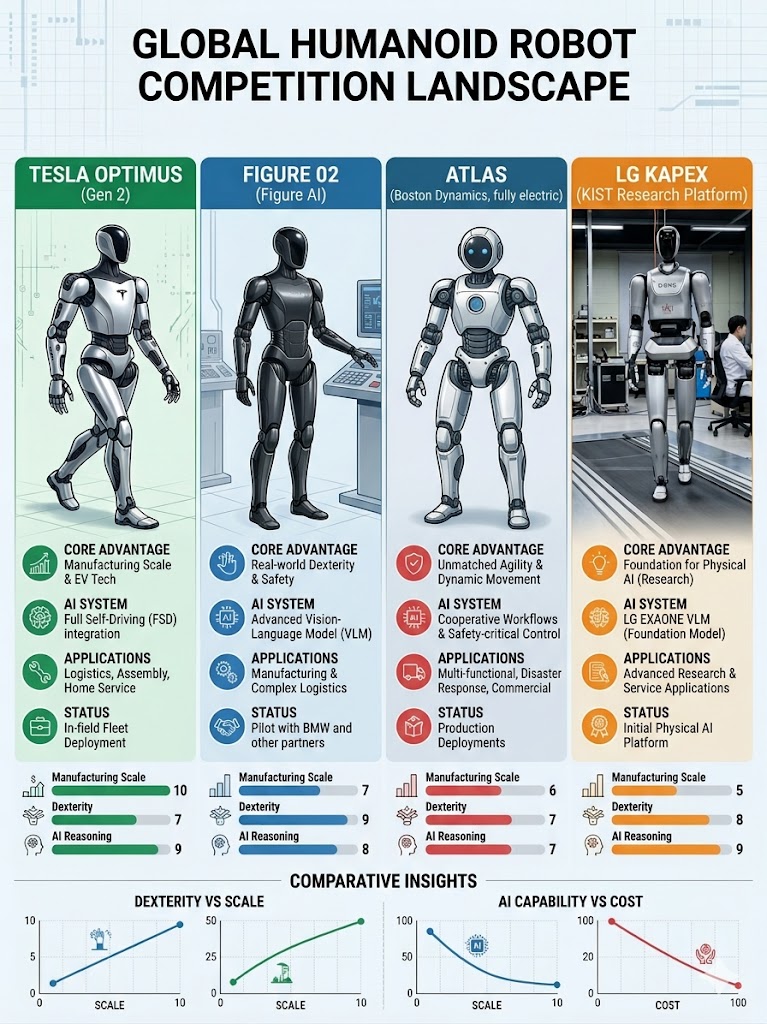
Tesla is accumulating real-world data by operating its Optimus robot in its own factories. Its EV plants are becoming robot training grounds. Figure AI is already working in BMW factories, and Apptronik has partnered with Amazon warehouses.
What is the decisive difference between these companies and LG?
Two things: manufacturing capability and ecosystem.
Tesla and Figure AI can build robots, but they don’t have factories capable of mass-producing hundreds of thousands of precision actuators.
They also don’t have a battery affiliate to supply all-solid-state batteries.
And they lack a channel to reach hundreds of millions of households through appliance distribution networks.
What LG is building is not just a robot, but the entire supply chain for the robot industry. This is a moat that cannot be replicated in a short period.
On the other hand, LG’s weakness is software.
While EXAONE is evolving rapidly, it’s still far behind when compared to the robot AI research of OpenAI or Google DeepMind.
The pace of AI competition is unpredictable, and software superiority can be overturned faster than hardware.
This is also why LG partnered with NVIDIA. They borrow the best in software and build the hardware themselves.
XIV. 2026-2029: Phased Realization Scenarios
LG’s proposed roadmap consists of three phases:
Phase 1 (2026-2027): Securing Component Supply Chain
Before completing a single robot, the ability to mass-produce robot components is essential. This phase aims for mass production of actuators, internalizing reducers, and B2B demonstrations of the EXAONE-based robot AI platform. Pilot operations will begin in large hospitals, logistics warehouses, and smart factories.
Phase 2 (2027-2028): Service Expansion
The cloud brain robot architecture, combining the Paju AIDC and 5G/6G networks, will be fully operational. The home robot market will be pioneered through the advancement of CLOi robots, and the RaaS business model will be fully launched.
Phase 3 (2029 onwards): Fully Humanoid
Fully autonomous humanoid robots, combined with second-generation all-solid-state batteries, will be deployed in homes, elder care, and manufacturing sites. Physical solutions that replace simple human manual labor will become a reality.
It’s uncertain how accurately this roadmap will be realized. Technology doesn’t mature as planned. However, the direction itself is clear. And it’s clear that movement in this direction has already begun.
XV. The Final Question
The act of picking up a cup and putting it in the dishwasher.
For humans, it’s a 3-second task. For robots, it was a problem requiring decades of research. And now, those 3 seconds are becoming closer to reality.
But come to think of it, this question takes an even more interesting turn. If robots do the dishes, what do people do with that time?
The same question arose when washing machines were introduced. If women didn’t have to wash clothes by hand, what would they do with that time? In reality, leisure time didn’t increase; cleaning standards did. What was washed once a week began to be washed daily. The total amount of labor didn’t change; only the form of labor did.
If robots take over simple labor, will humans engage in more complex labor? Or will they truly rest? Or will entirely new problems arise that we cannot imagine now?
What LG Electronics is building is a robot. But on the day it’s completed, what we face may not be a technological problem. It may be a problem of how we define the existence of being human.
That question, no one has answered yet.
References
- LG AI Research, “Technical White Paper and Visual Cognitive Intelligence Specification for Super-Large Multimodal Foundation Model EXAONE 4.5” (2026)
- LG Electronics, “Q1 2026 Earnings Announcement and Corporate Conference Call Transcript - Announcements on Humanoid Robot Business and Partnership Plans with NVIDIA” (April 2026)
- Hana Securities Research Center, “LG Electronics Company Analysis Report: Full Onboarding to Robot Value Chain and Target Price Increase” (May 2026)
- Seoul Economic TV, “The Substance Behind LG Electronics’ Intra-day Surge: Analysis of Strategic Intimacy with NVIDIA in Physical AI” (May 2026 Video Report)
- NewsPim, “LG Electronics Announces Mass Production of Reducers/Actuators in First Half and Robot Collaboration with NVIDIA” (April 2026)
- Korea Institute of Science and Technology (KIST), “K-Moonshot Core Project: Development Specification and Consortium Plan for Korean High-Function Humanoid Robot Platform ‘KAPEX’” (2026)
- ZDNet Korea, “Report on LG Electronics’ Next-Generation Liquid Cooling Solution CDU Technology Features and Discussions on Entry into NVIDIA’s Certified Supply Chain” (2026)
- Shinhan Investment & Securities, “LG Electronics Stock Valuation Rerating and Outlook for Subscription-Based Business Linking Smart Home Appliances and Service Robots” (April 2026)
- Korea Economic Daily, “Analysis of LG Electronics’ Agreement with Global EMS Company Flex for Joint Development of Modular Cooling Solutions for AI Data Centers” (November 2025)
- News1, “One Team LG Strategy: Conception of Agentic AI Future Combining Paju AIDC Construction and EXAONE 4.5” (March 2026)
- SOD Tech Channel, “The Hidden Reality of Korean AI Robot Platforms and World-Astonishing Humanoid Development Technology” (October 2025)
- Shinsaimdang Channel, “Jensen Huang’s Big Picture and the NVIDIA-LG Physical Alliance: Precise Analysis of the Upcoming 1,000 Trillion Won Robot Market” (May 2026)
- Goldman Sachs Global Investment Research, “The Robot Revolution: The Economics of Humanoid Automation” (2025)
- McKinsey Global Institute, “Generative AI and the Physical World: From Language Models to Physical AI” (2025)
- NVIDIA Corporation, “Isaac Platform and Jetson AI Edge Computing for Robotics — Technical Overview” (2026)