

Most of us have probably thought at some point how unpredictable the world is these days. Things that were certain yesterday disappear today, and unimaginable events become reality. It’s like navigating through thick fog, isn’t it? To understand this era of uncertainty, we need to know about two animals: the ‘Black Swan’ and the ‘Gray Rhino’.
At first glance, they seem like opposite concepts. One symbolizes an unpredictable shock that suddenly appears and upends everything, while the other represents a massive threat that is clearly visible from afar but that we stubbornly ignore. However, in my opinion, these two are actually two sides of the same coin. Rather, they complement each other and serve as truly important analytical tools that allow us to understand the risks of this complex world we stand on more deeply.
Nassim Nicholas Taleb, who popularized the term ‘Black Swan’, constantly warns us about how little we truly know. On the other hand, Michele Wucker, who introduced the concept of the ‘Gray Rhino’, points out our behavioral failures in why we turn away from risks we already know.
In this article, we won’t just define the two concepts. We’ll delve deep into the framework of the theories and apply this lens to events that have shaped history. Then, we’ll diagnose the crises we face today and contemplate the future risks faintly visible beyond the horizon. I hope this article serves as at least some kind of map for you navigating through the fog.
Part 1: How We Perceive (or Fail to Perceive) Risk
In this part, we will thoroughly dissect the core of the two concepts, Black Swan and Gray Rhino. Moving beyond simple metaphors, this is about the philosophy and psychology contained within them, and why we fail to see these two animals clearly.
1.1 The Black Swan: The Attack of the Unimaginable
The term ‘Black Swan’ originally stemmed from the discovery of a real black swan in Australia during a time when people believed “there are no black swans in the world.” Millennia of empirical wisdom (‘all swans are white’) were shattered by a single observation. Black Swan events thus have three characteristics:
- Unpredictability: An event that is beyond our common sense and expectations, which cannot be predicted by any past data.
- Extreme Impact: Once it occurs, it has an enormous influence on society, economy, and history. For better or worse.
- Hindsight Bias: After the event happens, we reassure ourselves by concocting plausible reasons and stories, as if it were predictable from the start. We think, “Ah, that was the signal then!” This is precisely why we fail to learn the real lessons.
Taleb divides the world we live in into the ‘Kingdom of the Average’ and the ‘Kingdom of Extremistan’. Black Swans are born precisely in this Kingdom of Extremistan. We fail to see Black Swans not because of a lack of information, but because of our cognitive biases: the “illusion of understanding” (thinking we know the world too well), the “narrative fallacy” (fitting the past into stories), and the blind faith in expert predictions.
What’s important is that a Black Swan is relative to the observer. The tragedy that befell a turkey on Thanksgiving morning was a Black Swan for the turkey, but not for the butcher. Therefore, the real goal of Black Swan theory is not to predict the future, but ’to avoid being the turkey’. It’s about building an ‘Antifragile’ system that doesn’t break from unpredictable shocks, but rather becomes stronger by overcoming them. That’s the core.
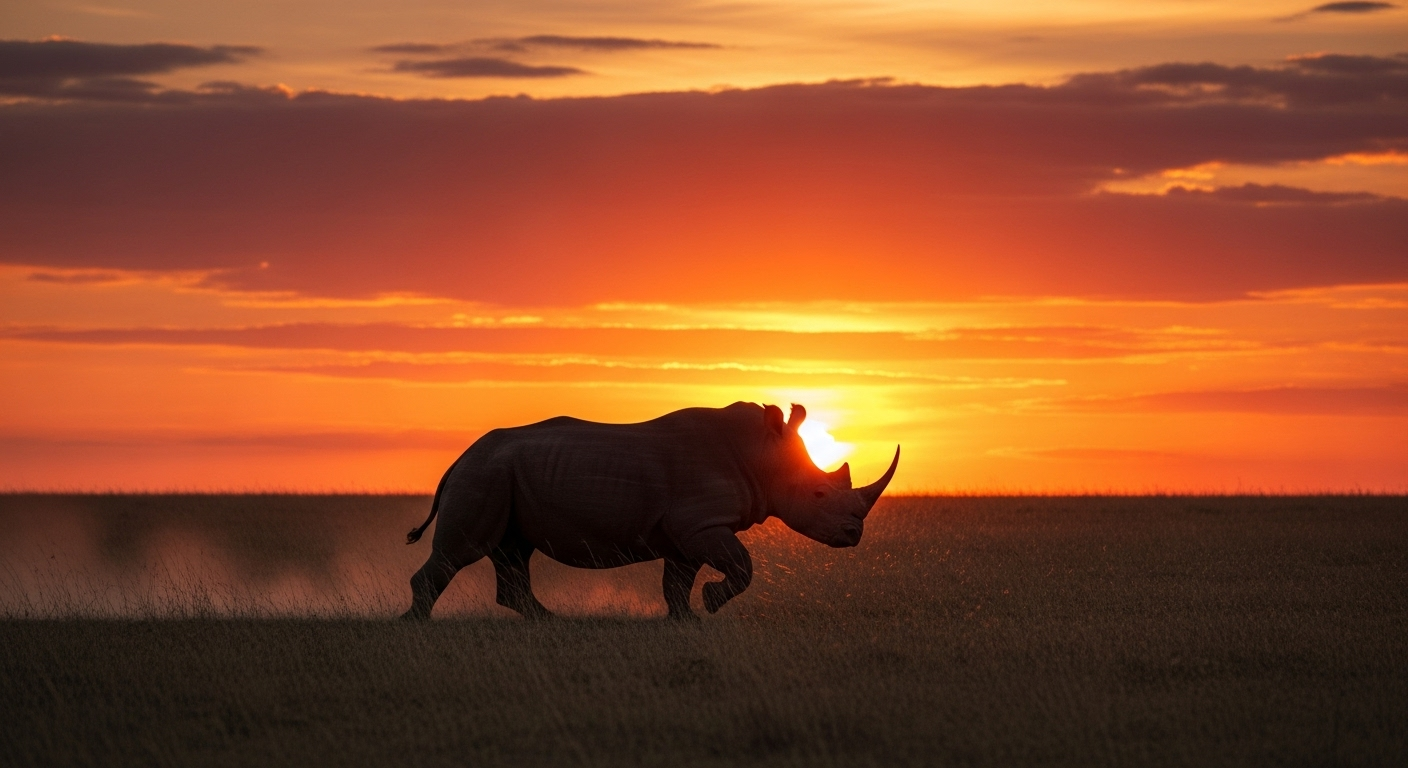
1.2 The Gray Rhino: A Rhino is Charging Over There!
The ‘Gray Rhino’ can be likened to a situation where a 2-ton rhino is charging towards you, raising a cloud of dust from afar. It’s a threat so obvious that it’s impossible not to see it, yet we strangely ignore it or pretend it’s not happening, thinking, “It won’t really come to me, will it?” This is despite its high probability of occurrence and significant impact.
Michele Wucker explains how we fail in the face of this obvious threat in five stages:
- Denial: We deny the problem itself, saying, “There’s no such thing as a rhino.”
- Complacency: We acknowledge the risk but postpone action, saying, “There’s still time.”
- Diagnosis: We realize the severity of the problem and begin to seek solutions.
- Panic: When the rhino is right in front of us, we become flustered and confused.
- Action: We finally avoid or confront the threat. However, it might be too late.
There are psychological issues like the optimism bias (“I’ll be fine”) and the confirmation bias (seeing only what we want to see), as well as structural problems like the short terms of politicians or CEOs who must focus only on immediate results, which make us pretend not to see this giant rhino.
1.3 A Dialogue Between Two Beasts: Black Swan vs. Gray Rhino
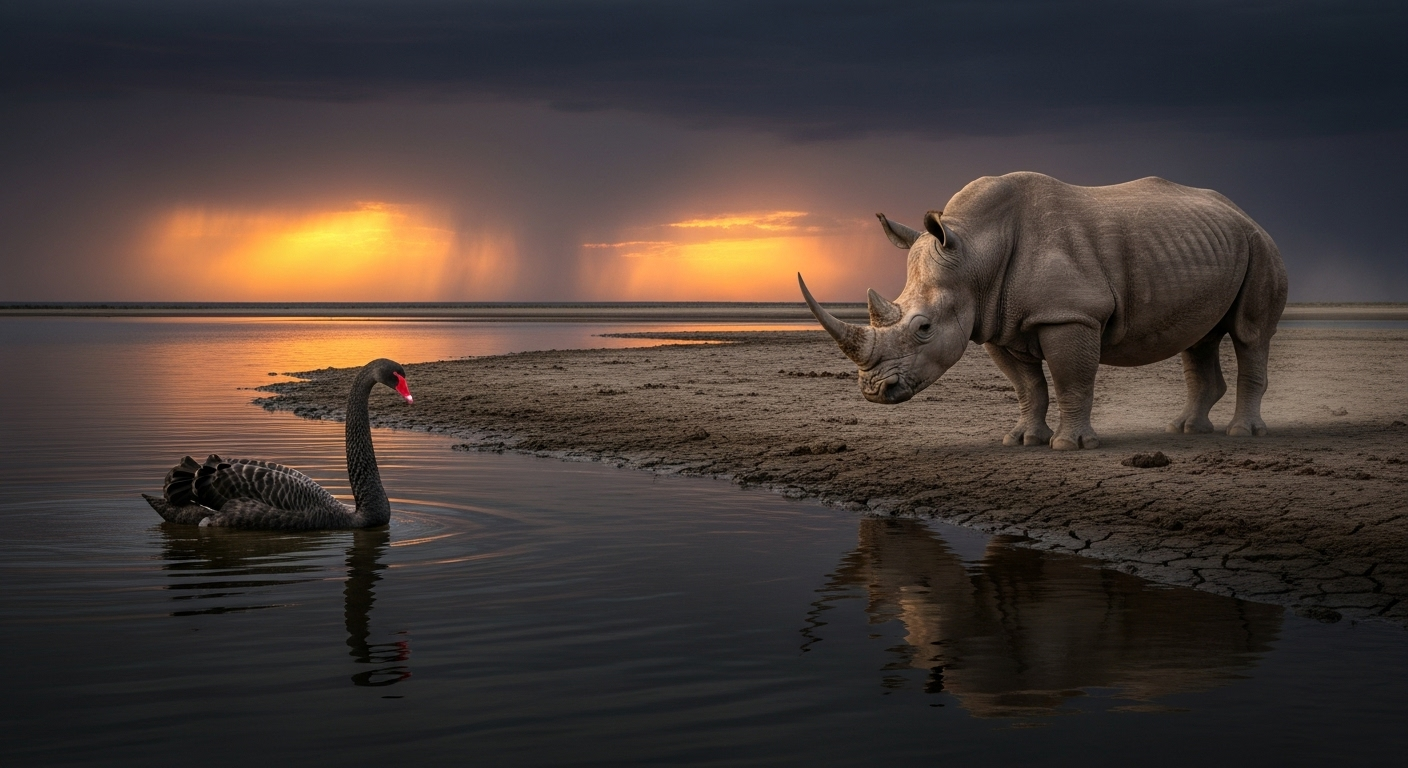
Understanding the relationship between these two is truly important. What happens if we continue to ignore and neglect multiple Gray Rhinos (e.g., real estate bubbles, excessive debt)? The entire system becomes extremely fragile, and eventually collapses with even a small shock. And to the eyes of the unprepared majority, this sudden collapse will look exactly like a ‘Black Swan’. The 2008 financial crisis is a prime example of this.
The Black Swan narrative of “no one predicted it” often serves as a very convenient excuse for leaders to evade responsibility. However, the Gray Rhino framework sharply questions, “The warnings were clear. Why didn’t you act?”
Part 2: History Speaks - Real Cases of Swans and Rhinos
Enough theory for now. Let’s dive into actual history and examine through vivid examples how these two animals have shaken the world.
- Unpredictable Revolution: The Internet (Positive Black Swan) Who would have imagined that the U.S. Department of Defense’s military network would become the catalyst for an information revolution connecting the entire world? The advent of the internet is the greatest positive Black Swan of our time.
- The Day the World Changed: 9/11 Attacks (Geopolitical Black Swan) The incident on September 11, 2001, where civilian airplanes struck the heart of New York, was a terrible Black Swan for people worldwide. It fundamentally changed our concept of security.
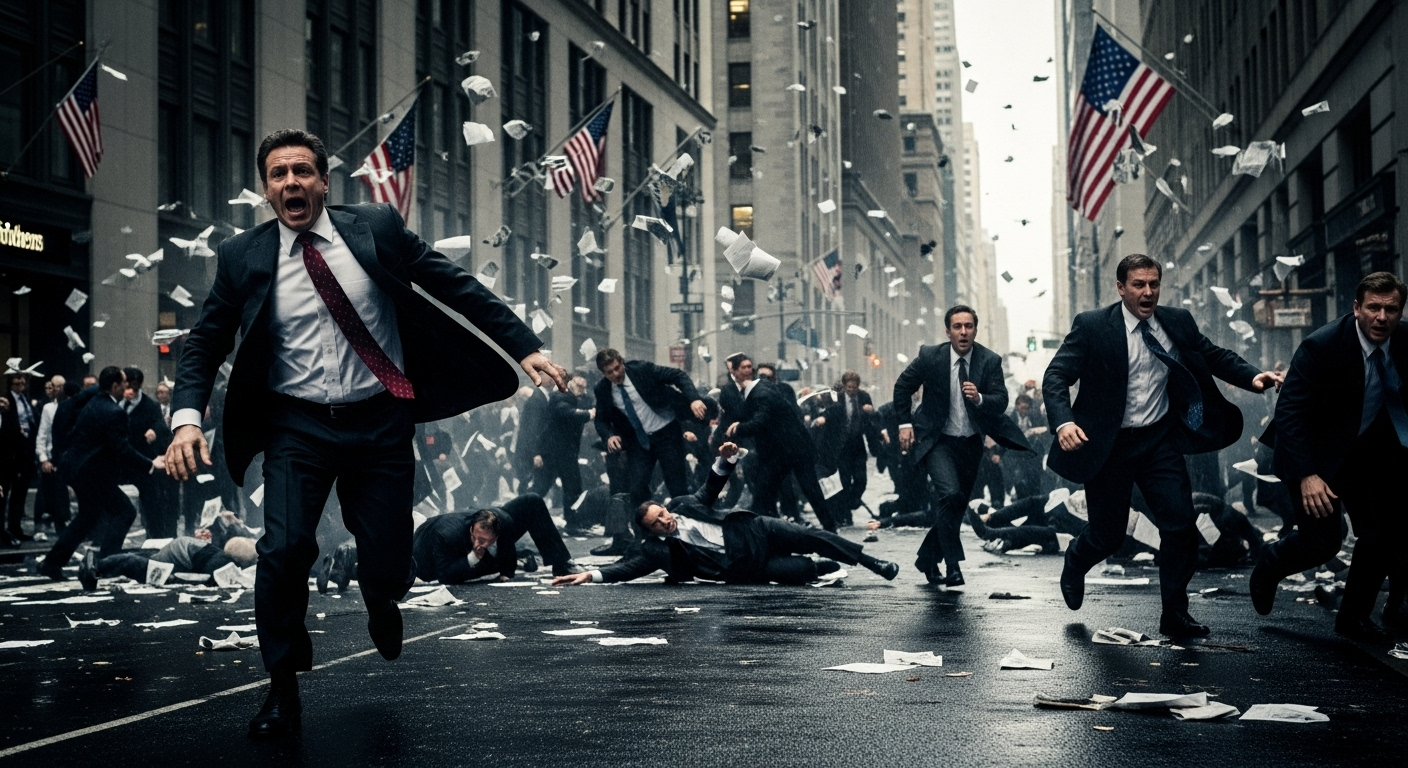
- The Collapse Everyone Ignored: The 2008 Financial Crisis (Gray Rhino) Many people call the 2008 financial crisis a Black Swan, but honestly, it’s a textbook Gray Rhino case. Numerous economists vociferously warned of the dangers of the housing market bubble and subprime mortgages. However, a collective hypnosis of “it’s different this time” and greed blinded by short-term profits made us pretend not to see this obvious rhino.
- Slowly Boiling Water: Climate Change (The Ultimate Gray Rhino) Climate change is perhaps the most enormous and complex Gray Rhino humanity faces. Scientists have been warning for decades, and now we are barely entering a phase of mixed panic and action.
- The Slump Trap: Japan’s ‘Lost Decade’ (Policy Failure Rhino) Japan’s long-term recession in the 1990s was the result of policy failures in not dealing with the Gray Rhino of ‘zombie banks’ full of bad debts in a timely manner.
- The Foretold Epidemic: COVID-19 (Ignored Warnings) The COVID-19 pandemic might also have felt like a Black Swan. However, numerous experts, including Bill Gates, strongly warned of a pandemic caused by a novel virus. It was a tragedy that showed the terrible price of a Gray Rhino that we collectively decided to ignore.
Part 3: What are the Swans and Rhinos Before Our Eyes Today?
Let’s set aside past stories for now and turn our eyes to the present and future. What rhinos are charging towards us today, and what Black Swans await us beyond the horizon?
3.1 A Stampede of Rhinos: The Current Risk Environment
The current global economy is close to a situation of a ‘crash of rhinos’, where multiple Gray Rhinos are charging simultaneously.
- Persistent Inflation
- Global Debt Bomb
- Geopolitical Fragmentation
What’s more terrifying is that these rhinos stimulate each other, causing a chain reaction. Geopolitical conflicts (Rhino 1) lead to soaring energy prices (Rhino 2) and inflation (Rhino 3), ultimately materializing into a debt crisis (Rhino 5).

3.2 Beyond the Horizon: Potential Black Swans of the 21st Century
So, where are the Black Swans that we can’t even imagine hidden?
- Emergence of Artificial General Intelligence (AGI): The advent of AGI that surpasses human intelligence could be the ultimate Black Swan, leading to either utopia or dystopia.
- The End of Cryptography (‘Q-Day’): The moment quantum computers render current cryptographic systems useless, global systems could halt instantaneously.
- The Backlash of Biotechnology: Gene editing technology holds the dream of conquering disease, but it could also become Pandora’s Box for disasters like engineered viruses.
- Sudden Collapse of Great Powers: Looking back at history, the unexpected collapse of great powers has always been a massive geopolitical Black Swan.
Conclusion: Not Through Prediction, But Preparation; We Must Become Stronger to Survive
How should we navigate this uncertain 21st century? The answer lies in a dual approach.
First, we must confront the Gray Rhinos before our eyes head-on. We must fight the temptation to “postpone it for later,” identify clear threats, and act responsibly.
Second, we must prepare thoroughly for the invisible Black Swans. Prediction is ultimately impossible. Therefore, instead of prediction, we should focus on building a system that can withstand any shock (Robust), recover quickly (Resilient), and even become stronger through that shock (Antifragile).
The ultimate lesson might be very simple. As we diligently deal with the Gray Rhinos we can see, our society and systems will naturally become more robust and resilient. And isn’t that the best, and perhaps the only, defense against the Black Swans we cannot see? The future should not be a fate of being ambushed, but something we shape through preparation and response.
References
- Taleb, Nassim Nicholas. The Black Swan: The Impact of the Highly Improbable. Random House, 2007.
- Wucker, Michele. The Gray Rhino: How to Recognize and Act on the Obvious Dangers We Ignore. St. Martin’s Press, 2016.
- IPCC. AR6 Synthesis Report: Climate Change 2023. 2023.
- Gates, Bill. “The next outbreak? We’re not ready.” TED, 2015.
- International Monetary Fund. World Economic Outlook.
- World Bank. Global Economic Prospects.
- World Economic Forum. Global Risks Report.